Author: Heather

  • Airbnb Experience: “Discover street food with a local”

    Airbnb Experience: “Discover street food with a local”

    When Kevin and I went to Amsterdam we kicked off our trip with a food tour, which was both a unique culinary experience and a great walking tour with a local guide. We were introduced to the food tour via Booking.com but since we didn’t use them for our trip this time around we decided to try a new source of fun: Airbnb “experiences”.

    We participated in 2 different experiences during our trip, and the first was called “discover street food with a local“. We did this on Tuesday, and it was one of the highlights of our trip!

    We started off in the morning outside of El Templo Mayor where we met our guide, Pili. She gave us a brief history of the temple and market square and church nearby. From there, we hopped on the subway and went to explore a local market. This particular market served as a distribution hub for fresh flowers, so it was quite beautiful.

    Near the market was a type of food court, and we went there to learn how to cook a traditional Mexican dish, huaraches. They’re typically quite large but since we were novices, we made smaller huaraches – a corn flower dough, with a bean paste in the middle. The technique was kind of like making a perogie: flatten a small ball of dough, add in the filling, then pull the tough tight around it and pinch it sealed. However, then you also flatten out the dough and fry it.

    Huaraches are served with a pile of toppings, and we also made those! Toppings included tomatillo salsa, cactus, and huitlacoche. This was pretty exciting because huitlacoche is a delicacy that originated in Aztec cuisine and is unlike anything we’d ever eat in Canada.

    The English term for huitlacoche is “corn smut”. Huitlacoche is a type of corn fungus, which is why it’s rarely found north of Mexico. As we expected, it’s delicious!

    After we ate our huaraches, Pili and our chef host, Evelyn, made us quesadillas as well. From there we need an energy boost, so Pili took us back to city centre to visit a market famed for its traditional coffee. I had a chocolate drink that was incredible and Kevin enjoyed an espresso.

    To wrap up the day we visited a stall that sells insects as cuisine! The other couple in our group (shout out to Landon and Jerusalem!) were brave enough to try, but I was too full/afraid.

    The whole “experience” lasted approximately 4 hours and was jam-packed with learning and fun. Pili was a great host and she showed us a great time. She was fun and friendly, very knowledgeable, and open to answering any questions we had. Spending the day with her was like hanging out with a friend, and I would absolutely recommend her tours to anyone.

    If you’re looking for a great half-day experience in Mexico City then I definitely recommend you take her tour!

    See below for the many photos of our adventure with Pili!


  • El Bazaar Sábado

    El Bazaar Sábado

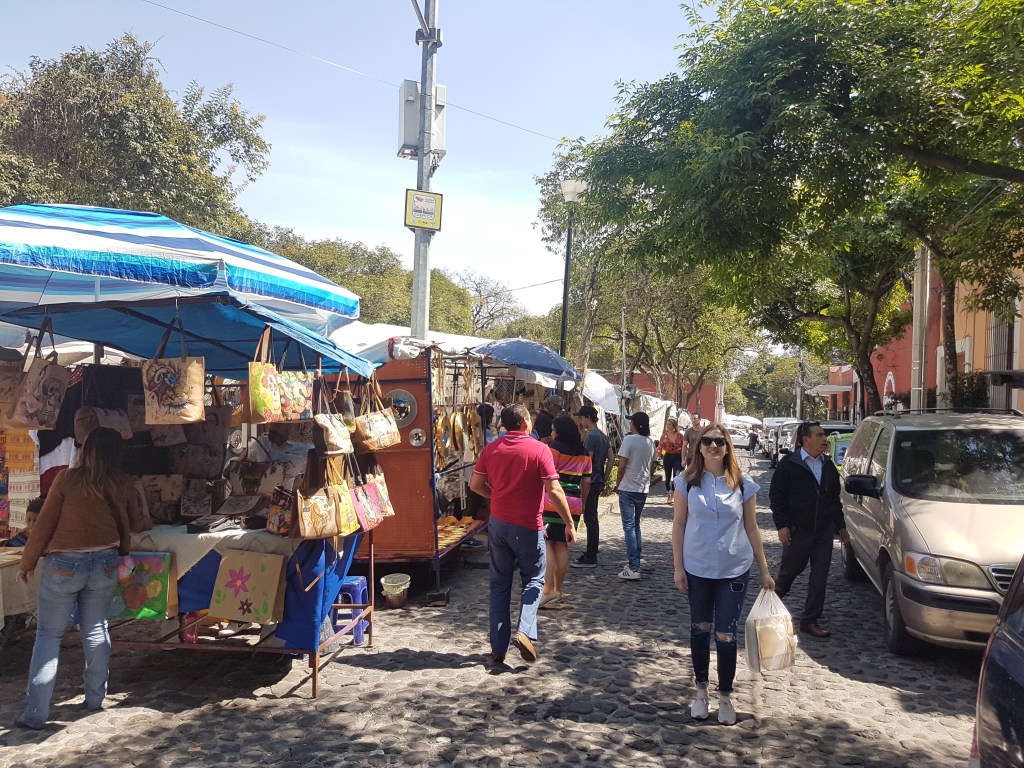
    Our first full day in Mexico City fell on a Saturday. Our Airbnb host recommended that we take this opportunity to visit “El Bazaar Sábado” (aka the Saturday Bazaar) as it’s a unique event that only happens once per week. And so on Saturday morning we took an Uber south into the historic neighbourhood of San Angel.

    The bazaar has 2 parts: a variety of kiosk stalls in a market, and a wide variety of artists exhibiting their work in the park.

    We started in the stalls of the market and were quickly impressed with the range and quality of the goods available. From there we wandered over to the park to start shopping for art! Again, we were quite impressed.

    Kevin and I spend a lot of time visiting artisan markets in Toronto, and we were amazed (again) by the range and quality of the work available. We had heard that Mexico City had a great arts scene, and this was certainly the first of many days/events that proved it to be true. We ended up buying a bunch of art and souvenirs, though the best part of the day was simply walking around in the sun.

    After the market, we walked to the San Angel Inn to try some of their famous margaritas. They were worth the hype, and while the rest of the food/service were just okay, overall the San Angel Inn kept us entertained as we watched upper middle class people wandering in and putting on their airs.

    After lunch we visited Museo Casa Estudio Diego Rivera y Frida Kahlo, the home where the famous Mexican artists Frida Kahlo and Diego River lived together. There’s more to come on that one later. For now, check out the below photos of our adventures in San Angel!

  • We made it to Mexico City! (Just in time for an earthquake)

    We made it to Mexico City! (Just in time for an earthquake)

    For the next week we are in Mexico City, the capital of Mexico and the most populous city in the Americas (fighting neck and neck with Sao Paulo for the top listing). We arrived yesterday, and so far we are having a great time!

    Of course, if you’ve been reading the news you also know that Mexico City suffered from an earthquake earlier yesterday afternoon. You can get all the details here but essentially there was a 7.2 magnitude earthquake off the southern coast of Mexico, which was felt across a wide area of the country, including Mexico City.

    It was a significant event as the city is still suffering the physical and emotional after-effects of a deadly and destructive earthquake in September 2017.

    Our flight arrived around 2pm and we were picked up at the airport by a driver, all arranged by our AirBnB host. We are currently staying at the world’s greatest AirBnB and our host, Leonore, is wonderful. She arranged for us to be picked up at the airport and then met us at our apartment. In fact, 10 minutes ago she dropped in to make sure we were okay following the earthquake (her cat and dog dropped in too! Photos to come later).

    So, we arrived at our apartment for the week, chatted with Leonore about different sites to see, and then headed off in search of tacos.

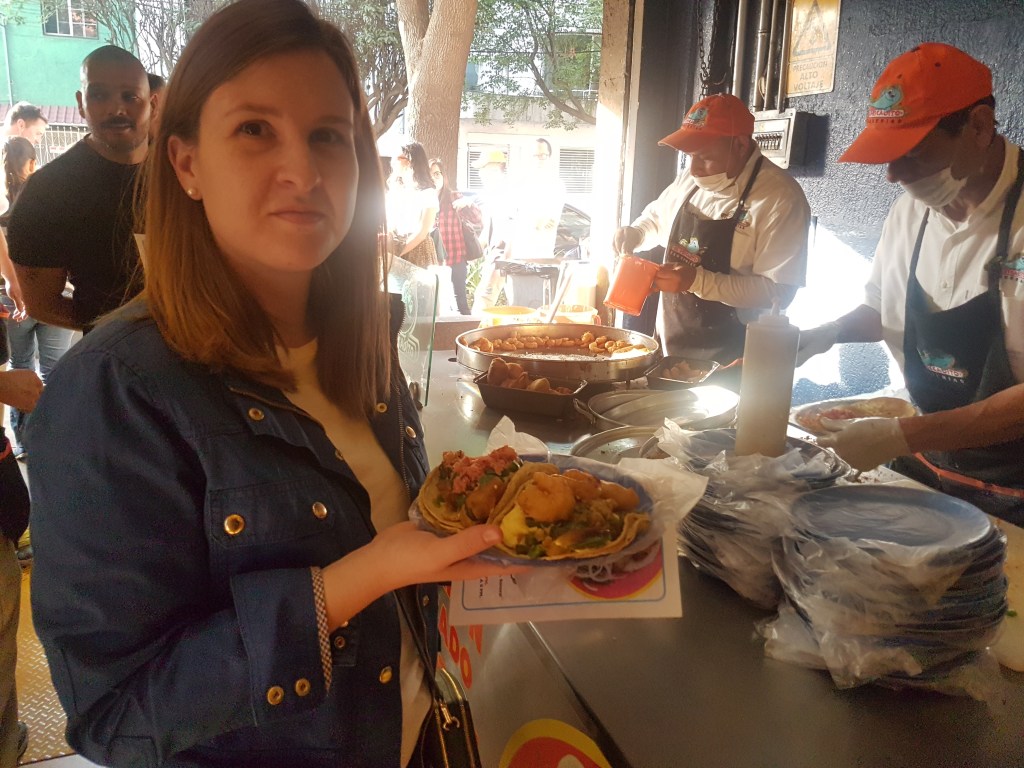
    We walked to a nearby taqueria, El Pescadito Condesa (highly recommend!). We loaded up our plates with delicious shrimp and fish tacos and settled in to watch the street life while we enjoyed tacos and beers.

    Around 20 minutes into eating, everyone sitting near the windows jumped up and ran outside into the streets. Kevin and I hesitated for a few seconds until the restaurant manager gave a stern look and directions to get moving. And so we stood in the street in a crowd of distressed people and we felt the earth moving under our feet.

    As it turns out, Mexico has an early warning system for earthquakes, the Mexican Seismic Alert System. It was this system that started the flood of people into the streets. And sure enough, as we joined the crowd we could hear the alert system and a few seconds later we felt the earthquake.

    I’ve lived most of my life in Ontario, where there are few earthquakes and fewer reasons for people to worry about emergency preparedness. So when I felt the earthquake today I was definitely taken aback. It was unlike anything I’d previously experienced (obviously Kevin has experienced earthquakes in both Canada and Portugal, so I guess I’m behind the times). I am 100% okay, but it was pretty scary. Despite their well-founded distress and fear, the people of Mexico City proceeded with a calm and orderliness that was quite impressive. I have a lot to learn on this front.

    That said, the event completely changed the tone of the city and the people around us. For the rest of the day we could tell that everyone was on their phones trying to get in touch with loved ones and confirm they were okay. The sombre emotions and stress were palpable as we walked around exploring the city for the next 3 hours. It should be interesting to see how this manifests throughout the rest of our trip.

    Photos below from our first few hours in Mexico City!

  • Day 7 in Amsterdam – Wind Mills & Walking!

    Day 7 in Amsterdam – Wind Mills & Walking!

    When we first arrived in Amsterdam we’d planned to rent bikes and spend a day biking into the countryside to see windmills. Unfortunately, it was a lot colder and rainier than anticipated so that plan didn’t work out.

    However, there is one windmill on the East side of the city, not far from the Maritime Museum. And bonus: it’s attached to a local brewery!

    After spending 3 hours in the Maritime Museum, we were ready for some more drinking and eating, so we walked down to see the De Gooyer windmill at Brouwerij ‘t IJ (the IJ Brewery).

    The De Gooyer windmill is not opened to the public so you can’t go inside, but you can certainly look at it. It is the tallest wooden mill in the Netherlands and has a fairly serious history:

    The original mill was constructed in the 16th century. After destruction and some movements, in 1725 the mill stood on the site of the current Orange-Nassau barracks. Finally, in 1814 the mill moved again to its current location on Funenkade atop the stone base of a watermill that had been demolished in 1812.

    This mill is the last 26 corn mills on the bastions of the 17th century walls of Amsterdam. The location of the mills was at that time very favourable as the outskirts of town provided ample wind.

    After the mill had fallen into disrepair, it was purchased in 1928 by the city of Amsterdam for 3200 guilders and restored. Due to the lack of power during the Second World War the mill served as a corn mill for Amsterdam.

    In the building beside the windmill is a brewery with a large outdoor seating area. They serve a variety of beer, along with some traditional Dutch snacks. We ordered some snacks and a flight of beers, then spent a couple of hours relaxing in the sun beside a real windmill.

    After our afternoon snack we went on another long walk, eventually ending up at dinner. This was another Esther recommendation, but it wasn’t as successful as her previous recommendation. The restaurant Greetje fancies itself as a places that serves “elevated Dutch food”. The restaurant was lovely and the service was great, but the food just wasn’t that good. It was served in such a way that suggested they thought it was high-end, but the flavours just didn’t compute. Or perhaps my tastebuds aren’t sophisticated enough!

    In any case, our last day in Amsterdam included a couple of lacklustre experiences, but nothing can dampen your spirits when you’re never more than 5 minutes away from breathtaking canal views. We ended our night with a long and lovely walk home, with a pit stop for a few drinks.

    Overall, it was a really great trip. We had a lot of fun, learned a ton, and actually made time to relax quite a bit. Our nightlife was decidedly more low key than it was on our trip to Madrid, which meant we had plenty of time to sleep. We don’t usually make time to rest and restore when we go on trips, so this was a nice change of pace. We’re recommending Amsterdam to all our friends and family because it’s so lovely and so easy to manage. I’m sure we’ll be back again one day!

  • Day 7 in Amsterdam – Visiting Nederlands Scheepvaartmuseum

    Day 7 in Amsterdam – Visiting Nederlands Scheepvaartmuseum

    Up front disclosure: this was the worst museum we visited in Amsterdam. And according to Wikipedia, it’s famously bad:

    In 2013, there was a deadly shooting incident during the “Waterfront” festivity at the museum.[8] For the next three months, the museum was not allowed to rent out its space. After 2013, the number of visitors started to decline and director Willem Bijleveld, who had supervised the renovation of 2011, departed after a tenure of 18 years. The museum was criticised for having become too commercial for a cultural institution and having been turned into an amusement park.[9] The “Raad van Cultuur” – a government board that monitors cultural activity in the Netherlands and advises the government on subsidies for museums – judged that the Scheepvaartmuseum had focused too much on entertainment and not enough on its task as a museum.[10]

    The building is cool, and there’s lots to look at, but the educational component is questionable at best.

    When we visited the naval museum in Madrid, I found it had too much information. The Dutch National Maritime Museum, or Nederlands Scheepvaartmuseum, had the exact opposite problem. It feels more like a light entertainment centre for kids.

    We started our day out with a long walk through the city, so we headed right for lunch at the museum. The in-house restaurant was great, and we had a delightful lunch.

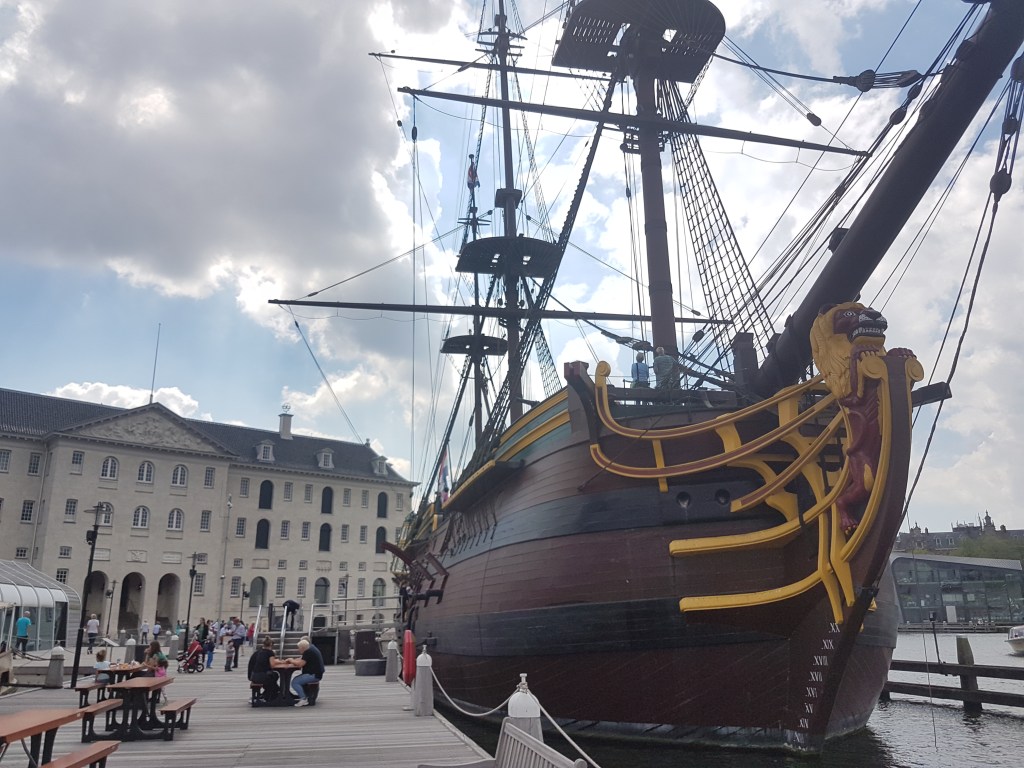
    We then headed outside to the boat element of the museum’s ‘collection’. It was interesting but not that educational and, oh my god, there were kids everywhere!

    Our favourite exhibit was all about Dutch shipping and ports. As a major shipping centre, the Netherlands have some serious port facilities and enormous-sized ships. We were able to take a virtual tour of a ship and journey along the shipping route that goes through Amsterdam. We also saw some cool exhibits about maps and navigational instruments. You can learn more about the range of exhibits here. For me, the range of interesting to boring was too wide. Visiting a museum requires a certain mindset, and if that gets thrown off, it can be hard to switch back into ‘learning’ mode.

    Overall, we didn’t learn much, but we did take a lot of photos! Check ’em out!

    (Note, if it seems like this post is out of order, that’s because it is. I forgot to click ‘publish’ months ago!)


  • Day 6 in Amsterdam – Visiting the Hermitage Amsterdam

    Day 6 in Amsterdam – Visiting the Hermitage Amsterdam

    As you may have noted by now, we went to a lot of museums while we were in Amsterdam. Most of them were excellent – some of the best we’d ever visited.

    But not all met that standard. Enter: the Hermitage Amsterdam.

    The Hermitage Amsterdam is the sister museum of the famous Hermitage Museum in St Petersburg, Russia. The State Hermitage Museum was started in the late 1700s by Catharine the Great, and currently has one of the largest and most valuable art collections in the world. It spans across several buildings, including the Winter Palace where the Russian royal family once lived. It’s a bucket-list kind of museum for most museum nerds, which is why I was excited to visit the Hermitage Amsterdam.

    Since 2009 the Hermitage Amsterdam has been the Hermitage’s largest satellite location, in keeping with the museum’s mandate to increase the global reach of their impressive collection.

    Given the nature of their collection, and the difficulties of transporting art, I suspect that there is a wide range in quality of exhibits at the Hermitage Amsterdam. We visited in August, but beginning in October until May 2018 they’re hosting an exhibit called “Dutch Masters”. Prior to that, their last major exhibit ended in January 2017.

    The main exhibit on during our visit was about the Russian Revolution… while it was quite educational, it was light on art and on artifacts in general. The big disappointment was the ratio of fabrege egg information to fabrege eggs themselves… felt like a million to zero. But we did learn a lot about the Russian Revolution, which was interesting because this year marked the 100 year anniversary of its beginning.

    Still, for the price we paid to get in, we did not at all feel that it was worth it. However, for a different exhibit, I can imagine feeling differently. This may be one worth visiting, but do your research first.

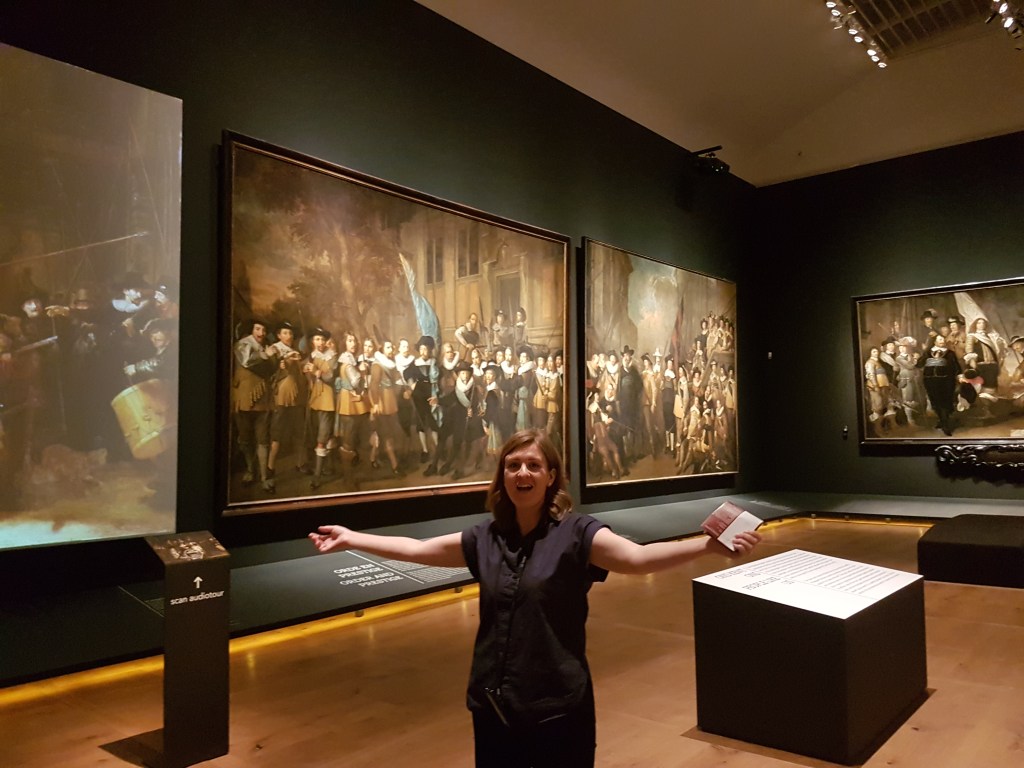
    The one exhibit that we did quite enjoy was the “Portrait Gallery of the Golden Age”, which was entirely comprised of large scale photos of Dutch guild members and other merchants. Otherwise, we weren’t impressed, but we’ll have our eye on this place for future visits.

    Check out our photos below!

  • Day 5 in Amsterdam – Paddle Boating Through the Canals!

    Day 5 in Amsterdam – Paddle Boating Through the Canals!

    During our time in Amsterdam we often saw people boating through the canals. It’s a relatively popular form of leisure transit. While locals seemed to treat their boats as picnic spots – spending time meandering down the canals while drinking wine and snacking – we also spotted many (presumed) tourists paddle boating.

    After spending a few hours indoors at the Stedelijk, we were ready to get some sun and try out paddle boating.

    You can see this video of our exploits:

    Overall the process was fairly straightforward. Along the canals there are a variety of kiosks where you can rent a boat. You get a map and some instructions on how to ‘drive’, which canals you’re allowed to traverse, and which kiosks are valid “drop off” sites. From there, you’re on your own. As long as you get the boat home in time, there’s nothing to worry about.

    Navigating the paddle boat was definitely a bit more challenging than I’d anticipated but eventually we figured it out, and we loved it. It was so relaxing and calming to boat through the canals and view the city from a new perspective. The rental company’s guide also included some fun facts about sites along the route, so again we were learning.

    And on the topic of learning, we also found this article about the history of Amsterdam’s city design. Yes, they are famous for being very cyclist and pedestrian friendly, but this wasn’t always the case. Walking and paddle boating around such a beautiful place, it’s easy to imagine that this place is just magical by nature. But in fact the accessibility of Amsterdam is the result of specific choices made by the people of Amsterdam.

    We wrapped up our day with dinner and drinks at a local hangout called Cafe de Prins. All in all, an excellent day in an excellent city.

    Check out our photos below!

  • Day 5 in Amsterdam – Visiting the Stedelijk!

    Day 5 in Amsterdam – Visiting the Stedelijk!

    Amsterdam has a LOT of museums. The most popular is probably the Van Gogh Museum, which we did not visit because it required advance booking and/or booking a ticket to stand in line for a pre-scheduled time. We don’t like to plan that kind of stuff ahead, so we skipped it. We’d also just seen a Van Gogh exhibit in Toronto, so we didn’t feel we were missing out too much.

    Just down the street from the Van Gogh is the Stedelijk, Amsterdam’s primary contemporary art museum. Here’s the ‘official’ Wikipedia description:

    The Stedelijk Museum Amsterdam (Dutch pronunciation: [ˈsteːdələk myˈzeːjɵm ˌɑmstərˈdɑm]; Municipal Museum Amsterdam), colloquially known as the Stedelijk, is a museum for modern artcontemporary art, and design located in AmsterdamNetherlands.[8][9]

    The 19th century building was designed by Adriaan Willem Weissman and the 21st century wing with the current entrance was designed by Benthem Crouwel Architects. It is located at the Museum Square in the borough Amsterdam South.

    The collection comprises modern and contemporary art and design from the early 20th century up to the 21st century. It features artists such as Vincent van GoghWassily KandinskyErnst Ludwig KirchnerMarc ChagallHenri MatisseJackson PollockKarel AppelAndy WarholWillem de KooningMarlene DumasLucio Fontana, and Gilbert & George.[9]

    When approaching the museum, the first thing that you notice is the new wing, added onto the original historic building. It’s shaped like a gigantic bathtub, so it’s pretty tough to miss. Once you go inside, you work your work through all of the rooms, which are all white square or rectangular spaces. This museum, like many of the others we visited, offer complimentary audio guides… simply find a kiosk in the museum, grab a little “phone”, choose your language, and start walking!

    The collection is great, and ranges from audio visual modern art to more classical modernist or constructivist painting, to contemporary photography, to exhibits about new technologies being used to accommodate refugees. Some of the stuff that we saw here we saw again in Toronto at EDIT (Expo for Design, Innovation, & Technology).

    We took quite a few photos, so you can check it out for yourself!

  • Day 4 in Amsterdam – Visiting the Rijksmuseum!

    Day 4 in Amsterdam – Visiting the Rijksmuseum!

    We started out our fourth day in Amsterdam by visiting the Tulip Museum for a quick visit. We then walked south through the city to visit their flagship art “quarter”. The section of the city has several museums, and on this day we visited just one of them: the Rijksmuseum. I’d read about this museum a few years ago when it was renovated to include a bike path that treads directly through the building, so we were quite excited to see it all in person.

    Here’s what Wikipedia has to say about the museum and its collection:

    The Rijksmuseum (Dutch pronunciation: [ˈrɛiksmyˌzeːjʏm]; English: National Museum) is a Dutch national museum dedicated to arts and history in Amsterdam. The museum is located at the Museum Square in the borough Amsterdam South.

    The Rijksmuseum was founded in The Hague in 1800 and moved to Amsterdam in 1808, where it was first located in the Royal Palace and later in the Trippenhuis.[1] The current main building was designed by Pierre Cuypers and first opened its doors in 1885.[3] On 13 April 2013, after a ten-year renovation which cost  375 million, the main building was reopened by Queen Beatrix.[11][12][13] In 2013 and 2014, it was the most visited museum in the Netherlands with record numbers of 2.2 million and 2.47 million visitors.[6][14] It is also the largest art museum in the country.

    The museum has on display 8,000 objects of art and history, from their total collection of 1 million objects from the years 1200–2000, among which are some masterpieces by RembrandtFrans Hals, and Johannes Vermeer

    We were in the museum for hours and still didn’t manage to see it all. Below are the many, many photos we took on our full day museum adventure. Read the comments to learn about all the highlights from our day! And shout out to Restaurant ‘t Zwaantje for serving us an incredible dinner.


  • Day 4 in Amsterdam – Visiting the Tulip Museum!

    Day 4 in Amsterdam – Visiting the Tulip Museum!

    If you’ve been following the news stories about bitcoin lately, you may have heard some references to tulips and Dutch tulip mania. Or perhaps you’ve been to the Ottawa Tulip Festival, connected to WWII and the Dutch love of tulips. Either way, it’s more than just a flower, which is why we stopped by the Tulip Museum in Amsterdam.

    Much like the Canal House Museum, this small, specialized museum was impressively high quality and educational.

    You enter the museum through their storefront. In the museum’s store you can buy a wide variety of tulip related souvenirs, but we skipped that to beeline for some learning. In the back of the storefront you go down a small set of stairs to enter the museum. It begins with the origins of tulips, then traces the plant’s migration to the Netherlands. Once the story arrives in Amsterdam, the exhibit goes into detail about Tulip Mania in the 1600s:

    The introduction of the tulip to Europe is usually attributed to Ogier de Busbecq, the ambassador of Ferdinand I, Holy Roman Emperorto the Sultan of Turkey, who sent the first tulip bulbs and seeds to Vienna in 1554 from the Ottoman Empire.[14] The tulip was different from every other flower known to Europe at that time, with a saturated intense petal color that no other plant had. The appearance of the nonpareil tulip as a status symbol at this time coincides with the rise of newly independent Holland’s trade fortunes.

    As a result, tulips rapidly became a coveted luxury item, and a profusion of varieties followed.

    Tulip mania (Dutch: tulpenmanie) was a period in the Dutch Golden Age during which contract prices for some bulbs of the recently introduced and fashionable tulip reached extraordinarily high levels and then dramatically collapsed in February 1637.[2] It is generally considered the first recorded speculative bubble;

    This was another of our favourite museums from the trip, and it’s something I’d recommend to anyone. Most museums can be fun and educational, but they don’t all teach lessons that can be applied to modern-day economics. This one does, and it’s cute as heck to boot. If you’re in Amsterdam, you should check it out. See our photos below!