Author: Heather

  • Back in Grimsby :: Thoughts on accepting unexpected changes in 2015

    Back in Grimsby :: Thoughts on accepting unexpected changes in 2015

    I’ve been working on this post for sometime, building it in my head, finally writing it out, and coming back to it with edits on edits. It seems fitting to publish this on New Year’s Eve, after a rather surprising and challenging year.

    When I started writing this blog, Kevin and I were living in Cambodia. We’d quit our jobs, sold or given away most of our clothing, furniture, technology, etc, and moved across the globe on a new adventure.

    Going into this, our expectation was that we’d live abroad and travel Southeast Asia & surrounding areas for 3 to 5 years, and then see where life/work led us from there.

    What we weren’t expecting was my homesickness to result in a mandatory trip home at Christmas.

    Still, we worked in some extra benefits to that trip. After going home for Christmas, we’d planned to travel through Spain to France, and then fly from Paris back to Phnom Penh, Cambodia.

    What we weren’t expecting was for Kevin to get hit in the mouth with a hockey stick while playing “pick up” hockey in Grimsby. When that happened, we got some quick dental work done, then headed to Portugal to finish the rest.

    What we also weren’t expecting was to learn that recovering from a traumatic dental injury takes several months, not several weeks. Fast forward to December 31st, and we’re still 1.5 months away from a full resolution.

    Back in February, when we were coming to terms with the recovery outlook, we realized pretty quickly that our goal of living 2-5 years in Asia was going to be postponed, and possibly replaced with a new plan that worked for our current circumstances.

    Coming back to Canada in July, and having to re-explain that to everyone who thought we were still living in Asia, was harder than I’d expected. In a sense, I felt like we’d failed on this big journey that we’d planned and talked about for so long. For the sake of moving away, we’d given up both things and opportunities, and coming back so soon had me wondering if all that was in vain. It also feels weird to have only travelled for such a short period of time, when our “move” had been aimed that avoiding a type of rushed,”see it once, then head home”, type of travelling. And yet, the things we saw and accomplished during our travels were incredible. And as I’ve written before, there’s nothing quite like travelling to cure oneself of the notion that it’s even possible to ‘see it all’, so should I really be disappointed that I didn’t?

    I’m still kind of grappling with these thoughts, but also trying to full embrace our current circumstances.

    So… yes, we’re back in Canada. Yes, we live in Grimsby. Yes, our untethered lifestyle is indefinitely on ‘pause’. But I’m actually okay with that. And after a year of health/dental related drama and stress, I am more than okay with saying goodbye to 2015, and looking forward to whatever 2016 holds. If these past couple of months are any indication, there are many good times ahead for our life in Canada.

  • #tbt – My friend Anne came to visit us in Portugal!

    #tbt – My friend Anne came to visit us in Portugal!

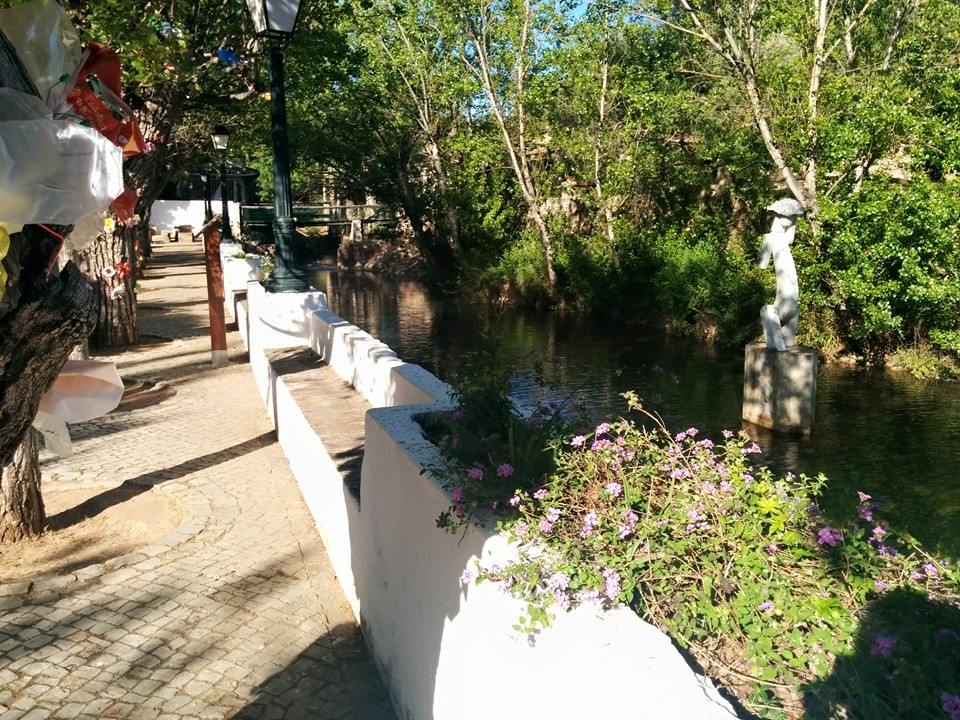
    One of the loveliest benefits of spending time in Portugal was the proximity to some of my fellow Canadian friends. One such friend, Anne, was working in London for the first half of 2015. Before she headed back to Canada, she took a quick jaunt to Alte, where we spent a few days enjoying the sunshine.

    Between her travels and my travels, Anne and I don’t get to see each other too often. And yet, we’ve been friends since we were 11, and that means that when do get together, it’s like we were never apart. I was acutely reminded of this when she came to visit us in Portugal. With Kevin laid up in bed, suffering through his recent implants surgery, Anne and I had plenty of time to explore Alte together. Activities included long walks, sitting in the sun, and drinking espressos, going for a trail run, and talking constantly.

    Despite being in pain and needing rest, Kevin was also generous enough to drive us for a wonderful sunset/dinner combination. Kevin is an outstanding host, who puts quite a bit of thought into showing guests the very best of the Algarve, so we were lucky that he got out of bed to entertain us. The next day we spent laying out on the beach with several of our Portuguese friends, which is a classic Algarve experience. In retrospect, it was asking way too much of Kevin to take us around like this. Never have I regretted so much my inability to drive standard/manual.

    In any case, Anne’s visit was a lot of fun. With Kevin’s injuries/dental work, our time in Portugal was a bizarre combination of amazing and stressful. It was so relaxing for me to have one of my oldest friends check in help me review all the things that were on my mind. Moral of the story? Never underestimate the the goodness your friends can bring to your own mental health. With this experience in mind, I was so stoked when Kevin’s best friend Mark came to visit a couple of months later – and for that, I actually did learn to drive standard. There’ll be much more on that adventure soon 🙂

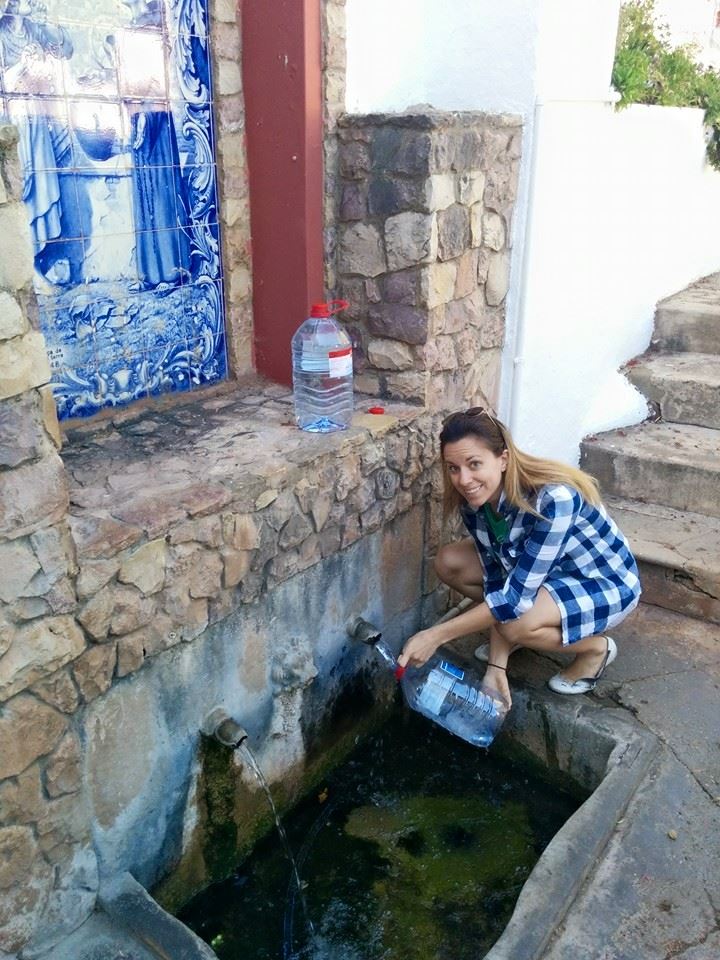
    Anne and I were having too much fun to take many photos, but I’ve snagged a few of Anne’s from Facebook, which you can see below:

  • Back in Grimsby :: An update on what’s happening with this here blog

    Back in Grimsby :: An update on what’s happening with this here blog

    If you’re reading closely, 2 things are clear:

    1. Kevin and I are back in Canada
    2. Most of the posts about our travels are describing things have taken place a few months ago

    At the end of July, Kevin and I booked one-way tickets back to Canada. We’d been in Portugal since early 2015, and had been travelling/living in Southeast Asia before that.

    We didn’t anticipate coming back to Canada nearly this soon, but here we are. So, what happens to a travel blog when you’re no longer “travelling”?

    The immediate plan is to continue writing. There are still tons of photos and stories to share from our adventures in the first half of 2015. I’ll be posting those as a “Throwback Thursday” entry, once a week.

    Alongside the Thursday posts, I’ll be writing about what we’re doing and exploring in Canada, along documenting with any other shorter trips that we get to.

    When we left Toronto and set out on our ‘big international adventure’, we chose to plan a long period of travel because we like to take our time. In Portugal, we *really* took our time, exploring many nooks and crannies of the Algarve, often seeing the same place or thing many times, and yet appreciating it all the same.

    One thing that we learned very quickly is that it’s next to impossible to see all the incredible and beautiful and interesting things/places out there, because the opportunities to do so are limitless. If the opportunities to explore beautiful experiences abroad are so numerous, it stands to reason that the same thing applies wherever life finds us. Right now, we’re living in Grimsby, the quickly growing small-ish town where I grew up. Much to my surprise, there are plenty of things to see and explore here, as long as you look for such opportunities.

    As someone who has started and abandoned many projects, I’m still a bit shocked that I’ve maintained this blog for so long. Though I’m geographically back where I started, I’ll keep documenting Kevin’s photos and our stories. (Beside, this blog was started to share our adventures with friends and family. With most of our friends in Toronto, being in Grimsby can feel so far away that we might as well still be in a foreign country 😉 )

    I’m not at all looking forward to winter, but Kevin and I will be doing our best to get into some winter sports and activities, making sure we get the most out of the unique experience of a Canadian winter.

  • Canadian Thanksgiving traditions in Grimsby

    Canadian Thanksgiving traditions in Grimsby

    It’s American Thanksgiving, so it’s as good a time as any to write about our adventures during the Canadian Thanksgiving weekend.

    A couple of years ago, I went to Ottawa and spent Thanksgiving weekend with Kevin. While there, I ate the most delicious Thanksgiving dinner that I’d ever had. Since we’re back in Grimsby, room-mating it up with my parents, we cried “dibs” pretty immediately on preparing Thanksgiving dinner. My mom was away for a wedding that weekend, so we had free reign over the kitchen. Of course, there were some other antics afoot before we got the oven running.

    We were making our Thanksgiving dinner on Sunday, so on Friday I set out to buy a turkey. I’d attempted to purchase a turkey on Thursday, to no avail. Apparently everyone buys their turkey at least 2 weeks early, and I had missed the memo. On Friday morning, Kevin told me “go to Lococo’s, they’ll have a 10kg Butterball for sure”. With Thursday’s empty turkey freezers in mind, I drove my parents to the airport on Friday, and proceeded to spend 3 hours driving all around Mississauga and Oakville in search of a 10kg+ Butterball turkey. I could barely find a 7kg turkey, let alone a butterball, so I began to panic. I bought the first 10kg turkey I could find, Butterball be damned.

    Then, to stock up on veggies and stuffing and all that other Thanksgiving goodness, I went to Lococo’s. As Kevin had promised, they had multiple Butterballs over 10kg. So what did I do? I bought one. As of today, we still have an extra turkey just waiting it out in our basement freezer.

    Double turkey purchases aside, Thanksgiving weekend in Grimsby involves just one tradition: Attending the Balls Falls Craft Show. So before we got to cooking, Kevin agreed to indulge me and attend the craft show. Balls Falls is a conservation area in Vineland, ON, that also happens to be the home of several old/historic buildings. It’s a wedding hotspot these days, which makes sense because it’s quite lovely.

    Fortunately, the craft show is not just about crafts. There are several historical displays that showcase 20th century technologies. There was also a “raptor” display, where we saw some really cool birds, most importantly, a Bald Eagle!!!! The next best thing to a Bald Eagle was seeing a genuine Military Band Organ from 1911. Still in full working order, this was a pretty cool site to see. It was restored and maintained by a gentleman named Captain John Leonard, who toured it all around the great lakes regions, in the United States and Canada. Though Captain John has since passed away, his wife and and his friend continue this great tradition, bringing a taste of early 20th century musical technology to the masses.

    Here’s a quick video of what the inner workings of the machine, as seen through the back, looks like:

    Surprisingly, we got quite into the whole craft scene, and went through to see every vendor there. While I’d planned to check out the festival for 30 minutes, once we saw the food tent, we got sucked in, and ended up spending more than 2 hours crafting about. I’ve been to this festival in some terrible weather, so the bright sunny day was a real treat.

    The next day, guided by some tips from Gordon Ramsay, we embarked on our Thanksgiving cooking extravaganza. With Kevin leading, me sous-chefing, and my brothers assisting, it was a pretty big production. I can honestly say that we could not have pulled this off without the help of Tyler and Kristopher, who helped with all the preparation, and made dessert. Tyler also ran point on serving the wine, which is essential for family holidays. We kicked off dinner by toasting with a glass of sparkling wine for everyone at the table, then proceeded to dig in.

    The menu included:

    • A 10 kg turkey, perfectly prepared
    • Garlic mashed potatoes
    • Green beans with bacon
    • 3 types of gravy
    • Stovetop Stuffing (yes, from the box – don’t mess with a classic!)
    • Gwyneth’s roasted cauliflower and chickpeas
    • Pumpkin pie
    • Homemade Gingerbread Cookies
    • Homemade Lemon Meringue Pie (courtesy of Nana Ev)
    • Wine, wine, and more wine (all from Niagara’s 20 Valley Region, of course)

    And that’s it. The secret to a great Thanksgiving weekend? Wine and teamwork. Hopefully Christmas will be similar entertaining! Check out the various photos of our Canadian Thanksgiving weekend, below:

  • Visiting Sagres

    Visiting Sagres

    Throughout the duration of Tyler’s trip to Portugal, I was incredibly ill. I slept most of the time and felt terribly shivery and gross for most of the time that I wasn’t sleeping. As a result, I didn’t get out for too many excursions, and Tyler’s blog posts have covered the majority of his second week with us in Portugal, where we relaxed in the Algarve.

    There was one trip for which I did manage to drag myself out of bed: a day trip to the Fort at Sagres.

    Sagres is the most south-west point of Portugal, with a large landmass that juts out into the ocean. The Fort of Sagres occupies this space, a place connected to Portugal’s history of exploration. The Fort may or may not have been connected to the work for Portuguese Prince Henry the Navigator:

    It is traditionally suggested that Henry gathered at his villa on the Sagres peninsula a school of navigators and map-makers. However modern historians hold this to be a misconception. He did employ some cartographers to chart the coast of Mauritania after the voyages he sent there, but there was no center of navigation science or observatory in the modern sense of the word, nor was there an organized navigational center.[7]

    Referring to Sagres, sixteenth century Portuguese mathematician and cosmographer, Pedro Nunes, remarked, “”from it our sailors went out well taught and provided with instruments and rules which all map makers and navigators should know.”[8]

    The view that Henry’s court rapidly grew into the technological base for exploration, with a naval arsenal and an observatory, etc., although repeated in popular culture, has never been established.[9][10][11] Henry did possess geographical curiosity, and employed cartographers. Jehuda Cresques, a noted cartographer, has been said to have accepted an invitation to come to Portugal to make maps for the infante. This last incident probably accounts for the legend of the School of Sagres, which is now discredited. (Wikipedia)

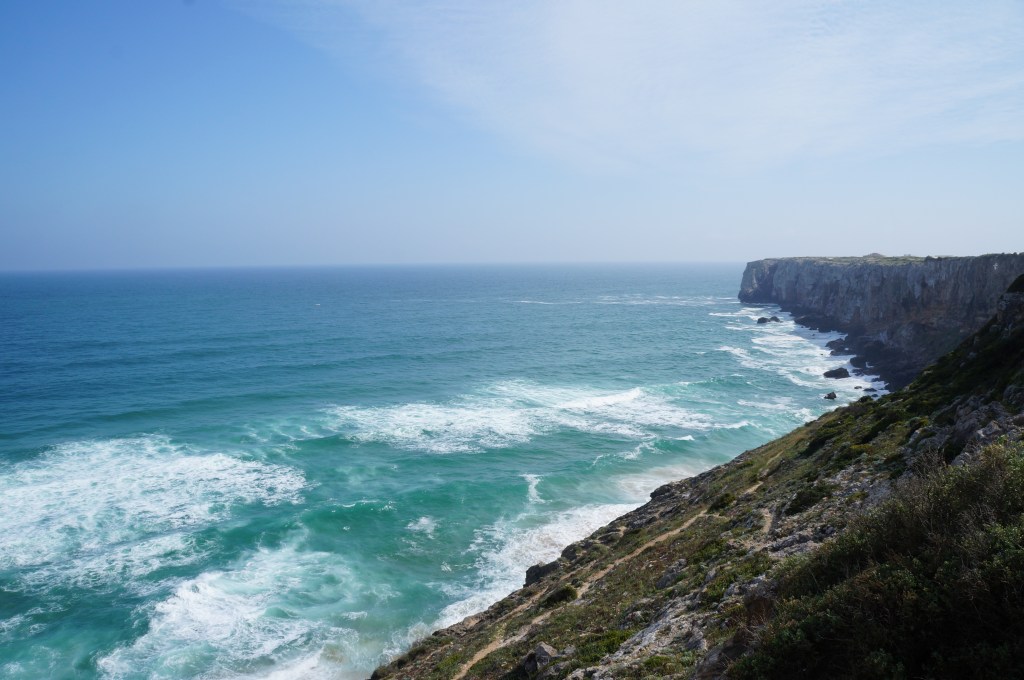
    The location was stunning. Walking along the cliffs, watching birds fly above the waves, and looking back at the rather flat, open space of the fort, it was a beautiful scene. As far as museums go, it was fairly unimpressive. Very little information was offered about what we were looking at, though Wikipedia has suggested that the Fort’s importance is up for debate, which may explain the lack of concrete information at the site.

    In either case, it was a lovely day, made even better by a really fantastic seafood lunch. We dined at A Sagres, the closest restaurant to the Fort. While those around us were eating spaghetti and other such nonsense, we requested the daily specials, and were treated to an amazing seafood stew and freshly caught fish.

    On the way home we took a scenic route along the coast. We stopped at a beautiful beach, and took a detour for a supposed ‘archaeological site of interest’ that was actually just a field.

    Check out our photos to enjoy the view:

  • Road Trip Day 3: Evora & Illness & the Algarve

    Road Trip Day 3: Evora & Illness & the Algarve

    After waking up in Marvao and spending our morning exploring, we set off to Evora. Of course, Tyler rolled his ankle on those beautiful cobblestone streets the night before, and I woke up feeling the beginning of a fever. Still, we had 2 more stops on our road trip, beginning with the city of Evora, followed by the nearby Monsaraz, then the city of Beja. By the time we had lunch, Kevin realized his couple of Pages were too ill, and he promptly drove us the last 3 hours home to the Algarve.

    Before our trip was cut short, we did get to explore Evora. We also had an incredible lunch at a restaurant that only serves 9 people at a time. “Botequim da Mouraria” is run by a welcoming Portuguese couple. In their small restaurant, there’s bar seating only, which means that we were incredibly lucky to arrive in time for lunch and find 3 empty chairs waiting for us. The service and the food were excellent. This was one of those places Kevin had found in the course of his detailed research, and it was very much worth the hype.

    After lunch, we explored Evora and its incredible history. A very old city, Evora still has Roman ruins and an incredible variety of historic architecture. On all our other stops, I read aloud to the guys various historical fun facts. Being sick in Evora meant that I didn’t really do this, and so we learned a bit less there than everywhere else. The city is more than 2000 years old, and was occupied by the Celts and the Moors before becoming the #2 city in Portugal for a time, becoming the site of much lavish spending on the behalf of Portuguese rulers.

    Here are a couple of other fun facts about Evora:

    Évora has a history dating back more than two millennia.

    It was known as Ebora by the Celts, a tribal confederacy, south of the Lusitanians (and of Tagus river), who made the town their regional capital.

    The etymological origin of the name Ebora is from the ancient Celtic word ebora/ebura, plural genitive of the word eburos (yew), name of a species of tree, so its name means “of yew tree.” The city of York, in northern England, at the time of the Roman Empire, was called Eboracum/Eburacum, named after the ancient Celtic place name Ebora Kon (Place of Yew Trees), so the old name of York is etymologically related to the city of Évora.[6]

    (Wikipedia)

    Évora is also remarkable for reasons other than its monumental heritage related to significant historic events. The 16th century was a time of major urban planning and great intellectual and religious influence. While Évora also has many noteworthy 16th-century patrician houses (Cordovil house, the house of Garcia de Resende), the unique quality of the city arises from the coherence of the minor architecture of the 16th, 17th and 18th centuries. This unity finds its overall expression in the form of numerous low whitewashed houses, decorated with Dutch tiles and wrought-iron balconies and covered with tile roofs or terraces which line narrow streets of medieval configuration and which in other areas bears witness to the concentric growth of the town until the 17th century. It also served to strengthen the fundamental unity of a type of architecture that is perfectly adapted to the climate and the location.

    Évora remained mainly undamaged by the great earthquake of 1755 that destroyed many towns in Portugal, including Lisbon. The monuments of the Historic Centre of Évora bear witness to their profound influence on Portuguese architecture in Brazil.

    (UNESCO)

    In retrospect, while we recognized how beautiful Evora was, I was a bit too sick to recognize and appreciate the signs of its long storied history. It was also clearly packed with tourists from all of the world, which became a bit of a distraction itself. All the same, we managed to take a few photos. Enjoy!


  • Road Trip Days 2 & 3: Visiting Marvao

    Road Trip Days 2 & 3: Visiting Marvao

    Ok, so the last few posts have detailed some fairly magical sights. But to be honest, there’s more to come here. This trip was pretty surreal, and we saw many memorable places.

    The driving on the trip may also have been a bit much, but in this case it turned out to be worth it. After driving 2.5 hours to Piodao, we spent a couple of hours exploring this small yet remarkable village. And then we got back in the truck and Kevin drove us another 3 hours to Marvao, a city on a hill right on the border of Portugal and Spain. About an hour into this trip, I was really questioning this decision, but when we drove up to this walled-city on a foggy night, all doubts were forgotten.

    Here’s what you need to know about Marvao (courtesy of Wikipedia):

    Commanding spectacular views across the Tagus basin (the same river to connects Lisbon to the Atlantic) and Serra de Estrela (highest point in Portugal) to the north, the fortified rock of Marvão has been a site of significant strategic importance since the earliest human settlements. Today lying on the ‘raia’ that divides Portugal and Spain, Marvão has consistently stood on a frontier zone between peoples: Celtici, Vettones and Lusitani (4th-2nd century BCE); Lusitanians and the Romans ofHispania Ulterior (2nd-1st century BCE); migratory Suevi, Alans, Vandals and Visigoths (5th-7th century CE); conquering moors and Visigoths (8th century); muwallad rebels and the Cordoban emirate (9th-10th century); Portuguese nation-builders and Moors (12th-13th century); Templars and Hospitallers (12th-14th century); Portuguese and Castilians (12th century-present day); Liberals and Absolutists (19th century); the fascist regimes of Salazar and Franco (20th century).

    Marvão’s natural assets have contributed to the ‘uniqueness’ of this remote village as perceived by visitors today: (i) as nigh-impregnable ‘eagle’s nest’ fortress – perched high on a granite crag, and bordered on the south and west by the Sever river; (ii) as vital lookout-point towards the Alcántara Bridge (70 km (43 mi) away), a wide stretch of the Tagus basin and the Serra de Estrela; (iii) as a gateway to Portugal from Spain via the Porta da Espada (‘Sword Gate’) mountain pass of the Serra de São Mamede. These assets have ensured its status as the ‘Mui Nobre e Sempre Leal Vila de Marvão’ (Very Noble and Ever-Loyal Town) into the present day.

    As with other 11th-13th-century castles, the early medieval improvements and development of Marvão castle reflect the innovations brought back by crusading orders from the near east (notably the highly influential Hospitaller castle in Syria, the Krak des Chevaliers). The medieval castle seen in Marvão today mostly post-dates the year 1299, and features numerous characteristic features of a crusader-era castle: a tall central keep with raised entrance on the first floor; a series of lower, outlying turrets (some semi-circular); high-placed arrow-slits; open spaces to aid the sheltering and assembly of villagers and troops; a well, and huge rain-collecting cistern to supply water to both keep and the wider castle in the event of siege; bent entrances (both on the village and castle gates) to slow down invaders in the event of breached gates; a series of narrow killing zones (notably, in the triple gate on the village-side of the castle); extensive crenellated battlements and curtain walls that enhanced the natural defences provided by the escarpments of Marvão’s rock.[22]

    That’s only a smattering of interesting information about Marvao, as this place is filled with historical significance. When we arrived at night fog filled the town, we had to park the truck just outside of the gates in order to walk to our hotel (we stayed and ate at the the Casa do Alentejo, where we were welcomed with the traditional and impressive Alentejo hospitality). With the characteristic preservation of the buildings’ historical style, it felt like we were walking back in time. After a lengthy dinner, we got some sleep, then woke up early for breakfast and further touring. We explored all through the town and the castle, and were constantly in awe of the view and the spirit of the region. Similar to Sintra, looking across the hills you could easily imagine what it was like to look across that view 1000 years ago. A very cool feeling that won’t soon be forgotten.

    Check out our photos below!

  • Roadtrip Day 2: Piodao

    Roadtrip Day 2: Piodao

    When I say that Kevin researched and planned our road trip with Tyler, I don’t mean that lightly. As soon as Tyler booked his tickets to visit, the research began. And not just some simple google searches of ‘best sights in Portugal’. If Kevin has ever helped you with anything, you know that his research-style is all-in and he stops at nothing to get the best possible outcome. Nothing exemplifies this more than our stop off in Piodao.

    A few weeks before the trip, Kevin showed me a photo of a place that looked amazing, and told me that it was a must-do stop. When I convinced him to shorten the road trip from 6 days to 3, Piodao was one of those places that was a must-see, not to be compromised. And he was so, so right.

    After our morning at the Knights Templar’s Convent of Christ in Tomar, we got back into the truck and embarked on what I can honestly say is the wildest, most breathtaking and most nerve-racking road trip of my life. Before I get into too many road trip details, let’s talk about why Piodao is special and worth seeing.

    Piodao, known as the “nativity village” is a small collection of stone buildings, tucked into a mountain side. Unlike most of the places we’ve visited on this trip, Piodao, due to its remote geographic location, was almost entirely disconnected from Portuguese history. How disconnected? This village didn’t have electricity until the 1970s. This geographic isolation is what makes Piodao so unique – because they were limited to local resources, which is reflected in the architecture of the town itself, their traditions were well-preserved over the years, due to a lack of outside influences. Entering Piodao, picturesquely placed in between 2 hills in a mountain range, feels like entering a fairy tale. As you stand on the hillside, you can even hear the echo of jingling bells from the goat herds. My only regret of this entire trip is that we didn’t stay longer.

    Now, about that road trip. It was long and a bit harrowing. And as the trip went on, we felt increasingly alone. There were long stretches (on this 2.5 hour drive) without seeing other people and cars, though we did see a herd of goats crossing the road. We climbed up into the mountaintops, driving along winding roads, on the edge of cliffs, surrounded by clouds. I was both in awe of the view and in awe of Kevin’s patience & composure while navigating these roads. There’s absolutely no way that a bus could have made this journey.

    Visiting Piodao was a truly surreal and magical experience. I recommend it very much. And beyond being beautiful, the town itself offers great food and friendly people. Check out our many photos below!

  • Roadtrip Day 2: An Aqueduct “just around the corner”

    Roadtrip Day 2: An Aqueduct “just around the corner”

    While we were visiting the Convent of Christ in Tomar, the map of the site said that there was an aqueduct attached. Tyler was pretty excited about this, never having seen a real aqueduct. Kevin and I had seen some in Lisbon, but agreed that it was pretty cool.

    While Tyler and I searched for the aqueduct ruins (which we found outside, attached to the Castle of Tomar), Kevin searched on Google. When we were done at the Castle/Convent, Kevin said he had one more stop he wanted to make. He handed me the phone with a seemingly random spot marked on the map nearby. He told me what we were up to but hadn’t said anything yet to Tyler.

    5 minutes of driving later, we came to the Pegoes Aqueduct, to which the aqueduct ruins at the castle were attached.

    But rather than just a couple of arches, what we saw was a full aqueduct crossing a valley. And the best part? It was open and also empty! From where we parked, we walked just a few steps to climb up onto the aqueduct through an old water inspection station. In the silent countryside, we walked along an ancient aqueduct, just the 3 of us.

    A quick little surprise, and one of the highlights of our trip. Enjoy the photos below!

  • Roadtrip Day 2: Tomar and the Convent of Christ

    Roadtrip Day 2: Tomar and the Convent of Christ

    After our day of adventures in Sintra, we drove 2 hours to the city of Tomar.

    When planning this roadtrip, Kevin did quite a lot of research. All the places that we travelled to see made the list because of their unique history/beauty, making it almost impossibly to have a favourite site.

    The city of Tomar was originally founded in 1162 under an order of the Knights Templar, and it was actually the last Templar town to be commissioned for construction.

    Tomar then became the headquarters of the Order of the Knights Templar in Portugal. From this base, the Templars ruled a vast area of central Portugal, defending that territory from the Moors who ruled in the South. As the Catholic church became nervous of the power of the Templars, and then banned the order altogether, the Portuguese King negotiated to create a new “Order of Christ”, which took over the power and place of the Templar’s order. As such, Tomar is considered the last home of the Knights Templar in Portugal.

    This story got a bit more interesting when Henry the Navigator, the leader of Portuguese exploration, became the head of the Order of Christ (from Wikipedia):

    Henry the Navigator was made the Governor of the Order, and it is believed that he used the resources and knowledge of the Order to succeed in his enterprises in Africa and in the Atlantic. The cross of the Order of Christ that was painted in the sails of the caravels that crossed the seas, and the Catholic missions in the new lands were under the authority of the Tomar clerics until 1514. Henry, enriched by his overseas enterprises, was the first ruler to ameliorate the buildings of the Convento de Cristo since its construction by Gualdim Pais. He also ordered dams to be built to control the river Nabão and swamps to be drained. This allowed the burgeoning town to attract more settlers. Henry ordered the new streets to be designed in a rational, geometrical fashion, as they can still be seen today.

    Interestingly, this time in Portuguese history was also an important time in Jewish history:

    Just after 1492 with the expulsion of the Jews from Spain, the town increased further with Jewish refugee artisans and traders. The very large Jewish minority dynamized the city with new trades and skills. Their experience was vital in the success of the new trade routes with Africa. The original synagogue still stands.

    In the reign of Manuel I of Portugal the convent took its final form within the Manueline renaissance style. With the growing importance of the town as master of Portugal’s overseas empire, the leadership of the Order was granted to the King by the Pope.

    However, under pressure from the Monarchs of Spain, the King soon proclaimed by Edict that all the Jews remaining within the territory of Portugal would be after a short period considered Christians, although simultaneously he forbade them to leave, fearing that the exodus of Jewish men of knowledge and capital would harm Portugal’s burgeoning commercial empire. Jews were largely undisturbed as nominal Christians for several decades, until the establishment of a Tribunal of the Portuguese Inquisition by the initiative of the Catholic Clergy in the town. Under persecution, wealthier Jews fled, most others were forced to convert. Hundreds of both Jews and New Christians were arrested, tortured and burned at the stake in autos da fé, in a frenzy of persecution that peaked around 1550. Many others were expropriated of their property. Jewish ascendancy, more than Jewish religion, together with personal wealth determined whom would be persecuted, since the expropriations reverted to the institution of the Inquisition itself. The town lost then with the persecution of its merchants and professionals most of its relevance as a trading centre.

    Despite its great importance during the growth and expansion of Portugal and Europe, Tomar is now a town of just 20,000 people, quietly tucked away in Portugal. If you’re interested in knowing more about Jewish history in Portugal, I recommend you check out this Wikipedia article, as well as this article that talks about the town of Belmonte (by the way, home to some pretty good kosher olive oil!).

    Anyways, so as we were driving to Tomar, I was reading out all of these Wikipedia articles to Kevin and Tyler, getting all pumped up about our trip. We arrived late at night, grabbed dinner at a Knights-Templar-themed restaurant, and headed off to bed. With big plans for the next day, we got up early, ate breakfast in our family-run Pensao, and then headed up the hill to the Convent of Christ.

    If Tomar itself has some deep history going on, the Convent of Christ is right at the centre of the action. Built over hundreds of years, the building boasts a great variety of architectural and design styles. The level of detail is impressive, and we spent SO much time in the church flipping about how cool it was to be in the church built by Templar Knights.

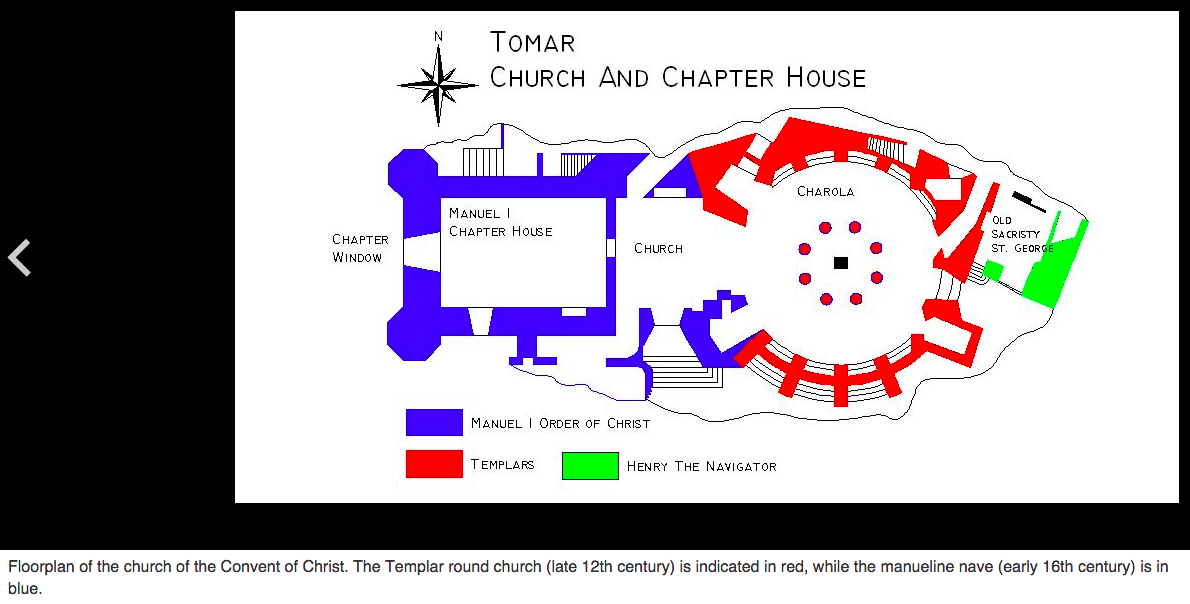
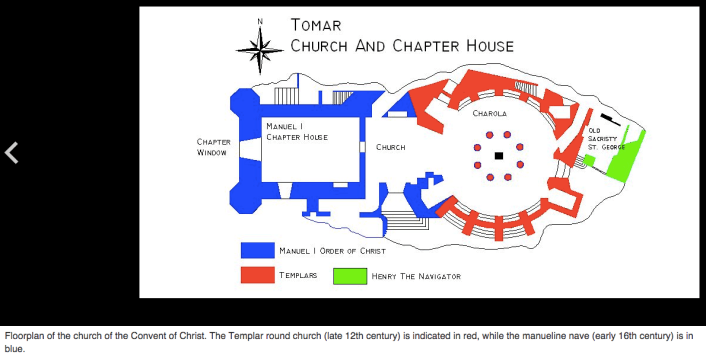
    To give you an idea of how the design of the church came to be, here’s a photo from Wikipedia:
    Screen Shot 2015-09-17 at 12.57.28 PM

    Similar to when I visited Canterbury earlier this year, it was really obvious that this place grew to become a great centre of activity in Tomar. What you see as blue in the above map is a truly massive set up, designed to house and feed those who lived and visited here. We entered in the oldest part of the building, shown above in green, and worked our way through to the chapter houses. We had only planned to spent 45 minutes here, but we ended up spending well over 2 hours exploring and taking photos.

    All in all, Tomar was a wonderful place to visit. We didn’t get to see all of the sites or explore all of the myths, but the Convent of Christ was itself worth the drive. We expected it to be cool, and still Tomar very much exceeded those high expectations. Enjoy our photos below, we had a lot of fun taking them!