Category: Algarve

  • #tbt: Spring time in the Algarve

    #tbt: Spring time in the Algarve

    April in Canada is the time when mother nature teases us all. Releasing sunshine and flowers, just in time to snow all over it one last time.

    Nonetheless, spring is upon us, which means that it’s the season for adorable baby animals, the return of flowers, and much more.

    This time last year, Kevin and I were in Alte, living with his grandmother in southern Portugal. With the weather being decidedly less chilly, the spring seasons feels much more played out. That is to say, there’s no temporary pause, and the warm months go on for quite a while. If you’re paying attention, you can easily see the springtime cycles of life emerging. Particularly in the rural Algarve, this is especially true.

    We saw a mama duck sitting on her eggs, and just a few weeks later we saw her baby ducks beside the river. A month later, many of those babies hadn’t survived, but we all knew who the new teenager ducks were, and we were so happy to see the swimming around and thriving.

    When the neighbour’s cat had kittens (this was a big theme in the Algarve – we met a lot of people whose neighbour’s cat had kittens last spring), Kevin and I would sneak food outside for them. The would sit on the neighbours shed and “mew, mew, mew” in the saddest way possible, and then we’d sneak out and toss them our leftover bones & scraps from dinner.

    Down the street, there was a neighbour who had a horse. It was fairly routine to see him riding around on the horse instead of using a car. It was also fairly routine for the horse to be housed in all different yards and fields in and around Alte. Two of those locations were a quick walk down the street (basically in someone’s backyard). One day while walking, we noticed there was a baby horse hiding behind the mother. Over the proceeding weeks and months, we saw the baby become bigger and more independent. On one particularly memorable day we saw the baby walk right up to us:

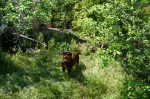
    If you follow Kevin and I on Instagram, then you might already know about our baby “javali” – Portuguese for wild boar. My friend Christina and I had gone for a run. Attracted by the sound of our voices, a baby javali wandered out of an orange grove and followed us.

    After a while, we managed to get him to wander off on his own, and we ran home to tell Kevin about what we saw. He agreed that it would be good to help the isolated little guy, so we drove out to the hills and picked him up.

    Kevin’s grandmother was not impressed. Javali are famously destructive. They’ll eat anything and everything, and she was concerned about her flower beds. Our little javali had to stay in the garage.

    Within 24 hours, it was pretty clear that he was sick. Within 36 hours, it was pretty clear that he was going to die. A family friend who raises javali came to pick him up, but even his nursing wasn’t enough. Not such a happy ending to that springtime adventure, but part of the season of growth and change nonetheless.

    Now that we’re in Canada, we’re keeping our eyes open for springtime growth and life. With a shorter warm season, we’ll be missing the variety of activity we saw in the Algarve, but we’re getting into birding and hiking, so time will tell how many baby creatures we’ll get to see this year.

  • #tbt: Summer of 2015 and learning how to ‘beach’

    #tbt: Summer of 2015 and learning how to ‘beach’

    Going to the beach is a sport in the Algarve. In the Algarve, people stay in between January and April, as it’s cold, most things are closed, and seasonal employees are out of work.

    Come late April, early May, the Algarvieu (Algarvians) come out to play. And that means hitting up the beach with a level of deep seriousness.

    To say the weather here is perfect is a complete understatement. As the spring and summer progress, and the weather gets hotter, you see the entire landscape becoming busy. More traffic, more people, more restaurants, and more sun!

    Growing up, I’d only been to the beach a handful of times. The Page kids were not into beach life; no sand in our toes, no seaweed on our feet, no sunburns on our skin, thank you very much.

    The Silva kids were the complete opposite. Spending most summers in the Algarve, with all their local friends in Alte, Kevin and his brother were total beach kids who spent many, many hours playing on the beach, swimming in the ocean, enjoying the sun.

    I had a lot to learn, but luckily for me I was learning how to “beach” with the help of an expert.

    In June, and July, we went to the beach almost everyday. And there were A LOT of beaches to choose from. Beautiful white sand beaches with crystal-blue water aren’t just for the Carribbean, people! Algarve beaches are famously beautiful, and we were spoiled enough to have multiple amazing beaches within just a 20 minute drive. In doing a bit of pre-writing research, I realized that some of the most “well reviewed” beaches are places we never went to, but it’s hard to justify driving an hour to a perfect beach when you have 6 almost-perfect beaches to choose from in your backyard!

    So, how does one beach?

    There are only a few things required:

    • water, and lots of it. My beach bag contained at least 8 water bottles at all times.
    • towels, 1.5 per person. I always had 3 towels for Kevin and I, so we could lay them out in a way that would keep ourselves and the towels sand-free
    • hats. With the Algarve sun, a hat is essential
    • euros – there’s a restaurant/bar at almost every beach, and the best way to end your day is with a bottle of wine at sunset (bars with a good wine selection are preferred).
    • paddle-ball equipment – surprisingly fun, and good exercise
    • tanning oil (for Kevin and all our Portuguese friends)
    • immense amounts of sunscreen for me (I also had a pre-departure routine that included sunscreening my entire body, head toe)
    • tanning technique – not as easy as one might think. You need to keep regular movement throughout the day to get an even tan all over your body. And pay attention to the sun, so you can angle yourself appropriately. Whether standing or laying down, you need to tack with the movement of the sun in order to get maximum rays.
    • sunglasses. duh.
    • e-readers. essential activity when you’re growing that tan on the sand
    • beer in a cooler – not required every time, but you need both together whenever required.
    • Google Maps – a required assistant when scanning the coast in search of a hidden beach!

    It’s hard to get a proper list of the beaches we went to, because all our friends referred to the beaches based on local history and/or the name of the restaurant at the beach. And some of the beaches were “hidden”, aka only limited walking access, which means the only way you can find them is by carefully scanning Google Maps’ Satellite View. In any case, we did take a lot photos, which you can peruse below!

  • #tbt – My friend Anne came to visit us in Portugal!

    #tbt – My friend Anne came to visit us in Portugal!

    One of the loveliest benefits of spending time in Portugal was the proximity to some of my fellow Canadian friends. One such friend, Anne, was working in London for the first half of 2015. Before she headed back to Canada, she took a quick jaunt to Alte, where we spent a few days enjoying the sunshine.

    Between her travels and my travels, Anne and I don’t get to see each other too often. And yet, we’ve been friends since we were 11, and that means that when do get together, it’s like we were never apart. I was acutely reminded of this when she came to visit us in Portugal. With Kevin laid up in bed, suffering through his recent implants surgery, Anne and I had plenty of time to explore Alte together. Activities included long walks, sitting in the sun, and drinking espressos, going for a trail run, and talking constantly.

    Despite being in pain and needing rest, Kevin was also generous enough to drive us for a wonderful sunset/dinner combination. Kevin is an outstanding host, who puts quite a bit of thought into showing guests the very best of the Algarve, so we were lucky that he got out of bed to entertain us. The next day we spent laying out on the beach with several of our Portuguese friends, which is a classic Algarve experience. In retrospect, it was asking way too much of Kevin to take us around like this. Never have I regretted so much my inability to drive standard/manual.

    In any case, Anne’s visit was a lot of fun. With Kevin’s injuries/dental work, our time in Portugal was a bizarre combination of amazing and stressful. It was so relaxing for me to have one of my oldest friends check in help me review all the things that were on my mind. Moral of the story? Never underestimate the the goodness your friends can bring to your own mental health. With this experience in mind, I was so stoked when Kevin’s best friend Mark came to visit a couple of months later – and for that, I actually did learn to drive standard. There’ll be much more on that adventure soon 🙂

    Anne and I were having too much fun to take many photos, but I’ve snagged a few of Anne’s from Facebook, which you can see below:

  • Visiting Sagres

    Visiting Sagres

    Throughout the duration of Tyler’s trip to Portugal, I was incredibly ill. I slept most of the time and felt terribly shivery and gross for most of the time that I wasn’t sleeping. As a result, I didn’t get out for too many excursions, and Tyler’s blog posts have covered the majority of his second week with us in Portugal, where we relaxed in the Algarve.

    There was one trip for which I did manage to drag myself out of bed: a day trip to the Fort at Sagres.

    Sagres is the most south-west point of Portugal, with a large landmass that juts out into the ocean. The Fort of Sagres occupies this space, a place connected to Portugal’s history of exploration. The Fort may or may not have been connected to the work for Portuguese Prince Henry the Navigator:

    It is traditionally suggested that Henry gathered at his villa on the Sagres peninsula a school of navigators and map-makers. However modern historians hold this to be a misconception. He did employ some cartographers to chart the coast of Mauritania after the voyages he sent there, but there was no center of navigation science or observatory in the modern sense of the word, nor was there an organized navigational center.[7]

    Referring to Sagres, sixteenth century Portuguese mathematician and cosmographer, Pedro Nunes, remarked, “”from it our sailors went out well taught and provided with instruments and rules which all map makers and navigators should know.”[8]

    The view that Henry’s court rapidly grew into the technological base for exploration, with a naval arsenal and an observatory, etc., although repeated in popular culture, has never been established.[9][10][11] Henry did possess geographical curiosity, and employed cartographers. Jehuda Cresques, a noted cartographer, has been said to have accepted an invitation to come to Portugal to make maps for the infante. This last incident probably accounts for the legend of the School of Sagres, which is now discredited. (Wikipedia)

    The location was stunning. Walking along the cliffs, watching birds fly above the waves, and looking back at the rather flat, open space of the fort, it was a beautiful scene. As far as museums go, it was fairly unimpressive. Very little information was offered about what we were looking at, though Wikipedia has suggested that the Fort’s importance is up for debate, which may explain the lack of concrete information at the site.

    In either case, it was a lovely day, made even better by a really fantastic seafood lunch. We dined at A Sagres, the closest restaurant to the Fort. While those around us were eating spaghetti and other such nonsense, we requested the daily specials, and were treated to an amazing seafood stew and freshly caught fish.

    On the way home we took a scenic route along the coast. We stopped at a beautiful beach, and took a detour for a supposed ‘archaeological site of interest’ that was actually just a field.

    Check out our photos to enjoy the view:

  • Road Trip Day 3: Evora & Illness & the Algarve

    Road Trip Day 3: Evora & Illness & the Algarve

    After waking up in Marvao and spending our morning exploring, we set off to Evora. Of course, Tyler rolled his ankle on those beautiful cobblestone streets the night before, and I woke up feeling the beginning of a fever. Still, we had 2 more stops on our road trip, beginning with the city of Evora, followed by the nearby Monsaraz, then the city of Beja. By the time we had lunch, Kevin realized his couple of Pages were too ill, and he promptly drove us the last 3 hours home to the Algarve.

    Before our trip was cut short, we did get to explore Evora. We also had an incredible lunch at a restaurant that only serves 9 people at a time. “Botequim da Mouraria” is run by a welcoming Portuguese couple. In their small restaurant, there’s bar seating only, which means that we were incredibly lucky to arrive in time for lunch and find 3 empty chairs waiting for us. The service and the food were excellent. This was one of those places Kevin had found in the course of his detailed research, and it was very much worth the hype.

    After lunch, we explored Evora and its incredible history. A very old city, Evora still has Roman ruins and an incredible variety of historic architecture. On all our other stops, I read aloud to the guys various historical fun facts. Being sick in Evora meant that I didn’t really do this, and so we learned a bit less there than everywhere else. The city is more than 2000 years old, and was occupied by the Celts and the Moors before becoming the #2 city in Portugal for a time, becoming the site of much lavish spending on the behalf of Portuguese rulers.

    Here are a couple of other fun facts about Evora:

    Évora has a history dating back more than two millennia.

    It was known as Ebora by the Celts, a tribal confederacy, south of the Lusitanians (and of Tagus river), who made the town their regional capital.

    The etymological origin of the name Ebora is from the ancient Celtic word ebora/ebura, plural genitive of the word eburos (yew), name of a species of tree, so its name means “of yew tree.” The city of York, in northern England, at the time of the Roman Empire, was called Eboracum/Eburacum, named after the ancient Celtic place name Ebora Kon (Place of Yew Trees), so the old name of York is etymologically related to the city of Évora.[6]

    (Wikipedia)

    Évora is also remarkable for reasons other than its monumental heritage related to significant historic events. The 16th century was a time of major urban planning and great intellectual and religious influence. While Évora also has many noteworthy 16th-century patrician houses (Cordovil house, the house of Garcia de Resende), the unique quality of the city arises from the coherence of the minor architecture of the 16th, 17th and 18th centuries. This unity finds its overall expression in the form of numerous low whitewashed houses, decorated with Dutch tiles and wrought-iron balconies and covered with tile roofs or terraces which line narrow streets of medieval configuration and which in other areas bears witness to the concentric growth of the town until the 17th century. It also served to strengthen the fundamental unity of a type of architecture that is perfectly adapted to the climate and the location.

    Évora remained mainly undamaged by the great earthquake of 1755 that destroyed many towns in Portugal, including Lisbon. The monuments of the Historic Centre of Évora bear witness to their profound influence on Portuguese architecture in Brazil.

    (UNESCO)

    In retrospect, while we recognized how beautiful Evora was, I was a bit too sick to recognize and appreciate the signs of its long storied history. It was also clearly packed with tourists from all of the world, which became a bit of a distraction itself. All the same, we managed to take a few photos. Enjoy!


  • A Trip to the Algarve – Kevin’s backyard

    A Trip to the Algarve – Kevin’s backyard

    The moment I told Kevin I’d booked my flight, he went into trip planning mode. Two weeks was a lot of time to fill, but it got booked up fairly quickly. We considered and rejected visiting the North & Porto (too far), some additional castles (I rolled my ankle), another historical town (Heather got sick), and a winery (we slept in). But still we ended up seeing a lot. A couple days sightseeing in Lisbon, a few days on the road being steeped in history, and finally a full week exploring the Algarve.

    2015-04-17 21.07.10
    🎶 “…One is a genius, the other’s insane” 🎶

    As Heather has recapped some of the Lisbon tour and the road trip, I’ll share a couple of our day trips exploring the Algarve.

    Avo Olimpia & Exploring Town

    Because Heather works remotely and at night (Australia hours) we usually get a pretty late start our day. We typically didn’t wake up, shower, have breakfast (a Canadian tradition apparently) and a cafe [Editor’s note, we now refer to ‘coffee’ in Portuguese, hence ‘cafe’], and head out until at least noon. Avo Olimpia, on the other hand, is much busier in the morning. Everyday when I would wander downstairs to scrounge up some breakfast around 10am, she would be well into her day – a trip to the market complete, laundry washed-dried-folded, and soap-opera watched. I’d get a “bon dia, bread’s on the table” and she’d be off yet again, now to the cafe with friends. She’s always on the move, and we rarely knew where to.

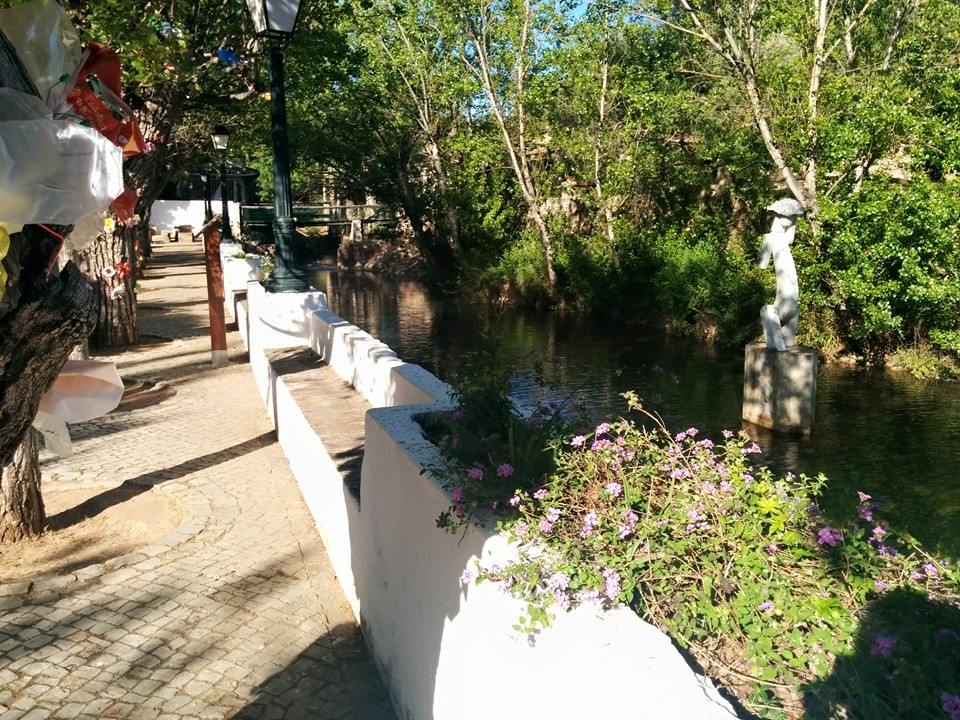
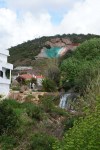
    One day I got the grand tour of the town and Kevin’s childhood playground. We walked to the pool, fed ducks in the creek, and saw the old-old church, the new-old church and pointed out every coffee place in town (there were many). There were some really cool sights too! Other than the history (“so the Romans built those walls”, “this buidling pre-dates Canada” etc.) my favourite sight was the giant Portuguese flag overlooking the entire town. Apparently during a previous World Cup (soccer…er I mean, football) some kids had scaled a nearby hill and painted a Portugese flag to cheer on their nation. This act of fan-dalism has since remained, and honestly looks pretty great!

    I thought Grimsby (pop 20,000) was a small town where everyone knows everyone, but Alte puts it to shame. Throughout the week of exploring we rarely walked down the street without stopping to chat with a neighbour, old friend, or relative because everyone knows each other. Case in point: Alte, it turns out, is so small you can accidently run into family. On one of our urban tours we stumbled upon Avo. We chatted for a bit with her friends (all in Portuguese so have no idea what was said, but assume my height and fair skin were questioned) but she was too busy for us (going dancing?) and we each continued on our separate ways.

    All in all I enjoyed seeing this small town.

    Avo Maria, The Farm, and the old House

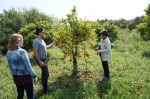
    While we spent the week with Avo Olimpia, one of our day trips included a visit to see Avo Maria and some of the family farm land. If it was nice having fruit trees in the yard for fresh juice, then visiting Avo Maria was a delight. She has fruit trees as far you can see – grapefruits, oranges, lemons, limes, whatever – just sitting there ready to be picked! I got a tour of the farm (included more Kevin stories “used to climb this tree”, “had a tire swing here”) and we loaded up on fruit, all while dodging chickens underfoot.

    The most hilarious part of this day trip was meeting Daisy. Daisy is Avo Maria’s older but still very much active dog. She followed us around for the whole tour, chasing chickens and keeping us entertained. As we got back to the house though, she surprised all of us by hunting down and catching a pigeon out of mid-air before scampering off to finish her treat!

    The Beach

    One of my favourite Algarve day trips included visiting a beach hidden from the mainroads and mostly known to locals. Here we got to walk the beach for a little while with the sand, sun, and ocean breeze all to ourselves. Kevin knows about the place because he used to visit with his grandfather and fish for clams in the summer. We got a full theatrical explanation of how he would walk in neck deep water (“it was up to here!”) trying to keep up with his grandfather while fighting the ocean (“current was trying to suck me out the whole time!”) so they could eat fresh seafood for dinner. It was a neat story which gave a beautiful pit-stop all the more meaning.

    As were leaving the beach we noticed it had rained earlier (sidenote – apparently it rained so much during my visit I’m not allowed back, bad luck) and the dirt parking lot was now filled with mud. So while Heather rolled her eyes Kevin and I hooked up the camera and drove circles through the mud having a blast! Check it out:

    Doesn’t get any better than that.

  • A Trip to the Algarve – A Culinary Experience

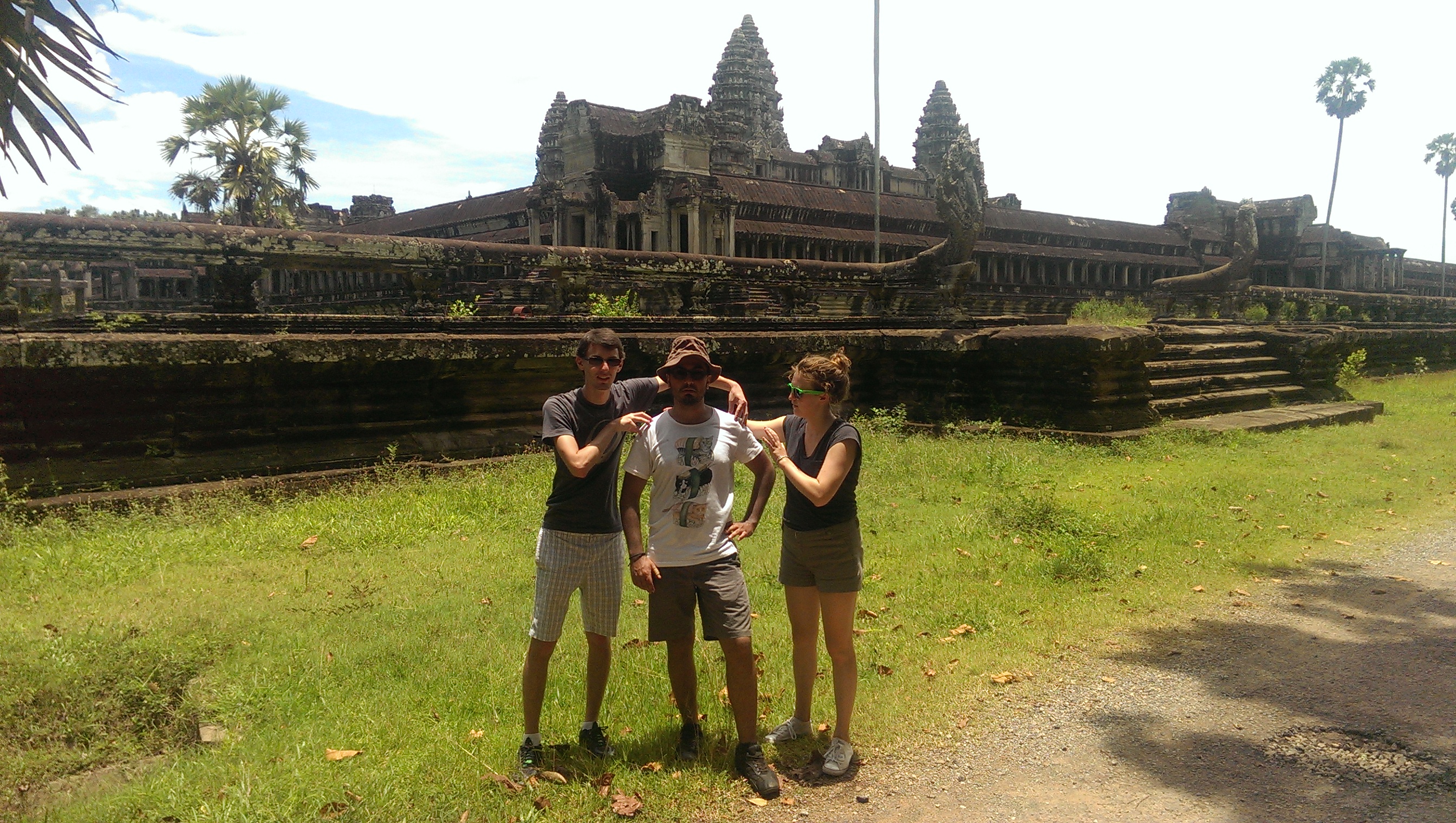
    So…hey there. I’m Tyler, one of Heather’s (decidedly larger) little brothers. Last year when Heather was on her Asian tour I stopped by for a visit in Cambodia. And here’s the thing, if you ever get the chance to vacation with Heather and Kevin, take it! A trip with these two is truly a vacation experience. They find all the most interesting people, order the best food, plan the best day trips, and before you know it you’re staging ridiculous photo-ops in front of Ancient World Wonders.

    2014-08-23 01.22.36
    Angkor Watt with these two (and KP), a world away – nice hat Kevin

    So when I got the offer to come visit in Alte, I took it! And in April, I met Heather and Kevin in Lisbon, kicking off a two week adventure of history, roadtrips, and wine.

    And what a trip. These two know road-trips. In Cambodia it involved a motorcycle ride through the dusty backroads to Angkor Watt. For Portugal it was slightly more tame but just as scenic; stops in Sintra (possibly my favourite place on Earth), Piodao (an incredible mountain town lost in time) and Marvao (where I rolled my ankle, but still got to see a medieval style castle), driving over mountains and through clouds, with Kanye West on repeat for 2 days, before finally arriving in Alte.

    While the road-trip was great (and Heather can discuss more), spending a week in the Algarve with Kevin was the most uniquely relaxing time I’ve ever had. We explored the area (which I’ll talk more about later) learning a good deal about Alte, the Algarve, Kevin’s family, and in true European fashion, we ate some great food along the way!

    2015-04-15 17.14.18

    You may recall previous concerns about picky eating, and they’re fairly justified. I’ve never really been described as “vegetable friendly” or “likes to try new food”, nope, just pizza and peanut butter please and thank you! However, travelling with Heather and Kevin involves visiting some pretty great restaurants, as they take their reviewing pretty seriously, so we worked on expanding our horizons…or waistlines. Here are some the things I picked up along the way:

    1. Portuguese take their french fries seriously

    Spending the week in the Algarve we visited a few local, family owned restaurants. All the food is freshly caught or hunted and cooked, the wines are usually local, service is friendly (helps that Kevin knows everyone). One thing stood out – the fries are delicious. These aren’t you’re frozen then deepfried run-of-the-mill fries; no, every cook here has their own recipe and technique. At one meal we even ended up in a 30 minute discussion on the finer points of potato choice, oil temperature, and crispness. Lines were drawn. Sides were chosen. Accusations were flung. We all had some more wine. Very serious indeed.

    2. Always order the special

    We travelled out to the coast one morning (afternoon) to see Henry the Navigator’s navigation school, and stopped for lunch at a nearby restaurant. The restaurant, being right across from the ocean, was of course a seafood restaurant and the special was whatever they caught that morning. I believe we had originally wanted goose barnacles (percebes), but the water had been choppy that morning so none were caught. So we made due with what was available.

    While people around us enjoyed chicken fingers and spaghetti (tourists!) we were treated to clams (in garlic & butter – awesome!), prawn stew, fresh fish (Dourada aka Sea Bream), and some wine. Everything was fantastic. The clams disappeared quickly, Kevin de-boned the fish for us, and even the prawns (despite looking gross) were delicious. We even ended up ordering dessert!

    We must have made a scene enjoying everything, enough so that eventually the owner took notice and paid us a visit. Evidently he was glad to see someone enjoying his food so much, and, when he found Kevin was from Alte, even had drink with us (his own medronho – Portuguese moonshine – cleared Heather’s migraine real quick), and let us know we were the “table of the day”! It was a pretty cool meal, and a great introduction to seafood.

    3. Crab is delicious…

    …but a lot of work. On one of our last Algarve meals we made a two-hour trek to yet another seafood place, right on the coast. It’s fairly popular among locals, so we were lucky to get in without a reservation, and it turned out to be another meal worth the adventure! We enjoyed clams again (I’m a lifetime fan now), and some shrimp (had to actually tear them apart ourselves – gross!) to start.

    For our main course, we actually got to pick which crab we wanted to eat (sort of morbid) and they served it fresh! [side note: up to this point Kevin had been telling me at every meal to use a fork & knife, not fingers, lest I embarrass him] I’d never had crab before, but got a quick run down: crack open the legs, pull out the meat, eat it quick before Kevin takes all the good parts! I was surprised at first because every other meal involved taking a lot more care, but eating crab was a messy, delicious, affair. At different points crab leg bits ended hitting Kevin in the face (he retaliated, and I got hit too), the table, the floor, a different table, and a window. Worth it.

  • Roadtripping to Lisbon

    Roadtripping to Lisbon

    There’s an efficient way of driving to Lisbon, and then there’s the Heather-and-Kevin way of driving to Lisbon.

    The drive to Lisbon takes around 3 hours. Or 6 hours. You know, whatever. Here’s the map of the route we took (you can see the direct highway on the right, going straight up to Lisbon at reasonable speeds):

    Cabo_Sardão_-_Google_Maps

    Anyways, our route included missed turns due to my inability to read maps, gorgeous cliffs, lunch, a ferry ride, and a drive across Lisbon’s answer to the Golden Gate Bridge.

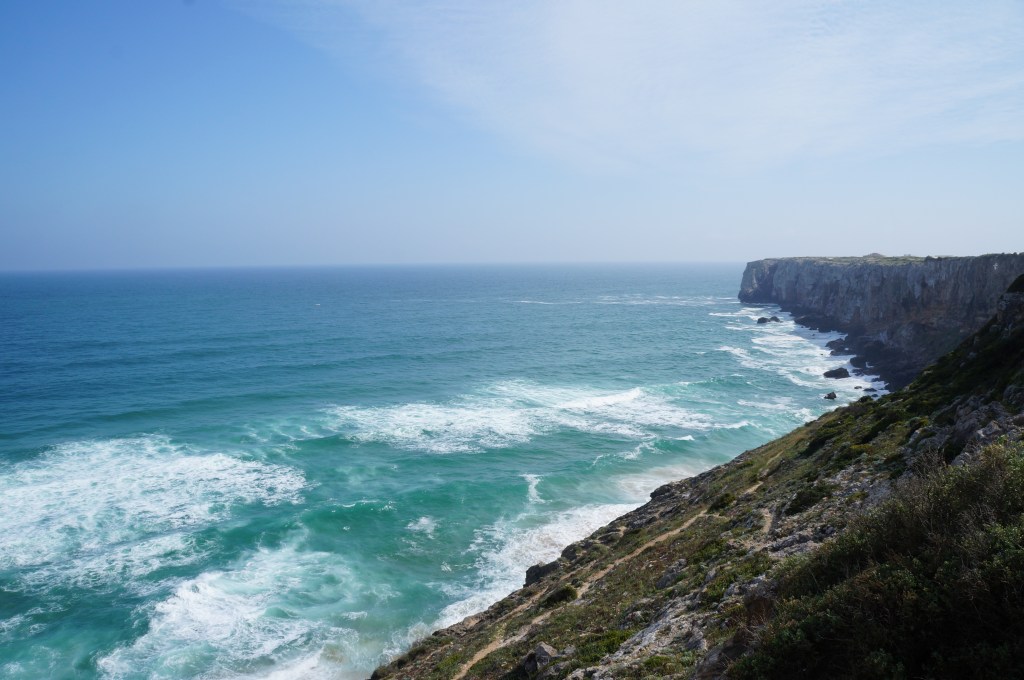
    The highlight of the trip was cliffs at Cabo Sardao, featured in our photos below. They were about a zillion times more beautiful and impressive in person, as with most natural sites caught on a cell phone camera. The cliffs were sheer, and Kevin was quite worried that I’d trip and fall over the edge. In every photo of me, he’s cautioning me to be careful, then grabbing my hand as soon as the photo is taken. Usually I’m the one who’s acting safety-crazed, so I got quite a laugh out of it all.

    Fun fact about Cabo Sardao: it was constructed 180 degrees differently than intended. The front door is supposed to face the road but instead it faces the sea. Apparently the guy in charge of construction read the papers wrong. And at a location that remote, you don’t exactly send out any random inspection crews.

    After Cabo Sardao, we drove to Sines, where I leveraged TripAdvisor to find us a true local hangout for lunch. The food (frango – bbq’d chicken) wasn’t amazing, but it was pretty darn good, at a laid back restaurant called Adega de Sines. We then took a short walk around Sines, and got back in the car. On a normal trip, we’d have been in Lisbon by now.

    Next, we drove to a ferry stop just south of Lisbon. I’d never taken a ferry with a car, and it was a pretty neat experience. Pretty darn windy, but interesting to experience being in a car-on-a-boat-crossing-a-harbour. After we left the ferry, we were just a quick drive away from Lisbon. Before long, we crossed the 25th of April Bridge, and were in Lisbon.

    We were in town for a few days, crashing at our friend Soledad’s gorgeous apartment while she was out of town. Our fun roadtrip was a sign of things to come, as we had a total blast exploring Lisbon together. Those stories are coming soon. For now, enjoy the photos from our roadtrip to Libson.
     

  • Castelo de Silves

    Castelo de Silves

    When it was a bit chilly, Kevin and I drove east to see the Palace of Estoi. A few weeks later, on one of the first truly warm days this year, Kevin and I drove west to see the Castle of Silves.

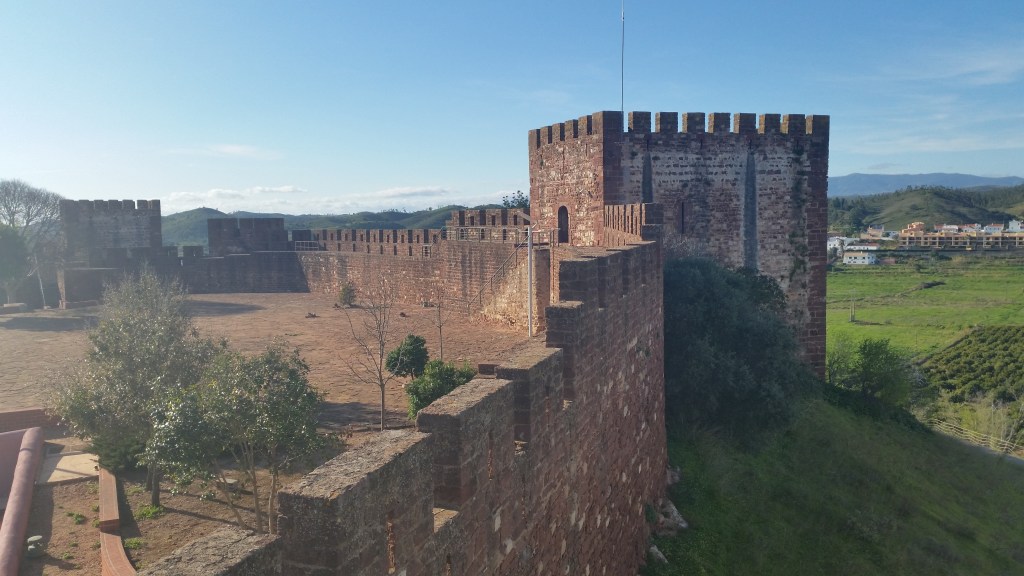
    The Castle of Silves is stunning. I’d seen it many times, lit up at night, while driving through Silves to have dinner somewhere. This day was the first time Kevin and I had been there, and we were quite impressed. The Palacio do Estoi is pretty, but the Castelo de Silves is, like, a really serious/big piece of history in this region. according to Wikipedia:

    “Built between the 8th and 13th century, the castle is one of the best preserved of the Moorish fortifications in Portugal … from archaeological excavations, it is assumed that the first fortress on this site consisted of a Lusitanian castro. It is believed that Phoenicans, Greeks and Carthaginians traversed the site at one time, but that around 201 B.C. the Romans conquered Silves, transforming it into a citadel of their occupation, and commercial center that prospered for the next five centuries.

    Around 716, the Visigothic citadel was conquered by the Umayyad Caliphate who reinforced the existing fortifications with a new series of walls. This new period resulted in a great period of development, under the Moorish occupiers, that include the extensive walls in the west. In 1160, it was sacked by Ferdinand I of León and Castile, but remained only for a short time in the hand of the Christians: it was quickly recaptured by the Moors. King Sancho I of Portugal, supported by the powerful Crusader army, conquered the city, after a prolong encirclement in 1189. But, a grande army, under orders from Amir al-Mu’minin, in 1191, retook the city. The buildings of the Taifa kingdoms of the 11th century, which includes the Palace of Balconies (where Al-Mutamid lived as the poet Ibn Amarhe) progressed in the 11th century. The walls and towers that today represent the Castle of Silves came from these campaigns and public works by Almoravides and Almohads in the 12th and 13th centuries. The castles internal water catchment, and large rain fed underground cistern were used to provide freshwater for the surrounding dwellings (to as late as the 1920s). It would only be in the 13th century, during the reign of Afonso III of Portugal, that forces under the command of D. Paio Peres Correia, would definitively take the fortress.

    So yeah, more than 2000 years ago, the site of Silves Castle was established by Moorish forces, who then passed it back and forth with Christian conquerors for 1400 years, until the Portuguese finally took hold of the whole thing.

    When you’re inside the castle walls, you can see why it was chosen as the location for a massive fortification. It sits atop a hill, and you can see everything for miles. You can’t quite see the ocean, but any invading ocean forces would be held up by and easily visible crossing a natural geographic barrier – the sierra hills south of the castle.

    Other than a cafe, there’s not much in the way of an organized presentation of information at the castle, but we had fun walking around the massive site, checking out the views from every angle and trying to interpret the map we had.

    There was one exhibit in the room that used to be for water storage. It described the Iberian Lynx, a beautiful animal on the verge of extinction, native to Spain & Portugal.

    Take a look at our photos below. It was a really beautiful day!

  • Celebrating Carnival in the Algarve

    Celebrating Carnival in the Algarve

    Carnival is a fairly historied Catholic tradition (and probably goes back even further than that, really). I’m assuming most of y’all aren’t up to date on Catholic traditions, so here’s a quick refresher course, courtesy of our friends at Wikipedia:

    Carnival (see other spellings and names) is a festive season that occurs immediately before the Christian season of Lent. The main events typically occur during February. Carnival typically involves a public celebration and/or parade combining some elements of a circus, masks and public street party. People wear masks during many such celebrations, an overturning of life’s normal things. The celebrations have long been associated with heavy alcohol consumption.

    When we came to Portugal for a 2 week holiday last year, we were here for Carnival, so though this year’s festivities weren’t a surprise, they were definitely a delight.

    In Canada, I’m used to parades being a rather straightforward affair. The first float marks the beginning, and the last float marks the end. As with most things in Canada, it’s efficient. In the fun-and-fancy-free mild Portuguese weather, parades are a bit different. Instead of a straight-line-kind-of-parade, the Carnival parade is on loop!

    One of the most traditional Carnival parades is held each year in Alte. It’s definitely more old-fashioned than the parade in the neighbouring city of Loule, and it has more of a local/hometown feel to it. The floats line up, populated by people from Alte, and they’re observed by the townspeople from Alte and surrounding areas (including me and Kevin). Most people know each other, and everyone is drinking (float people and audience alike), so things get pretty fun pretty fast. For the first hour, Kevin knew and chatted with someone from every float.

    The floats aren’t that big, so there are always crowds of people walking with them. And instead of being sponsored by or representing companies, community groups, etc, they’re simply a creative theme. Often, the players on the float act out a type of narrative as well.

    One float’s theme was 101 Dalmatians. There was a “Cruella” driving the car, and a couple of henchmen who ran around picking up puppies and putting them in a big cage (who then escaped). The Braveheart float eventually staged a battle in the middle of the street, with various players storming their castle.

    Because the parade goes on and on, the floats end up evolving; acting a kind of performance art. It’s artistic and it’s very fun.

    I found some videos online taken at this year’s Alte Carnival. I played it for Kevin and his immediate reaction was “oh man, I know so many people in this … and everyone’s drunk”.

    I don’t think I’ve ever been to such a fun parade. You can check out more vidoes here, here, and here.

    We also went to the Carnival in Loule, and you can see photos of it below. Being in a city, it’s a much larger scale parade, with much fancier floats, often mocking various EU politicians. It’s neat, but doesn’t have the same spirit at the Carnival in Alte. Have a look below to see all the snapshots we captured!

    And leave a comment below: have you ever seen a parade like this one?