Blog

  • I Went Backpacking in Patagonia!

    I Went Backpacking in Patagonia!

    Intro | Part I | Part II | Part III

    Hey all! I’ve just returned from two weeks of backpacking in Patagonia and Heather has kindly agreed to let me share my story with a few more guest-posts!

    Where did I go?

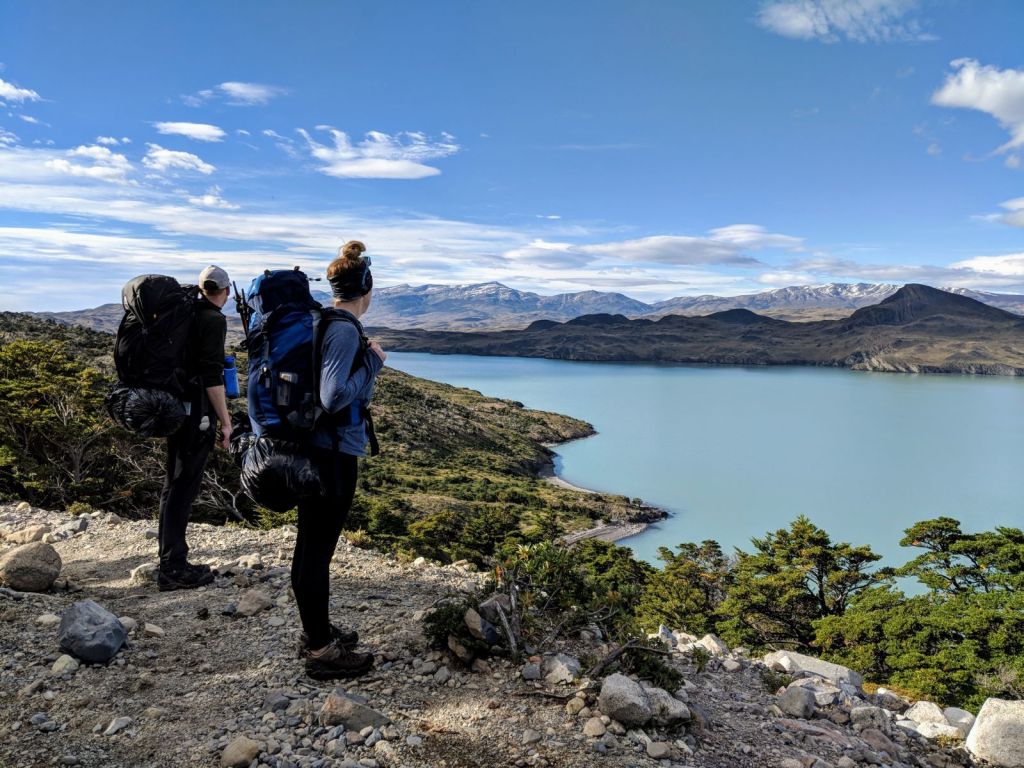
    I don’t have a history of camping or outdoor adventuring so it surely came as a surprise when I announced my intention to visit Patagonia. Truth be told, I’d been mulling some kind of South American adventure (Easter Island? Machu Picchu?) but lacked the language skills and backpacking experience to confidently commit. So when my friend Robin suggested a trip to Torres del Paine in Patagonia, it was an easy “yes”. Our friend Charlotte felt the same way, and the three of us quickly started planning.

    I only knew Patagonia as a retailer of sustainable clothing, so some research was required. For those reading along at home: Patagonia refers to a region in South America, specifically the Southern tip. It is 90% Argentinian and 10% Chilean, and is home to a number of beautiful parks, backpacking trails, and jumping off points for Antarctic tours, cruises, and expeditions.

    1024px-patagonia_rg


    Aside: The Argentinian portion of Patagonia contains Cerro Fitz Roy (pictured below, via Google) whose skyline inspires the clothing brand’s logo. It was chosen by founder Yvon Chouinard after he climbed the mountain in 1968.

    1280px-fitz_roy_chalten_argentina_todor_bozhinov_2013 cq5dam-logolg-600-300


    Further research was required for our ultimate destination, Torres del Paine National Park. Residing within Chilean Patagonia, Torres del Paine is a National Park containing over 227,000 hectares (four times the size of Toronto) of mountains, forests, glaciers, and lakes.

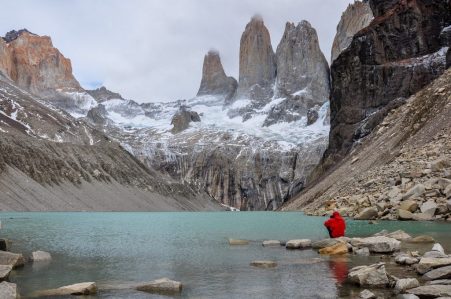
    Its namesake, the Torres (the Towers), are three distinctive mountain peaks sitting behind a small glacial lake. They’re a bit of a climb to reach (the lake sits at 1,000 meters), but if you wake up early enough the sunrise is quite beautiful. The photograph below (borrowed from Google) shows the Torres, I’ll share my own photos in a couple posts.
    foto_torres_del_paine_01-1024x680

    Torres del Paine via torresdelpaine.com

    The park is a popular destination for day-hikes, kayaking, weekend trips, and backpacking circuits (park map, pdf). The most popular hiking treks are called the “W” and “O” Circuits, named for the their respective shapes. The “W” is a West to East hike across the South side of the mountains. It’s more popular and developed, with nice lodges and stocked bars at most camp sites. The “O Circuit”, traces an O-shaped route around the park’s mountains and valleys (overlapping with the “W”). The backside (North side) of the trek has more basic amenities, as well as steep hike up and over John Gardner Pass. We opted for the “O Circuit”.

    Getting There

    When we enjoyed an “I’ve Never Camped Before” practice-trip last summer at Algonquin park, it was a logistically simple 3-hour drive. Reaching Torres del Paine takes a bit more work. While we were fortunate enough to book direct flights from Toronto to Santiago (10.5 hours), our trip still required a flight to Punta Arenas (3 hours), a bus to Puerto Natales (3 hours), and finally a bus to the park (2 hours).

    It was bit of a trek, but it came with couple of interesting side adventures and helped us get acclimated to our off-the-grid lifestyle before reaching the park.

    Up next: starting our hike!

  • Adventure with our Toronto neighbours in Mexico City!

    Adventure with our Toronto neighbours in Mexico City!

    In Toronto our neighbours, Greg and Adrienne, also happen to be old friends of ours. Greg and I attended high school together, and so we were all delighted to find out we were living in the same building, on the same floor.

    To keep the coincidences coming, a week after we booked our trip to Mexico City we realized that Greg and Adrienne were also going and that our trips would overlap!

    We didn’t plan it that way, but it worked out to be a lot of fun because went spent 2 nights partying together in Mexico City. Bonus: Greg & Adrienne both work in the Toronto restaurant industry and so we got to tag along to the trendy places that their colleagues had recommended.

    Greg and Adrienne arrived a few days after us and we met up with them for a ‘taco and mezcal crawl’ that Greg had planned. It was a Sunday night so many places were closed. It was also the first time that we realized there was a major discrepancy between the posted business hours on Google Maps vs reality.

    On the day before they left we had lunch in the same restaurant (Pujol, more on that later), though not together. Before leaving we made plans to meet up for dinner and more drinking. The evening ended in a local fast food joint at 4am, so I’d say it was a successful night on the town.

    So, where did we go? I honestly couldn’t tell you from memory because Greg directed us to each place and I rarely knew what anything was called. But Google is a handy thing, so I’ve put together a list (and photos are included below):

    Sunday night taco & mezcal crawl

    • El Huequito: the first stop on our taco crawl, this place showed what was really possible with under-highway space, as the restaurant was located on a large sidewalk under a highway underpass. Great tacos, great service, great mezcal.
    • Taqueria Los Parados: This was a quick little counter service taco place. Delicious tacos made on the grill in front of you.
    • Paramos: This place was très trendy and almost felt like being in Toronto, and wow the mezcal margaritas were great. When we arrived we headed upstairs to get a table but the wait was over an hour. So we drank margaritas while sitting on couches in their lobby and waited! Once seated at our table, the service was rather slow but again those margaritas balanced it all out. The food was good and the ambiance was cool. It’ worth noting that by this point in the night I was full and could no longer eat much anyways. The highlight was, again, the mezcal margaritas, which were the best I had all week.
    • The next 2 places on our list ended up closing early, so we called it a night and headed home to bed.

    Wednesday night rager:

    • Comedor Jacinta: I’m not sure why we went for dinner because we were all so full from lunch anyways. But Comedor Jacinta had good service and good mezcal margaritas. Food was hit or miss. We ordered some kind of shrimp ceviche that wasn’t good, but some of the smaller guacamole & chips type dishes were great. The service was good though, and they kept the drinks coming. After a few rounds we’d gotten to some personal truths about each other and were ready to move to the next place.
    • Le Tachinomi Desu: This place was very trendy and cool, which normally means there’s a catch, but in this case there wasn’t. The wine and sake selections were unreal, and the service was great. It was the coolest place we went all week and we had a great time. It was the perfect spot for simply standing, drinking, and enjoying each other’s company. We were here until nearly 4 in the morning and we weren’t even the last people to leave. The place is run by a Japanese Mexican man and this place imports some really interesting sakes and wines. At one point they suggested we try a bottle so rare that there were less than 10 in the country. Sounds obnoxious, but it was worth the hype. Again, unreal. After being so full (from lunch still!) that I could hardly walk, it turns out that drinking sake until 4am was the cure. We also met some pretty interested characters to round out the night.
    • La Casa de Toño, Zona Rosa: This is a local chain that’s open late and basically serves whatever you could want to eat, but fried. This late at night they’d stopped serving beer, which was probably for the best or we’d have been there for hours. As it was, we ordered, ate, and went home to bed.

    It’s always fun to see familiar faces in a foreign city, and this was no different. Our trip to Mexico City was incredible throughout, but spending a couple of nights with Greg and Adrienne made it even better.

  • Airbnb Experience: Dive into real Mexico

    Airbnb Experience: Dive into real Mexico

    Our second Airbnb experience on this trip was called “Dive into real Mexico” and the name is a perfect descriptor. It was a full day experience – just over 10 hours long.

    We met our host Daniel in the morning and he drove us 2 hours away to the state where his family originates, Tlaxcala. After exploring the state capital, also called Tlaxcala, we drove to Daniel’s hometown, Texoloc, to cook in his grandfather’s traditional kitchen (seriously, it was over 100 years old!).

    That sounds short and sweet, but this trip was a long day, jam packed with food, activities, and knowledge. Obviously, we loved it.

    We haven’t blogged much about it yet, but throughout our trip we learned a lot about Mexico’s history and culture, particular the pre-European cultures and traditions throughout the region. Our adventure with Daniel, our last full day in Mexico, was the perfect way to wrap this up, as Tlaxcala and the Tlaxcalan people have a very rich history. You can read more about it here, but the summary from Daniel is essentially this: Tlaxcala has existed for thousands of years, and they were proudly distinct from the Mexica people who were otherwise dominating much of the surrounding area (and who also founded Mexico City’s precursor, Tenochtitlan). When the Spanish colonizers arrived they formed strategic alliances with non-Mexica groups, the first of which was their alliance with Tlaxcala. Tlaxcala people traveled to Madrid to sign this agreement, and they eventually travelled with Spanish colonizers to the Philippines. Even today some traditional Tlaxcala words are spoken in the Philippines, and Tlaxcala descendants still live in the Philippines.

    Aside from learning, we also ate A LOT. We started our day in a Mexico City market, eating tamales for breakfast. Then we drove to Tlaxcala where we ate our way through market stalls and wandered around admiring the variety of foods and goods available.

    We took a trip through an artisanal market on our way to drink pulque (a pre-hispanic drink known as the nectar of the gods – more on this later). Next we visited the church in Tlaxcala, which is one of the oldest Spanish churches in the Americas. We also visited the city’s bullfighting arena.

    And then, after all that, it was time to make dinner!

    We went to Daniel’s grandfather’s house where we met his parents and learned how to cook using traditional pre-hispanic tools and techniques. Daniel’s delightful mother lead us through the entire process of making tlacoyos from scratch – including the dough! We even made homemade tortillas!

    After all that, we ate again. We then explored Daniel’s grandfather’s farm and took a quick walk through the town of Texeloc (fun fact: everyone in the world with the last name Tecpa can trace their roots back to this very town!).

    We took many, many photos, all of which you can see below (with explanatory notes added in for context). If you ever have a free day to spend in Mexico, and if you love food and history, then you definitely should sign up for Daniel’s “dive into real Mexico“! It’s truly one of the most interesting things I’ve ever done while travelling.

    Here’s a video of Kevin and I making tlacoyos, and below that are our photos from the day!


  • Our home away from home in the Condesa Aurora Sunroom!

    Our home away from home in the Condesa Aurora Sunroom!

    Kevin was in charge of finding our Airbnb and I’m sure he looked at hundreds of listings to narrow down his options. Ever the skilled researcher, Kevin found us what I can honestly describe as the world’s best Airbnb host, Leonor.

    We had initially planned to reserve one of her full apartments, but we took too long to book and thus missed out. I was ready to find someone else, but Kevin insisted that Leonor was so amazing that it would be worthwhile to stay in a room within one of her apartments.

    He was absolutely correct. And bonus: the room that we booked did essentially feel like a private apartment, with private access to our own kitchen and bathroom.

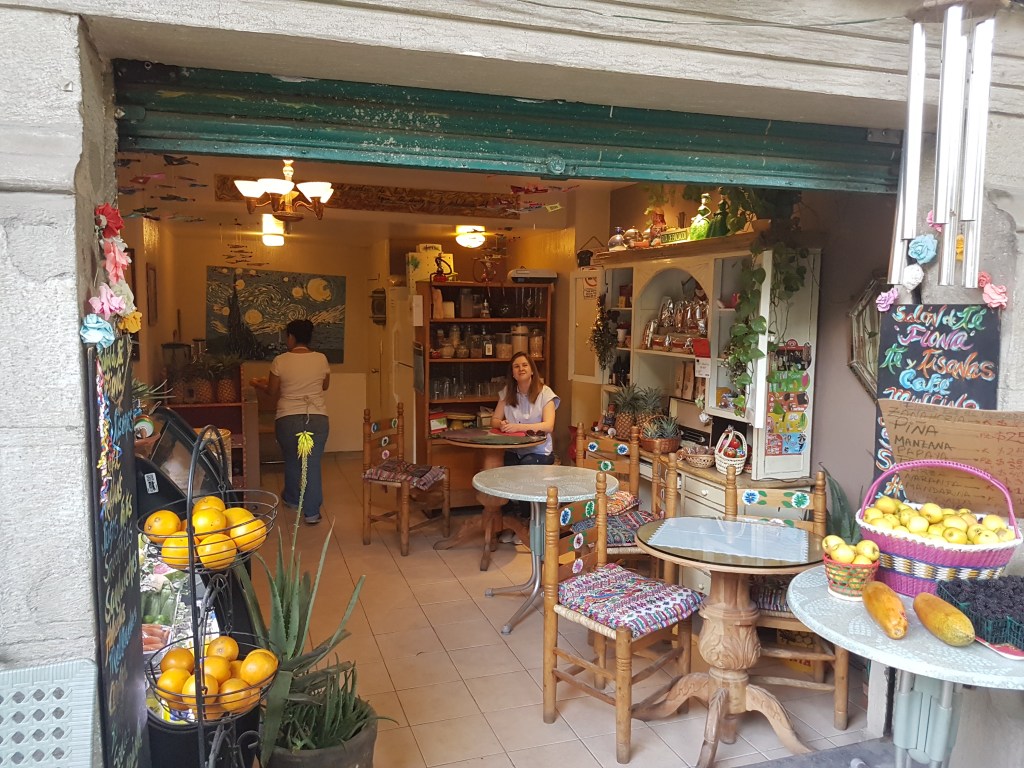
    Because we stayed with Leonor we got free pick up at the airport which made for a delightfully stress-free start to our trip. Leonor also runs a cafe around the corner where we ate complimentary continental breakfast everyday.

    The cafe is called “Cafe Fiona”, named after her dog Fiona, who carries her own purse down to the cafe each morning and then spends her time greeting patrons.

    Overall, staying at Leonor’s place was wonderful. She was a great resource to access, whether checking in on us post-earthquake, letting us borrow hats to visit Teotihuacan, or offering us restaurant recommendations. The next time we visit Mexico City, I can guarantee that we’ll be staying at one of Leonor’s apartments. If you’re looking for a well-priced gem in La Condesa neighbourhood, I highly recommend the Condesa Aurora Sun Room!


  • Airbnb Experience: “Discover street food with a local”

    Airbnb Experience: “Discover street food with a local”

    When Kevin and I went to Amsterdam we kicked off our trip with a food tour, which was both a unique culinary experience and a great walking tour with a local guide. We were introduced to the food tour via Booking.com but since we didn’t use them for our trip this time around we decided to try a new source of fun: Airbnb “experiences”.

    We participated in 2 different experiences during our trip, and the first was called “discover street food with a local“. We did this on Tuesday, and it was one of the highlights of our trip!

    We started off in the morning outside of El Templo Mayor where we met our guide, Pili. She gave us a brief history of the temple and market square and church nearby. From there, we hopped on the subway and went to explore a local market. This particular market served as a distribution hub for fresh flowers, so it was quite beautiful.

    Near the market was a type of food court, and we went there to learn how to cook a traditional Mexican dish, huaraches. They’re typically quite large but since we were novices, we made smaller huaraches – a corn flower dough, with a bean paste in the middle. The technique was kind of like making a perogie: flatten a small ball of dough, add in the filling, then pull the tough tight around it and pinch it sealed. However, then you also flatten out the dough and fry it.

    Huaraches are served with a pile of toppings, and we also made those! Toppings included tomatillo salsa, cactus, and huitlacoche. This was pretty exciting because huitlacoche is a delicacy that originated in Aztec cuisine and is unlike anything we’d ever eat in Canada.

    The English term for huitlacoche is “corn smut”. Huitlacoche is a type of corn fungus, which is why it’s rarely found north of Mexico. As we expected, it’s delicious!

    After we ate our huaraches, Pili and our chef host, Evelyn, made us quesadillas as well. From there we need an energy boost, so Pili took us back to city centre to visit a market famed for its traditional coffee. I had a chocolate drink that was incredible and Kevin enjoyed an espresso.

    To wrap up the day we visited a stall that sells insects as cuisine! The other couple in our group (shout out to Landon and Jerusalem!) were brave enough to try, but I was too full/afraid.

    The whole “experience” lasted approximately 4 hours and was jam-packed with learning and fun. Pili was a great host and she showed us a great time. She was fun and friendly, very knowledgeable, and open to answering any questions we had. Spending the day with her was like hanging out with a friend, and I would absolutely recommend her tours to anyone.

    If you’re looking for a great half-day experience in Mexico City then I definitely recommend you take her tour!

    See below for the many photos of our adventure with Pili!


  • El Bazaar Sábado

    El Bazaar Sábado

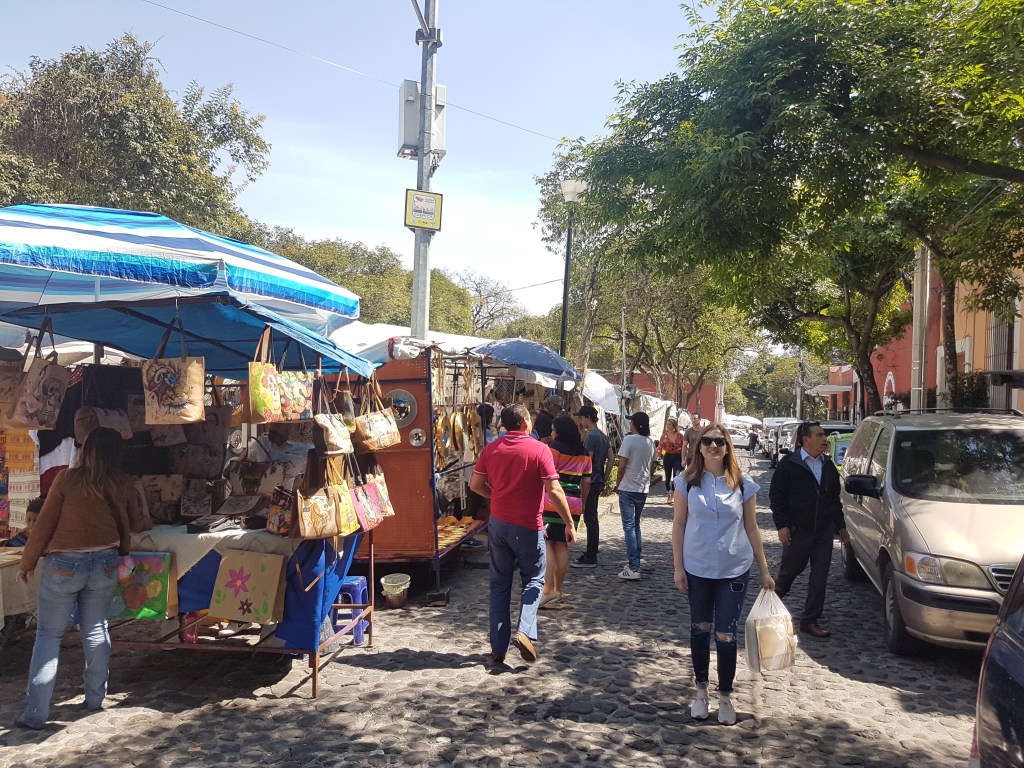
    Our first full day in Mexico City fell on a Saturday. Our Airbnb host recommended that we take this opportunity to visit “El Bazaar Sábado” (aka the Saturday Bazaar) as it’s a unique event that only happens once per week. And so on Saturday morning we took an Uber south into the historic neighbourhood of San Angel.

    The bazaar has 2 parts: a variety of kiosk stalls in a market, and a wide variety of artists exhibiting their work in the park.

    We started in the stalls of the market and were quickly impressed with the range and quality of the goods available. From there we wandered over to the park to start shopping for art! Again, we were quite impressed.

    Kevin and I spend a lot of time visiting artisan markets in Toronto, and we were amazed (again) by the range and quality of the work available. We had heard that Mexico City had a great arts scene, and this was certainly the first of many days/events that proved it to be true. We ended up buying a bunch of art and souvenirs, though the best part of the day was simply walking around in the sun.

    After the market, we walked to the San Angel Inn to try some of their famous margaritas. They were worth the hype, and while the rest of the food/service were just okay, overall the San Angel Inn kept us entertained as we watched upper middle class people wandering in and putting on their airs.

    After lunch we visited Museo Casa Estudio Diego Rivera y Frida Kahlo, the home where the famous Mexican artists Frida Kahlo and Diego River lived together. There’s more to come on that one later. For now, check out the below photos of our adventures in San Angel!

  • We made it to Mexico City! (Just in time for an earthquake)

    We made it to Mexico City! (Just in time for an earthquake)

    For the next week we are in Mexico City, the capital of Mexico and the most populous city in the Americas (fighting neck and neck with Sao Paulo for the top listing). We arrived yesterday, and so far we are having a great time!

    Of course, if you’ve been reading the news you also know that Mexico City suffered from an earthquake earlier yesterday afternoon. You can get all the details here but essentially there was a 7.2 magnitude earthquake off the southern coast of Mexico, which was felt across a wide area of the country, including Mexico City.

    It was a significant event as the city is still suffering the physical and emotional after-effects of a deadly and destructive earthquake in September 2017.

    Our flight arrived around 2pm and we were picked up at the airport by a driver, all arranged by our AirBnB host. We are currently staying at the world’s greatest AirBnB and our host, Leonore, is wonderful. She arranged for us to be picked up at the airport and then met us at our apartment. In fact, 10 minutes ago she dropped in to make sure we were okay following the earthquake (her cat and dog dropped in too! Photos to come later).

    So, we arrived at our apartment for the week, chatted with Leonore about different sites to see, and then headed off in search of tacos.

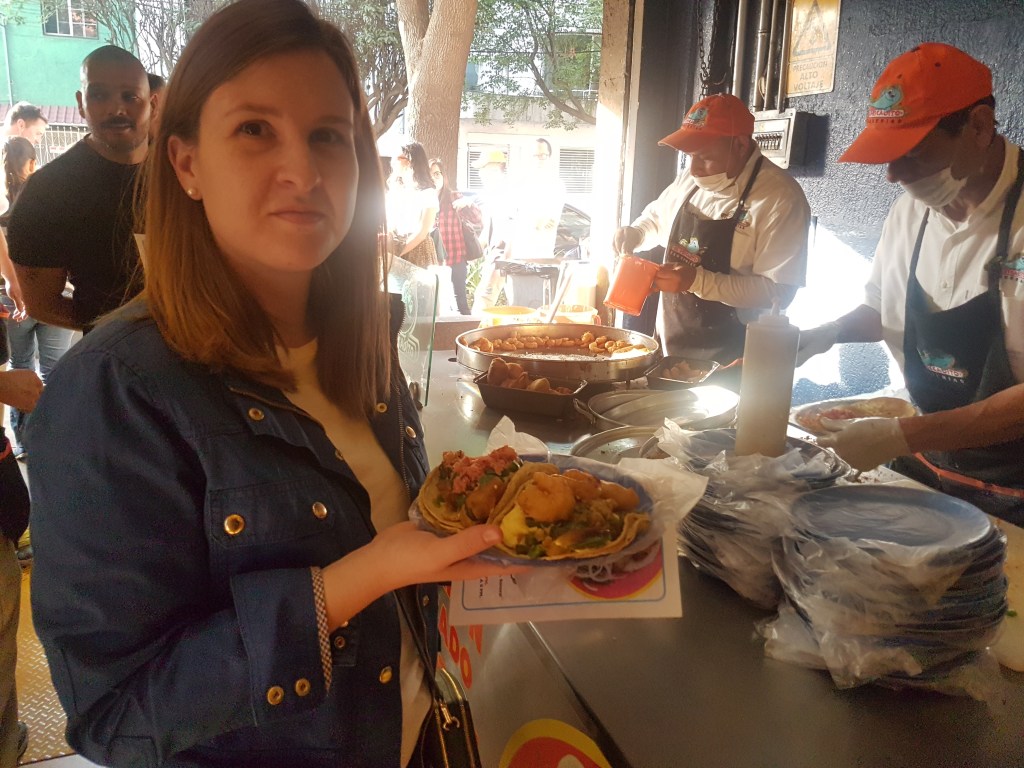
    We walked to a nearby taqueria, El Pescadito Condesa (highly recommend!). We loaded up our plates with delicious shrimp and fish tacos and settled in to watch the street life while we enjoyed tacos and beers.

    Around 20 minutes into eating, everyone sitting near the windows jumped up and ran outside into the streets. Kevin and I hesitated for a few seconds until the restaurant manager gave a stern look and directions to get moving. And so we stood in the street in a crowd of distressed people and we felt the earth moving under our feet.

    As it turns out, Mexico has an early warning system for earthquakes, the Mexican Seismic Alert System. It was this system that started the flood of people into the streets. And sure enough, as we joined the crowd we could hear the alert system and a few seconds later we felt the earthquake.

    I’ve lived most of my life in Ontario, where there are few earthquakes and fewer reasons for people to worry about emergency preparedness. So when I felt the earthquake today I was definitely taken aback. It was unlike anything I’d previously experienced (obviously Kevin has experienced earthquakes in both Canada and Portugal, so I guess I’m behind the times). I am 100% okay, but it was pretty scary. Despite their well-founded distress and fear, the people of Mexico City proceeded with a calm and orderliness that was quite impressive. I have a lot to learn on this front.

    That said, the event completely changed the tone of the city and the people around us. For the rest of the day we could tell that everyone was on their phones trying to get in touch with loved ones and confirm they were okay. The sombre emotions and stress were palpable as we walked around exploring the city for the next 3 hours. It should be interesting to see how this manifests throughout the rest of our trip.

    Photos below from our first few hours in Mexico City!

  • Day 7 in Amsterdam – Wind Mills & Walking!

    Day 7 in Amsterdam – Wind Mills & Walking!

    When we first arrived in Amsterdam we’d planned to rent bikes and spend a day biking into the countryside to see windmills. Unfortunately, it was a lot colder and rainier than anticipated so that plan didn’t work out.

    However, there is one windmill on the East side of the city, not far from the Maritime Museum. And bonus: it’s attached to a local brewery!

    After spending 3 hours in the Maritime Museum, we were ready for some more drinking and eating, so we walked down to see the De Gooyer windmill at Brouwerij ‘t IJ (the IJ Brewery).

    The De Gooyer windmill is not opened to the public so you can’t go inside, but you can certainly look at it. It is the tallest wooden mill in the Netherlands and has a fairly serious history:

    The original mill was constructed in the 16th century. After destruction and some movements, in 1725 the mill stood on the site of the current Orange-Nassau barracks. Finally, in 1814 the mill moved again to its current location on Funenkade atop the stone base of a watermill that had been demolished in 1812.

    This mill is the last 26 corn mills on the bastions of the 17th century walls of Amsterdam. The location of the mills was at that time very favourable as the outskirts of town provided ample wind.

    After the mill had fallen into disrepair, it was purchased in 1928 by the city of Amsterdam for 3200 guilders and restored. Due to the lack of power during the Second World War the mill served as a corn mill for Amsterdam.

    In the building beside the windmill is a brewery with a large outdoor seating area. They serve a variety of beer, along with some traditional Dutch snacks. We ordered some snacks and a flight of beers, then spent a couple of hours relaxing in the sun beside a real windmill.

    After our afternoon snack we went on another long walk, eventually ending up at dinner. This was another Esther recommendation, but it wasn’t as successful as her previous recommendation. The restaurant Greetje fancies itself as a places that serves “elevated Dutch food”. The restaurant was lovely and the service was great, but the food just wasn’t that good. It was served in such a way that suggested they thought it was high-end, but the flavours just didn’t compute. Or perhaps my tastebuds aren’t sophisticated enough!

    In any case, our last day in Amsterdam included a couple of lacklustre experiences, but nothing can dampen your spirits when you’re never more than 5 minutes away from breathtaking canal views. We ended our night with a long and lovely walk home, with a pit stop for a few drinks.

    Overall, it was a really great trip. We had a lot of fun, learned a ton, and actually made time to relax quite a bit. Our nightlife was decidedly more low key than it was on our trip to Madrid, which meant we had plenty of time to sleep. We don’t usually make time to rest and restore when we go on trips, so this was a nice change of pace. We’re recommending Amsterdam to all our friends and family because it’s so lovely and so easy to manage. I’m sure we’ll be back again one day!

  • Day 7 in Amsterdam – Visiting Nederlands Scheepvaartmuseum

    Day 7 in Amsterdam – Visiting Nederlands Scheepvaartmuseum

    Up front disclosure: this was the worst museum we visited in Amsterdam. And according to Wikipedia, it’s famously bad:

    In 2013, there was a deadly shooting incident during the “Waterfront” festivity at the museum.[8] For the next three months, the museum was not allowed to rent out its space. After 2013, the number of visitors started to decline and director Willem Bijleveld, who had supervised the renovation of 2011, departed after a tenure of 18 years. The museum was criticised for having become too commercial for a cultural institution and having been turned into an amusement park.[9] The “Raad van Cultuur” – a government board that monitors cultural activity in the Netherlands and advises the government on subsidies for museums – judged that the Scheepvaartmuseum had focused too much on entertainment and not enough on its task as a museum.[10]

    The building is cool, and there’s lots to look at, but the educational component is questionable at best.

    When we visited the naval museum in Madrid, I found it had too much information. The Dutch National Maritime Museum, or Nederlands Scheepvaartmuseum, had the exact opposite problem. It feels more like a light entertainment centre for kids.

    We started our day out with a long walk through the city, so we headed right for lunch at the museum. The in-house restaurant was great, and we had a delightful lunch.

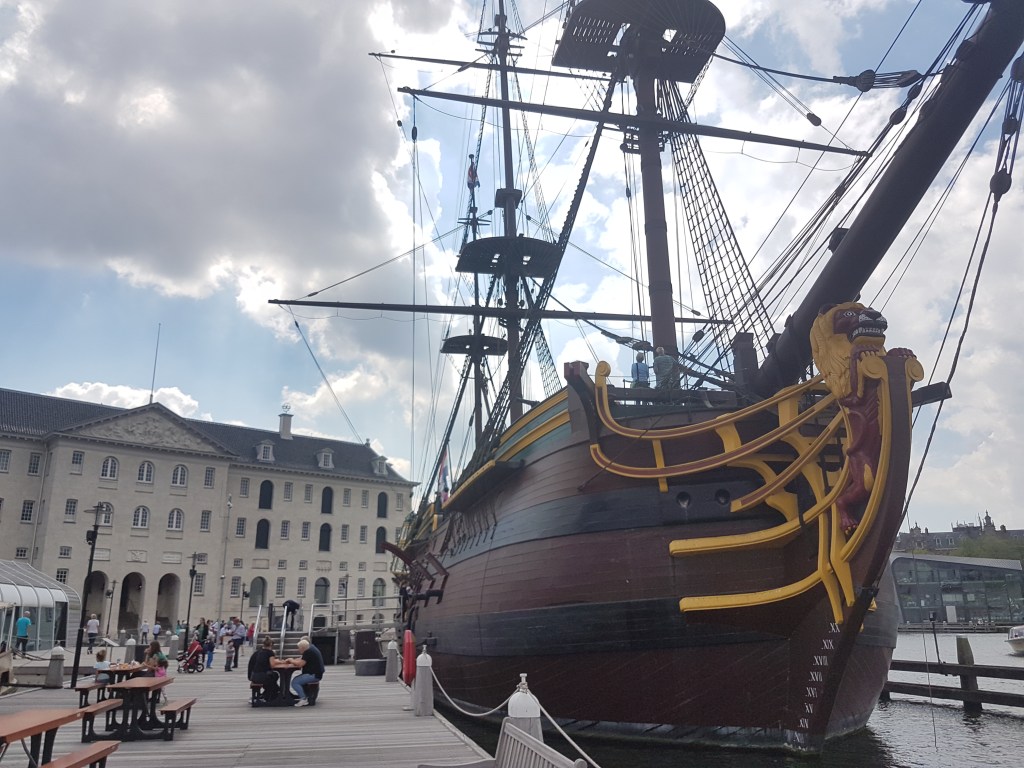
    We then headed outside to the boat element of the museum’s ‘collection’. It was interesting but not that educational and, oh my god, there were kids everywhere!

    Our favourite exhibit was all about Dutch shipping and ports. As a major shipping centre, the Netherlands have some serious port facilities and enormous-sized ships. We were able to take a virtual tour of a ship and journey along the shipping route that goes through Amsterdam. We also saw some cool exhibits about maps and navigational instruments. You can learn more about the range of exhibits here. For me, the range of interesting to boring was too wide. Visiting a museum requires a certain mindset, and if that gets thrown off, it can be hard to switch back into ‘learning’ mode.

    Overall, we didn’t learn much, but we did take a lot of photos! Check ’em out!

    (Note, if it seems like this post is out of order, that’s because it is. I forgot to click ‘publish’ months ago!)


  • Day 6 in Amsterdam – Visiting the Hermitage Amsterdam

    Day 6 in Amsterdam – Visiting the Hermitage Amsterdam

    As you may have noted by now, we went to a lot of museums while we were in Amsterdam. Most of them were excellent – some of the best we’d ever visited.

    But not all met that standard. Enter: the Hermitage Amsterdam.

    The Hermitage Amsterdam is the sister museum of the famous Hermitage Museum in St Petersburg, Russia. The State Hermitage Museum was started in the late 1700s by Catharine the Great, and currently has one of the largest and most valuable art collections in the world. It spans across several buildings, including the Winter Palace where the Russian royal family once lived. It’s a bucket-list kind of museum for most museum nerds, which is why I was excited to visit the Hermitage Amsterdam.

    Since 2009 the Hermitage Amsterdam has been the Hermitage’s largest satellite location, in keeping with the museum’s mandate to increase the global reach of their impressive collection.

    Given the nature of their collection, and the difficulties of transporting art, I suspect that there is a wide range in quality of exhibits at the Hermitage Amsterdam. We visited in August, but beginning in October until May 2018 they’re hosting an exhibit called “Dutch Masters”. Prior to that, their last major exhibit ended in January 2017.

    The main exhibit on during our visit was about the Russian Revolution… while it was quite educational, it was light on art and on artifacts in general. The big disappointment was the ratio of fabrege egg information to fabrege eggs themselves… felt like a million to zero. But we did learn a lot about the Russian Revolution, which was interesting because this year marked the 100 year anniversary of its beginning.

    Still, for the price we paid to get in, we did not at all feel that it was worth it. However, for a different exhibit, I can imagine feeling differently. This may be one worth visiting, but do your research first.

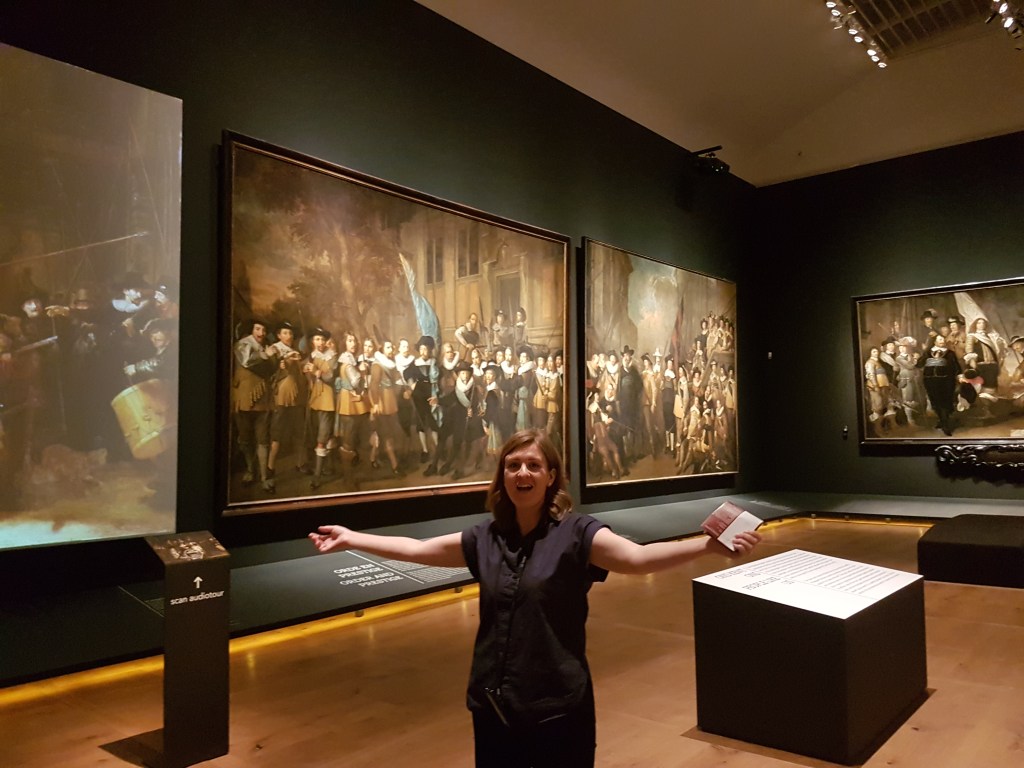
    The one exhibit that we did quite enjoy was the “Portrait Gallery of the Golden Age”, which was entirely comprised of large scale photos of Dutch guild members and other merchants. Otherwise, we weren’t impressed, but we’ll have our eye on this place for future visits.

    Check out our photos below!