Tag: adventure travel

  • Road Trip Days 2 & 3: Visiting Marvao

    Road Trip Days 2 & 3: Visiting Marvao

    Ok, so the last few posts have detailed some fairly magical sights. But to be honest, there’s more to come here. This trip was pretty surreal, and we saw many memorable places.

    The driving on the trip may also have been a bit much, but in this case it turned out to be worth it. After driving 2.5 hours to Piodao, we spent a couple of hours exploring this small yet remarkable village. And then we got back in the truck and Kevin drove us another 3 hours to Marvao, a city on a hill right on the border of Portugal and Spain. About an hour into this trip, I was really questioning this decision, but when we drove up to this walled-city on a foggy night, all doubts were forgotten.

    Here’s what you need to know about Marvao (courtesy of Wikipedia):

    Commanding spectacular views across the Tagus basin (the same river to connects Lisbon to the Atlantic) and Serra de Estrela (highest point in Portugal) to the north, the fortified rock of Marvão has been a site of significant strategic importance since the earliest human settlements. Today lying on the ‘raia’ that divides Portugal and Spain, Marvão has consistently stood on a frontier zone between peoples: Celtici, Vettones and Lusitani (4th-2nd century BCE); Lusitanians and the Romans ofHispania Ulterior (2nd-1st century BCE); migratory Suevi, Alans, Vandals and Visigoths (5th-7th century CE); conquering moors and Visigoths (8th century); muwallad rebels and the Cordoban emirate (9th-10th century); Portuguese nation-builders and Moors (12th-13th century); Templars and Hospitallers (12th-14th century); Portuguese and Castilians (12th century-present day); Liberals and Absolutists (19th century); the fascist regimes of Salazar and Franco (20th century).

    Marvão’s natural assets have contributed to the ‘uniqueness’ of this remote village as perceived by visitors today: (i) as nigh-impregnable ‘eagle’s nest’ fortress – perched high on a granite crag, and bordered on the south and west by the Sever river; (ii) as vital lookout-point towards the Alcántara Bridge (70 km (43 mi) away), a wide stretch of the Tagus basin and the Serra de Estrela; (iii) as a gateway to Portugal from Spain via the Porta da Espada (‘Sword Gate’) mountain pass of the Serra de São Mamede. These assets have ensured its status as the ‘Mui Nobre e Sempre Leal Vila de Marvão’ (Very Noble and Ever-Loyal Town) into the present day.

    As with other 11th-13th-century castles, the early medieval improvements and development of Marvão castle reflect the innovations brought back by crusading orders from the near east (notably the highly influential Hospitaller castle in Syria, the Krak des Chevaliers). The medieval castle seen in Marvão today mostly post-dates the year 1299, and features numerous characteristic features of a crusader-era castle: a tall central keep with raised entrance on the first floor; a series of lower, outlying turrets (some semi-circular); high-placed arrow-slits; open spaces to aid the sheltering and assembly of villagers and troops; a well, and huge rain-collecting cistern to supply water to both keep and the wider castle in the event of siege; bent entrances (both on the village and castle gates) to slow down invaders in the event of breached gates; a series of narrow killing zones (notably, in the triple gate on the village-side of the castle); extensive crenellated battlements and curtain walls that enhanced the natural defences provided by the escarpments of Marvão’s rock.[22]

    That’s only a smattering of interesting information about Marvao, as this place is filled with historical significance. When we arrived at night fog filled the town, we had to park the truck just outside of the gates in order to walk to our hotel (we stayed and ate at the the Casa do Alentejo, where we were welcomed with the traditional and impressive Alentejo hospitality). With the characteristic preservation of the buildings’ historical style, it felt like we were walking back in time. After a lengthy dinner, we got some sleep, then woke up early for breakfast and further touring. We explored all through the town and the castle, and were constantly in awe of the view and the spirit of the region. Similar to Sintra, looking across the hills you could easily imagine what it was like to look across that view 1000 years ago. A very cool feeling that won’t soon be forgotten.

    Check out our photos below!

  • Roadtrip Day 1: A Moorish Castle and Palace of Pena

    Roadtrip Day 1: A Moorish Castle and Palace of Pena

    We typically take our sweet, sweet time when doing anything, but because we were on a road trip, we had certain goals for where to be and when to be there by. We were also exploring unfamiliar territory, and perhaps underestimated how much time we’d want to spend in certain places.

    That said, everything that we saw on the first day of our Road trip was within the magical area known as Sintra, where castles and natural beauty abound. There are tons and tons of incredible sites to see in Sintra, but we oriented our trip to the advice of our friend Soledad, and selected those she described as ‘must-see’ items.

    We visited 2 different castles on that day, and they couldn’t have been more different: The Moorish Castle, and Palace of Pena.

    Let’s start with the Moorish Castle.

    The Moorish Castle was the decidedly more ruin-y of the two. It is a military fort built around the 10th century by the Muslim populations that occupied the Iberian peninsula. It acted as a control tower for the Atlantic coast and land to the north, serving as an outpost for the city of Lisbon.

    For a building that’s more than 1000 years old, it was in pretty decent shape. All of the exterior castle walls remain, and we were able to walk up, down, all around, and catch amazing views throughout. From the top of the castle walls, you can see all that’s built up in the Park in the centuries since: a town, castles, mansions, etc. And yet, you can imagine how it felt 1000 years ago to look out and see no evidence of other people. Placed atop a large hill, this place is definitely an impressive and well planned military location.

    And not *just* military either. After the large castle walls had been built, people began to settle just outside of them. A “second circle of walls” was later built to protect these settlements.

    If you’re interested in the nitty gritty history timeline for the Castle of the Moors, check out Wikipedia.

    After the Castle of the Moors, we headed to the Palace of Pena.

    While it was cool, the Palace of Pena (Palacio da Pena) is one road trip stop we could’ve done without. We crammed a lot of sites into this road trip. That’s not usually our style, but we went a bit overboard with expectations for what we wanted to see. In its defense, it’s part of a large garden complex, but we only saw the castle itself, because it was raining and we were rushing to see another place afterwards (more on that later this week!). By rushing to see the Palacio, we cost ourself some appreciation of its history. The routinely under-informational museum pamphlet also didn’t give us the full story of site.

    Here’s what Wikipedia has to say:

    The palace’s history started in the Middle Ages when a chapel dedicated to Our Lady of Pena was built on the top of the hill above Sintra. According to tradition, construction occurred after an apparition of the Virgin Mary.

    In 1493, King John II, accompanied by his wife Queen Leonor, made a pilgrimage to the site to fulfill a vow. His successor, King Manuel I, was also very fond of this sanctuary, and ordered the construction of a monastery on this site which was donated to the Order of Saint Jerome. For centuries Pena was a small, quiet place for meditation, housing a maximum of eighteen monks.

    In the 18th century the monastery was severely damaged by lightning. However, it was the Great Lisbon Earthquake of 1755, occurring shortly afterwards, that took the heaviest toll on the monastery, reducing it to ruins. Nonetheless, the chapel escaped without significant damage.

    For many decades the ruins remained untouched, but they still astonished young prince Ferdinand. In 1838, as King consort Ferdinand II, he decided to acquire the old monastery, all of the surrounding lands, the nearby Castle of the Moors and a few other estates in the area. King Ferdinand then set out to transform the remains of the monastery into a palace that would serve as a summer residence for the Portuguese royal family. The commission for the Romantic style rebuilding was given to Lieutenant-General and mining engineer Baron Wilhelm Ludwig von Eschwege. Eschwege, a German amateur architect, was much traveled and likely had knowledge of several castles along the Rhine river. The construction took place between 1842–1854, although it was almost completed in 1847: King Ferdinand and Queen Maria II intervened decisively on matters of decoration and symbolism. Among others, the King suggested vaul tarches, Medieval and Islamic elements be included, and he also designed an ornate window for the main façade (inspired by the chapter house window of the Convent of the Order of Christ in Tomar).

    Having done my Wikipedia research, it’s clear that this place’s history actually fits well with many of the other sites that we saw in Sintra and in Tomar. That information was definitely not in the pamphlet we received upon entering, but either way we had a fun time. It’s by far the most colourful castle I’ve ever seen, which gives it an almost-comical appearance.

    All this site-seeing constituted just part of our day. Enjoy the photos below, there’s more to come from our final (and favourite!) stop coming soon.


  • We converted, and now we’re obsessed.

    We converted, and now we’re obsessed.

    Back when e-readers came out, I worked at Chapters. I thought the Kobo was a cool concept but, like many people, I love buying, holding, having books. It had been suggested that I buy an e-reader, but I’d always declined. In my mind, nothing can beat a real book, in my hand, and then on my bookshelf to be perused and re-read in the future.

    When we moved to Phnom Penh, this became something of a problem. I couldn’t take books with me to Phnom Penh, but I felt silly buying books there because I couldn’t take them with me when I left either. I had lots of time to relax, so I did buy a handful of books, but the selection was terribly limited. In one case, I actually bought a book that I knew was sitting unread in my parents’ garage.

    And that’s when I realized: e-readers are perfect for travelling or living abroad.

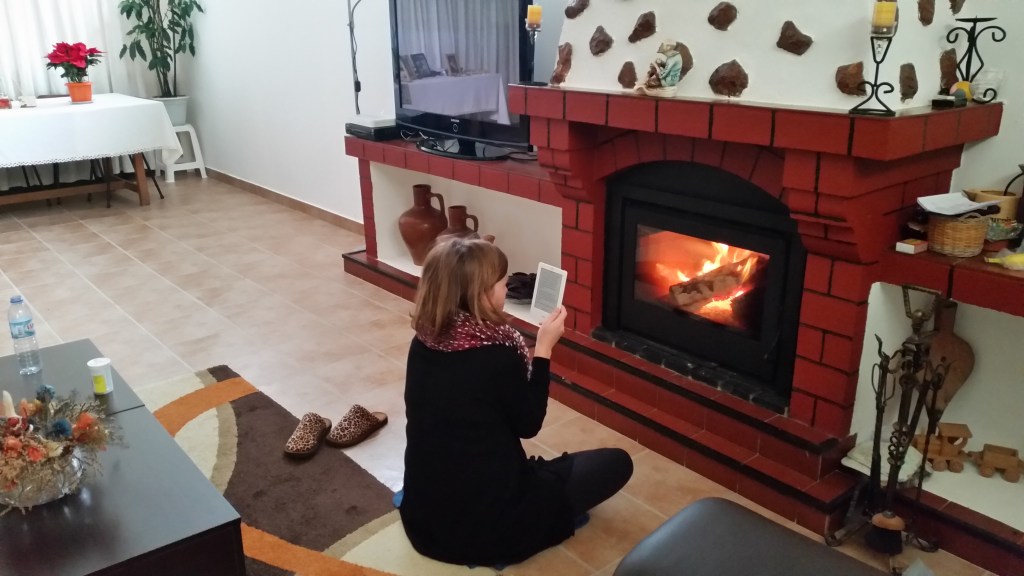
    When I came home at Christmas, I went out an splurged on a Kobo. I loaded it up with books, and was reading non-stop once I got to Portugal.

    After a couple of weeks, Kevin picked it up, then asked to borrow it. Within a couple of hours he was hooked.

    I hopped online and looked up e-readers in Portugal. The best option was to buy a Kindle from Amazon.com, and that’s just what I did, saying to Kevin “I’m ordering you a Kindle, but I’m keeping it for myself if it’s better than the Kobo”.

    It is, and I did.

    So now we have a set of e-readers and we rarely leave the house without them.

    I’ve read 34 books so far this year. That’s probably more books that I’ve read in the past 3 years combined.

    Kevin concurs, having read 30 so far.

    We’ve always been big readers. As kids we were total library nerds, and we consume a hefty amount of internet reading, and readings for school. But actual books, fiction in particular? We haven’t read this many in years.

    We never thought we’d say this, but we would never part with our e-readers.

  • Back to the beginning: a few days in Lisbon

    Back to the beginning: a few days in Lisbon

    Back in December, when Kevin and I were in Canada for Christmas, we planned out a trip that would involve a couple of weeks in Lisbon followed by travels through Spain, all the way to Paris, where we’d then fly back to Cambodia.

    We booked plane tickets to Lisbon, Portugal for January 4th.

    Back in November, I’d been planning a January trip to Vietnam with two of my lady friends, Julie & Komal. Due to the complications of life and travel visas, that hadn’t worked out. However, Julie planned to be in Lisbon for 2 days along with Kevin and I.

    When Kevin was hit in the mouth with a hockey stick on January 2nd, I was admittedly freaking out. Not only had we booked tickets to Lisbon, but my friend had booked a trip to meet us there. Needless to say, we didn’t miss our flight. I hopped Kevin up on pain killers and got him on the plane to Lisbon. His godfather met us there, and showed us to an incredibly wonderful few days in one of my favourite cities that I’ve been to yet.

    Many photos are attached, because we were able to cram lots of fun into a few short days. One of the most important things to note is how much we were able to do while also being completed relaxed. Julie was coming off a serious bout of food poisoning, and Kevin was obviously also in quite a bit of pain. However, Lisbon is such a welcoming and easy-to-access, non-touristy, relaxed place that were able to really make the most of our time there.

    Rather than crash at a hotel, we rented an AirBnB through a group called Travel & Tales. The fine gentlemen who run Travel & Tales, Pedro & Duarte, rent out a series of apartments in the chic Lisbon neighbourhood of Principe Real.

    One of the most bizarre things about Lisbon is how similar (also better than) it is to San Francisco. Hills are one such similarity, and when Kevin’s godfather drove us up into Principe Real, and then parked on one of the steepest hills imaginable, I knew we were in for an authentically Lisbon experience. Pedro helped us check in and hooked us up with some free SIM cards for our phones, and we were off on an adventure. Oh, and the apartment we were renting? Absolutely beautiful. Historical. Interesting. Clean. Well-located. I cannot say enough good things. It really represented the best of what Lisbon has to offer.

    Relative to other European capital cities, Lisbon is geographically small and rather inexpensive. And yet, as the capital city of the once-massive Portuguese empire, it’s jam-packed with history, old-world beauty, and remnants of the colonial wealth that created it.

    The city has many interesting neighbourhoods, and an hour or two of walking can really take you through a great cross-section of the best of Lisbon. We walked everywhere and saw a lot. It also helps that the hills of Lisbon mean you’re never far from an incredible, heightened view of the city. From old plazas with fountains and monuments galore, to the city’s oceanfront, where colonial ships once presented their wealth to kingdom, to ruins, and one of the first elevators in Europe, we walked and saw it all.

    Kevin took a couple of much-needed naps, as well as an afternoon trip to a private hospital to see if his lip was actually recovering, so Julie and I also had a couple of long exploratory jaunts. On one occasion we hopped in a cab to the Belem neighbourhood. There, we sat by waterfront along the Tagus river and enjoyed some lovely January sunshine. We also saw the Jeronimos Monastery, and the “Monument to the Discoveries”. We also caught a glimpse of the Ponte de 25 April (April 25th Bridge), which is essentially Lisbon’s version of the Golden Gate Bridge in San Francisco. It’s 27th largest suspension bridge in the world. I highly suggest you click on all those links and read what Wikipedia has to say about all these sights. So many interesting things to learn! On another jaunt, we decided to start walking and just see where we ended up. Turns out that we ended up at a lookout point behind a neighbourhood that had enticed us with a long yet lovely staircase. It was the perfect spot to watch the sunset, though regrettably I didn’t have my camera. That type of magical experience is exactly what makes Lisbon so enchanting.

    With all that walking, we obviously needed to eat, and Lisbon had us covered there as well. Because Lisbon is so old, almost every building is special in some way, which makes dining that much more interesting. We opted for a couple of low-key local places for lunch, and tried some fancier dining at night. Portuguese food is simple yet delicious, and I think that would describe our Lisbon culinary experience as well.

    If you can’t already tell, I’m a big fan of Lisbon. More than that, I’m a big fan of spending time with the people who I care about. I’ll let you see more of what we did by perusing the photos below. What really made this trip special was getting to explore a beautiful city with Kevin and my dear friend Julie. If you’ve never considered visiting Lisbon, I suggest that you add it to your to-do list, but more than that, I hope that you make the time to have interesting experiences with the people who you love.


  • Final thoughts and photos from my lovely trip to Canterbury

    Final thoughts and photos from my lovely trip to Canterbury

    My week in Canterbury was one of the most unique and special trips I’ve ever been on. I don’t think that I’d spent so much uninterrupted ‘grandparent time’ since I was a kid, and as a kid I rarely saw the adults being anything other than a caretaker/entertainer for me.Having this one-on-one time was really the best, because we were able to explore Canterbury through each other’s eyes, and there’s no more enjoyable way to connect with someone than by exploring a shared interest. My Nana Ev has now taken 3 winterly sojourns to this beautiful town, in a beautiful apartment. It goes without saying, this place and this experience are meaningful for her, and I can certainly see why. The youthfulness of the energy in Canterbury, combined with the freedom of living in a truly walkable city is a perfect reflection of the life she lives. For those of you who don’t know my Nana Ev, she is truly on fire with regards to living life. She’s one of the busiest, strongest, and most independent women that I’ve ever known. Visiting her in this special place, taking the time to connect about our family and our lives, taught me so much about much grandmother and my grandfather and who they are as people. It was a really special glimpse into who I might become one day, and I’m so grateful that I had the opportunity to make this trip.

    Our time in Portugal has given Kevin a similar opportunity to reconnect with his grandmothers, both of whom retired to the Algarve after years of working in Toronto. Similar to me, Kevin spent a lot of time with his grandparents growing up, but as he went away to school, began his career, etc, those opportunities for grandparent-ly connections became less and less frequent. Now, we live with one of his grandmothers and regularly visit the other. While the suffering of Kevin’s dental injury is very real, he recognizes and appreciates this unique trip and the time he’s been able to spend with his grandmothers, exploring his family history and his own connection to the Algarve.

    He’ll be on here once in a while with his own posts about our experiences here in the Algarve, but it’s safe to say that we’re both feeling incredibly lucky to spend so much long, uninterrupted time with the people that we love. If you take anything away from this blog post, it’s that time with family is important. Life can be crazy busy, but I promise you that it’s worth it to take the time to connect with your grandparents. I know that I’m already looking very forward to the next time I can get back to Canada and see mine!