While we were visiting the Convent of Christ in Tomar, the map of the site said that there was an aqueduct attached. Tyler was pretty excited about this, never having seen a real aqueduct. Kevin and I had seen some in Lisbon, but agreed that it was pretty cool.
While Tyler and I searched for the aqueduct ruins (which we found outside, attached to the Castle of Tomar), Kevin searched on Google. When we were done at the Castle/Convent, Kevin said he had one more stop he wanted to make. He handed me the phone with a seemingly random spot marked on the map nearby. He told me what we were up to but hadn’t said anything yet to Tyler.
5 minutes of driving later, we came to the Pegoes Aqueduct, to which the aqueduct ruins at the castle were attached.
But rather than just a couple of arches, what we saw was a full aqueduct crossing a valley. And the best part? It was open and also empty! From where we parked, we walked just a few steps to climb up onto the aqueduct through an old water inspection station. In the silent countryside, we walked along an ancient aqueduct, just the 3 of us.
A quick little surprise, and one of the highlights of our trip. Enjoy the photos below!
If you’ve ever read this blog, you know that we typically take our travel slowly. Even if that means we miss out on some possible sites, we always try to spend the maximum amount of time in our travel pursuits, in an attempt to really understand where it is that we’re visiting. Clearly we didn’t quite take that approach on our road trip, where we packed quite a bit of stuff in. I mean, we’re now 3 posts into Day 1 of our Sintra road trip, and yet we still drove another 2+ hours on this day!
Our wonderful friend, Soledad, insisted that we visit “Quinta da Regaleira”. It roughly translates to being “Estate of Regaleira” (the land was once owned by the wealthy Regaleira family from Northern Portugal). Soledad told us that this was her favourite place in the world, and once we arrived we realized why. We also very much regretted not budgeting more time to be here. There was so much to see, and we certainly didn’t let the rain slow us down!
The Quinta da Regaleira is essentially an estate that was once owned by a rich guy with big dreams of making something fancy. And this guy, António Carvalho Monteiro (actually nicknamed Moneybags Monteiro) sure achieved his goal. He was an eccentric guy who leveraged his family fortune to become a coffee tycoon in Brazil, then returned to Portugal study everything from law to bugs.
After purchasing the land in 1892, he spent until 1910 creating a magical villa and gardens, a neo-Manueline extravaganza all dreamed up by Italian opera-set designer Luigi Manini (Lonely Planet).
Despite the rain, we spent most of our time exploring the extensive gardens. This place is a landscape architect’s dream, boasting arches, gazebos, grottos, aquariums, gardens, patios, paths, fountains, tunnels, bridges, and more. The highlight is almost certainly what’s known as the “Initiation Wells”. We spent at least 30 minutes trying to find them, and it was well worth the effort. Here’s some background info, courtesy of our friends at Ancient-Origins.net:
The pair of wells, known as the ‘Initiation Wells’ or ‘Inverted Towers’, consist of ‘winding stair’ architecture, which carries symbolic meaning including the death/rebirth allegory common to many hermetic traditions.
One of the wells contains nine platforms, which are said to be “reminiscent of the Divine Comedy by Dante and the nine circles of Hell, the nine sections of Purgatory and the nine skies which constitute Paradise.” A smaller well, called the “Unfinished Well,” contains a set of straight staircases, connecting the ring-shaped floors to one another. It is believed that the spacing of the landings, as well as the number of steps in between were dictated by Masonic principles.
The two wells are connected to a series of underground tunnels and caves. Once we entered the primary initiation well, we descended deep underground.
To our great delight, we ended up in passing through the other well and entering a grotto/lake/waterfall area. We were beyond thrilled at this turn of events. We’d been freaking out about the beauty of this site all day, but this discovery topped them all, and we immediately agreed that Soledad was right about this place.
The inside of the mansion was pretty cool as well, but nothing close to the outdoor gardens and its secrets. If you plan to visit this site, give yourself at least 3 hours to see everything!
Check out the photos to see all this beauty for yourself (some are a bit blurry due to the rain – we were completely soaked, as was the phone!):
We began our adventure on the edge of the gardens
This level of detail and beauty existed throughout
soaking wet and trying to read our map as it falls apart
From the top of the initation well!
down, down, down…
…down, down, down…
at the bottom!
as we make our way through the tunnels, we see the light!
and hear we are!
we then crossed the lake!
we passed a fountain…
…and made our way to the castle
the view was stunning!
This chapel was built in Italy and then transported to Portugal
Sometimes being in Portugal with Kevin feels like being on a non-stop field trip. That is to say, he’s always cooking up new ideas and trips and adventures to keep me entertained. Back in February, Kevin planned a whole-day outing for us to see the Palacio do Estoi (aka the Palace of Estoi). Our drive to Estoi wasn’t your regular ol’ highway drive. Kevin chose the most scenic route possible, and included a stop in the nearby town of Salir, where a sign promised us castle ruins.
Salir really was beautiful, and as it sits on a top of a hill, it cuts a lovely view. The ruins were a bit disappointing, but as you’ll see below, meeting a cute cat more than made up for it.
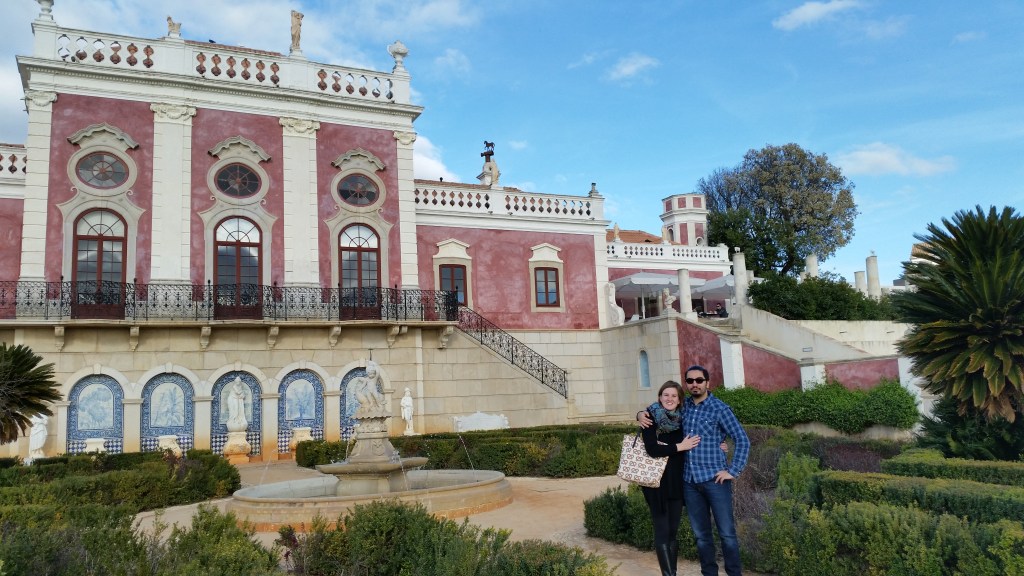
Our next stop was the Palacio do Estoi. It’s a palace built by a rich guy in the late 1800s and it’s a great example of the Rococo style. It’s also probably one of the only examples of Rococo style to be found in the Algarve.
Recently, it was acquired by a hotel chain that specializes in unique properties. They’ve added an expansion to the palace that contains a pool and accommodations. As for the original palace, they’ve kept it mostly as-is, operating 2 restaurants out of the building. As a guest or a visitor you can explore various gardens and sitting rooms, all of which maintain their original beautiful style.
The patio outside is part of the restaurant, and that’s where we sat, enjoying a light lunch, a bottle of “vinho verde” (green wine), an ocean view, and a stunning sunset. Despite being an old beautiful palace-turned-hotel, it maintains a casual atmosphere that makes anyone feel welcome.
It was a simple day, visiting a simple site, and it was all wonderful. If you make it to Portugal, this is a site worth seeing.
Making a quick stop in Salir to see some castle ruins
great view!
Inside one of the sitting rooms.
the walls around the palace
From the mural inside. Kevin sent this to my parents and said it was the two of us.
Kevin & I, looking fab.
me and Kevin
view from the cafe on the patio
view from one of the balconies
checking out someone’s wheels
me in the palace gardens
view of the inaccessible, wild gardens, from the gardens close to the palace
enjoying lunch/wine and the sunset. As you can see, Kevin insists on places his lips on a fresh spot for each sip.




 the stories that I'm telling.