Tag: Art

  • A Sunday in CDMX & Visiting Palacio Belles Artes

    A Sunday in CDMX & Visiting Palacio Belles Artes

    CDMX refers to La Ciudad de Mexico… known in English as Mexico City. CDMX refers to the municipality that encompasses Mexico City, home to nearly 22 million people. On Sundays, many of those people have the day off, and the downtown core is filled with people and families who come in search of festivals, entertainment, and relaxation.

    This was our second full solo day (and our first day waking up fully rested) in Mexico City, so we were feeling ready to explore. If you’re someone who doesn’t like crowds, then exploring the old downtown of Mexico City might not be the best call on a Sunday, but we had a lot of fun.

    One thing we hadn’t expected was how much we would be affected by the city’s altitude. For the first few days we staved off headaches with Advil, and we both experienced some difficulty breathing. The day’s heat didn’t help, and by mid-afternoon we were ready for a break.

    We started by visiting Mexico City’s famous art deco landmark, the Palacio de Belles Artes. The Palacio de Belles Artes is near the historic centre of Mexico City, and has been a site of cultural activity for thousands of years. In Pre-Hispanic times it was a site of Aztec altars for worship. Under Spanish colonial occupation, the site was home to a convent, which later was torn down to construct low income housing and textile mills. In the late 1800s, the National Theatre was built on this site, the nearest predecessor to today’s Palacio de Belles Artes:

    The old theatre was demolished in 1901, and the new theatre would be called the Gran Teatro de Ópera … Despite the 1910 deadline, by 1913, the building was hardly begun with only a basic shell. One reason for this is that the project became more complicated than anticipated as the heavy building sank into the soft spongy subsoil. The other reason was the political and economic instability that would lead to the Mexican Revolution.

    The project would sit unfinished for about twenty years. In 1932, construction resumed under Mexican architect Federico Mariscal. Mariscal completed the interior but updated it from Boari’s plans to the more modern Art Deco style. The building was completely finished in 1934.

    The floors between the ground floor and the uppermost floor are dominated by a number of murals painted by most of the famous names of Mexican muralism.[7]

    On the 2nd floor are two early-1950s works by Rufino Tamayo: México de Hoy (Mexico Today) and Nacimiento de la Nacionalidad (Birth of Nationality), a symbolic depiction of the creation of the mestizo (person of mixed indigenous and Spanish ancestry) identity.[2]

    At the west end of the 3rd floor is El hombre controlador del universo (Man, controller of the universe- known as Man at the Crossroads), originally commissioned for New York’s Rockefeller Center in 1933. The mural depicts a variety of technological and societal themes (such as the discoveries made possible by microscopes and telescopes) and was controversial for its inclusion of Lenin and a Soviet May Day parade. The Rockefellers were not happy with the painting and the incomplete work was eventually destroyed and painted over. Rivera recreated it here in 1934.[2][7] On the north side of the third floor are David Alfaro Siqueiros’ three-part La Nueva Democracía (New Democracy) and Rivera’s four-part Carnaval de la Vida Mexicana (Carnival of Mexican Life); to the east is José Clemente Orozco’s La Katharsis (Catharsis), depicting the conflict between humankind’s ‘social’ and ‘natural’ aspects.[2]

    The part above about the murals is quite important because that definitely was the main focus of our visit (as you’ll see in our photos). After our day exploring all types of art at Bazaar Sabado, it was quite exciting to see some of the country’s historic art. But more than that, it was interesting to see how many other people were there admiring the art with their friends and families. It wasn’t hard for us to recognize that the artistic talents and passions on display at the Bazaar were in some way related to the same passion and appreciation for arts that brings thousands of families to the Palacio to view these same murals.

    After spending a few hours at Belles Artes we went for lunch at Cafe de Tacuba, famous for their mole sauce (pronounced mo-lay). The restaurant is located in a former convent and has been open since 1912, so in addition to the delicious food it’s also beautiful just to see.

    With full stomachs, we walked to the historic centre of Mexico City:

    The historic center of Mexico City (SpanishCentro Histórico de la Ciudad de México), also known as the Centro or Centro Histórico, is the central neighborhood in Mexico CityMexico, focused on Zócalo or main plaza and extending in all directions for a number of blocks, with its farthest extent being west to the Alameda Central.[2] The Zocalo is the largest plaza in Latin America.[3] It can hold up to nearly 100,000 people.[4]

    What is now the historic downtown of Mexico City roughly correlates with the ancient Aztec city of Tenochtitlan, which was founded around 1325. During the prehispanic era, the city developed in a planned fashion, with streets and canals aligned with the cardinal directions, leading to orderly square blocks.[5]

    After the Spanish conquest, this design remained largely intact, mostly due to the efforts of Alonso Garcia Bravo, who supervised much of the rebuilding of the city. This reconstruction conserved many of the main thoroughfares such as Tenayuca, renamed Vallejo; Tlacopan, renamed México Tacuba, and Tepeyac, now called the Calzada de los Misterios. They also kept major divisions of the city adding Christian prefixes to the names such as San Juan Moyotla, Santa María Tlaquechiuacan, San Sebastián Atzacualco and San Pedro Teopan. In fact, most of the centro historicos is built with the rubble of the destroyed Aztec city.[5]

    Historically, the Zócalo, or main plaza, has been a venue for fine and popular cultural events.

    Just off the Zócalo are the Palacio Nacional, the Cathedral Metropolitana, the Templo Mayor with its adjoining museum, and Nacional Monte de Piedadbuilding. The Palacio Nacional borders the entire east side of the Zocalo and contains the offices of the President of Mexico, the Federal Treasury, the National Archives as well as murals depicting pre-Hispanic life and a large mural filling the central stairway depicting the entire history of the Mexican nation from the Conquest on.

    There was some kind of festival taking place, in addition to a large market, so the Zocalo was packed with people participating in and watching the festivities.

    Here’s a short video from the day, though it doesn’t really capture the scale of the area or the crowds:

    Check out our favourite photos from the day below!

  • El Bazaar Sábado

    El Bazaar Sábado

    Our first full day in Mexico City fell on a Saturday. Our Airbnb host recommended that we take this opportunity to visit “El Bazaar Sábado” (aka the Saturday Bazaar) as it’s a unique event that only happens once per week. And so on Saturday morning we took an Uber south into the historic neighbourhood of San Angel.

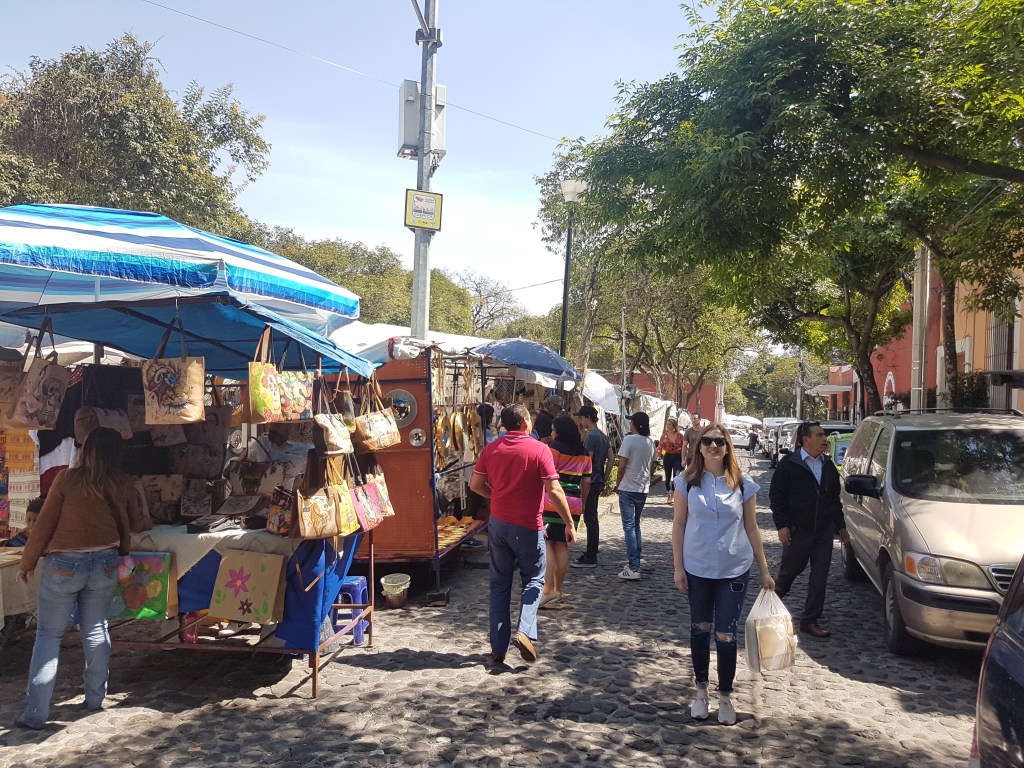
    The bazaar has 2 parts: a variety of kiosk stalls in a market, and a wide variety of artists exhibiting their work in the park.

    We started in the stalls of the market and were quickly impressed with the range and quality of the goods available. From there we wandered over to the park to start shopping for art! Again, we were quite impressed.

    Kevin and I spend a lot of time visiting artisan markets in Toronto, and we were amazed (again) by the range and quality of the work available. We had heard that Mexico City had a great arts scene, and this was certainly the first of many days/events that proved it to be true. We ended up buying a bunch of art and souvenirs, though the best part of the day was simply walking around in the sun.

    After the market, we walked to the San Angel Inn to try some of their famous margaritas. They were worth the hype, and while the rest of the food/service were just okay, overall the San Angel Inn kept us entertained as we watched upper middle class people wandering in and putting on their airs.

    After lunch we visited Museo Casa Estudio Diego Rivera y Frida Kahlo, the home where the famous Mexican artists Frida Kahlo and Diego River lived together. There’s more to come on that one later. For now, check out the below photos of our adventures in San Angel!

  • Day 4 in Amsterdam – Visiting the Rijksmuseum!

    Day 4 in Amsterdam – Visiting the Rijksmuseum!

    We started out our fourth day in Amsterdam by visiting the Tulip Museum for a quick visit. We then walked south through the city to visit their flagship art “quarter”. The section of the city has several museums, and on this day we visited just one of them: the Rijksmuseum. I’d read about this museum a few years ago when it was renovated to include a bike path that treads directly through the building, so we were quite excited to see it all in person.

    Here’s what Wikipedia has to say about the museum and its collection:

    The Rijksmuseum (Dutch pronunciation: [ˈrɛiksmyˌzeːjʏm]; English: National Museum) is a Dutch national museum dedicated to arts and history in Amsterdam. The museum is located at the Museum Square in the borough Amsterdam South.

    The Rijksmuseum was founded in The Hague in 1800 and moved to Amsterdam in 1808, where it was first located in the Royal Palace and later in the Trippenhuis.[1] The current main building was designed by Pierre Cuypers and first opened its doors in 1885.[3] On 13 April 2013, after a ten-year renovation which cost  375 million, the main building was reopened by Queen Beatrix.[11][12][13] In 2013 and 2014, it was the most visited museum in the Netherlands with record numbers of 2.2 million and 2.47 million visitors.[6][14] It is also the largest art museum in the country.

    The museum has on display 8,000 objects of art and history, from their total collection of 1 million objects from the years 1200–2000, among which are some masterpieces by RembrandtFrans Hals, and Johannes Vermeer

    We were in the museum for hours and still didn’t manage to see it all. Below are the many, many photos we took on our full day museum adventure. Read the comments to learn about all the highlights from our day! And shout out to Restaurant ‘t Zwaantje for serving us an incredible dinner.


  • Day 4 in Madrid: A Full Day of Museums

    Day 4 in Madrid: A Full Day of Museums

    When we woke up on Thursday, I knew we had to allocate much of the day to visiting museums, and we were particularly interested in visiting the Reina Sofia museum, aka the home of Picasso’s Guernica. I’d learned my lesson about waiting in line earlier in the week, and bought our tickets online ahead of time.

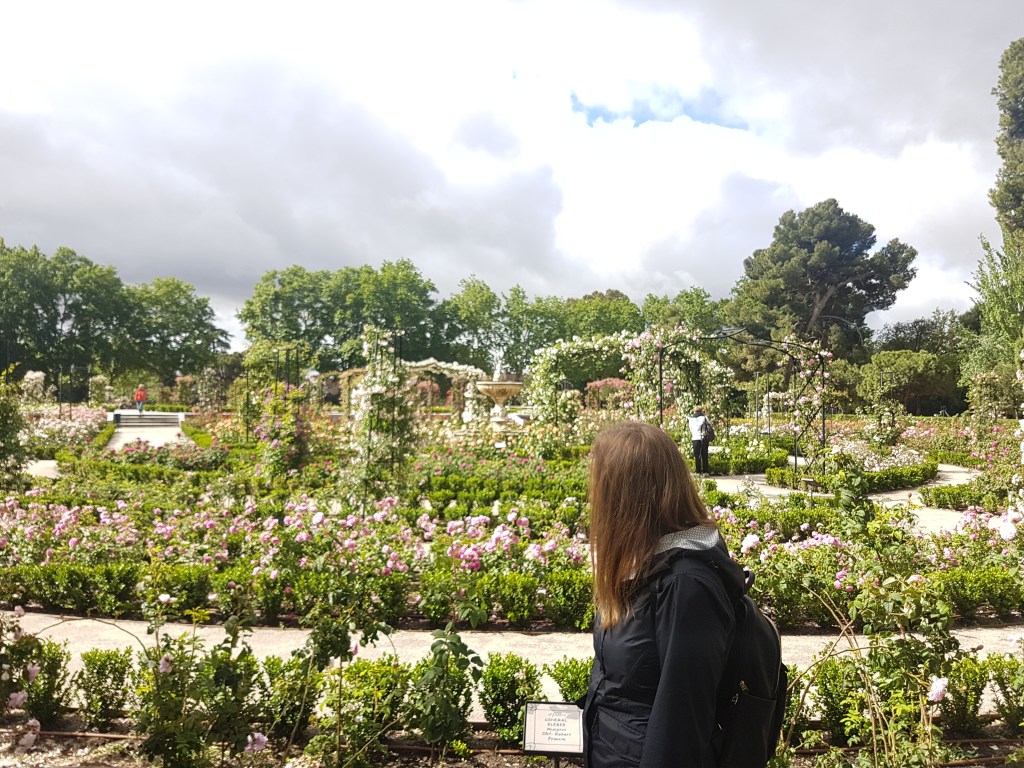
    The other lesson I’d learned was the importance of food before going into a museum. We grabbed a quick breakfast snack around the corner, and walked through Retiro Park on our way to the museum.

    We had a few museums on our list that day, but the Reina Sofia was our primary goal, so that’s where we started.

    Officially called the Museo Nacional Centro de Arte Reina Sofía, the Reina Sofia is Spain’s primary destination for 20th century art. The Prado, which we’d already visited, housed many historic Spanish pieces, but anything from the 1900s is in the Reina Sofia (there’s a separate museum for contemporary art, which unfortunately we didn’t have time for).

    The bulk of the collection is by Spanish artists, and the most famous pieces are by Pablo Picasso and Salvador Dali. We were keen to Picasso’s Guernica, and luckily for us the museum had on a special Guernica-themed exhibit that showcased much of Picasso’s works all in one space.

    The Reina Sofia is a very large museum, housed primarily in an old hospital, which means the layout lacks the typical ‘flow’ you encounter in museums. This, combined with incredible size of the museum, meant that by the time we had worked our way through the Guernica exhibit, we gave up on trying to see the regular collection.

    So, the Guernica exhibit. It was both educational and well curated. The exhibit starts out by discussing the 1937 World’s Fair in Paris, for which the painting was created, and then it dives into the history of the Spanish Civil War. Here’s what Wikipedia has to say:

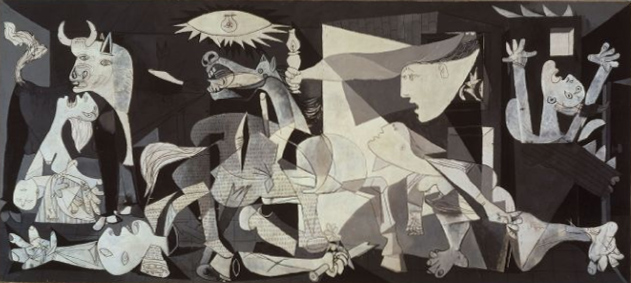
    Guernica is a mural-sized oil painting on canvas by Spanish artist Pablo Picasso completed in June 1937,[1] at his home on Rue des Grands Augustins, in Paris. The painting, which uses a palette of gray, black, and white, is regarded by many art critics as one of the most moving and powerful anti-war paintings in history.[2] Standing at 3.49 meters (11 ft 5 in) tall and 7.76 meters (25 ft 6 in) wide, the large mural shows the suffering of people wrenched by violence and chaos. Prominent in the composition are a gored horse, a bull, and flames.

    The painting was created in response to the bombing of Guernica, a Basque Country village in northern Spain, by Nazi Germany and Fascist Italian warplanes at the request of the Spanish Nationalists. Upon completion, Guernica was exhibited at the Spanish display at the Exposition Internationale des Arts et Techniques dans la Vie Moderne (Paris International Exposition) in the 1937 World’s Fair in Paris and then at other venues around the world. The touring exhibition was used to raise funds for Spanish war relief.[3] The painting became famous and widely acclaimed, and it helped bring worldwide attention to the Spanish Civil War.

    As we learned, the Spanish government commissioned Picasso to create a work of art for the World’s Fair, and it was only after the fact that he decided to create this moving painting, in what could well be described as an act of protest:

    In January 1937, the Spanish Republican government commissioned Picasso to create a large mural for the Spanish display at the Exposition Internationale des Arts et Techniques dans la Vie Moderne at the 1937 World’s Fair in Paris. At the time, Picasso was living in Paris, where he had been named Honorary Director-in-Exile of the Prado Museum. He had last visited Spain in 1934 and never returned.[4] His initial sketches for the project, on which he worked somewhat dispassionately from January until late April, depicted his perennial theme of the artist’s studio.[1] Immediately upon hearing reports of the 26 April bombing of Guernica, the poet Juan Larrea visited Picasso and urged him to make the bombing his subject.[1] However, it was only on 1 May, having read George Steer‘s eyewitness account of the bombing (originally published in both The Times and The New York Times on 28 April), that he abandoned his initial project and started sketching a series of preliminary drawings for Guernica.[5]

    After the bombing, the work of the Basque and Republican sympathizer and The Times journalist George Steer propelled this event onto the international scene and brought it to Pablo Picasso’s attention. Steer’s eyewitness account was published on 28 April in both The Times and The New York Times, and on the 29th appeared in L’Humanité, a French Communist daily. Steer wrote:

    Guernica, the most ancient town of the Basques and the centre of their cultural tradition, was completely destroyed yesterday afternoon by insurgent air raiders. The bombardment of this open town far behind the lines occupied precisely three hours and a quarter, during which a powerful fleet of aeroplanes consisting of three types of German types, Junkers and Heinkel bombers, did not cease unloading on the town bombs weighing from 1,000 lbs. downwards and, it is calculated, more than 3,000 two-pounder aluminium incendiary projectiles. The fighters, meanwhile, plunged low from above the centre of the town to machinegun those of the civilian population who had taken refuge in the fields.”[12]

    We weren’t able to take photos in the exhibit, but here’s what Guernica looks like:

    PicassoGuernica

    Per Picasso’s wishes, the painting itself did not return to Spain until the country enjoyed a republic.

    I was quite excited to see this painting, and it definitely lived up to the hype. As the building used to be a hospital, the overall footprint was not laid out well, but this exhibit was so well curated and included so many incredible pieces from Picasso’s career that it was well worth the visit.

    After 3-4 hours of taking this in, we headed out to get something to eat before hitting up another museum.

    Before we came to Madrid, Zoya sent us a list of restaurants to check out. After ‘starring’ them on our map, we were always able to find a great spot to eat. And once we got there, we referenced her notes on what to order, where to sit, etc. For lunch on this day, we sat at the bar in Mercado de la Reina and ordered amazing tapas dishes that included shrimp and friend artichoke. It was a quick lunch, and one of my favourite spots of the week.

    From there we headed over to the Naval Museum of Madrid:

    The Museo Naval de Madrid —in English, Naval Museum of Madrid— is a national museum in Madrid, Spain. It shows the history of the Spanish Navy since the Catholic Monarchs, in the 15th century, up to the present. The displays set naval history in a wide context with information about Spanish rulers and the country’s former colonies. The collections include navigation instruments, weapons, maps and paintings.

    For a 3 euro entrance fee, this museum is a pretty good deal, but I won’t be rushing back. If you’re really interested in naval history, and models of boats and military seafaring are your thing, then this is the museum for you.

    However, as general students of history and politics, we found the museum a bit lacking.

    To give some context, here’s what Wikipedia has to say about the Spanish Navy:

    The Spanish Navy (Spanish: Armada Española), is the maritime branch of the Spanish Armed Forces and one of the oldest active naval forces in the world. The Spanish navy was responsible for a number of major historic achievements in navigation, the most famous being the discovery of America and the first global circumnavigation by Magellan and Elcano. For several centuries, it played a crucial logistical role in the Spanish Empire and defended a vast trade network across the Atlantic Ocean between the Americas and Europe and across the Pacific Ocean between Asia and the Americas.

    The Spanish Navy was one of the most powerful maritime forces in the world in the 16th and 17th centuries and possibly the world`s largest navy at the end of the 16th century and in the early 17th century. Reform under the Bourbon dynasty improved its logistical and military capacity in the 18th century, for most of which Spain possessed the world’s third largest navy. In the 19th century, the Spanish Navy built and operated the first military submarine, made important contributions in the development of destroyer warships, and achieved the first global circumnavigation by an ironclad vessel.

    The 1820s saw the loss of most of the Spanish Empire in the Americas. With the empire greatly reduced in size and Spain divided and unstable after its own war of independence, the navy lost its importance and shrank greatly.

    During the Spanish–American War in 1898, a badly supported and equipped Spanish fleet of four armored cruisers and two destroyers was overwhelmed by numerically and technically superior forces (three new battleships, one new second class battleship, and one large armored cruiser) as it tried to break out of an American blockade in the Battle of Santiago de Cuba. Admiral Cervera‘s squadron was overrun in an attempt to break a powerful American blockade off Cuba.

    In the Philippines, a squadron, made up of ageing ships, including some obsolete cruisers, had already been sacrificed in a token gesture in Manila Bay. The Battle of Manila Bay took place on 1 May 1898, during the Spanish–American War. The American Asiatic Squadron under Commodore George Dewey engaged and destroyed the Spanish Pacific Squadron under Admiral Patricio Montojo y Pasarón. The engagement took place in Manila Bay in the Philippines, and was the first major engagement of the Spanish–American War. This war marked the end for the Spanish Navy as a global maritime force.

    Currently, the Spanish ‘Armada’ is the third largest navy in Europe, after the British Royal Navy and the French Navy, and the sixth in the world ranking.

    For centuries, Spain was a major naval power, and the museum does a great job of showcasing their strengths. However, the museum does a perplexingly bad job of discussing the decline of the Spanish navy in the 1800s. Case in point? They effectively skip over the destruction of the Spanish Armada, and while they do discuss their colonial expansion, there’s no mention of struggles around decolonization, or of the decisive Spanish American war. If you didn’t know better, the museum would give you the impression that Spain is still a hard-hitting naval power.

    That said, there are approximately a gazillion boat models in this museum, and it’s 10x larger than it seems at  the outset, with over 30 rooms of boats, maps, and artifacts. If you’re even remotely interested in maritime history, this is worth checking out.

    That night, we had plans to eat dinner in northern neighbourhood in Madrid. On our way there, we stopped in at one last museum, the Sorolla Museum. Madrid has a series of museums about Spanish artists, primarily based in the historic home of said artist. In this case, we visited a museum in the home of Joaquin Sorolla:

    The building was originally the artist’s house and was converted into a museum after the death of his widow. Designed by Enrique María Repullés, it was declared Bien de Interés Cultural in 1962.[citation needed] The principal rooms continue to be furnished as they were during the artist’s life, including Sorolla’s large, well-lit studio, where the walls are filled with his canvasses. Other rooms are used as galleries to display Sorolla’s paintings, while the upstairs rooms are a gallery for special exhibitions.

    Our walk to the Sorolla Museum followed a variety of busy streets, which made the walled garden of the home feel like a true oasis. I always really enjoy exploring homes, and this museum didn’t disappoint. Sorolla painted in the impressionist style, and painted beautiful landscapes and portraits. The artwork in the museum showcased his love of painting his family, and of his skill painting light and water. For a small entry fee, the Sorolla Museum was well worth it.

    Dinner itself was a whole other experience, which I’ll save for the next post…

  • A Trip to the Algarve – Kevin’s backyard

    A Trip to the Algarve – Kevin’s backyard

    The moment I told Kevin I’d booked my flight, he went into trip planning mode. Two weeks was a lot of time to fill, but it got booked up fairly quickly. We considered and rejected visiting the North & Porto (too far), some additional castles (I rolled my ankle), another historical town (Heather got sick), and a winery (we slept in). But still we ended up seeing a lot. A couple days sightseeing in Lisbon, a few days on the road being steeped in history, and finally a full week exploring the Algarve.

    2015-04-17 21.07.10
    🎶 “…One is a genius, the other’s insane” 🎶

    As Heather has recapped some of the Lisbon tour and the road trip, I’ll share a couple of our day trips exploring the Algarve.

    Avo Olimpia & Exploring Town

    Because Heather works remotely and at night (Australia hours) we usually get a pretty late start our day. We typically didn’t wake up, shower, have breakfast (a Canadian tradition apparently) and a cafe [Editor’s note, we now refer to ‘coffee’ in Portuguese, hence ‘cafe’], and head out until at least noon. Avo Olimpia, on the other hand, is much busier in the morning. Everyday when I would wander downstairs to scrounge up some breakfast around 10am, she would be well into her day – a trip to the market complete, laundry washed-dried-folded, and soap-opera watched. I’d get a “bon dia, bread’s on the table” and she’d be off yet again, now to the cafe with friends. She’s always on the move, and we rarely knew where to.

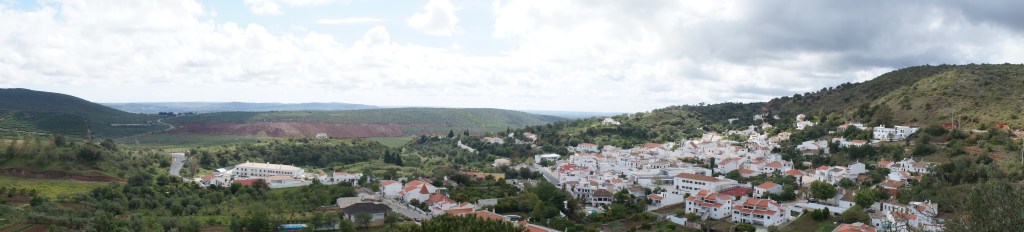
    One day I got the grand tour of the town and Kevin’s childhood playground. We walked to the pool, fed ducks in the creek, and saw the old-old church, the new-old church and pointed out every coffee place in town (there were many). There were some really cool sights too! Other than the history (“so the Romans built those walls”, “this buidling pre-dates Canada” etc.) my favourite sight was the giant Portuguese flag overlooking the entire town. Apparently during a previous World Cup (soccer…er I mean, football) some kids had scaled a nearby hill and painted a Portugese flag to cheer on their nation. This act of fan-dalism has since remained, and honestly looks pretty great!

    I thought Grimsby (pop 20,000) was a small town where everyone knows everyone, but Alte puts it to shame. Throughout the week of exploring we rarely walked down the street without stopping to chat with a neighbour, old friend, or relative because everyone knows each other. Case in point: Alte, it turns out, is so small you can accidently run into family. On one of our urban tours we stumbled upon Avo. We chatted for a bit with her friends (all in Portuguese so have no idea what was said, but assume my height and fair skin were questioned) but she was too busy for us (going dancing?) and we each continued on our separate ways.

    All in all I enjoyed seeing this small town.

    Avo Maria, The Farm, and the old House

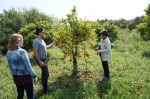
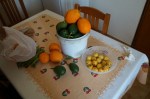
    While we spent the week with Avo Olimpia, one of our day trips included a visit to see Avo Maria and some of the family farm land. If it was nice having fruit trees in the yard for fresh juice, then visiting Avo Maria was a delight. She has fruit trees as far you can see – grapefruits, oranges, lemons, limes, whatever – just sitting there ready to be picked! I got a tour of the farm (included more Kevin stories “used to climb this tree”, “had a tire swing here”) and we loaded up on fruit, all while dodging chickens underfoot.

    The most hilarious part of this day trip was meeting Daisy. Daisy is Avo Maria’s older but still very much active dog. She followed us around for the whole tour, chasing chickens and keeping us entertained. As we got back to the house though, she surprised all of us by hunting down and catching a pigeon out of mid-air before scampering off to finish her treat!

    The Beach

    One of my favourite Algarve day trips included visiting a beach hidden from the mainroads and mostly known to locals. Here we got to walk the beach for a little while with the sand, sun, and ocean breeze all to ourselves. Kevin knows about the place because he used to visit with his grandfather and fish for clams in the summer. We got a full theatrical explanation of how he would walk in neck deep water (“it was up to here!”) trying to keep up with his grandfather while fighting the ocean (“current was trying to suck me out the whole time!”) so they could eat fresh seafood for dinner. It was a neat story which gave a beautiful pit-stop all the more meaning.

    As were leaving the beach we noticed it had rained earlier (sidenote – apparently it rained so much during my visit I’m not allowed back, bad luck) and the dirt parking lot was now filled with mud. So while Heather rolled her eyes Kevin and I hooked up the camera and drove circles through the mud having a blast! Check it out:

    Doesn’t get any better than that.