Canterbury Cathedral is arguably the most famous thing in Canterbury. When Nana Ev and I sit in her apartment and drink tea in the afternoon and the evening (that’s in addition to the tea we have in a local cafe – this is Britain, people!), we can see the cathedral as it towards above the surrounding buildings. When we go outside in the morning, it’s the first thing we see, as it’s approximately 20 metres away from Nana’s front door.
So, of course, visiting the Cathedral was a must-do for my trip. And so we went to Canterbury Cathedral. Not once, but twice!
First, here’s some interesting historical background on Canterbury Cathedral, courtesy of Wikipedia:
Canterbury Cathedral in Canterbury, Kent, is one of the oldest and most famous Christian structures in England and forms part of a World Heritage Site. It is the cathedral of the Archbishop of Canterbury, leader of the Church of England and symbolic leader of the worldwide Anglican Communion …
Founded in 597, the cathedral was completely rebuilt from 1070 to 1077. The east end was greatly enlarged at the beginning of the twelfth century, and largely rebuilt in the Gothic style following a fire in 1174, with significant eastward extensions to accommodate the flow of pilgrims visiting the shrine of Thomas Becket, the archbishop who was murdered in the cathedral in 1170. The Norman nave and transepts survived until the late fourteenth century, when they were demolished to make way for the present structures.
As with most of Europe, stuff here is crazy amounts of old. How old? Sold old that it has a history dating back to the Roman presence in Britain. Here’s what Wikipedia has to say about the various occupants/builders of the cathedral:
Roman
Christianity had started to become powerful in the Roman Empire around the third century, particularly after Augustine of Hippo converted to the religion in the 4th century. The cathedral’s first archbishop was Augustine of Canterbury, previously abbot of St. Andrew’s Benedictine Abbey in Rome. He was sent by Pope Gregory the Great in 596 as a missionary to the Anglo-Saxons. Augustine founded the cathedral in 597 and dedicated it to Jesus Christ, the Holy Saviour.
Anglo-Saxon
[The historian] Bede recorded that Augustine reused a former Roman church. The oldest remains found during excavations beneath the present nave in 1993 were, however, parts of the foundations of an Anglo-Saxon building, which had been constructed across a Roman road. They indicate that the original church consisted of a nave, possibly with a narthex, and side-chapels to the north and south. A smaller subsidiary building was found to the south-west of these foundations. During the ninth or tenth century this church was replaced by a larger structure (49 m. by 23 m.) with a squared west end.
The cathedral was badly damaged during Danish raids on Canterbury in 1011. The Archbishop, Alphege, was taken hostage by the raiders and eventually killed at Greenwich on 19 April 1012, the first of Canterbury’s five martyred archbishops. After this a western apse was added as an oratory of St. Mary, probably during the archbishopric of Lyfing (1013–1020) or Aethelnoth (1020–1038).
Norman
The cathedral was destroyed by fire in 1067, a year after the Norman Conquest. Rebuilding began in 1070 under the first Norman archbishop, Lanfranc (1070–77). He cleared the ruins and reconstructed the cathedral to a design based closely on that of the Abbey of St. Etienne in Caen, where he had previously been abbot, using stone brought from France. The new church, its central axis about 5m south of that of its predecessor,[6]was a cruciform building, with an aisled nave of nine bays, a pair of towers at the west end, aiseless transepts with apsidal chapels, a low crossing tower, and a short choir ending in three apses. It was dedicated in 1077.
As with many Romanesque church buildings, the interior of the choir was richly embellished.[14]William of Malmesbury wrote: “Nothing like it could be seen in England either for the light of its glass windows, the gleaming of its marble pavements, or the many-coloured paintings which led the eyes to the panelled ceiling above.”[14]
As is typical with gigantic old churches, its history is primarily a history of being built. Over centuries and over generations, it was build, torn down, damaged, re-built, refined, until it reached its current state of beauty. In fact, some parts of the Cathedral were even destroyed during WWII. This included the library (don’t worry, they were hiding the books in the basement of the church) and also some of the residence buildings for church-people. I can’t be certain, because this place is sparse on signs that don’t describe dead people, but I think some of the remains of these old bombed out buildings have been left, as there were single walls and arches in one of the gardens we explored.
One of the most important things that happened here is the murder of Thomas Becket, the Archbishop of Canterbury. He was caught up in the classic church-vs-state struggle. That is, he was the most powerful person in the church, and he used those powers to ex-communicate people who weren’t following the church’s rules. The state (aka King Henry II) didn’t like that so much. As the story goes, King Henry II yelled out “will nobody rid me of this turbulent man?!”. His guards overheard, and were obviously a bunch of ass-kissing keeners, because they hustled on down to Canterbury and murdered Thomas Becket in the Cathedral.
This was a fairly dramatic event. People totally flipped out, the Pope made this guy a saint (perhaps ex-communicating fools was considered a miracle back then) and people began to embark on pilgrimages from all across the country in order to visit the shrine of Thomas Becket. This massive influx of visitors created great wealth, and thus funded the continued growth and expansion of the church.
And let me tell you, there must have been an insane amount people visiting this site, because the church is massive. There is a truly remarkable amount of space for worship. It’s like 10 churches in 1. I can only imagine what the church would’ve been like at its heyday, when it was filled with pilgrims offering devotion. The crypt, as the oldest part of the church, was particularly memorable. I wasn’t allowed to take any photos down there, so google it.
Ok, I’ll calm down with all the history. Let’s talk about me and Nana Ev. On Sunday afternoon, Nana Ev and went to Canterbury Cathedral for Evensong. Evensong is basically the Sunday church service, but more singing and no communion. Those choirboys were wonderful singers, and their talents were beautifully highlighted by acoustics of the cathedral. It was a really special experience.
The next day, we went back to Canterbury Cathedral to take a tour and explore the grounds. Here’s an overhead view of the grounds. We basically saw it all, including the nearby campus of the King’s School. We walked and walked and walked. We probably spent close to 2 hours there, and could have easily spent more if lunch hadn’t been calling. It’s a truly beautiful place, with centuries history that would truly take years to explore. The ceilings, the windows, the walls, the gardens. All of it was lovely. There were also a lot of people buried within the cathedral, including King Henry IV, to whom my family is apparently related. We took a #familyselfie. Check the photos below for that gem 🙂
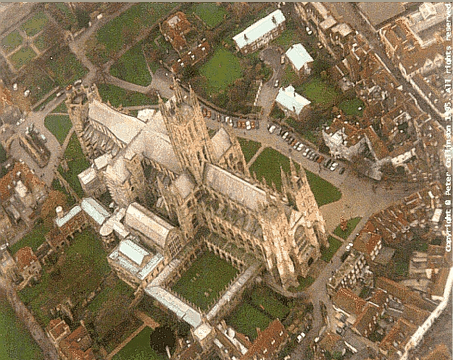
It’s certainly not the centre of the community that it once was, but it’s very clearly still a beehive of historical and religious activity. And no matter where you go, you can always catch a glimpse of it in the skyline. If you’re ever in Canterbury, you’d be a complete fool if you didn’t go to the Cathedral.
Check out the photos I took on our Canterbury Cathedral adventures. If you’ve ever taken photos in a church, you know that it’s an effort in vain, but there they are anyway:

Nana said we were related to this guy, so we took a #familyselfie

the program from Evensong




 the stories that I'm telling.