Tag: Castles

  • Castelo de Silves

    Castelo de Silves

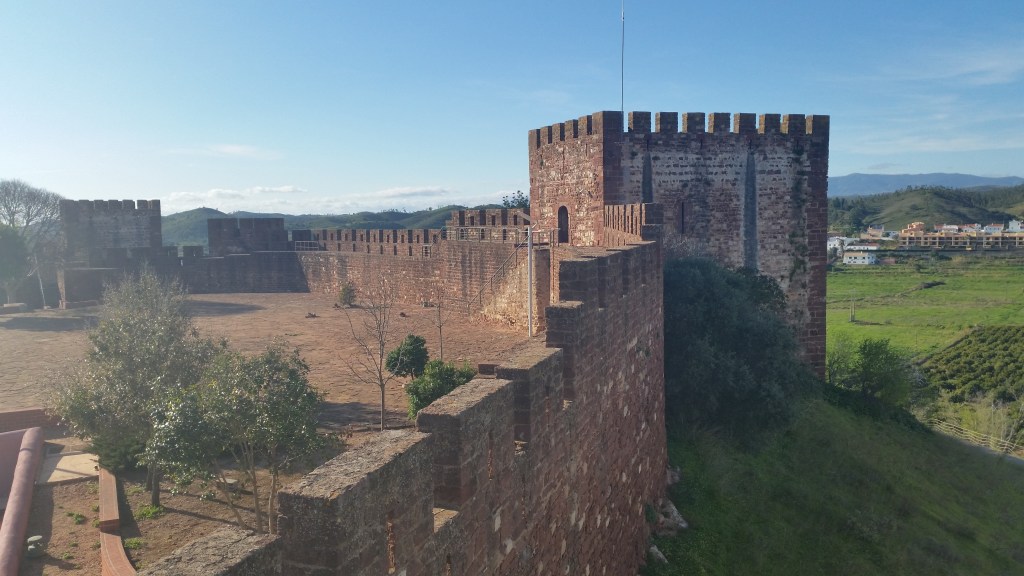
    When it was a bit chilly, Kevin and I drove east to see the Palace of Estoi. A few weeks later, on one of the first truly warm days this year, Kevin and I drove west to see the Castle of Silves.

    The Castle of Silves is stunning. I’d seen it many times, lit up at night, while driving through Silves to have dinner somewhere. This day was the first time Kevin and I had been there, and we were quite impressed. The Palacio do Estoi is pretty, but the Castelo de Silves is, like, a really serious/big piece of history in this region. according to Wikipedia:

    “Built between the 8th and 13th century, the castle is one of the best preserved of the Moorish fortifications in Portugal … from archaeological excavations, it is assumed that the first fortress on this site consisted of a Lusitanian castro. It is believed that Phoenicans, Greeks and Carthaginians traversed the site at one time, but that around 201 B.C. the Romans conquered Silves, transforming it into a citadel of their occupation, and commercial center that prospered for the next five centuries.

    Around 716, the Visigothic citadel was conquered by the Umayyad Caliphate who reinforced the existing fortifications with a new series of walls. This new period resulted in a great period of development, under the Moorish occupiers, that include the extensive walls in the west. In 1160, it was sacked by Ferdinand I of León and Castile, but remained only for a short time in the hand of the Christians: it was quickly recaptured by the Moors. King Sancho I of Portugal, supported by the powerful Crusader army, conquered the city, after a prolong encirclement in 1189. But, a grande army, under orders from Amir al-Mu’minin, in 1191, retook the city. The buildings of the Taifa kingdoms of the 11th century, which includes the Palace of Balconies (where Al-Mutamid lived as the poet Ibn Amarhe) progressed in the 11th century. The walls and towers that today represent the Castle of Silves came from these campaigns and public works by Almoravides and Almohads in the 12th and 13th centuries. The castles internal water catchment, and large rain fed underground cistern were used to provide freshwater for the surrounding dwellings (to as late as the 1920s). It would only be in the 13th century, during the reign of Afonso III of Portugal, that forces under the command of D. Paio Peres Correia, would definitively take the fortress.

    So yeah, more than 2000 years ago, the site of Silves Castle was established by Moorish forces, who then passed it back and forth with Christian conquerors for 1400 years, until the Portuguese finally took hold of the whole thing.

    When you’re inside the castle walls, you can see why it was chosen as the location for a massive fortification. It sits atop a hill, and you can see everything for miles. You can’t quite see the ocean, but any invading ocean forces would be held up by and easily visible crossing a natural geographic barrier – the sierra hills south of the castle.

    Other than a cafe, there’s not much in the way of an organized presentation of information at the castle, but we had fun walking around the massive site, checking out the views from every angle and trying to interpret the map we had.

    There was one exhibit in the room that used to be for water storage. It described the Iberian Lynx, a beautiful animal on the verge of extinction, native to Spain & Portugal.

    Take a look at our photos below. It was a really beautiful day!

  • We went to Dover Castle … sort of.

    We went to Dover Castle … sort of.

    On Friday, I arrived in Canterbury. I emailed my family a photo of Nana and I together, letting them know I’d arrived safely. Everyone responded quickly with well wishes, and suggestions for all the things I should do while there (context: this is the third year that Nana Ev has come to stay in Canterbury for several weeks. Both my aunt and my parents have previously visited during this trip).

    On Saturday, Nana Ev and I FaceTimed with my parents and Kristopher. On Sunday we FaceTimed with my Aunt Elaine and Uncle Joe.

    On both calls, we were asked a variation of this question: “so, have you done [insert activity] yet?” “did you go [insert location] here yet”.

    Nana and I could not stop laughing. These questions were hilariously ill-timed, considering I’d barely just arrived.

    In their enthusiasm about the many things to do in Canterbury, my Dad absolutely insisted that we must go to Dover Castle. We hadn’t initially planned to do this, because it was a bit more complicated to get to Dover without a car, but since my Dad insisted it was such a must-do activity, we figured out how to take the bus there.

    So, this morning we got up bright and early. We got on the bus, and headed for Dover Castle, a lovely 40 minute ride away.

    Quick facts on Dover Castle, courtesy of my fave, Wikipedia:

    Dover Castle is a medieval castle in Dover, Kent. It was founded in the 12th century and has been described as the “Key to England” due to its defensive significance throughout history. It is the largest castle in England.

    The site may have been fortified with earthworks in the Iron Age or earlier, before the Romans invaded in AD43. This is suggested on the basis of the unusual pattern of the earthworks which does not seem to be a perfect fit for the medieval castle. Excavations have provided evidence of Iron Age occupation within the locality of the castle, but it is not certain whether this is associated with the hillfort. There have also been excavations on the mound which the church and Roman Pharos are situated on, which has been discovered to be a Bronze Age mound.

    Our bus driver let us know when to get off the bus, and told us we had to walk a bit down the hill to get to the entrance (Keep in mind that Dover Castle sits atop a massive hill, which is why we were skeptical of making this trip sans car). Needless to say, when the bus driver said that the return bus stop was further up the hill, while the entrance to the castle was further down, we weren’t impressed.

    Thus, we walked down the hill, only to find another hill we needed to walk up in order to reach the castle. As we approached the gate, I began to question our decisions. The gate looked closed. I thought perhaps I wasn’t seeing things right, until I was standing in front of the locked gate, looking at a ticket booth that was very much closed.

    Well, shit. Now what? We sure didn’t see this coming. We also weren’t sure if the Castle was closed, or if just that particular entrance. We decided to walk further down the hill to reach the car entrance, hoping that might be open. Turns out, it wasn’t. The “Closed” sign was well visible from across the street.

    Not wanting to walk back up that darn hill, we continued to walk down. Eventually we were back in the lovely town of Dover. Also, we had no real idea where we were going, other than knowing we needed to get back on a bus. After asking a couple of people for directions (all of whom confirmed that it was unusual for the castle to be closed), we eventually found a bus stop. When we asked the bus driver if his particular bus would take us to the main station, he told us that it would, but so would a 5 minute walk through the park behind us. Obviously, we opted for the latter.

    Another 10 minutes of waiting, and we were back on the bus to Canterbury! As soon as we were in wifi range, we looked up Dover Castle’s hour. Indeed, it is only open on the weekends this month. Truly bizarre, because the sign on site said otherwise.

    Anyways, here are the pictures we took on our adventure to see Dover Castle. We did the Castle, though we didn’t get inside. Consider it the unsuccessful invaders’ version of the tour. Tres vintage.