Tag: cdmx

  • A Sunday in CDMX & Visiting Palacio Belles Artes

    A Sunday in CDMX & Visiting Palacio Belles Artes

    CDMX refers to La Ciudad de Mexico… known in English as Mexico City. CDMX refers to the municipality that encompasses Mexico City, home to nearly 22 million people. On Sundays, many of those people have the day off, and the downtown core is filled with people and families who come in search of festivals, entertainment, and relaxation.

    This was our second full solo day (and our first day waking up fully rested) in Mexico City, so we were feeling ready to explore. If you’re someone who doesn’t like crowds, then exploring the old downtown of Mexico City might not be the best call on a Sunday, but we had a lot of fun.

    One thing we hadn’t expected was how much we would be affected by the city’s altitude. For the first few days we staved off headaches with Advil, and we both experienced some difficulty breathing. The day’s heat didn’t help, and by mid-afternoon we were ready for a break.

    We started by visiting Mexico City’s famous art deco landmark, the Palacio de Belles Artes. The Palacio de Belles Artes is near the historic centre of Mexico City, and has been a site of cultural activity for thousands of years. In Pre-Hispanic times it was a site of Aztec altars for worship. Under Spanish colonial occupation, the site was home to a convent, which later was torn down to construct low income housing and textile mills. In the late 1800s, the National Theatre was built on this site, the nearest predecessor to today’s Palacio de Belles Artes:

    The old theatre was demolished in 1901, and the new theatre would be called the Gran Teatro de Ópera … Despite the 1910 deadline, by 1913, the building was hardly begun with only a basic shell. One reason for this is that the project became more complicated than anticipated as the heavy building sank into the soft spongy subsoil. The other reason was the political and economic instability that would lead to the Mexican Revolution.

    The project would sit unfinished for about twenty years. In 1932, construction resumed under Mexican architect Federico Mariscal. Mariscal completed the interior but updated it from Boari’s plans to the more modern Art Deco style. The building was completely finished in 1934.

    The floors between the ground floor and the uppermost floor are dominated by a number of murals painted by most of the famous names of Mexican muralism.[7]

    On the 2nd floor are two early-1950s works by Rufino Tamayo: México de Hoy (Mexico Today) and Nacimiento de la Nacionalidad (Birth of Nationality), a symbolic depiction of the creation of the mestizo (person of mixed indigenous and Spanish ancestry) identity.[2]

    At the west end of the 3rd floor is El hombre controlador del universo (Man, controller of the universe- known as Man at the Crossroads), originally commissioned for New York’s Rockefeller Center in 1933. The mural depicts a variety of technological and societal themes (such as the discoveries made possible by microscopes and telescopes) and was controversial for its inclusion of Lenin and a Soviet May Day parade. The Rockefellers were not happy with the painting and the incomplete work was eventually destroyed and painted over. Rivera recreated it here in 1934.[2][7] On the north side of the third floor are David Alfaro Siqueiros’ three-part La Nueva Democracía (New Democracy) and Rivera’s four-part Carnaval de la Vida Mexicana (Carnival of Mexican Life); to the east is José Clemente Orozco’s La Katharsis (Catharsis), depicting the conflict between humankind’s ‘social’ and ‘natural’ aspects.[2]

    The part above about the murals is quite important because that definitely was the main focus of our visit (as you’ll see in our photos). After our day exploring all types of art at Bazaar Sabado, it was quite exciting to see some of the country’s historic art. But more than that, it was interesting to see how many other people were there admiring the art with their friends and families. It wasn’t hard for us to recognize that the artistic talents and passions on display at the Bazaar were in some way related to the same passion and appreciation for arts that brings thousands of families to the Palacio to view these same murals.

    After spending a few hours at Belles Artes we went for lunch at Cafe de Tacuba, famous for their mole sauce (pronounced mo-lay). The restaurant is located in a former convent and has been open since 1912, so in addition to the delicious food it’s also beautiful just to see.

    With full stomachs, we walked to the historic centre of Mexico City:

    The historic center of Mexico City (SpanishCentro Histórico de la Ciudad de México), also known as the Centro or Centro Histórico, is the central neighborhood in Mexico CityMexico, focused on Zócalo or main plaza and extending in all directions for a number of blocks, with its farthest extent being west to the Alameda Central.[2] The Zocalo is the largest plaza in Latin America.[3] It can hold up to nearly 100,000 people.[4]

    What is now the historic downtown of Mexico City roughly correlates with the ancient Aztec city of Tenochtitlan, which was founded around 1325. During the prehispanic era, the city developed in a planned fashion, with streets and canals aligned with the cardinal directions, leading to orderly square blocks.[5]

    After the Spanish conquest, this design remained largely intact, mostly due to the efforts of Alonso Garcia Bravo, who supervised much of the rebuilding of the city. This reconstruction conserved many of the main thoroughfares such as Tenayuca, renamed Vallejo; Tlacopan, renamed México Tacuba, and Tepeyac, now called the Calzada de los Misterios. They also kept major divisions of the city adding Christian prefixes to the names such as San Juan Moyotla, Santa María Tlaquechiuacan, San Sebastián Atzacualco and San Pedro Teopan. In fact, most of the centro historicos is built with the rubble of the destroyed Aztec city.[5]

    Historically, the Zócalo, or main plaza, has been a venue for fine and popular cultural events.

    Just off the Zócalo are the Palacio Nacional, the Cathedral Metropolitana, the Templo Mayor with its adjoining museum, and Nacional Monte de Piedadbuilding. The Palacio Nacional borders the entire east side of the Zocalo and contains the offices of the President of Mexico, the Federal Treasury, the National Archives as well as murals depicting pre-Hispanic life and a large mural filling the central stairway depicting the entire history of the Mexican nation from the Conquest on.

    There was some kind of festival taking place, in addition to a large market, so the Zocalo was packed with people participating in and watching the festivities.

    Here’s a short video from the day, though it doesn’t really capture the scale of the area or the crowds:

    Check out our favourite photos from the day below!

  • Visiting Teotihuacan

    Visiting Teotihuacan

    Kevin did 90% of the research for our trip to Mexico City, and I could tell it was going to be a good trip because of how excited he would get about what he was reading.

    When he suggested that our trip include a day trip outside of the city I knew that we were in for something great because he’s well aware of my distaste for travelling within trips.

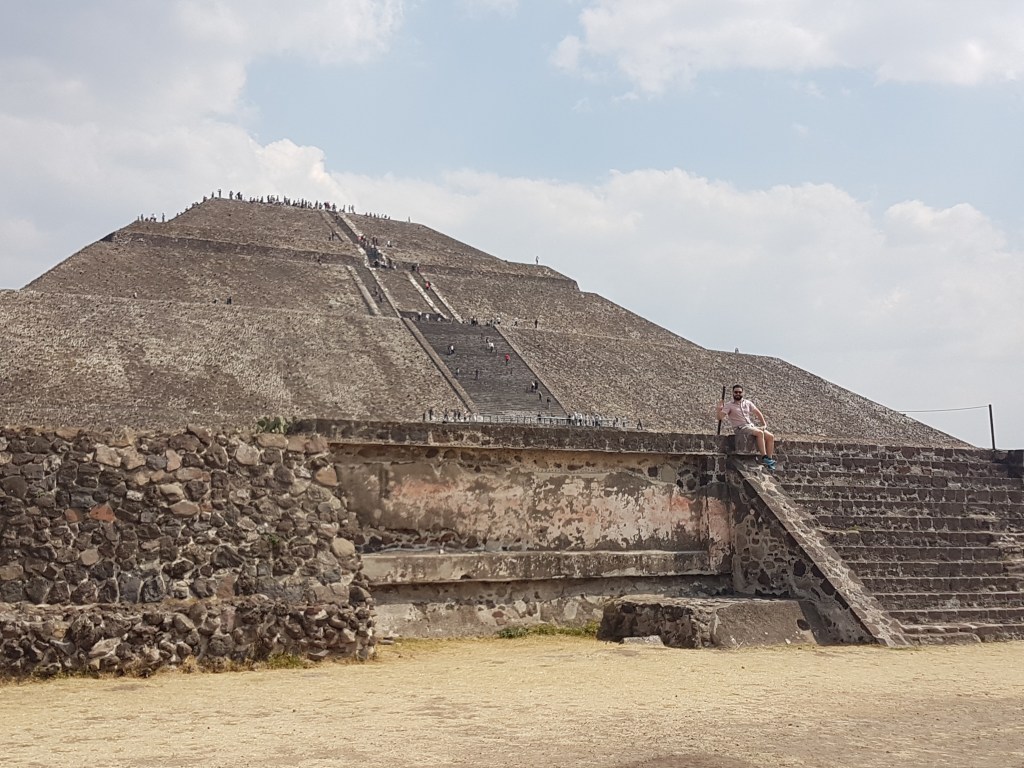
    Indeed, our day visiting the ancient Mesoamerican city of Teotihuacan was well worth the trek to get there. It was also one of the first things we did on our trip, and it set us up well for a week of learning about the incredible culture and history that have occurred on the lands of present-day Mexico. We were able to Uber there, and then found another Uber to drive us back later.

    Our day included a lot of walking and climbing, but you can easily enjoy the site without climbing the pyramids. If you go, be sure to bring a hat and some sunscreen. We also went on Monday so there were relatively few tourists. We’ve been told that Sunday is the busiest day to visit.

    Around 1200 CE, the Mexica were moving in search of a new location where they could establish a settlement and build a city. Along the way they found the remarkable site of Teotihuacan and they claimed a common ancestry with the city’s ancient founders. So, that’s how ancient and significant Teotihuacan is: some 800 years ago a power community found it and were so impressed that they took on some of city’s mythology and worked it into their own origin story.

    When most Canadians talk about pre-European peoples in Mesoamerica, the most prominent group mentioned is called “the Aztecs”. However, “Aztec” is a term coined by a European researcher. The Aztec Empire began as an alliance between 3 city-states in the Central Mexican Valley, and the most influential of these 3 group were actually known as the “Mexica” (pronounced May-Shee-Ka). The language that they spoke, Nahuatl, is still spoken in Mexico today, and many Nahuatl words have been incorporated into Mexican Spanish. In fact, some Nahuatl words are even spoken in the Philippines (more on that in a later post).

    So, what’s all the hype about?

    Well, before you ask, let me assure you that this site was not built by aliens.

    Teotihuacan, founded approx 2000 years ago, is the site of the largest pyramids outside of Egypt and was once a city home to over 125,000 people (some estimates suggest closer to 250,000). Such a large city was hub for trading and exchange and its cultural and economic influence appears in archaeological digs and cultural sites across Mesoamerica.

    Further details about its exact origins, who built it, etc are unclear, and there some different competing theories. However it is a rich archaeological site and researchers have been able to learn a lot about how life was live in this community. Their importances as a trading centre has helped researchers build a clear picture of the various groups living and trading across the Mesoamerican region at that time.

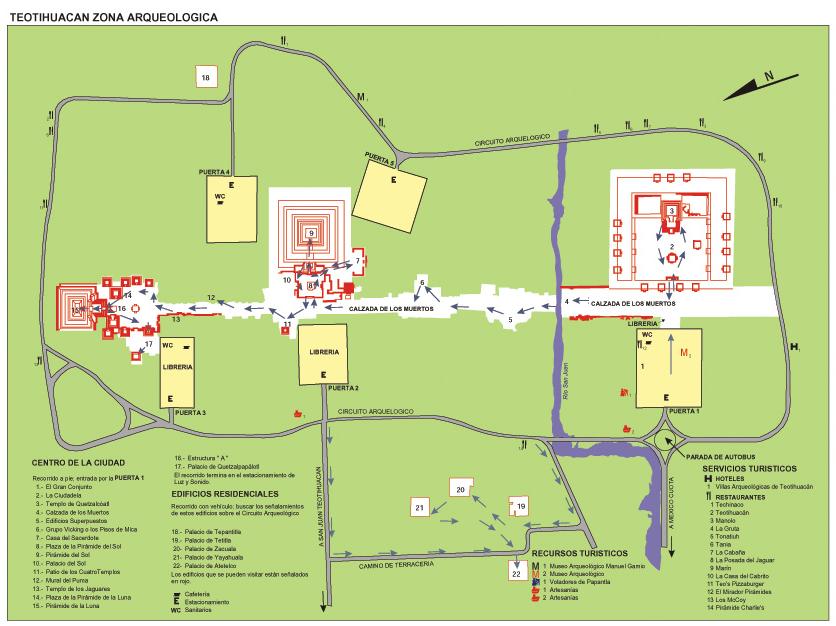
    Here’s a map of the site. The arrows show the recommended route through the site, which is exactly what we did:

    Teotihuacan_Archaeological_Area_Map_Edo_Mexico (1)

    Here’s what Wikipedia has to say about the site layout and design.

    The city’s broad central avenue, called “Avenue of the Dead” (a translation from its Nahuatl name Miccoatli), is flanked by impressive ceremonial architecture, including the immense Pyramid of the Sun (third largest in the World after the Great Pyramid of Cholula and the Great Pyramid of Giza). Pyramid of the Moon and The Ciudadela with Temple of the Feathered Serpent Quetzalcoatl are placed at the both ends of Avenue while Palace-museum Quetzalpapálot, fourth basic structure of site, situated between two main pyramids. Along the Avenue are many smaller talud-tablero platforms also. The Aztecs believed they were tombs, inspiring the name of the avenue. Scholars have now established that these were ceremonial platforms that were topped with temples.[citation needed]

    The Avenue of the dead is roughly forty meters wide and four Kilometers long.[64] Further down the Avenue of the Dead, after small river, is the area known as the Citadel, containing the ruined Temple of the Feathered Serpent Quetzalcoatl. This area was a large plaza surrounded by temples that formed the religious and political center of the city. The name “Citadel” was given to it by the Spanish, who believed it was a fort. Most of the common people lived in large apartment buildings spread across the city. Many of the buildings contained workshops where artisans produced pottery and other goods.

    While a lot is known about the site and its various inhabitants there is still much to learn. A recent discovery was made and we got to see the tent where they were continuing to explore it. Kevin insists that you read this article about it.

    Our path through the site also included a journey through their museum, which helped us get a better understanding of what we were seeing. We were impressed with the breadth of material on display and how well it was curated.

    Below you can see all of our photos from our visit to Teotihuacan, though it’s hard to do it justice. If you ever get the opportunity to go to Mexico City then I strong encourage you to make a trip out to visit this incredible historical gem!


  • The Museum of the Object of Objects!

    The Museum of the Object of Objects!

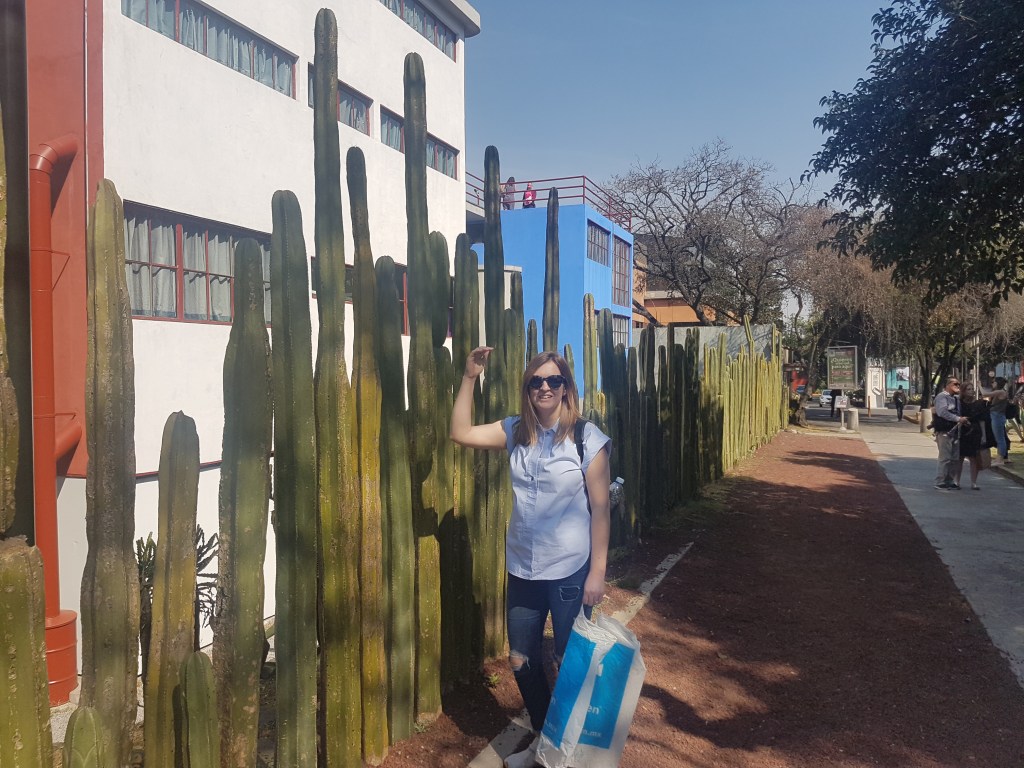
    After lunch at the San Angel Inn and a quick visit to the Museum of the House/Studio of Diego Rivera and Frida Kahlo, we headed to another interestingly named museum, the Museo del Objecto del Objecto. It translates to ‘the museum of the purpose (or object) of the object’.

    This is how Wikipedia describes it:

    The Museo del Objeto del Objeto (Museum of the Object [purpose] of the Object [item]), or MODO, is a museum in Mexico City and the first museum in Mexico dedicated to design and communications. It was opened in 2010 based on a collection of commercial packaging, advertising, graphic arts, common devices and many other objects dating back to 1810 collected by Bruno Newman over more than forty years. The museum is dedicated to the preservation of its collection of more than 30,000 items from two centuries, and it is dedicated to the research in the history of design and communications, as well as the promotion of collecting in general. The museum offers workshops, seminars, conferences and other activities intended to promote design and communication.

    I love the concept of this museum, which essentially centres on exploring the cultural value of everyday objects. If the current exhibit had been around anything other than soccer, it might have been one of my favourite spots on our trip. As it was, we were able to see a wide collection of soccer-related memorabilia and we learned a fair bit about how the sport’s equipment has evolved with technology.

    However, I’d have much preferred a collection of 200+ pieces of equipment from any non-sports related theme. This museum is definitely on the list again for my next trip to Mexico City.

    It takes about 30 minutes to see the whole exhibit and the price of the entry ticket was quite reasonable. I definitely recommend this museum, but check the exhibits listing beforehand.

    Afterwards we headed across the street for a snack and more wine at a rooftop patio. It was one of my favourite meals from the trip, so I definitely recommend visiting Meroma if you get the chance!

    Check out our photos below from MODO and Meroma:


  • Visiting the Museum of the House/Studio of Diego Rivera and Frida Kahlo

    Visiting the Museum of the House/Studio of Diego Rivera and Frida Kahlo

    After we enjoyed art shopping at El Bazaar Sabado and lunch (with a bottle of cava) at the San Angel Inn, we ventured across the street to visit the shared home and studio of the famous Mexican artists Frida Kahlo and Diego Rivera.

    We’d heard that the Frida Kahlo museum was famed for its long lines, so we opted instead to visit this less busy site. It was also conveniently close to the Bazaar. There were many more items on our to-do list for this trip than we were able to accomplish, partly because the city is just so big and there is so much to do. We had to adapt our plans and just do our best to see sites clustered within areas we visited.

    This blog post does a good job of summarizing the history and significance of the studio-house. Built in a neighbourhood dominated by Spanish colonial architecture, Diego commissioned a friend to built the house in a new, functionalist style, in contrast to its surroundings. This was following the Mexican Revolution, when there was a movement in the country to use art and design to foster national identity.

    Diego Rivera and Frida Kahlo are two of the most important and famous artists of the 20th century, and it’s not possible to visit Mexico City without thinking about them. The influence of their artwork was felt worldwide, but it’s especially poignant in their hometown.

    Even if you don’t know much about Kaho and Rivera, the museum is an interesting an inexpensive site to visit. Throughout the house/studio you can see different exhibits of their work and/of work that was influenced by them. It seemed as those these exhibits were rotated somewhat often.

    Below you can see photos of what we saw while we were visiting, including Diego Rivera’s studio and a variety of work related to his travels and political engagements.


  • Adventure with our Toronto neighbours in Mexico City!

    Adventure with our Toronto neighbours in Mexico City!

    In Toronto our neighbours, Greg and Adrienne, also happen to be old friends of ours. Greg and I attended high school together, and so we were all delighted to find out we were living in the same building, on the same floor.

    To keep the coincidences coming, a week after we booked our trip to Mexico City we realized that Greg and Adrienne were also going and that our trips would overlap!

    We didn’t plan it that way, but it worked out to be a lot of fun because went spent 2 nights partying together in Mexico City. Bonus: Greg & Adrienne both work in the Toronto restaurant industry and so we got to tag along to the trendy places that their colleagues had recommended.

    Greg and Adrienne arrived a few days after us and we met up with them for a ‘taco and mezcal crawl’ that Greg had planned. It was a Sunday night so many places were closed. It was also the first time that we realized there was a major discrepancy between the posted business hours on Google Maps vs reality.

    On the day before they left we had lunch in the same restaurant (Pujol, more on that later), though not together. Before leaving we made plans to meet up for dinner and more drinking. The evening ended in a local fast food joint at 4am, so I’d say it was a successful night on the town.

    So, where did we go? I honestly couldn’t tell you from memory because Greg directed us to each place and I rarely knew what anything was called. But Google is a handy thing, so I’ve put together a list (and photos are included below):

    Sunday night taco & mezcal crawl

    • El Huequito: the first stop on our taco crawl, this place showed what was really possible with under-highway space, as the restaurant was located on a large sidewalk under a highway underpass. Great tacos, great service, great mezcal.
    • Taqueria Los Parados: This was a quick little counter service taco place. Delicious tacos made on the grill in front of you.
    • Paramos: This place was très trendy and almost felt like being in Toronto, and wow the mezcal margaritas were great. When we arrived we headed upstairs to get a table but the wait was over an hour. So we drank margaritas while sitting on couches in their lobby and waited! Once seated at our table, the service was rather slow but again those margaritas balanced it all out. The food was good and the ambiance was cool. It’ worth noting that by this point in the night I was full and could no longer eat much anyways. The highlight was, again, the mezcal margaritas, which were the best I had all week.
    • The next 2 places on our list ended up closing early, so we called it a night and headed home to bed.

    Wednesday night rager:

    • Comedor Jacinta: I’m not sure why we went for dinner because we were all so full from lunch anyways. But Comedor Jacinta had good service and good mezcal margaritas. Food was hit or miss. We ordered some kind of shrimp ceviche that wasn’t good, but some of the smaller guacamole & chips type dishes were great. The service was good though, and they kept the drinks coming. After a few rounds we’d gotten to some personal truths about each other and were ready to move to the next place.
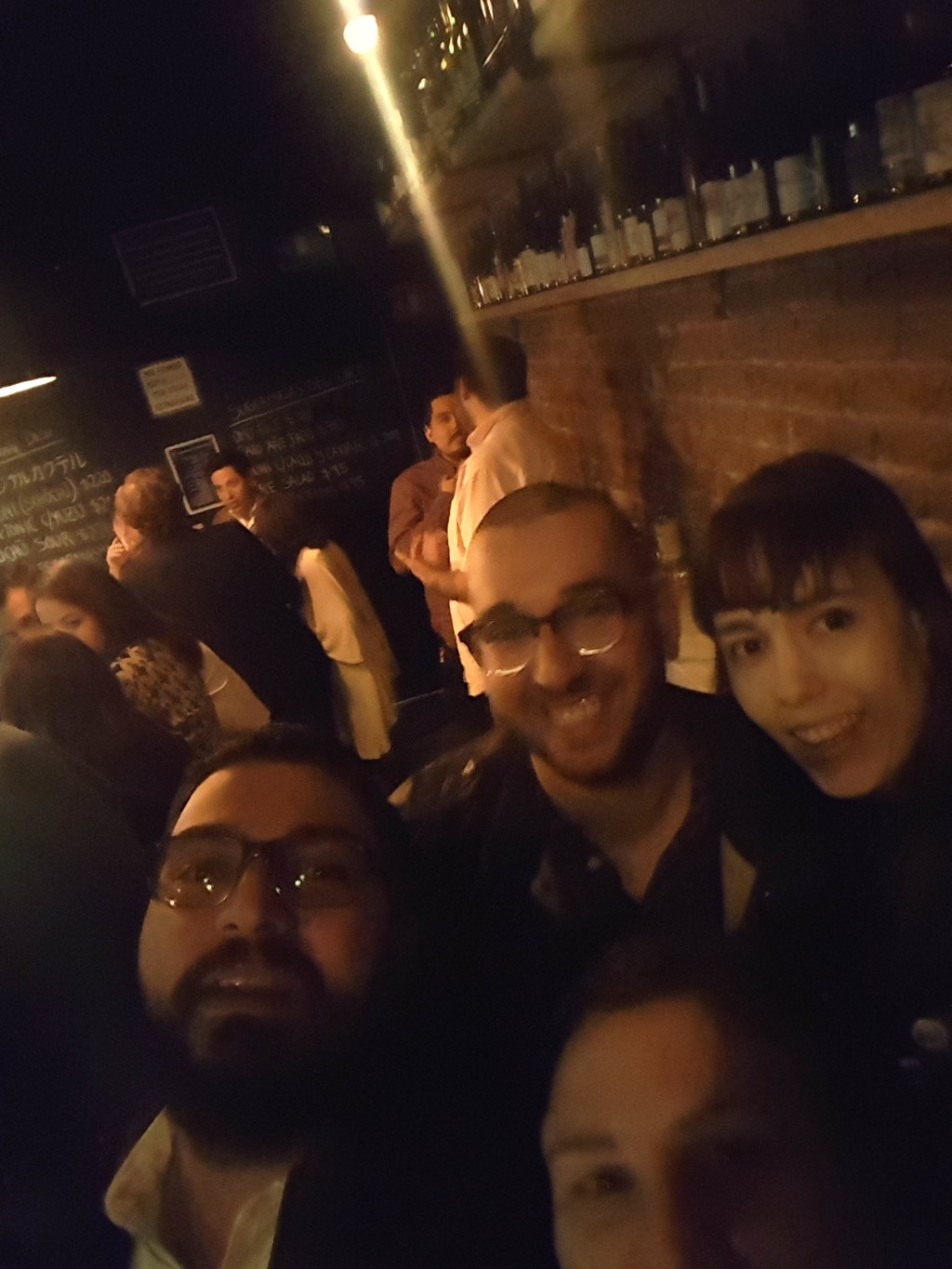
    • Le Tachinomi Desu: This place was very trendy and cool, which normally means there’s a catch, but in this case there wasn’t. The wine and sake selections were unreal, and the service was great. It was the coolest place we went all week and we had a great time. It was the perfect spot for simply standing, drinking, and enjoying each other’s company. We were here until nearly 4 in the morning and we weren’t even the last people to leave. The place is run by a Japanese Mexican man and this place imports some really interesting sakes and wines. At one point they suggested we try a bottle so rare that there were less than 10 in the country. Sounds obnoxious, but it was worth the hype. Again, unreal. After being so full (from lunch still!) that I could hardly walk, it turns out that drinking sake until 4am was the cure. We also met some pretty interested characters to round out the night.
    • La Casa de Toño, Zona Rosa: This is a local chain that’s open late and basically serves whatever you could want to eat, but fried. This late at night they’d stopped serving beer, which was probably for the best or we’d have been there for hours. As it was, we ordered, ate, and went home to bed.

    It’s always fun to see familiar faces in a foreign city, and this was no different. Our trip to Mexico City was incredible throughout, but spending a couple of nights with Greg and Adrienne made it even better.

  • Airbnb Experience: Dive into real Mexico

    Airbnb Experience: Dive into real Mexico

    Our second Airbnb experience on this trip was called “Dive into real Mexico” and the name is a perfect descriptor. It was a full day experience – just over 10 hours long.

    We met our host Daniel in the morning and he drove us 2 hours away to the state where his family originates, Tlaxcala. After exploring the state capital, also called Tlaxcala, we drove to Daniel’s hometown, Texoloc, to cook in his grandfather’s traditional kitchen (seriously, it was over 100 years old!).

    That sounds short and sweet, but this trip was a long day, jam packed with food, activities, and knowledge. Obviously, we loved it.

    We haven’t blogged much about it yet, but throughout our trip we learned a lot about Mexico’s history and culture, particular the pre-European cultures and traditions throughout the region. Our adventure with Daniel, our last full day in Mexico, was the perfect way to wrap this up, as Tlaxcala and the Tlaxcalan people have a very rich history. You can read more about it here, but the summary from Daniel is essentially this: Tlaxcala has existed for thousands of years, and they were proudly distinct from the Mexica people who were otherwise dominating much of the surrounding area (and who also founded Mexico City’s precursor, Tenochtitlan). When the Spanish colonizers arrived they formed strategic alliances with non-Mexica groups, the first of which was their alliance with Tlaxcala. Tlaxcala people traveled to Madrid to sign this agreement, and they eventually travelled with Spanish colonizers to the Philippines. Even today some traditional Tlaxcala words are spoken in the Philippines, and Tlaxcala descendants still live in the Philippines.

    Aside from learning, we also ate A LOT. We started our day in a Mexico City market, eating tamales for breakfast. Then we drove to Tlaxcala where we ate our way through market stalls and wandered around admiring the variety of foods and goods available.

    We took a trip through an artisanal market on our way to drink pulque (a pre-hispanic drink known as the nectar of the gods – more on this later). Next we visited the church in Tlaxcala, which is one of the oldest Spanish churches in the Americas. We also visited the city’s bullfighting arena.

    And then, after all that, it was time to make dinner!

    We went to Daniel’s grandfather’s house where we met his parents and learned how to cook using traditional pre-hispanic tools and techniques. Daniel’s delightful mother lead us through the entire process of making tlacoyos from scratch – including the dough! We even made homemade tortillas!

    After all that, we ate again. We then explored Daniel’s grandfather’s farm and took a quick walk through the town of Texeloc (fun fact: everyone in the world with the last name Tecpa can trace their roots back to this very town!).

    We took many, many photos, all of which you can see below (with explanatory notes added in for context). If you ever have a free day to spend in Mexico, and if you love food and history, then you definitely should sign up for Daniel’s “dive into real Mexico“! It’s truly one of the most interesting things I’ve ever done while travelling.

    Here’s a video of Kevin and I making tlacoyos, and below that are our photos from the day!


  • Our home away from home in the Condesa Aurora Sunroom!

    Our home away from home in the Condesa Aurora Sunroom!

    Kevin was in charge of finding our Airbnb and I’m sure he looked at hundreds of listings to narrow down his options. Ever the skilled researcher, Kevin found us what I can honestly describe as the world’s best Airbnb host, Leonor.

    We had initially planned to reserve one of her full apartments, but we took too long to book and thus missed out. I was ready to find someone else, but Kevin insisted that Leonor was so amazing that it would be worthwhile to stay in a room within one of her apartments.

    He was absolutely correct. And bonus: the room that we booked did essentially feel like a private apartment, with private access to our own kitchen and bathroom.

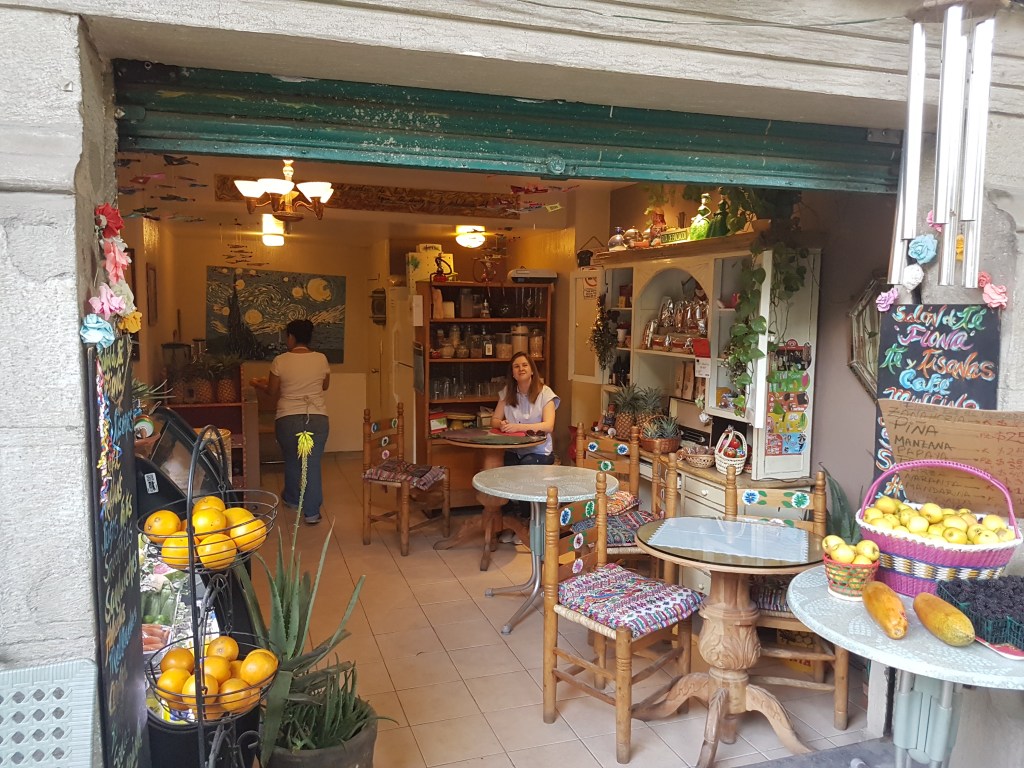
    Because we stayed with Leonor we got free pick up at the airport which made for a delightfully stress-free start to our trip. Leonor also runs a cafe around the corner where we ate complimentary continental breakfast everyday.

    The cafe is called “Cafe Fiona”, named after her dog Fiona, who carries her own purse down to the cafe each morning and then spends her time greeting patrons.

    Overall, staying at Leonor’s place was wonderful. She was a great resource to access, whether checking in on us post-earthquake, letting us borrow hats to visit Teotihuacan, or offering us restaurant recommendations. The next time we visit Mexico City, I can guarantee that we’ll be staying at one of Leonor’s apartments. If you’re looking for a well-priced gem in La Condesa neighbourhood, I highly recommend the Condesa Aurora Sun Room!


  • Airbnb Experience: “Discover street food with a local”

    Airbnb Experience: “Discover street food with a local”

    When Kevin and I went to Amsterdam we kicked off our trip with a food tour, which was both a unique culinary experience and a great walking tour with a local guide. We were introduced to the food tour via Booking.com but since we didn’t use them for our trip this time around we decided to try a new source of fun: Airbnb “experiences”.

    We participated in 2 different experiences during our trip, and the first was called “discover street food with a local“. We did this on Tuesday, and it was one of the highlights of our trip!

    We started off in the morning outside of El Templo Mayor where we met our guide, Pili. She gave us a brief history of the temple and market square and church nearby. From there, we hopped on the subway and went to explore a local market. This particular market served as a distribution hub for fresh flowers, so it was quite beautiful.

    Near the market was a type of food court, and we went there to learn how to cook a traditional Mexican dish, huaraches. They’re typically quite large but since we were novices, we made smaller huaraches – a corn flower dough, with a bean paste in the middle. The technique was kind of like making a perogie: flatten a small ball of dough, add in the filling, then pull the tough tight around it and pinch it sealed. However, then you also flatten out the dough and fry it.

    Huaraches are served with a pile of toppings, and we also made those! Toppings included tomatillo salsa, cactus, and huitlacoche. This was pretty exciting because huitlacoche is a delicacy that originated in Aztec cuisine and is unlike anything we’d ever eat in Canada.

    The English term for huitlacoche is “corn smut”. Huitlacoche is a type of corn fungus, which is why it’s rarely found north of Mexico. As we expected, it’s delicious!

    After we ate our huaraches, Pili and our chef host, Evelyn, made us quesadillas as well. From there we need an energy boost, so Pili took us back to city centre to visit a market famed for its traditional coffee. I had a chocolate drink that was incredible and Kevin enjoyed an espresso.

    To wrap up the day we visited a stall that sells insects as cuisine! The other couple in our group (shout out to Landon and Jerusalem!) were brave enough to try, but I was too full/afraid.

    The whole “experience” lasted approximately 4 hours and was jam-packed with learning and fun. Pili was a great host and she showed us a great time. She was fun and friendly, very knowledgeable, and open to answering any questions we had. Spending the day with her was like hanging out with a friend, and I would absolutely recommend her tours to anyone.

    If you’re looking for a great half-day experience in Mexico City then I definitely recommend you take her tour!

    See below for the many photos of our adventure with Pili!


  • El Bazaar Sábado

    El Bazaar Sábado

    Our first full day in Mexico City fell on a Saturday. Our Airbnb host recommended that we take this opportunity to visit “El Bazaar Sábado” (aka the Saturday Bazaar) as it’s a unique event that only happens once per week. And so on Saturday morning we took an Uber south into the historic neighbourhood of San Angel.

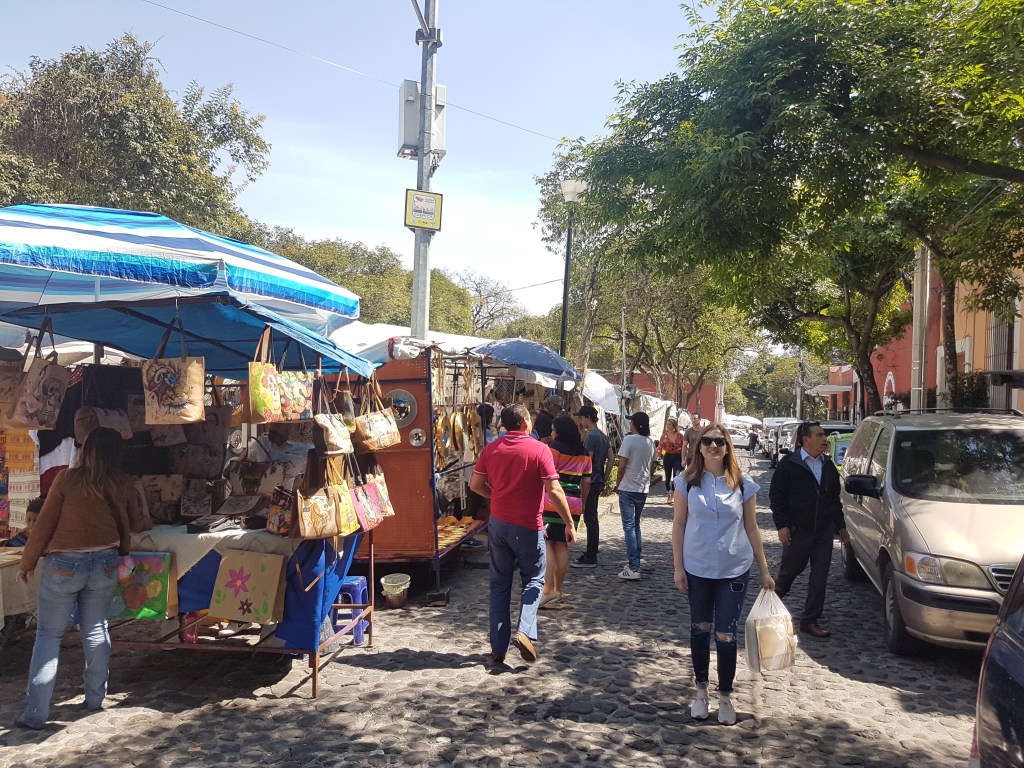
    The bazaar has 2 parts: a variety of kiosk stalls in a market, and a wide variety of artists exhibiting their work in the park.

    We started in the stalls of the market and were quickly impressed with the range and quality of the goods available. From there we wandered over to the park to start shopping for art! Again, we were quite impressed.

    Kevin and I spend a lot of time visiting artisan markets in Toronto, and we were amazed (again) by the range and quality of the work available. We had heard that Mexico City had a great arts scene, and this was certainly the first of many days/events that proved it to be true. We ended up buying a bunch of art and souvenirs, though the best part of the day was simply walking around in the sun.

    After the market, we walked to the San Angel Inn to try some of their famous margaritas. They were worth the hype, and while the rest of the food/service were just okay, overall the San Angel Inn kept us entertained as we watched upper middle class people wandering in and putting on their airs.

    After lunch we visited Museo Casa Estudio Diego Rivera y Frida Kahlo, the home where the famous Mexican artists Frida Kahlo and Diego River lived together. There’s more to come on that one later. For now, check out the below photos of our adventures in San Angel!