
After leaving Nacpan Beach, we took a bus down to the Palawan capital of Puerto Princesa, where we were scheduled to catch a flight back to Manila. So, we boarded an air-conditioned van that took us on a 7 hour bus ride, despite telling us it would be 4.5 hours. But hey – rain, a flat tire, and slow-moving fellow passengers get in the way of schedules sometimes. Anyways, Puerto Princesa bills itself as “a city within a forest”, and while we didn’t see much of the city, we did check out the area’s main attraction – the Underground River.
This included a wild van ride through the forest to get to said attraction, followed by a boat ride inside extensive caves underneath the mountain where the Underground River flows. I’m sure there was a lot of science-y facts to be learned about this place, but we didn’t learn any of them on our tour. Here’s what the UNESCO website has to say:
“Puerto-Princesa Subterranean River National Park encompasses one of the world’s most impressive cave systems, featuring spectacular limestone karst landscapes, pristine natural beauty, and intact old-growth forests and distinctive wildlife. It is located in the south-western part of the Philippine Archipelago on the mid western coast of Palawan, approximately 76 km northwest of Puerto Princesa and 360 km southwest of Manila.
The property, comprising an area of approximately 5,753ha, contains an 8.2km long underground river. The highlight of this subterranean river system is that it flows directly into the sea, with its brackish lower half subjected to tidal influence, distinguishing it as a significant natural global phenomenon. The river’s cavern presents remarkable, eye-catching rock formations. The property contains a full mountain-to-sea ecosystem which provides significant habitat for biodiversity conservation and protects the most intact and noteworthy forests within the Palawan biogeographic province. Holding the distinction of being the first national park devolved and successfully managed by a local government unit, the park’s effective management system is a symbol of commitment by the Filipino people to the protection and conservation of their natural heritage.” (UNESCO)
Our tour went more like this:
“That rock, up there, looks like the Virgin Mary”
“That formation ahead looks like carrots”
“If you look to the right, you’ll see it looks like garlic”
“Again, that to the left looks like the Virgin Mary”
“Up at the top, those formations, they look like the Last Supper”
So, not very scientific, but quite entertaining. The caves were really stunning; also, filled with bats. I did get some bat poop in my hair but fortunately none in my mouth – apparently that actually happens to people sometimes.
This video does a pretty good job of showing what the canoe right into the caves looked like:
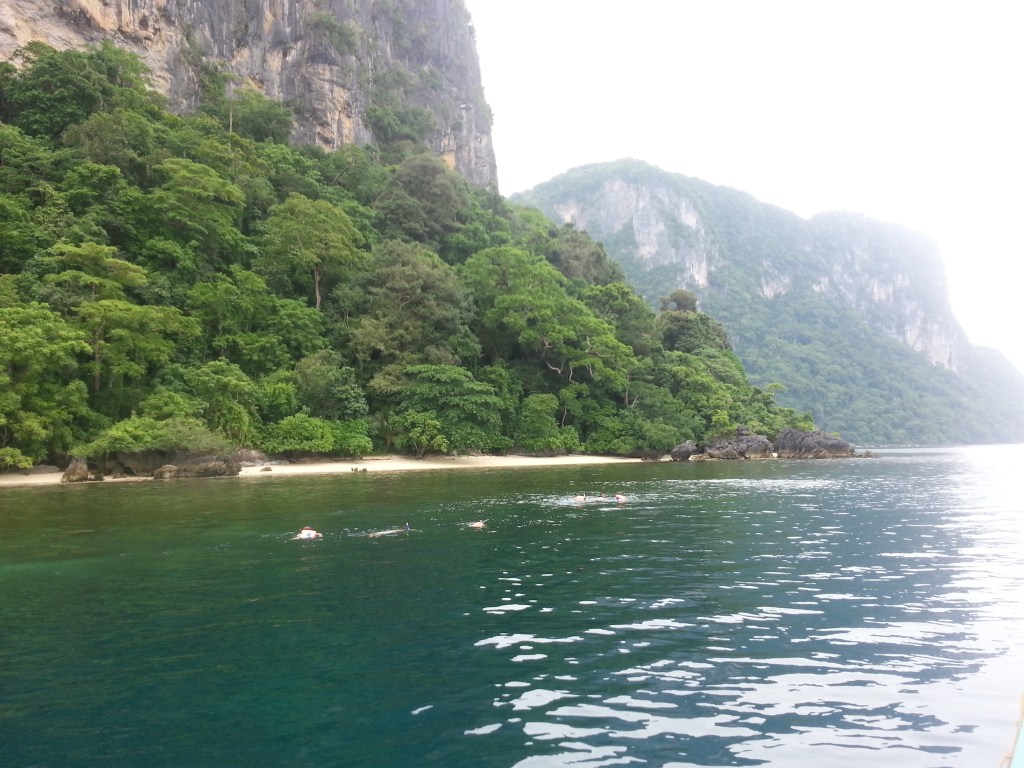
Below we have photos of Kevin playing with Mimi the cat at our hotel, the scenery on the way to the Underground River, and photos of us at the Underground River with our friend Breann (who we met on our crazy van ride). Check it out!




 the stories that I'm telling.