Tag: europe

  • #tbt – Friendship reunion in Cannes!

    #tbt – Friendship reunion in Cannes!

    In the time that I’ve been travelling, the glorious technology of iMessage & Group Chats has been a complete lifesaver, helping me keep in constant touch with some of my best friends in Canada. I have a group chat with 2 of my friends, Julie and Komal, that is essentially a haven of love, positivity, and support as we share each others fears and excitement while building our lives and careers from three different cities.

    Komal is currently producing a documentary about female CEOs and entrepreneurs called “Dream, Girl“, and thus was invited to speak on a panel at the Cannes Film Festival this year in Cannes, France. You know France… just around the corner from Portugal? In a series of events that still seems to good to have been true, we all decided to go to France together in support of Komal and in search of sunshine.

    The trip was four women in total: me, Julie, Komal, and Taylor (another very good friend of Komal’s and overall talented woman).

    Cannes was all booked up by the time we planned this trip, so we opted to stay in Nice, which is just a 30 minute train ride away from Cannes.

    Four women. Five days in France. Here are the numbers on what we got up to:

    • number of delayed flights: 0 (win!)
    • number of hours spent on the beach: at least 24 – we made a point of clocking hours in the sun
    • number of small children that we saw poop into a bag while on the beach: 1 (gross.)
    • number of parties that we snuck into: 1 (Komal said, “act like you belong”, and we went with it)
    • number of parties we tried and failed to sneak into: 1
    • number of creeps that we met: 2
    • number of wonderful people that we met: many, many, many
    • number of ways we tried to sneak in: 5
    • number of celebrities that we saw: at least 10
    • number of reunions with a friend from Cambodia: 1
    • number of friends that Julie and I made while dancing till 7am: more than I can remember, that’s for sure.
    • number of minutes that Julie and I were on the Cannes-to-Paris train instead of the Cannes-to-Nice train: 45
    • number of panelists on the “Cutting Edge Collaborators: Women Achieving in Film” panel discussion: 5
    • number of red carpet photos taken between the 4 of us: 20+
    • number of vlogs recorded: 10+
    • number of times we used the word “glam”: 50+
    • number of times we were glam: always
    • number of times we felt immense gratitude for this trip with these people: constant. Still feeling grateful as I relive the memories now
    • number of photos we took: surprisingly few, and all the best are below.

    Leaving Kevin to go to France just a week after his implants surgery (and on an expired travel visa!) was actually pretty scary. But it was worth every second of it to enjoy the unique experience of travelling to be a cheerleader for Komal. Also pretty cool because it means that Julie and I had 2 European-adventures together in 2015! It was a rough year, but the bright spots were very, very bright.

  • Roadtrip Day 2: Piodao

    Roadtrip Day 2: Piodao

    When I say that Kevin researched and planned our road trip with Tyler, I don’t mean that lightly. As soon as Tyler booked his tickets to visit, the research began. And not just some simple google searches of ‘best sights in Portugal’. If Kevin has ever helped you with anything, you know that his research-style is all-in and he stops at nothing to get the best possible outcome. Nothing exemplifies this more than our stop off in Piodao.

    A few weeks before the trip, Kevin showed me a photo of a place that looked amazing, and told me that it was a must-do stop. When I convinced him to shorten the road trip from 6 days to 3, Piodao was one of those places that was a must-see, not to be compromised. And he was so, so right.

    After our morning at the Knights Templar’s Convent of Christ in Tomar, we got back into the truck and embarked on what I can honestly say is the wildest, most breathtaking and most nerve-racking road trip of my life. Before I get into too many road trip details, let’s talk about why Piodao is special and worth seeing.

    Piodao, known as the “nativity village” is a small collection of stone buildings, tucked into a mountain side. Unlike most of the places we’ve visited on this trip, Piodao, due to its remote geographic location, was almost entirely disconnected from Portuguese history. How disconnected? This village didn’t have electricity until the 1970s. This geographic isolation is what makes Piodao so unique – because they were limited to local resources, which is reflected in the architecture of the town itself, their traditions were well-preserved over the years, due to a lack of outside influences. Entering Piodao, picturesquely placed in between 2 hills in a mountain range, feels like entering a fairy tale. As you stand on the hillside, you can even hear the echo of jingling bells from the goat herds. My only regret of this entire trip is that we didn’t stay longer.

    Now, about that road trip. It was long and a bit harrowing. And as the trip went on, we felt increasingly alone. There were long stretches (on this 2.5 hour drive) without seeing other people and cars, though we did see a herd of goats crossing the road. We climbed up into the mountaintops, driving along winding roads, on the edge of cliffs, surrounded by clouds. I was both in awe of the view and in awe of Kevin’s patience & composure while navigating these roads. There’s absolutely no way that a bus could have made this journey.

    Visiting Piodao was a truly surreal and magical experience. I recommend it very much. And beyond being beautiful, the town itself offers great food and friendly people. Check out our many photos below!

  • Roadtrip Day 1 (still!): Quinta da Regaleira

    Roadtrip Day 1 (still!): Quinta da Regaleira

    If you’ve ever read this blog, you know that we typically take our travel slowly. Even if that means we miss out on some possible sites, we always try to spend the maximum amount of time in our travel pursuits, in an attempt to really understand where it is that we’re visiting. Clearly we didn’t quite take that approach on our road trip, where we packed quite a bit of stuff in. I mean, we’re now 3 posts into Day 1 of our Sintra road trip, and yet we still drove another 2+ hours on this day!

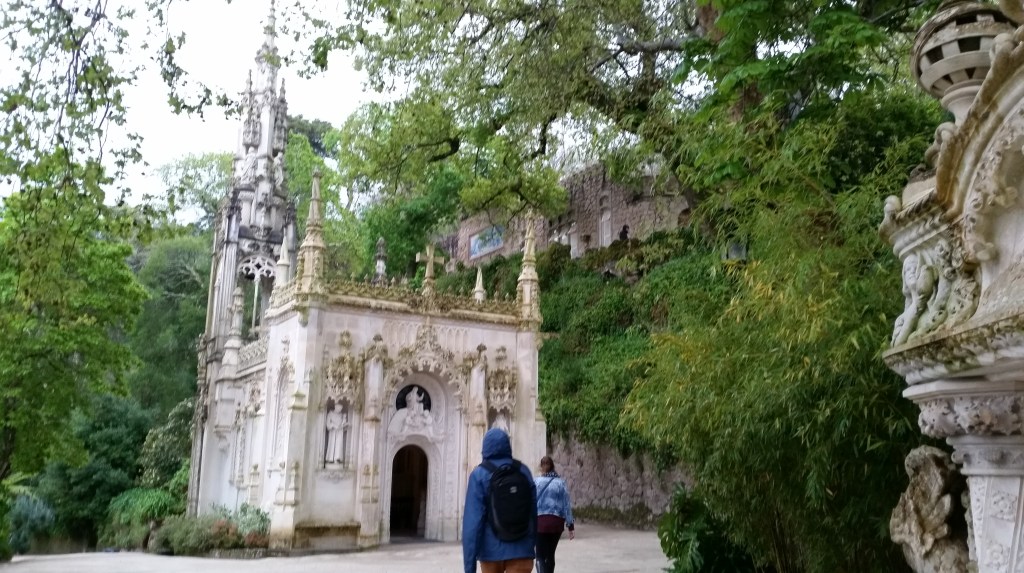
    Our wonderful friend, Soledad, insisted that we visit “Quinta da Regaleira”. It roughly translates to being “Estate of Regaleira” (the land was once owned by the wealthy Regaleira family from Northern Portugal). Soledad told us that this was her favourite place in the world, and once we arrived we realized why. We also very much regretted not budgeting more time to be here. There was so much to see, and we certainly didn’t let the rain slow us down!

    The Quinta da Regaleira is essentially an estate that was once owned by a rich guy with big dreams of making something fancy. And this guy, António Carvalho Monteiro (actually nicknamed Moneybags Monteiro) sure achieved his goal. He was an eccentric guy who leveraged his family fortune to become a coffee tycoon in Brazil, then returned to Portugal study everything from law to bugs.

    After purchasing the land in 1892, he spent until 1910 creating a magical villa and gardens, a neo-Manueline extravaganza all dreamed up by Italian opera-set designer Luigi Manini (Lonely Planet).

    Despite the rain, we spent most of our time exploring the extensive gardens. This place is a landscape architect’s dream, boasting arches, gazebos, grottos, aquariums, gardens, patios, paths, fountains, tunnels, bridges, and more. The highlight is almost certainly what’s known as the “Initiation Wells”. We spent at least 30 minutes trying to find them, and it was well worth the effort. Here’s some background info, courtesy of our friends at Ancient-Origins.net:

    The pair of wells, known as the ‘Initiation Wells’ or ‘Inverted Towers’, consist of ‘winding stair’ architecture, which carries symbolic meaning including the death/rebirth allegory common to many hermetic traditions.

    One of the wells contains nine platforms, which are said to be “reminiscent of the Divine Comedy by Dante and the nine circles of Hell, the nine sections of Purgatory and the nine skies which constitute Paradise.” A smaller well, called the “Unfinished Well,” contains a set of straight staircases, connecting the ring-shaped floors to one another. It is believed that the spacing of the landings, as well as the number of steps in between were dictated by Masonic principles.

    The two wells are connected to a series of underground tunnels and caves. Once we entered the primary initiation well, we descended deep underground.

    To our great delight, we ended up in passing through the other well and entering a grotto/lake/waterfall area. We were beyond thrilled at this turn of events. We’d been freaking out about the beauty of this site all day, but this discovery topped them all, and we immediately agreed that Soledad was right about this place.

    The inside of the mansion was pretty cool as well, but nothing close to the outdoor gardens and its secrets. If you plan to visit this site, give yourself at least 3 hours to see everything!

    Check out the photos to see all this beauty for yourself (some are a bit blurry due to the rain – we were completely soaked, as was the phone!):


  • Roadtrip Day 1: Exploring the Convent of the Capuchos

    Roadtrip Day 1: Exploring the Convent of the Capuchos

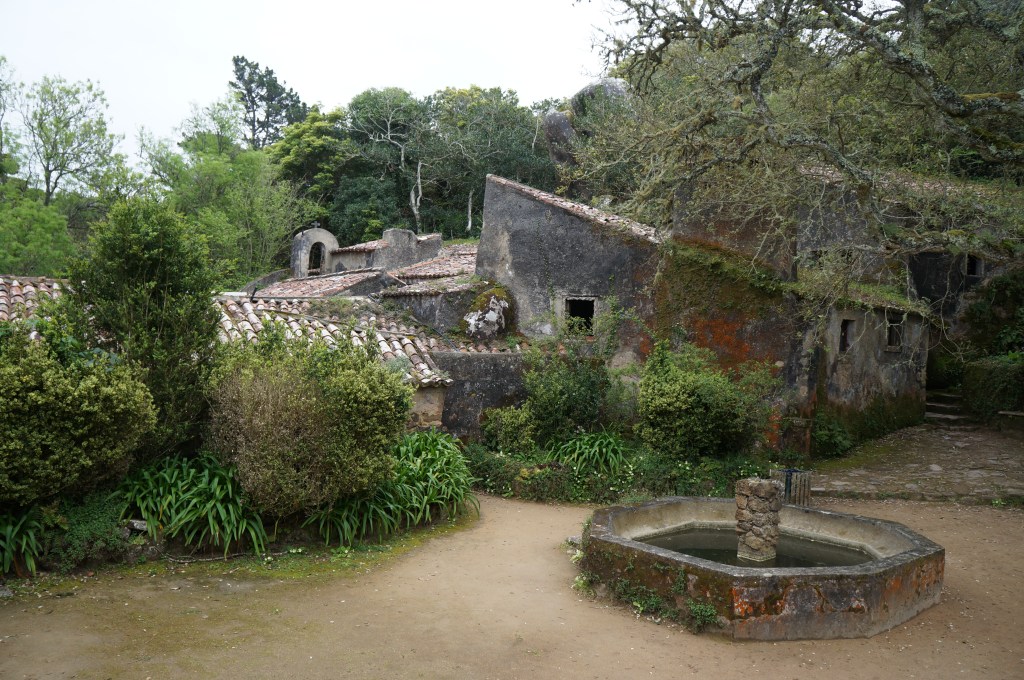
    After stopping at the Cabo da Roca, we drove back into the Sintra-Cascais Natural Park. The drive alone was incredible: beautiful trees, winding roads that twisted up a hillside. Our next stop was at ruins of the centuries old Convent of the Capuchos.

    Literally translating to the “Cork Convent”, its name comes from the insulation used in the construction of the buildings here. It was first formed in the mid-1500s, and according to the lovely brochure that I’ve been saving for this exact occasion,

    The Cork Convent was built in accordance with a philosophy that stressed harmony between human and divine works, for which reason the building merges inseparably with nature and the surrounding vegetation, incorporation enormous granite boulders. Through the exercise of contemplation, fulfilling the teachings of Saint Francis of Assisi, the friars worshipped the Creator through what they considered to be His greatest work; the natural world”

    Though the convent has ceased to be operated as such, and is now simply a series of ruins to be toured by visitors, you can easily see the convent’s philosophy at work. It’s impossible to wander through the small buildings, built into the side of a hill, without reflecting on the beauty and calming effects of nature. The smell and feel in the air of so much nature all in one place was truly magical. And this magical place really was the perfect start to a magical day in magical Sintra.

    We spent about an hour exploring all the nooks and crannies of these small, simple buildings. We snapped some great photos, and also some “band photos”. There were lots of laughs at this early point in our roadtrip, and that continued on throughout the day.

    Check out the photos below!

  • Roadtrip Day 1: We went to the edge of continental Europe!

    Roadtrip Day 1: We went to the edge of continental Europe!

    A quick post today before we head out to the beach. This post is a bit late coming, but Kevin’s best friend Mark is currently visiting, so we’ve been out and about (we also drove to Lisbon to pick him up 2 days in a row, because the first day we drove up we were a day too early).

    Anyways, when Tyler was here, our post-Lisbon road trip began with a drive to Cabo da Roca, a lighthouse at the westernmost point of continental Europe. Perhaps not the coolest claim to fame of all time, but it was gorgeous nonetheless.

    The western coast of Portugal is dotted with gorgeous cliffs, and Cabo da Roca is no exception. It’s a popular tourist attraction in the picturesque Sintra-Cascais Natural Park, and was the first of many beautiful spots that we saw in Sintra that day. Because it was March, we were 3 of maybe 8 people there that day. Being along the cliffs, with the beautiful green fields behind us felt magical. It was a great to start to an excellent day.

    See below for the photos!


  • Life with a garden in Alte

    Life with a garden in Alte

    The garden at Avo Olimpia’s house in Alte is not just for lemon trees and orange trees. It’s also a place for herbs and flowers.

    Many, many flowers. In particular, roses.

    When I was growing up, my grandparents had a truly incredible rose garden. I frequently remember walking through the garden with my grandparents, examining the roses, learning their names, and choosing favourites. I’d never expected to experience rose-induced nostalgia, but as winter ended and the roses began blooming in Alte, it hit me. And it kind of freaked me out, too. Kevin and I would walk through the garden, he’d pose question about a flower, and I’d know the answer. For a small amount of time, I felt the like the Jason Bourne of gardening. Totally weird, but also nice to be reminded that there is lasting evidence from that time in my life, beyond simple memories.

    Beyond roses, the gardens in Alte are filled with the types of flowers you typically only see in bouquets in Canada. The weather here is far more forgiving, which means that plants which die during the winter at home actually survive here. Not only do I get to see unique flowers, I also get to see flowers that are larger than I’ve ever seen before.

    Take a look below to see some shots Kevin has captured in the garden over the past couple of months. Beautiful colours, beautiful flowers, beautiful memories.


  • Back to the beginning: a few days in Lisbon

    Back to the beginning: a few days in Lisbon

    Back in December, when Kevin and I were in Canada for Christmas, we planned out a trip that would involve a couple of weeks in Lisbon followed by travels through Spain, all the way to Paris, where we’d then fly back to Cambodia.

    We booked plane tickets to Lisbon, Portugal for January 4th.

    Back in November, I’d been planning a January trip to Vietnam with two of my lady friends, Julie & Komal. Due to the complications of life and travel visas, that hadn’t worked out. However, Julie planned to be in Lisbon for 2 days along with Kevin and I.

    When Kevin was hit in the mouth with a hockey stick on January 2nd, I was admittedly freaking out. Not only had we booked tickets to Lisbon, but my friend had booked a trip to meet us there. Needless to say, we didn’t miss our flight. I hopped Kevin up on pain killers and got him on the plane to Lisbon. His godfather met us there, and showed us to an incredibly wonderful few days in one of my favourite cities that I’ve been to yet.

    Many photos are attached, because we were able to cram lots of fun into a few short days. One of the most important things to note is how much we were able to do while also being completed relaxed. Julie was coming off a serious bout of food poisoning, and Kevin was obviously also in quite a bit of pain. However, Lisbon is such a welcoming and easy-to-access, non-touristy, relaxed place that were able to really make the most of our time there.

    Rather than crash at a hotel, we rented an AirBnB through a group called Travel & Tales. The fine gentlemen who run Travel & Tales, Pedro & Duarte, rent out a series of apartments in the chic Lisbon neighbourhood of Principe Real.

    One of the most bizarre things about Lisbon is how similar (also better than) it is to San Francisco. Hills are one such similarity, and when Kevin’s godfather drove us up into Principe Real, and then parked on one of the steepest hills imaginable, I knew we were in for an authentically Lisbon experience. Pedro helped us check in and hooked us up with some free SIM cards for our phones, and we were off on an adventure. Oh, and the apartment we were renting? Absolutely beautiful. Historical. Interesting. Clean. Well-located. I cannot say enough good things. It really represented the best of what Lisbon has to offer.

    Relative to other European capital cities, Lisbon is geographically small and rather inexpensive. And yet, as the capital city of the once-massive Portuguese empire, it’s jam-packed with history, old-world beauty, and remnants of the colonial wealth that created it.

    The city has many interesting neighbourhoods, and an hour or two of walking can really take you through a great cross-section of the best of Lisbon. We walked everywhere and saw a lot. It also helps that the hills of Lisbon mean you’re never far from an incredible, heightened view of the city. From old plazas with fountains and monuments galore, to the city’s oceanfront, where colonial ships once presented their wealth to kingdom, to ruins, and one of the first elevators in Europe, we walked and saw it all.

    Kevin took a couple of much-needed naps, as well as an afternoon trip to a private hospital to see if his lip was actually recovering, so Julie and I also had a couple of long exploratory jaunts. On one occasion we hopped in a cab to the Belem neighbourhood. There, we sat by waterfront along the Tagus river and enjoyed some lovely January sunshine. We also saw the Jeronimos Monastery, and the “Monument to the Discoveries”. We also caught a glimpse of the Ponte de 25 April (April 25th Bridge), which is essentially Lisbon’s version of the Golden Gate Bridge in San Francisco. It’s 27th largest suspension bridge in the world. I highly suggest you click on all those links and read what Wikipedia has to say about all these sights. So many interesting things to learn! On another jaunt, we decided to start walking and just see where we ended up. Turns out that we ended up at a lookout point behind a neighbourhood that had enticed us with a long yet lovely staircase. It was the perfect spot to watch the sunset, though regrettably I didn’t have my camera. That type of magical experience is exactly what makes Lisbon so enchanting.

    With all that walking, we obviously needed to eat, and Lisbon had us covered there as well. Because Lisbon is so old, almost every building is special in some way, which makes dining that much more interesting. We opted for a couple of low-key local places for lunch, and tried some fancier dining at night. Portuguese food is simple yet delicious, and I think that would describe our Lisbon culinary experience as well.

    If you can’t already tell, I’m a big fan of Lisbon. More than that, I’m a big fan of spending time with the people who I care about. I’ll let you see more of what we did by perusing the photos below. What really made this trip special was getting to explore a beautiful city with Kevin and my dear friend Julie. If you’ve never considered visiting Lisbon, I suggest that you add it to your to-do list, but more than that, I hope that you make the time to have interesting experiences with the people who you love.


  • Roman Ruins in Canterbury

    Roman Ruins in Canterbury

    Did you know that the romans used to have a giant empire? And did you know that it included a sizeable chunk of the present-day UK? Here’s a map:

    roman_emp

    The earliest history of Canterbury actually goes back even further than the Romans, but they seem to have left the largest footprint. Here’s what Wikipedia has to say about it:

    The Canterbury area has been inhabited since prehistoric times. Lower Paleolithic axes, and Neolithic and Bronze Age pots have been found in the area. Canterbury was first recorded as the main settlement of the Celtic tribe of the Cantiaci, which inhabited most of modern day Kent. In the 1st century AD, the Romans captured the settlement and named it Durovernum Cantiacorum. The Romans rebuilt the city, with new streets in a grid pattern, a theatre, a temple, a forum, and public baths. In the late 3rd century, to defend against attack from barbarians, the Romans built an earth bank around the city and a wall with seven gates, which enclosed an area of 130 acres (53 ha).

    Despite being counted as one of the 28 cities of Sub-Roman Britain, it seems that after the Romans left Britain in 410 Durovernum Cantiacorum was abandoned except by a few farmers and gradually decayed.[12] Over the next 100 years, an Anglo-Saxon community formed within the city walls, as Jutish refugees arrived, possibly intermarrying with the locals.[13] In 597, Pope Gregory the Great sent Augustine to convert its King Æthelberht to Christianity. After the conversion, Canterbury, being a Roman town, was chosen by Augustine as the centre for his episcopal see in Kent, and an abbey and cathedral were built. Augustine thus became the first Archbishop of Canterbury.[14] The town’s new importance led to its revival, and trades developed in pottery, textiles, and leather. By 630, gold coins were being struck at the Canterbury mint. In 672, the Synod of Hertford gave the see of Canterbury authority over the entire English Church.

    In 842 and 851, Canterbury suffered great loss of life during Danish raids. In 978, Archbishop Dunstan refounded the abbey built by Augustine, and named it St Augustine’s Abbey. A second wave of Danish attacks began in 991, and in 1011 the cathedral was burnt and Archbishop Alphege was killed in 1012. Remembering the destruction caused by the Danes, the inhabitants of Canterbury did not resist William the Conqueror’s invasion in 1066.

    So, things and buildings in Britain are super old. However, once in awhile, modern people try to do some remodeling of one of these 500+ year old buildings. When they do, they have to dig. And sometimes they find the remnants of buildings and places that were built by Romans, 800+ years ago. So, ya, that’s pretty wild.

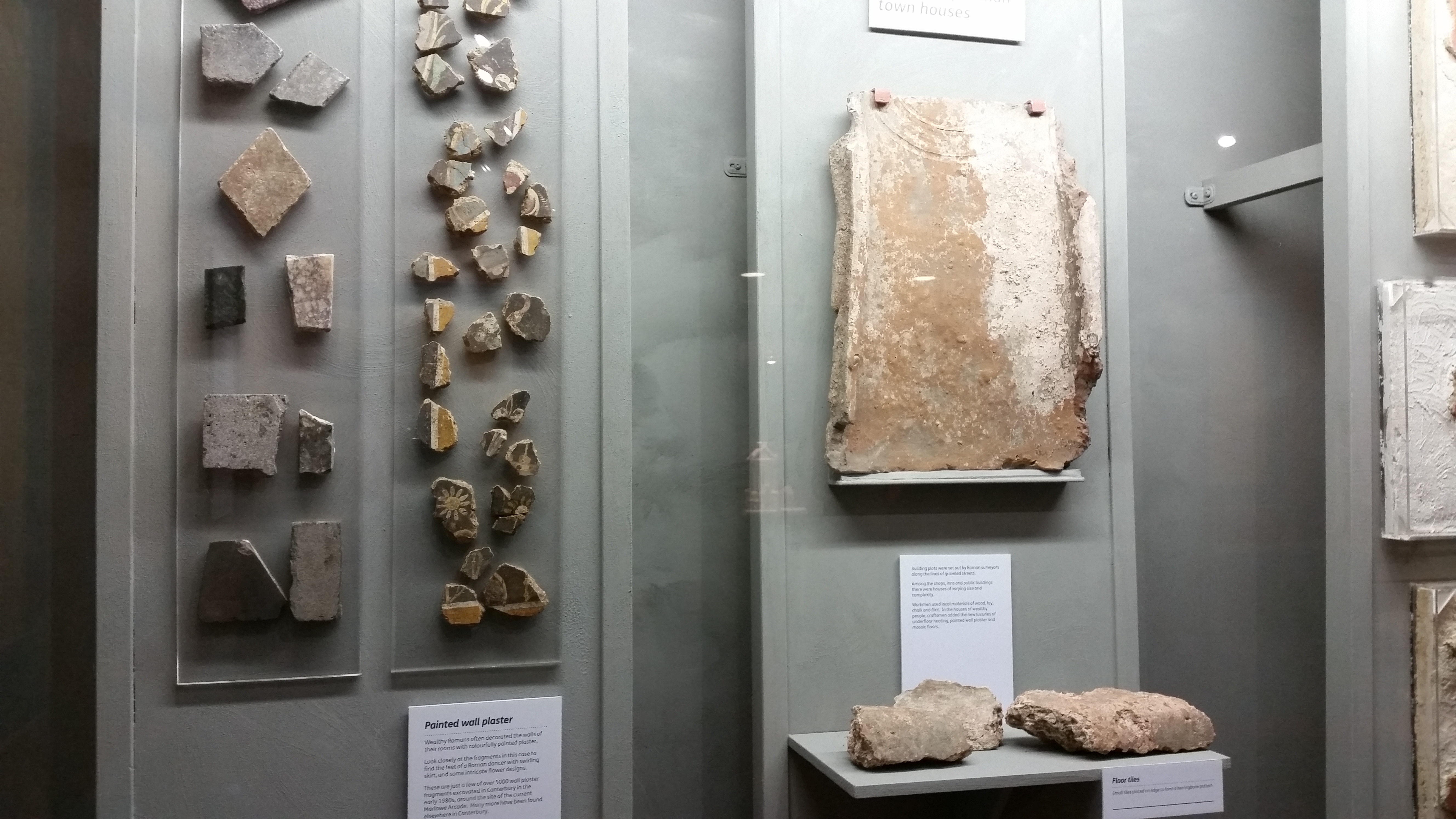
    And so, because it’s usually better to remember history than just build parkings lots and condos over top of it (I’m looking at you, Toronto), there are a couple of places in Canterbury where you can see the discovered ruins of Roman civilization. In one case, there’s an entire museum about Roman history in Canterbury. In another location, a section of ruins is preserved in a glassed-in room in the basement of a bookstore.

    Nana Ev and I went to see both!

    The bookstore was cool in a this-is-neat-to-see kind of way, but the museum found and preserved a fairly significant portion of a Roman bath, including a long hallway and the pipes that heated the baths, various floors, and walls.

    There’s not much to be said, so I’ll get out of your way and you can look at the pictures. The museum also showcased a ton of artifacts, including jewellery, glass jugs, and bowls. Enjoy!