Tag: featured

  • Day 3 in Madrid – Lunch at DSTAgE

    Day 3 in Madrid – Lunch at DSTAgE

    Before we came to Madrid, Zoya recommended we splurge on lunch at DSTAgE, a two Michelin star restaurant. She advised we’d need reservations, but when I tried to book us in, they were full.

    So what did Zoya do? She called them. She got us on the wait list for lunch everyday that we were in Madrid. On Tuesday, they called her back while we were in the museum, so we couldn’t go. But on Wednesday, they called her back just as we were waking up from a late slumber. Perfect timing. We got up, we got dressed, and we went to lunch at DSTAgE.

    Before we get into the amazing experience we had, a quick note on Michelin star restaurants.

    The Michelin Guide assigns star ratings (1, 2, or 3 stars) to top quality restaurants in select cities around the world. Receiving a Michelin star rating is considered rather prestigious, as the Michelin Guide is famed for its extremely high standards. Here’s where it all comes from, according to Wikipedia:

    In 1900, fewer than 3,000 cars graced the roads of France. To boost the demand for cars and, accordingly, car tires, brothers and car tire manufacturers Édouard and André Michelin published the first edition of a guide for French motorists, the Michelin Guide.[2] The brothers printed nearly 35,000 copies of this first, free edition of the Michelin Guide, which provided useful information to motorists, such as maps, tire repair and replacement instructions, car mechanics listings, hotels, and petrol stations throughout France. 

    Recognizing the growing popularity of the restaurant section of the guide, the brothers recruited a team of inspectors to visit and review restaurants, who were always careful in maintaining anonymity.[6]

    In 1926, the guide began to award stars for fine dining establishments. Initially, there was only a single star awarded. Then, in 1931, the hierarchy of zero, one, two, and three stars was introduced. Finally, In 1936, the criteria for the starred rankings were published:[3]

    • 1 Michelin star: “A very good restaurant in its category” (Une très bonne table dans sa catégorie)
    • 2 Michelin stars: “Excellent cooking, worth a detour” (Table excellente, mérite un détour)
    • 3 Michelin stars: “Exceptional cuisine, worth a special journey” (Une des meilleures tables, vaut le voyage).[6]

    Michelin reviewers (commonly called “inspectors”) are completely anonymous; they do not identify themselves, and their meals and expenses are paid for by the company founded by the Michelin brothers, never by a restaurant being reviewed.

    The French chef Paul Bocuse, one of the pioneers of nouvelle cuisine in the 1960s, said, “Michelin is the only guide that counts.”[11] In France, each year, at the time the guide is published, it sparks a media frenzy which has been compared to that for annual Academy Awards for films.

    So, that’s what the hype is all about. Accordingly, Michelin star restaurants are also quite expensive to eat at. Zoya and Shrip have found that, relative to other markets, Michelin star eating is a deal in Madrid, yet another reason why they encouraged us to try DSTAgE.

    So, what about DSTAgE itself? The restaurant is typically described as a ‘concept’ restaurant, and its known for experimentation and creativity. The owner and chef, Diego Guerrero, was previously the head chef at a different two Michelin star restaurant, and left to create his own restaurant in contrast to the uptight tradition and style of other high end restaurants in the city.

    According to the Michelin Guide:

    This restaurant has an urban and industrial look and a relaxed feel that reflects the personality of the chef. The name is an acronym of his core philosophy: ‘Days to Smell Taste Amaze Grow & Enjoy’. Discover cuisine that brings disparate cultures, ingredients and flavours together from Spain, Mexico and Japan.

    Now that you’re familiar with the concept of Michelin stars and with DSTAgE in particular, let’s talk about our experience.

    On Wednesday, we woke up to a call from Zoya about our reservation. From there, we got dressed and strolled across the city for lunch.

    One of the most interesting elements of our DSTAgE experience was how specifically everything was timed. When you arrive at the restaurant, you’re escorted to 1 of 2 stations at the bar of the open kitchen.

    There, you meet one of the cooks, who makes and serves you a palette opening dish, following by a palette cleansing drink. In our case, we had shrimps cooked over a Himalayan salt rock, served on a homemade cracker. It was bizarre and delicious, and hit every tastebud. Over the course of our meal, we watched every other group of patrons go through this experience as well.

    From there, you take a seat at your table, and decide how to tackle your meal. You can choose 12, 14, or 17 courses. You can also choose wine pairings for each course. We opted for 14 courses, without the pairings (it was lunch, after all!).

    Our first course was the seafood of the day: “razor clam with celeri dashi, almonds mild and coffee nectar”. The presentation was so cool that we took a video:


    When each course was brought to the table, our server explained how it was made, what is was, and how best to eat it.

    After the razor clams, we had something described to us as “Thailand in one bite”. It was pandan radish with pandan tea, and reminded us so much of the rice we had in Cambodia, which was often served with pandan leaves. Unfortunately we didn’t snap a picture of this one.

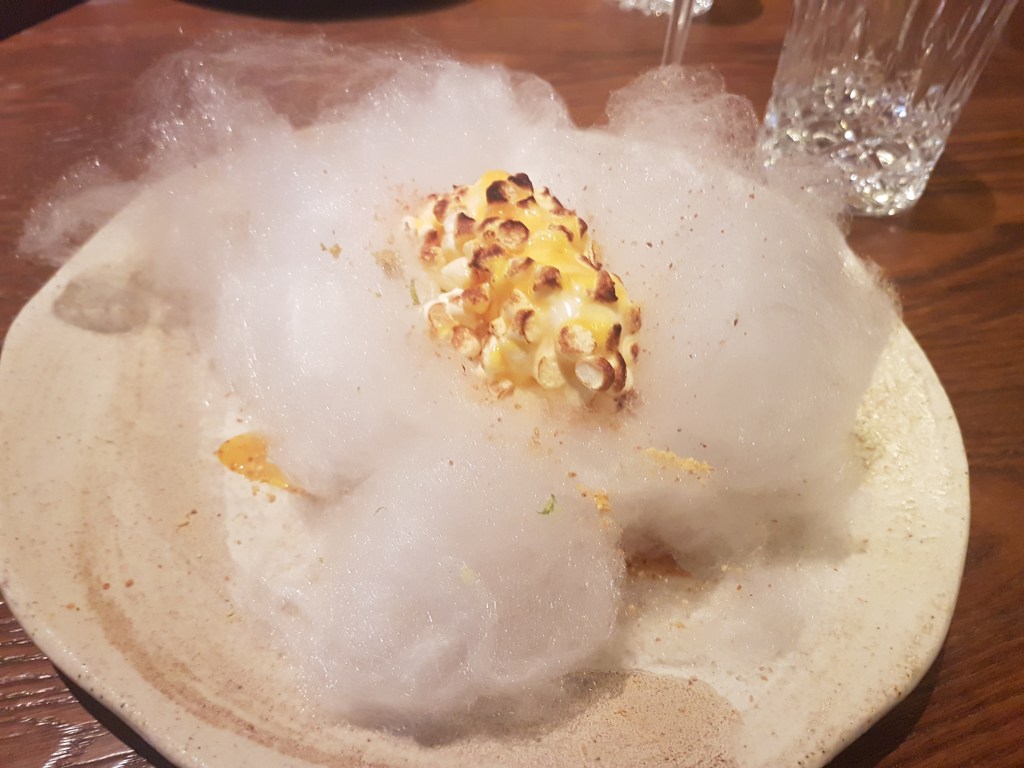
    However, we took photos of every other course, which you can check out below! I’ve added our notes on every dish below as well. As you can see, the amount and variety of food made for an intense experience, but it was absolutely worth it.

    See for yourself below… and then consider adding DSTAgE to the agenda when you’re next in Madrid!


  • Roadtrip Day 2: Piodao

    Roadtrip Day 2: Piodao

    When I say that Kevin researched and planned our road trip with Tyler, I don’t mean that lightly. As soon as Tyler booked his tickets to visit, the research began. And not just some simple google searches of ‘best sights in Portugal’. If Kevin has ever helped you with anything, you know that his research-style is all-in and he stops at nothing to get the best possible outcome. Nothing exemplifies this more than our stop off in Piodao.

    A few weeks before the trip, Kevin showed me a photo of a place that looked amazing, and told me that it was a must-do stop. When I convinced him to shorten the road trip from 6 days to 3, Piodao was one of those places that was a must-see, not to be compromised. And he was so, so right.

    After our morning at the Knights Templar’s Convent of Christ in Tomar, we got back into the truck and embarked on what I can honestly say is the wildest, most breathtaking and most nerve-racking road trip of my life. Before I get into too many road trip details, let’s talk about why Piodao is special and worth seeing.

    Piodao, known as the “nativity village” is a small collection of stone buildings, tucked into a mountain side. Unlike most of the places we’ve visited on this trip, Piodao, due to its remote geographic location, was almost entirely disconnected from Portuguese history. How disconnected? This village didn’t have electricity until the 1970s. This geographic isolation is what makes Piodao so unique – because they were limited to local resources, which is reflected in the architecture of the town itself, their traditions were well-preserved over the years, due to a lack of outside influences. Entering Piodao, picturesquely placed in between 2 hills in a mountain range, feels like entering a fairy tale. As you stand on the hillside, you can even hear the echo of jingling bells from the goat herds. My only regret of this entire trip is that we didn’t stay longer.

    Now, about that road trip. It was long and a bit harrowing. And as the trip went on, we felt increasingly alone. There were long stretches (on this 2.5 hour drive) without seeing other people and cars, though we did see a herd of goats crossing the road. We climbed up into the mountaintops, driving along winding roads, on the edge of cliffs, surrounded by clouds. I was both in awe of the view and in awe of Kevin’s patience & composure while navigating these roads. There’s absolutely no way that a bus could have made this journey.

    Visiting Piodao was a truly surreal and magical experience. I recommend it very much. And beyond being beautiful, the town itself offers great food and friendly people. Check out our many photos below!

  • Roman Ruins in Canterbury

    Roman Ruins in Canterbury

    Did you know that the romans used to have a giant empire? And did you know that it included a sizeable chunk of the present-day UK? Here’s a map:

    roman_emp

    The earliest history of Canterbury actually goes back even further than the Romans, but they seem to have left the largest footprint. Here’s what Wikipedia has to say about it:

    The Canterbury area has been inhabited since prehistoric times. Lower Paleolithic axes, and Neolithic and Bronze Age pots have been found in the area. Canterbury was first recorded as the main settlement of the Celtic tribe of the Cantiaci, which inhabited most of modern day Kent. In the 1st century AD, the Romans captured the settlement and named it Durovernum Cantiacorum. The Romans rebuilt the city, with new streets in a grid pattern, a theatre, a temple, a forum, and public baths. In the late 3rd century, to defend against attack from barbarians, the Romans built an earth bank around the city and a wall with seven gates, which enclosed an area of 130 acres (53 ha).

    Despite being counted as one of the 28 cities of Sub-Roman Britain, it seems that after the Romans left Britain in 410 Durovernum Cantiacorum was abandoned except by a few farmers and gradually decayed.[12] Over the next 100 years, an Anglo-Saxon community formed within the city walls, as Jutish refugees arrived, possibly intermarrying with the locals.[13] In 597, Pope Gregory the Great sent Augustine to convert its King Æthelberht to Christianity. After the conversion, Canterbury, being a Roman town, was chosen by Augustine as the centre for his episcopal see in Kent, and an abbey and cathedral were built. Augustine thus became the first Archbishop of Canterbury.[14] The town’s new importance led to its revival, and trades developed in pottery, textiles, and leather. By 630, gold coins were being struck at the Canterbury mint. In 672, the Synod of Hertford gave the see of Canterbury authority over the entire English Church.

    In 842 and 851, Canterbury suffered great loss of life during Danish raids. In 978, Archbishop Dunstan refounded the abbey built by Augustine, and named it St Augustine’s Abbey. A second wave of Danish attacks began in 991, and in 1011 the cathedral was burnt and Archbishop Alphege was killed in 1012. Remembering the destruction caused by the Danes, the inhabitants of Canterbury did not resist William the Conqueror’s invasion in 1066.

    So, things and buildings in Britain are super old. However, once in awhile, modern people try to do some remodeling of one of these 500+ year old buildings. When they do, they have to dig. And sometimes they find the remnants of buildings and places that were built by Romans, 800+ years ago. So, ya, that’s pretty wild.

    And so, because it’s usually better to remember history than just build parkings lots and condos over top of it (I’m looking at you, Toronto), there are a couple of places in Canterbury where you can see the discovered ruins of Roman civilization. In one case, there’s an entire museum about Roman history in Canterbury. In another location, a section of ruins is preserved in a glassed-in room in the basement of a bookstore.

    Nana Ev and I went to see both!

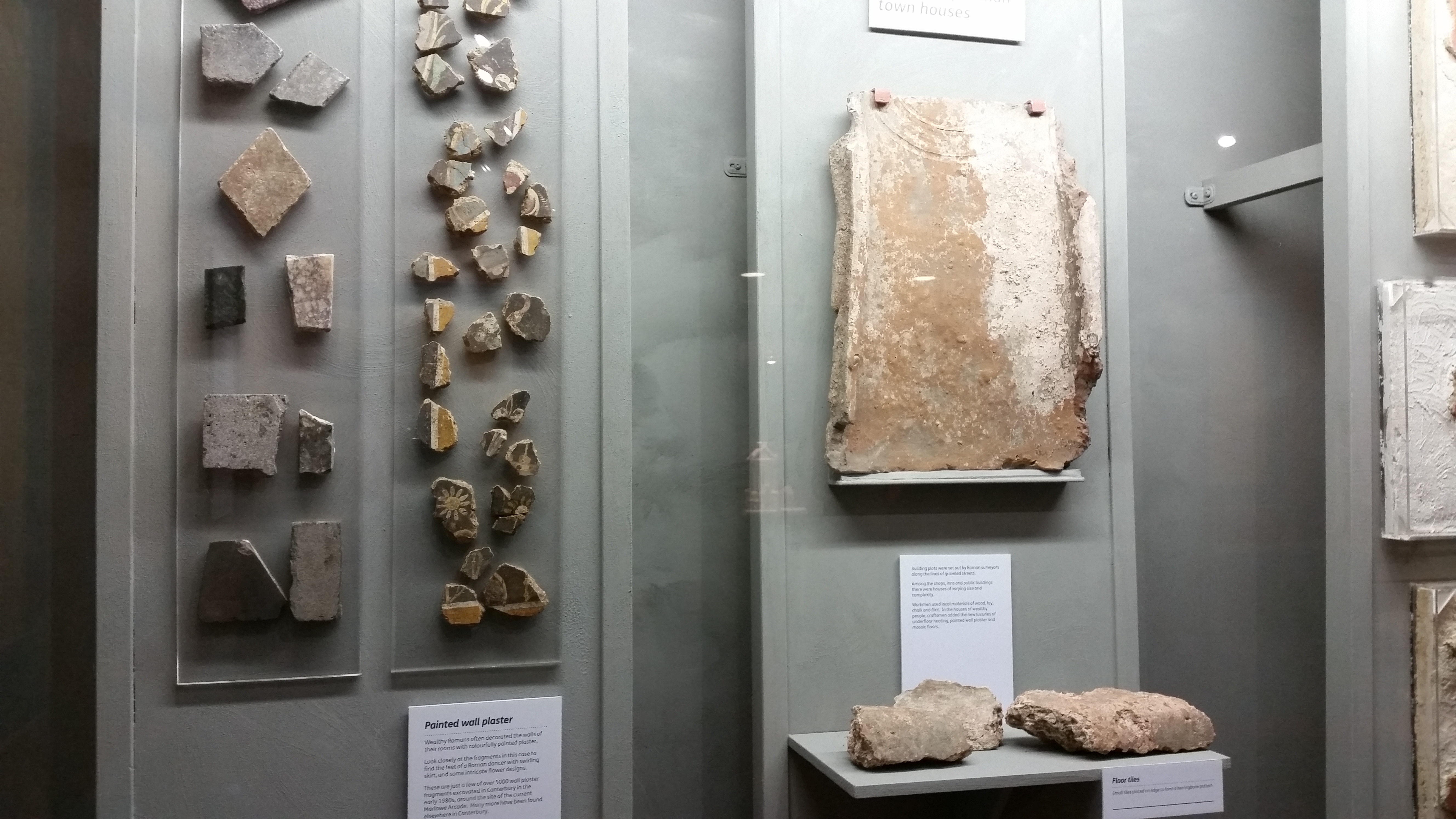
    The bookstore was cool in a this-is-neat-to-see kind of way, but the museum found and preserved a fairly significant portion of a Roman bath, including a long hallway and the pipes that heated the baths, various floors, and walls.

    There’s not much to be said, so I’ll get out of your way and you can look at the pictures. The museum also showcased a ton of artifacts, including jewellery, glass jugs, and bowls. Enjoy!


  • TWG does not equal Twinnings: Lessons in Observation

    TWG does not equal Twinnings: Lessons in Observation

    When I packed up and moved to Southeast Asia in July (still can’t believe it’s now nearly November!), I headed to Bangkok to meet Kevin. He’d already been there for about a month, but had recently transitioned over to Phnom Penh, Cambodia. Of course, I’d already booked my flight to Bangkok by the time he made that move, so he just flew back to meet me when I arrived.

    Wise move: Bangkok was a nice transition to Phnom Penh. Don’t get me wrong: it’s a crazy huge, crazy busy city, especially downtown, where we were staying, but it was certainly more like “home” than Phnom Penh. Anyways, we spent around 4 days in Bangkok, and did lots of various sight seeing. This, naturally, included going to malls. Downtown Bangkok is choc-full-o-malls: expensive malls, western malls, discount malls, small malls, enormous malls, super local malls, technology malls, you name it.

    This is just a long-winded way of saying: I went to Bangkok and I went to a mall and I saw something that I thought was pretty darn interesting.

    What was this? A TWG Tea Salon. I don’t have photos from that moment, but here are a few things I picked off Google Images that give a sense of what their signature Tea Salons look like: fancy, like tea-with-the-Queen fancy, but positioned in an open space in the middle of a mall. See below:

    This slideshow requires JavaScript.

    Kevin and I were really into the idea of this place. My reaction? “Wow, Twinnings has tea salons in Asia?? That would play SO well in North America!”. For weeks we talked about how much we liked this idea, how we were surprised Twinnings hadn’t opened something like this in Canada, and how we wanted to see if we could get the rights to open one of our own in Canada. I mean, come on. Twinnings? The favourite tea of the Canadian Motherland? How could that not be a success?

    A few weeks later, Kevin and I went to Manila, and found another of these delightful tea salons. In need of breakfast, we decided to sit down and eat there, instead of just ogling it from outside.

    Sitting there in a Tea Room in the middle of a mall in Manila, we noticed the following

    1. This is kinda weird – it feels like we’re on display

    2. This tea room looks fancy, but I can see un-fancy mall stores and people all around me

    3. Everything is labelled TWG – how exactly does that translate to Twinnings?

    Spoiler Alert: it doesn’t.

    After thinking and talking about this place for a month, we realized that we actually had no idea what we were talking about.

    TWG stands for The Wellness Group – a Singapore based company that imports teas from all around the world. Not connected to Twinnings.

    And yet, their branding seemed so similar – that yellow? TW? Seriously? It was a serious *mind blown* moment for us when we realized that TWG and Twinnings were totally separate companies.

    Anyways, there’s a TWG Shop in Times Square, and there’s also one in Phnom Penh, so I guess TWG is slowly but surely creeping around the world.

    When it reaches London, is Twinnings going to have something to say about this? I’d be calling my lawyer if I were them.

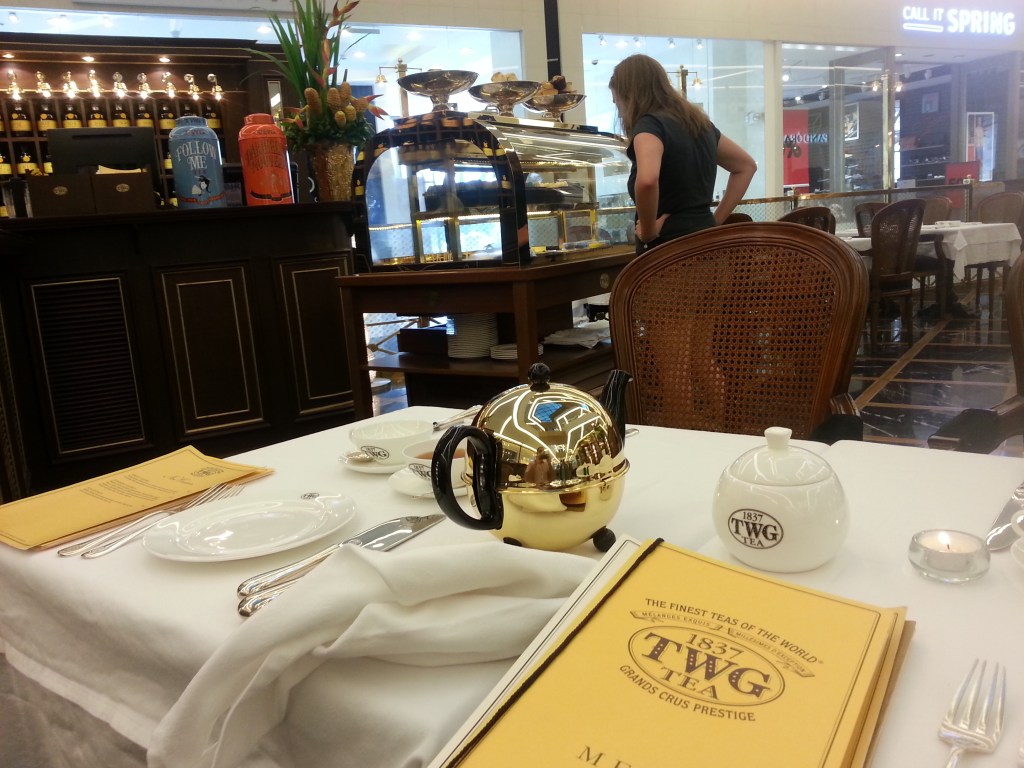
    Check out photos below of Kevin and I at TWG in Manila, including photos from their TWG Menu. A few feet away from their Tea Salon, they also have a Tea Shop, where they sell packaged teas, tea pots worth thousands of dollars, and other TWG merchandise.

  • Part 3 of our Philippines Trip: Nacpan Beach

    Part 3 of our Philippines Trip: Nacpan Beach

    Towards the end of our time in El Nido, we spent a day out at Nacpan Beach, a remote beach 45 minutes north of El Nido. We went to buy some coconuts, and the lady at the kiosk told us we should check out some rentable cottages further down the beach. So, coconuts in hand, we did just that. Nacpan beach is pretty spectacular, and the cottages were also pretty cute, so we changed our travel schedule, and decided to leave El Nido a day early to spend 2 nights at “Jack’s Place”. Getting there is pretty harrowing 45 minute tricycle ride, but it’s well worth it. Even Kevin says it’s the best beach he’s ever seen, and this guy knows his beaches.

    First, we spent a day there before heading back to El Nido and checking out of Golden Monkeys. That day was amazing, and for the first time ever we saw cows on the beach (see photos below).

    We returned the next day for two nights. That first afternoon was incredible, though that first night was a bit messy. Kevin and I set up the mosquito net completely wrong, and it ended up laying directly on top of Kevin for most of the night. This meant that he was bitten by mosquitos all over this body, and after he woke up realizing this around 3am, that was the end of sleep for the both of us.We spent the next few hours curled up in awkward positions with a way-too-hot blanket on top of us for protection. When the rose and the bugs subsided a bit, we headed outside to sleep in hammocks near the beach. A couple of hours later, we grabbed a bit more sleep back in bed. So, that was an awful few hours, but being in paradise more than made up for it. Lesson learned? When it comes to setting up mosquito nets, always ask for help.

    We spent our days on the beach and in the ocean. Not having spent much time in the ocean as a kid, I had a lot to learn. Like, how to jump into waves. How not to get knocked over. I did lose my sunglasses, but other than that I’ve adapted well.

    Jack’s Place only had power from 6pm to 9pm, so we took advantage of that time to hang out in a common area with a wonderful Swedish couple who were traveling in the region. There’s something interesting about living by the natural sunlight, and that something includes going to bed earlier than usual. In spaces like that, the company of other people felt especially valuable, and we welcomed gladly their conversation and card games.

    Check out the photos below! There was more nature than we’ve captured here (chickens, dogs, ox, pigs, running around all over the place), but Nacpan is so lovely that even our photos can show it.