Friday night I arrived at the airport in London (did you know they have like a zillion different London airports!? seriously. look it up if you care about things like that). I was quickly shuttled down to Canterbury. Despite Kevin’s concerns, I was not abducted, and I made the trip in approximately 90 minutes. My Nana Ev met me outside and we headed into her lovely apartment for tea and conversation before going to bed.
The next morning, we were up bright and early to go to Bletchley Park, the setting for this year’s rather famous movie, the Imitation Game, about Alan Turing and code breaking during WWII. The trip took around 3 hours, which was quite lovely as it gave Nana Ev and I lots of time to chat and catch up.
When we arrived at Bletchley Park, we were joined by Sue & Bob, some family members that I hadn’t seen in ages. Sue is one of my dad’s cousins, as her mother was the sister of my Papa Don. I don’t get to see this side of the family too often, so this was a real treat.
Since I went to Bletchley Park and you didn’t, I should probably tell you what the heck Bletchley Park is.
For those of you who saw the Imitation Game, one of those Oscar-worthy-type movies that came out this year, you’re probably at least slightly familiar with Bletchley Park.
Bletchley Park used to be a giant manor, in the middle of nowhere, owned by rich British people. In 1938, it was purchased by MI6 to be used as a research facility in the event of war. It’s located almost directly north of London, and is conveniently very close to a major rail line that connects it easily to London, Oxford, and Cambridge. Additionally, from overhead it looks like a giant manor for rich people and not like a government research facility. Convenient.
Before and during WWII (because you don’t need a war to spy on people’s encrypted messages), Bletchley Park was the site where a group of researchers, codebreakers, and math-y geniuses came together to try to decipher the encrypted messages that various enemies (Italian, Japanese, Germans, etc) were sending about military and other plans. At the height of the war, aka the time when codes got most complicated and also the time when enemy info was most important, the Bletchley Park operation was rather large, and employed around 9000 men and women.
The story in the Imitation Game was something like this: math nerds keep trying and failing to break any codes. They are very upset but keeping trying to same process over and over again with no success. Alan Turing arrives, tells them they’re idiots, starts building a computer-type machine named Christopher. Eventually, his machine works and helps them break the code. That one trick fixes all the problems, etc. The allies win the war. There’s a lot more about to the plot, but that’s the part that relates to Bletchley Park. You can learn more about the Imitation Game here, and more about Alan Turing here.
Anyways, my trip to Bletchley Park was initially a bit confusing, as the placards I was reading weren’t lining up with what I thought I knew. In reality, Alan Turing was very, very smart (and truly visionary thinker), but at Bletchley Park he wasn’t some kind magical genius surrounded by fuddy-duddy fools. Essentially, there were a ton of different enigma machines being used to encipher messages being sent between various enemy groups. Germany alone had different enigmas for different branches of the military. They would encipher a message, turning it into gobbledy-goop. Then the recipient, who knew the code with which it was enciphered, would decipher the message and read it. The trick is to know the code that enciphers the message. Oh, and there are like a kajabillion options.
A Polish researcher (turns out everyone was spying on everyone back then) had come up with a design for a machine that would help find the code with which a message was enciphered. As the war went on and Germany got wiser, the enigmas got more and more complicated. At various points in time, the codebreakers came up solutions that worked for awhile, until the enemy switched to a better/more complicated enigma machine. However, building on these initial Polish designs and ideas, Turing worked with a fellow codebreaker to design a machine that would be able to quickly find the needed code by testing possible options at a rapid rate. An engineer from a technology company then helped build this machine, known as the Bombe.
Beyond that, another thing the movie didn’t really touch on is the extent to which the process of codebreaking was a major operation. That is, it wasn’t just some smart people breaking codes. It was smart people figuring out how to break codes, and then tons of still very smart people making that process happen. Women worked standing all day in huts filled with hundreds of Bombes, while code possibilities were tested. When a match was found, it was passed to another hut, where someone used the code the translate those messages via Enigma. Next, the German in those messages was cleaned up. And then, it was translated into English. And then some high level British secret service operatives figured out how to turn these messages into military instructions without letting anyone realize that they were deciphering messages. Sound like a lot? It was. And I’m sure I’ve gotten some of it wrong and left out some information.
The point is, Bletchley Park, which was closed after WWII and left in disrepair for 50 years, was once a bustling spot where lots of smart women and men worked hard to solve problems.
Considering all that’s really left is the buildings, the exhibits were very impressive. The huts were outfitted with audio-visual elements that let you see and hear the men and women who would’ve worked there. Each room had video projectors of someone working there, so that when you walked in the hallway you could hear the voices coming from each room, quite like it might have been back then. The lighting and decor were all done up to show you what the huts would’ve looked and felt like. I was quite impressed. This could very easily have been an extremely boring exhibit, but great care and planning were given to make it interesting. I would very much recommend a visit to Bletchley Park if you ever get the chance.
Aside from all that I learned, my company was great. We enjoyed the beautiful weather as we walked around checking out the exhibits. We stopped for lunch and had tea later in the afternoon. It was a rather British day with my British family, and I am so glad that it happened.
Check out my photos below:

minitiature version of the Bombe machine

statue of Alan Turing

an Enigma machine

family #selfie

The style of Enigma machine used by the Germans

rebuilt version of the Bombe (aka Christopher?)

ridiculous poster

another ridiculous poster

a list of guidelines for the women to follow when billetted to family

Nana Ev with a baby in a gas mask!

a baby in a gas mask!

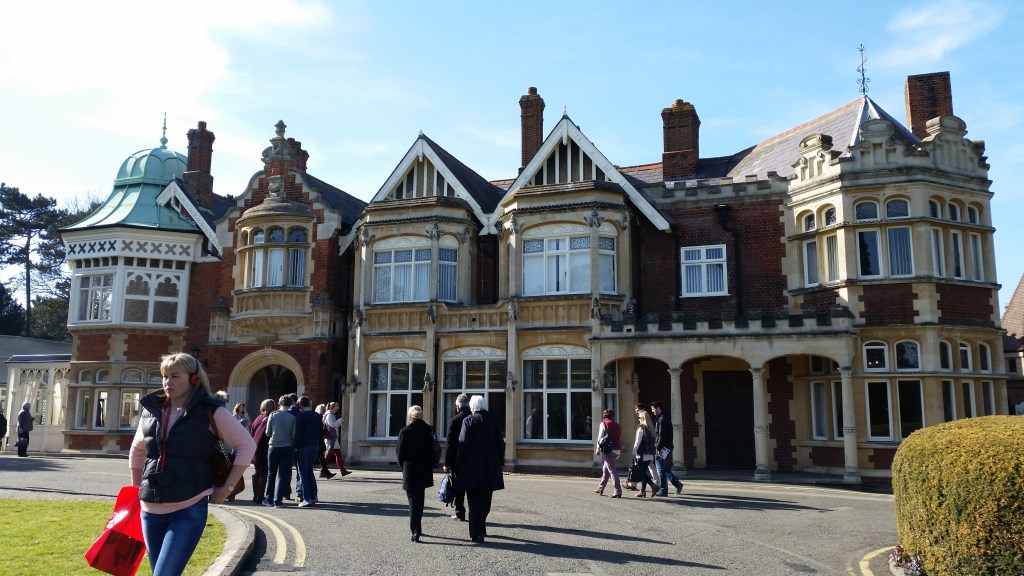
the mansion of Bletchley Park

bicycles!

Nana Ev, Bob & Sue, walking to the manse

the drawing room

the ceiling as you enter the ballroom

the bar from the film set, in the ballroom

film set

film set

Christopher, from the film

office furniture from the film

the library at Bletchley Park – they had a really cool book collection here

walking to the cottages where researchers lived and worked

the Polish Memorial, which recognizes the Polish contribution to the codebreaking research

Hut 1

the Huts where codebreakers and their teams worked

an exhibit recognizing the pigeons for the contribution to the war effort. Yes, pigeons.




 the stories that I'm telling.