Tag: fun

  • Visiting Sagres

    Visiting Sagres

    Throughout the duration of Tyler’s trip to Portugal, I was incredibly ill. I slept most of the time and felt terribly shivery and gross for most of the time that I wasn’t sleeping. As a result, I didn’t get out for too many excursions, and Tyler’s blog posts have covered the majority of his second week with us in Portugal, where we relaxed in the Algarve.

    There was one trip for which I did manage to drag myself out of bed: a day trip to the Fort at Sagres.

    Sagres is the most south-west point of Portugal, with a large landmass that juts out into the ocean. The Fort of Sagres occupies this space, a place connected to Portugal’s history of exploration. The Fort may or may not have been connected to the work for Portuguese Prince Henry the Navigator:

    It is traditionally suggested that Henry gathered at his villa on the Sagres peninsula a school of navigators and map-makers. However modern historians hold this to be a misconception. He did employ some cartographers to chart the coast of Mauritania after the voyages he sent there, but there was no center of navigation science or observatory in the modern sense of the word, nor was there an organized navigational center.[7]

    Referring to Sagres, sixteenth century Portuguese mathematician and cosmographer, Pedro Nunes, remarked, “”from it our sailors went out well taught and provided with instruments and rules which all map makers and navigators should know.”[8]

    The view that Henry’s court rapidly grew into the technological base for exploration, with a naval arsenal and an observatory, etc., although repeated in popular culture, has never been established.[9][10][11] Henry did possess geographical curiosity, and employed cartographers. Jehuda Cresques, a noted cartographer, has been said to have accepted an invitation to come to Portugal to make maps for the infante. This last incident probably accounts for the legend of the School of Sagres, which is now discredited. (Wikipedia)

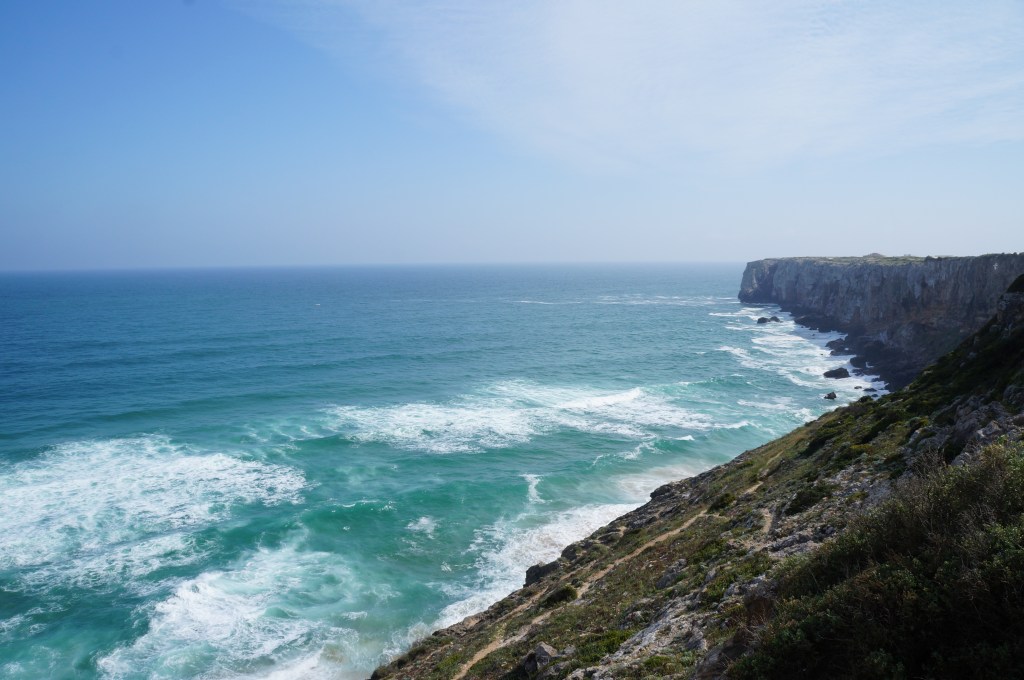
    The location was stunning. Walking along the cliffs, watching birds fly above the waves, and looking back at the rather flat, open space of the fort, it was a beautiful scene. As far as museums go, it was fairly unimpressive. Very little information was offered about what we were looking at, though Wikipedia has suggested that the Fort’s importance is up for debate, which may explain the lack of concrete information at the site.

    In either case, it was a lovely day, made even better by a really fantastic seafood lunch. We dined at A Sagres, the closest restaurant to the Fort. While those around us were eating spaghetti and other such nonsense, we requested the daily specials, and were treated to an amazing seafood stew and freshly caught fish.

    On the way home we took a scenic route along the coast. We stopped at a beautiful beach, and took a detour for a supposed ‘archaeological site of interest’ that was actually just a field.

    Check out our photos to enjoy the view:

  • Roadtrip Day 2: Piodao

    Roadtrip Day 2: Piodao

    When I say that Kevin researched and planned our road trip with Tyler, I don’t mean that lightly. As soon as Tyler booked his tickets to visit, the research began. And not just some simple google searches of ‘best sights in Portugal’. If Kevin has ever helped you with anything, you know that his research-style is all-in and he stops at nothing to get the best possible outcome. Nothing exemplifies this more than our stop off in Piodao.

    A few weeks before the trip, Kevin showed me a photo of a place that looked amazing, and told me that it was a must-do stop. When I convinced him to shorten the road trip from 6 days to 3, Piodao was one of those places that was a must-see, not to be compromised. And he was so, so right.

    After our morning at the Knights Templar’s Convent of Christ in Tomar, we got back into the truck and embarked on what I can honestly say is the wildest, most breathtaking and most nerve-racking road trip of my life. Before I get into too many road trip details, let’s talk about why Piodao is special and worth seeing.

    Piodao, known as the “nativity village” is a small collection of stone buildings, tucked into a mountain side. Unlike most of the places we’ve visited on this trip, Piodao, due to its remote geographic location, was almost entirely disconnected from Portuguese history. How disconnected? This village didn’t have electricity until the 1970s. This geographic isolation is what makes Piodao so unique – because they were limited to local resources, which is reflected in the architecture of the town itself, their traditions were well-preserved over the years, due to a lack of outside influences. Entering Piodao, picturesquely placed in between 2 hills in a mountain range, feels like entering a fairy tale. As you stand on the hillside, you can even hear the echo of jingling bells from the goat herds. My only regret of this entire trip is that we didn’t stay longer.

    Now, about that road trip. It was long and a bit harrowing. And as the trip went on, we felt increasingly alone. There were long stretches (on this 2.5 hour drive) without seeing other people and cars, though we did see a herd of goats crossing the road. We climbed up into the mountaintops, driving along winding roads, on the edge of cliffs, surrounded by clouds. I was both in awe of the view and in awe of Kevin’s patience & composure while navigating these roads. There’s absolutely no way that a bus could have made this journey.

    Visiting Piodao was a truly surreal and magical experience. I recommend it very much. And beyond being beautiful, the town itself offers great food and friendly people. Check out our many photos below!

  • Roadtrip Day 2: An Aqueduct “just around the corner”

    Roadtrip Day 2: An Aqueduct “just around the corner”

    While we were visiting the Convent of Christ in Tomar, the map of the site said that there was an aqueduct attached. Tyler was pretty excited about this, never having seen a real aqueduct. Kevin and I had seen some in Lisbon, but agreed that it was pretty cool.

    While Tyler and I searched for the aqueduct ruins (which we found outside, attached to the Castle of Tomar), Kevin searched on Google. When we were done at the Castle/Convent, Kevin said he had one more stop he wanted to make. He handed me the phone with a seemingly random spot marked on the map nearby. He told me what we were up to but hadn’t said anything yet to Tyler.

    5 minutes of driving later, we came to the Pegoes Aqueduct, to which the aqueduct ruins at the castle were attached.

    But rather than just a couple of arches, what we saw was a full aqueduct crossing a valley. And the best part? It was open and also empty! From where we parked, we walked just a few steps to climb up onto the aqueduct through an old water inspection station. In the silent countryside, we walked along an ancient aqueduct, just the 3 of us.

    A quick little surprise, and one of the highlights of our trip. Enjoy the photos below!

  • Roadtrip Day 2: Tomar and the Convent of Christ

    Roadtrip Day 2: Tomar and the Convent of Christ

    After our day of adventures in Sintra, we drove 2 hours to the city of Tomar.

    When planning this roadtrip, Kevin did quite a lot of research. All the places that we travelled to see made the list because of their unique history/beauty, making it almost impossibly to have a favourite site.

    The city of Tomar was originally founded in 1162 under an order of the Knights Templar, and it was actually the last Templar town to be commissioned for construction.

    Tomar then became the headquarters of the Order of the Knights Templar in Portugal. From this base, the Templars ruled a vast area of central Portugal, defending that territory from the Moors who ruled in the South. As the Catholic church became nervous of the power of the Templars, and then banned the order altogether, the Portuguese King negotiated to create a new “Order of Christ”, which took over the power and place of the Templar’s order. As such, Tomar is considered the last home of the Knights Templar in Portugal.

    This story got a bit more interesting when Henry the Navigator, the leader of Portuguese exploration, became the head of the Order of Christ (from Wikipedia):

    Henry the Navigator was made the Governor of the Order, and it is believed that he used the resources and knowledge of the Order to succeed in his enterprises in Africa and in the Atlantic. The cross of the Order of Christ that was painted in the sails of the caravels that crossed the seas, and the Catholic missions in the new lands were under the authority of the Tomar clerics until 1514. Henry, enriched by his overseas enterprises, was the first ruler to ameliorate the buildings of the Convento de Cristo since its construction by Gualdim Pais. He also ordered dams to be built to control the river Nabão and swamps to be drained. This allowed the burgeoning town to attract more settlers. Henry ordered the new streets to be designed in a rational, geometrical fashion, as they can still be seen today.

    Interestingly, this time in Portuguese history was also an important time in Jewish history:

    Just after 1492 with the expulsion of the Jews from Spain, the town increased further with Jewish refugee artisans and traders. The very large Jewish minority dynamized the city with new trades and skills. Their experience was vital in the success of the new trade routes with Africa. The original synagogue still stands.

    In the reign of Manuel I of Portugal the convent took its final form within the Manueline renaissance style. With the growing importance of the town as master of Portugal’s overseas empire, the leadership of the Order was granted to the King by the Pope.

    However, under pressure from the Monarchs of Spain, the King soon proclaimed by Edict that all the Jews remaining within the territory of Portugal would be after a short period considered Christians, although simultaneously he forbade them to leave, fearing that the exodus of Jewish men of knowledge and capital would harm Portugal’s burgeoning commercial empire. Jews were largely undisturbed as nominal Christians for several decades, until the establishment of a Tribunal of the Portuguese Inquisition by the initiative of the Catholic Clergy in the town. Under persecution, wealthier Jews fled, most others were forced to convert. Hundreds of both Jews and New Christians were arrested, tortured and burned at the stake in autos da fé, in a frenzy of persecution that peaked around 1550. Many others were expropriated of their property. Jewish ascendancy, more than Jewish religion, together with personal wealth determined whom would be persecuted, since the expropriations reverted to the institution of the Inquisition itself. The town lost then with the persecution of its merchants and professionals most of its relevance as a trading centre.

    Despite its great importance during the growth and expansion of Portugal and Europe, Tomar is now a town of just 20,000 people, quietly tucked away in Portugal. If you’re interested in knowing more about Jewish history in Portugal, I recommend you check out this Wikipedia article, as well as this article that talks about the town of Belmonte (by the way, home to some pretty good kosher olive oil!).

    Anyways, so as we were driving to Tomar, I was reading out all of these Wikipedia articles to Kevin and Tyler, getting all pumped up about our trip. We arrived late at night, grabbed dinner at a Knights-Templar-themed restaurant, and headed off to bed. With big plans for the next day, we got up early, ate breakfast in our family-run Pensao, and then headed up the hill to the Convent of Christ.

    If Tomar itself has some deep history going on, the Convent of Christ is right at the centre of the action. Built over hundreds of years, the building boasts a great variety of architectural and design styles. The level of detail is impressive, and we spent SO much time in the church flipping about how cool it was to be in the church built by Templar Knights.

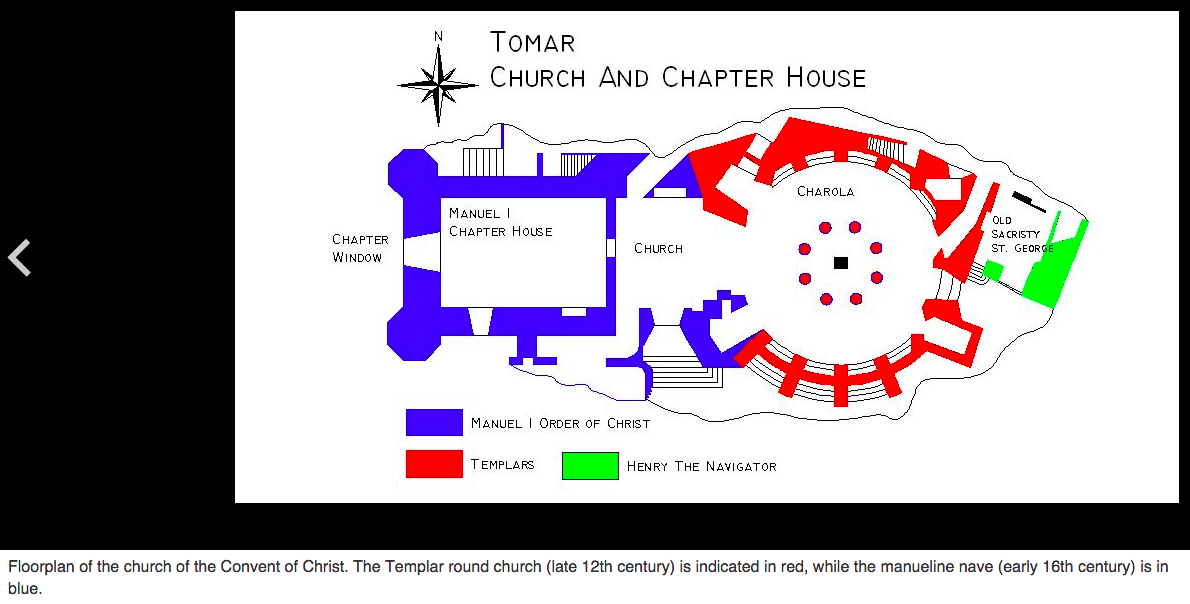
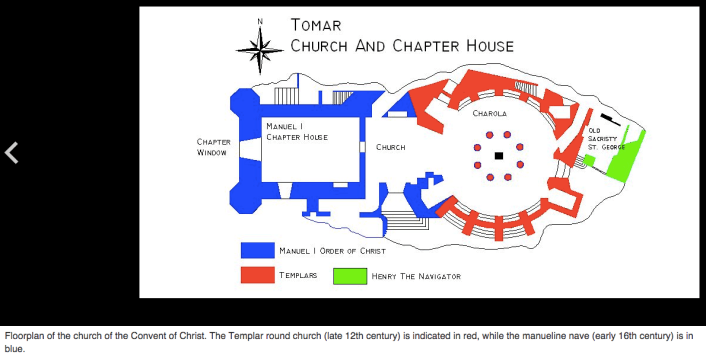
    To give you an idea of how the design of the church came to be, here’s a photo from Wikipedia:
    Screen Shot 2015-09-17 at 12.57.28 PM

    Similar to when I visited Canterbury earlier this year, it was really obvious that this place grew to become a great centre of activity in Tomar. What you see as blue in the above map is a truly massive set up, designed to house and feed those who lived and visited here. We entered in the oldest part of the building, shown above in green, and worked our way through to the chapter houses. We had only planned to spent 45 minutes here, but we ended up spending well over 2 hours exploring and taking photos.

    All in all, Tomar was a wonderful place to visit. We didn’t get to see all of the sites or explore all of the myths, but the Convent of Christ was itself worth the drive. We expected it to be cool, and still Tomar very much exceeded those high expectations. Enjoy our photos below, we had a lot of fun taking them!

  • An Afternoon at the Oceanario de Lisboa

    An Afternoon at the Oceanario de Lisboa

    Last year, the Oceanario in Lisboa was recommended to me by a friend as an absolutely must-see spot in Lisbon. It didn’t make the itinerary that time, but this year we made sure it was on our to-do list.

    At a cost of nearly 20 euros each to enter, we were a bit wary. But seriously, this place is SO GREAT.

    However, it is also enormous. While at first we were super excited about how cool it was, by the end we were totally ocean-ed out and walked through the last 3 exhibits like “seriously!? there’s still more?!”. There was also no cafe inside, which was rather un-Portuguese if you ask me.

    The Oceanarium is the largest indoor aquarium in Europe, and it’s an extremely impressive exhibit. Even the signage was interesting and helpful, which is usually not the case at attractions in Portugal.

    Here’s what Wikipedia has to say:

    The main exhibit is a 1,000 m2 (11,000 sq ft), 5,000 m3 (180,000 cu ft) tank with four large 49 m2 (530 sq ft) acrylic windows on its sides, and smaller focus windows strategically located around it to make sure it is a constant component throughout the exhibit space. It is 7 m (23 ft) deep, which lets pelagicswimmers to swim above the bottom dwellers, and providing the illusion of the open ocean. About 100 species from around the world are kept in this tank,[3]including sharks, rays, barracudas, groupers, and moray eels. One of the main attractions is a large sunfish.

    Four tanks around the large central tank house four different habitats with their native flora and fauna: the North Atlantic rocky coast, the Antarctic coastal line, the Temperate Pacifickelp forests, and the Tropical Indiancoral reefs. These tanks are separated from the central tank only by large sheets of acrylic to provide the illusion of a single large tank. Throughout the first floor there are an additional 25 thematic aquariums with each of the habitats’ own characteristics.

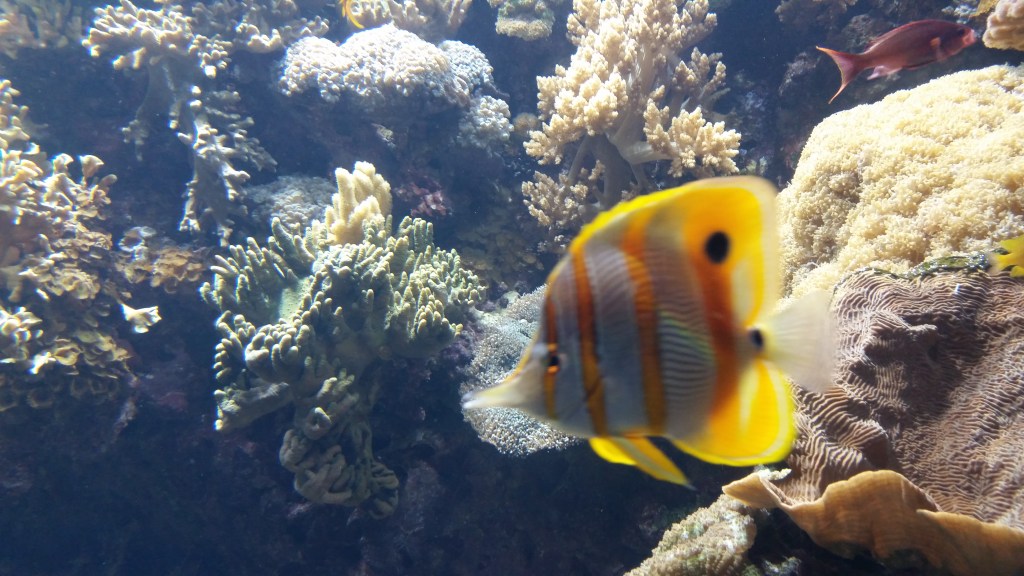
    Our favourite part was definitely the penguins, who were just so outrageously cute. We took some videos, of course, so we can revisit the cute-ness at our leisure. Other highlights included some very interesting and colourful fish, pictured below. I didn’t expect us to be quite so into the Oceanarium, but we had a really good time exploring it all.

    And of course, we foolishly took a lot of photos. The oceanarium is rather dark, so the pictures didn’t all turn out perfect, but I think they’ve captured how much fun we were having (A LOT).

    Enjoy!


  • Celebrating Carnival in the Algarve

    Celebrating Carnival in the Algarve

    Carnival is a fairly historied Catholic tradition (and probably goes back even further than that, really). I’m assuming most of y’all aren’t up to date on Catholic traditions, so here’s a quick refresher course, courtesy of our friends at Wikipedia:

    Carnival (see other spellings and names) is a festive season that occurs immediately before the Christian season of Lent. The main events typically occur during February. Carnival typically involves a public celebration and/or parade combining some elements of a circus, masks and public street party. People wear masks during many such celebrations, an overturning of life’s normal things. The celebrations have long been associated with heavy alcohol consumption.

    When we came to Portugal for a 2 week holiday last year, we were here for Carnival, so though this year’s festivities weren’t a surprise, they were definitely a delight.

    In Canada, I’m used to parades being a rather straightforward affair. The first float marks the beginning, and the last float marks the end. As with most things in Canada, it’s efficient. In the fun-and-fancy-free mild Portuguese weather, parades are a bit different. Instead of a straight-line-kind-of-parade, the Carnival parade is on loop!

    One of the most traditional Carnival parades is held each year in Alte. It’s definitely more old-fashioned than the parade in the neighbouring city of Loule, and it has more of a local/hometown feel to it. The floats line up, populated by people from Alte, and they’re observed by the townspeople from Alte and surrounding areas (including me and Kevin). Most people know each other, and everyone is drinking (float people and audience alike), so things get pretty fun pretty fast. For the first hour, Kevin knew and chatted with someone from every float.

    The floats aren’t that big, so there are always crowds of people walking with them. And instead of being sponsored by or representing companies, community groups, etc, they’re simply a creative theme. Often, the players on the float act out a type of narrative as well.

    One float’s theme was 101 Dalmatians. There was a “Cruella” driving the car, and a couple of henchmen who ran around picking up puppies and putting them in a big cage (who then escaped). The Braveheart float eventually staged a battle in the middle of the street, with various players storming their castle.

    Because the parade goes on and on, the floats end up evolving; acting a kind of performance art. It’s artistic and it’s very fun.

    I found some videos online taken at this year’s Alte Carnival. I played it for Kevin and his immediate reaction was “oh man, I know so many people in this … and everyone’s drunk”.

    I don’t think I’ve ever been to such a fun parade. You can check out more vidoes here, here, and here.

    We also went to the Carnival in Loule, and you can see photos of it below. Being in a city, it’s a much larger scale parade, with much fancier floats, often mocking various EU politicians. It’s neat, but doesn’t have the same spirit at the Carnival in Alte. Have a look below to see all the snapshots we captured!

    And leave a comment below: have you ever seen a parade like this one?