After our day of adventures in Sintra, we drove 2 hours to the city of Tomar.
When planning this roadtrip, Kevin did quite a lot of research. All the places that we travelled to see made the list because of their unique history/beauty, making it almost impossibly to have a favourite site.
The city of Tomar was originally founded in 1162 under an order of the Knights Templar, and it was actually the last Templar town to be commissioned for construction.
Tomar then became the headquarters of the Order of the Knights Templar in Portugal. From this base, the Templars ruled a vast area of central Portugal, defending that territory from the Moors who ruled in the South. As the Catholic church became nervous of the power of the Templars, and then banned the order altogether, the Portuguese King negotiated to create a new “Order of Christ”, which took over the power and place of the Templar’s order. As such, Tomar is considered the last home of the Knights Templar in Portugal.
This story got a bit more interesting when Henry the Navigator, the leader of Portuguese exploration, became the head of the Order of Christ (from Wikipedia):
Henry the Navigator was made the Governor of the Order, and it is believed that he used the resources and knowledge of the Order to succeed in his enterprises in Africa and in the Atlantic. The cross of the Order of Christ that was painted in the sails of the caravels that crossed the seas, and the Catholic missions in the new lands were under the authority of the Tomar clerics until 1514. Henry, enriched by his overseas enterprises, was the first ruler to ameliorate the buildings of the Convento de Cristo since its construction by Gualdim Pais. He also ordered dams to be built to control the river Nabão and swamps to be drained. This allowed the burgeoning town to attract more settlers. Henry ordered the new streets to be designed in a rational, geometrical fashion, as they can still be seen today.
Interestingly, this time in Portuguese history was also an important time in Jewish history:
Just after 1492 with the expulsion of the Jews from Spain, the town increased further with Jewish refugee artisans and traders. The very large Jewish minority dynamized the city with new trades and skills. Their experience was vital in the success of the new trade routes with Africa. The original synagogue still stands.
In the reign of Manuel I of Portugal the convent took its final form within the Manueline renaissance style. With the growing importance of the town as master of Portugal’s overseas empire, the leadership of the Order was granted to the King by the Pope.
However, under pressure from the Monarchs of Spain, the King soon proclaimed by Edict that all the Jews remaining within the territory of Portugal would be after a short period considered Christians, although simultaneously he forbade them to leave, fearing that the exodus of Jewish men of knowledge and capital would harm Portugal’s burgeoning commercial empire. Jews were largely undisturbed as nominal Christians for several decades, until the establishment of a Tribunal of the Portuguese Inquisition by the initiative of the Catholic Clergy in the town. Under persecution, wealthier Jews fled, most others were forced to convert. Hundreds of both Jews and New Christians were arrested, tortured and burned at the stake in autos da fé, in a frenzy of persecution that peaked around 1550. Many others were expropriated of their property. Jewish ascendancy, more than Jewish religion, together with personal wealth determined whom would be persecuted, since the expropriations reverted to the institution of the Inquisition itself. The town lost then with the persecution of its merchants and professionals most of its relevance as a trading centre.
Despite its great importance during the growth and expansion of Portugal and Europe, Tomar is now a town of just 20,000 people, quietly tucked away in Portugal. If you’re interested in knowing more about Jewish history in Portugal, I recommend you check out this Wikipedia article, as well as this article that talks about the town of Belmonte (by the way, home to some pretty good kosher olive oil!).
Anyways, so as we were driving to Tomar, I was reading out all of these Wikipedia articles to Kevin and Tyler, getting all pumped up about our trip. We arrived late at night, grabbed dinner at a Knights-Templar-themed restaurant, and headed off to bed. With big plans for the next day, we got up early, ate breakfast in our family-run Pensao, and then headed up the hill to the Convent of Christ.
If Tomar itself has some deep history going on, the Convent of Christ is right at the centre of the action. Built over hundreds of years, the building boasts a great variety of architectural and design styles. The level of detail is impressive, and we spent SO much time in the church flipping about how cool it was to be in the church built by Templar Knights.
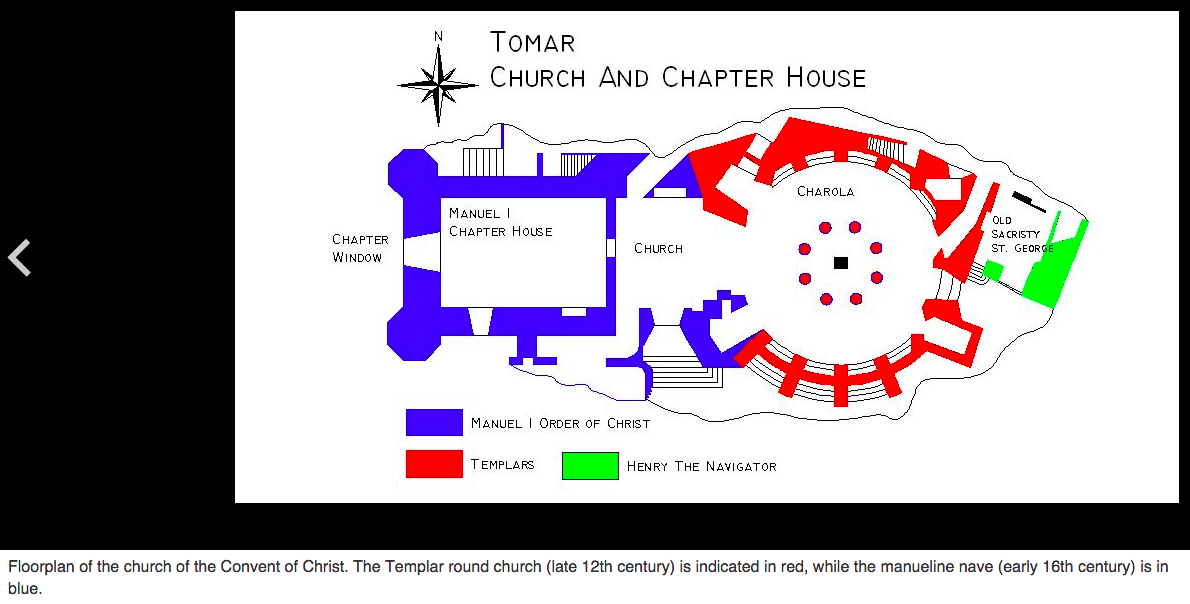
To give you an idea of how the design of the church came to be, here’s a photo from Wikipedia:
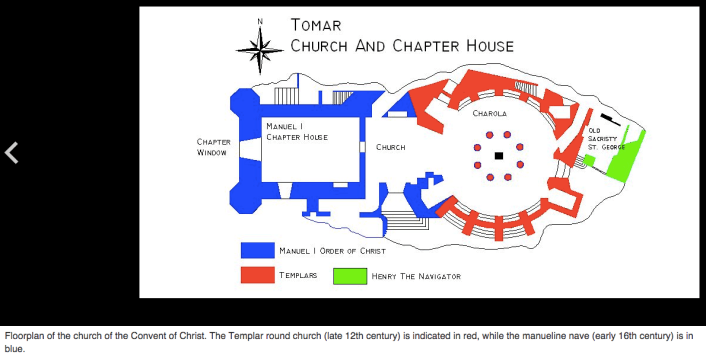
Similar to when I visited Canterbury earlier this year, it was really obvious that this place grew to become a great centre of activity in Tomar. What you see as blue in the above map is a truly massive set up, designed to house and feed those who lived and visited here. We entered in the oldest part of the building, shown above in green, and worked our way through to the chapter houses. We had only planned to spent 45 minutes here, but we ended up spending well over 2 hours exploring and taking photos.
All in all, Tomar was a wonderful place to visit. We didn’t get to see all of the sites or explore all of the myths, but the Convent of Christ was itself worth the drive. We expected it to be cool, and still Tomar very much exceeded those high expectations. Enjoy our photos below, we had a lot of fun taking them!

Dinner at the end of Day 1, at a Templar themed pub in Tomar

dessert was a pumpkin/fig cake

breakfast in the morning and then we’re off!

At the top of the hill, we parked the truck & approached the Convent

the oldest part of the facility, ruins where a king once lived

someone is buried here!!

This is inside the Knights Templars’ Convent of Christ

The scale and detail are pretty out of this world

at this point we’re getting into the Chapter House area

this particular building is one of the greatest examples of Manueline Style

see that details? *that’s* manuelin.

exploring the halls – there were prayer room and halls and accomodations off these hallways

spot me!




 the stories that I'm telling.