Our third day in Amsterdam was a full day, and it started quite early. We were up by 7am and out the door to explore the city and find breakfast by 7:30am. Given how quiet we’d noted the nightlife to be the previous evening, we had suspected the city would be bustling in the early morning, but that was not the case in reality.
In fact, the city was very quiet, and there was hardly anyone outside. We walked along the canal that would later host the Pride Parade and noted a few early birds setting up their floats or their viewing spots, but the city was mostly calm. We managed to find one breakfast place open. After a delicious meal, we headed to the first of many museums for the day: The Amsterdam Museum.
When we travel to a new city, we like to start with learning about the history of that city, as the city itself chooses to present. We’re both hoping that one day Toronto gets a similar institution to showcase our history for visitors; the courts currently housed in the Old City Hall will be moving out shortly, hopefully a Toronto Museum will move in!
As for the Amsterdam Museum… again, we arrived too early, so we had a coffee around the corner, and then later went back for some learning.
The Amsterdam Museum is all about the history of Amsterdam and how the city came to be. It’s located in the old historic city centre, in a building that once housed a municipal orphanage.
The museum begins with lessons on the city’s founding, and then evolves into exhibits on the modern features of Amsterdam, including a couple of interactive exhibits about what the city’s future should include.
The history of the city was well presented and it told an interesting tale. While most other European communities at the time were ruled by royalty, Amsterdam’s power was held by groups of regents, and membership in the ruling class was somewhat accessible. Relative to other cities in Europe at the time, Amsterdam was also know to be quite tolerant of religious diversity, and thus it was a popular destination among immigrants.
There’s much more to all this, and it’s described in greater detail on Wikipedia – check it out!
If you’re going to Amsterdam but you don’t know much about the city itself, this museum is well worth visiting. See below for photos from our early morning adventures and our time at the Amsterdam Museum!
early morning, quiet canals
still charging stations everywhere!
and more old cars!
getting close to the museum in the old city centre
here we are!
starting out with some fashions from back in the day
an absurbly extravagant animal tusk, courtesy of colonialism
learning!
visiting an exhibit
The Amsterdam Coat of Arms, found all over the city
The entire Iberian peninsula (inhabited for 1.2 million years) is full of complex history, and for a long time Cordoba was at the centre of some of the most significant events in the region.
The Iberian peninsula (essentially the land that makes up Spain and Portugal) was inhabited by Romans in 112 BCE, and served as a resource centre for much of their empire (Wikipedia). The peninsula was conquered and re-conquered by many different groups after that time, but the glory of Cordoba began in 711 CE:
In 711, a Muslim army invaded the Visigothic Kingdom in Hispania. Under Tariq ibn Ziyad, the Islamic army landed at Gibraltar and, in an eight-year campaign, occupied all except the northern kingdoms of the Iberian Peninsula in the Umayyad conquest of Hispania. Al-Andalus(Arabic: الإندلس, tr. al-ʾAndalūs, possibly “Land of the Vandals”),[24][25] is the Arabic name given to what is today southern Spain by its Muslim Berber and Arab occupiers.
From the 8th–15th centuries, only the southern part of the Iberian Peninsula was incorporated into the Islamic world and became a center of culture and learning, especially during the Caliphate of Córdoba, which reached its height under the rule of Abd-ar-Rahman III[citation needed]. The Muslims, who were initially Arabs and Berbers, included some local converts, the so-called Muladi. The Muslims were referred to by the generic name, Moors.
The Wikipedia page on Cordoba goes into greater detail:
CaliphAl Hakam II opened many libraries in addition to the many medical schools and universities which existed at the time, making Córdoba a centre for education. During these centuries, Córdoba became a society ruled by Muslims.[6] It returned to Christian rule in 1236, during the Reconquista. Today it is a moderately sized modern city; its population in 2011 was about 330,000.[7] The historic centre was named a UNESCOWorld Heritage Site.
In May 766, it was chosen as the capital of the independent Muslim emirate of al-Andalus, later a Caliphate itself. By 800, the megacity of Cordoba supported over 200,000 residents – that is 0.1 per cent share of global population then. During the caliphate apogee (1000 AD), Córdoba had a population of roughly 500,000 inhabitants,[17] though estimates range between 350,000 and 1,000,000. In the 10th and 11th centuries, Córdoba was one of the most advanced cities in the world as well as a great cultural, political, financial and economic centre.[18] The Great Mosque of Córdoba dates back to this time. Upon a change of rulers, though, the situation changed quickly. “The vizier al-Mansur–the unofficial ruler of al-Andalus from 976 to 1002—burned most of the books on philosophy to please the Moorish clergy; most of the others were sold off or perished in the civil strife not long after.[19]
In the ninth and tenth centuries, Córdoba was “one of the most important cities in the history of the world.” In it, “Christians and Jews were involved in the Royal Court and the intellectual life of the city.”[20]
During the Spanish Reconquista, Córdoba was captured by King Ferdinand III of Castile on 29 June 1236, after a siege of several months. The city was divided into 14 colaciones, and numerous new church buildings were added.
The city declined, especially after Renaissance times. In the 18th century it was reduced to just 20,000 inhabitants. The population and economy started to increase only in the early 20th century.
The above-mentioned “Great Mosque of Cordoba”, the Mezquita-Catedral de Córdoba in Spanish, is the main event. Cordoba is a relatively small town now, and its skyline is dominated by the the Mezquita.
On Sunday, visiting the Mezquita was our main goal, but we started out with a long walk. We stopped by a bunch of churches, and we also saw the site of an old Roman Temple. We also stopped for a delicious lunch at Norte y Sur Taberna Selecta.
Our walk took us through the ruins of the original entrance to Cordoba under Roman rule, and around the walls of the old city centre. We didn’t plan ahead, and most of the small churches and museums we wanted to go to were closed on Sunday afternoon. However, the Mezquita was opened, and in we went!
This video is in Spanish, but it visually gives an understanding of how the Mezquita expanded over time.
Here’s what we learned from the (extremely high quality) guide that they gave out at the entrance:
This space has been home to a collection of buildings among which was thh Visigoth Basilic of San Vincente (mid-sixth century), which became the city’s main Christian temple. With the arrival of the Muslims the area was divided and used by both communities.
Abd al-Rahman I built the original Mosque (786-788) in response to the growing population. Its floor plan includes eleven naves standing perpendicular to the qibla wall, with the central one being higher and wider than the side ones. Unlike other Muslim oratories, the qibla wall is not pointing towards Mecca, but instead faces south.
The period of prosperity experienced under the government of Abd al-Rahman II led to the first enlargement (833-848). The prayer hall was extended with the addition of eight south-facing naves.
Much later, in the year 951, the caliph Abd al-Rahman III began construction of a new minaret. This reached the height of 40 metres and inspired the minarets in the Mosques in Seville and Marrakesh.
The Umayyad Caliphate saw the continuation of the period of political, social, and cultural splendour which led to the city replacing Damascus in terms of importance. Al-Hakam II carried out the second enlargement (962-966), the most creative of all.
The final of the enlargements (991) was a demonstration of power by Almanzor, hajib of the caliph Hisham II. In this phase the site was extended towards the east by adding eight new naves.
With the conquest of Cordoba in 1236 the Aljama was consecrated as a Catholic church, installing the main altar in the former skylight of Al-Hakam II. In 1489 adaptation of works were carried out to reflect the new religion with the construction of a Main Chapel. Once the Transept was completed in 1607 this space became known as the Villaviciosa Chapel.
It was Bishop Alonso Manrique who ordered the building of the transept (1523-1606). The construction process was begun by Hernan Ruiz I in an imaginative way, combining the caliphal naves with the transept in the form of lateral naves. From the outside, the transept’s brickwork gives the building an appearance of verticality which contrasts with the horizontal sensation provided by the Mosque.
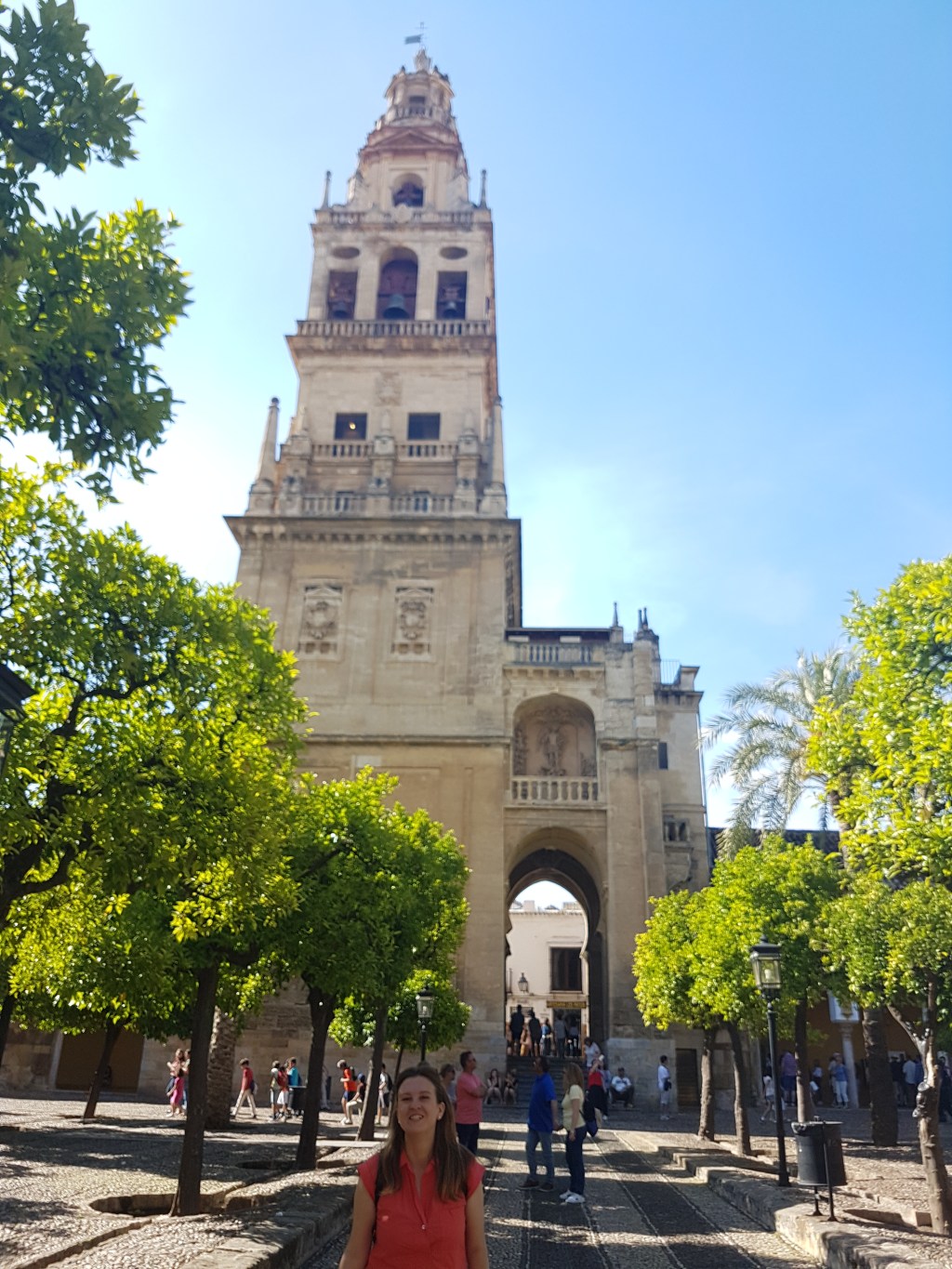
You enter the Mezquita through the walled orange tree garden. It’s a beautiful and peaceful space, and a great lead-in for the Mezquita itself, which is an enveloping and calming building. Walking around, it’s frequently not possible to the end of the space, and yet the entire building is open concept, so the space feels endless. The scale of it all was remarkable, and unlike anything we’d seen so far.
The Mezquita is at the heart of Cordoba’s history, and if you’re lucky to visit this city, it’s a definite must-see!
After our time at the Mezquita, Kevin and I went to meet up with the rest of the group. We spent a couple of hours snacking and enjoying wine and each other’s company at a cafe in a plaza/square.
To end the day, our group headed out to cross the bridge and see the view of the city from the other side of the Roman bridge. Our second day was wrapping up, and while we didn’t get to see everything, but we felt like we had seen enough to appreciate the magic of Cordoba.
Many, many photos below from our hours-long walk through the city.
Standing outside the walls of the Mezquita on our first day in Cordoba!
A church near our ‘pension’
Standing in the streets of Cordoba
Walking up to the ruins of an old Roman temple
The temple was under restoration so we couldn’t see much
Another church in Cordoba!
a beautiful church in a small courtyard
Standing in a square in Cordoba
And again!
Tapas for lunch at Norte y Sur!
Exploring the old city of Cordoba
The ruins of the original entrance to the city
The road to enter the city once ran between these two towers
Behind me is another entry way to the city walls
Sitting along the moat around the city walls
Heading in!
Lineup!
Roman ruins along the river!
Selfie with an old Roman bridge!
The Mezquita!
Inside the orange garden!
Entering the Mezquita
Under these clear panels are the original ruins of the San Vincente Chapel
Inside the original mosque of Abd al-Rahman I
passing the basilica in the centre of the Mezquita
The enlargement of Abd al-Rahman II
The Mihrab, a niche to show the direction of prayer, as well as a beautiful expample of Byzantine art.
The enlargement of Almanzor
Inside the Basilica
The organ and choir space in the Basilica
View of the Mezquita at night from the other side of the Roman bridge
Throughout the duration of Tyler’s trip to Portugal, I was incredibly ill. I slept most of the time and felt terribly shivery and gross for most of the time that I wasn’t sleeping. As a result, I didn’t get out for too many excursions, and Tyler’s blog posts have covered the majority of his second week with us in Portugal, where we relaxed in the Algarve.
There was one trip for which I did manage to drag myself out of bed: a day trip to the Fort at Sagres.
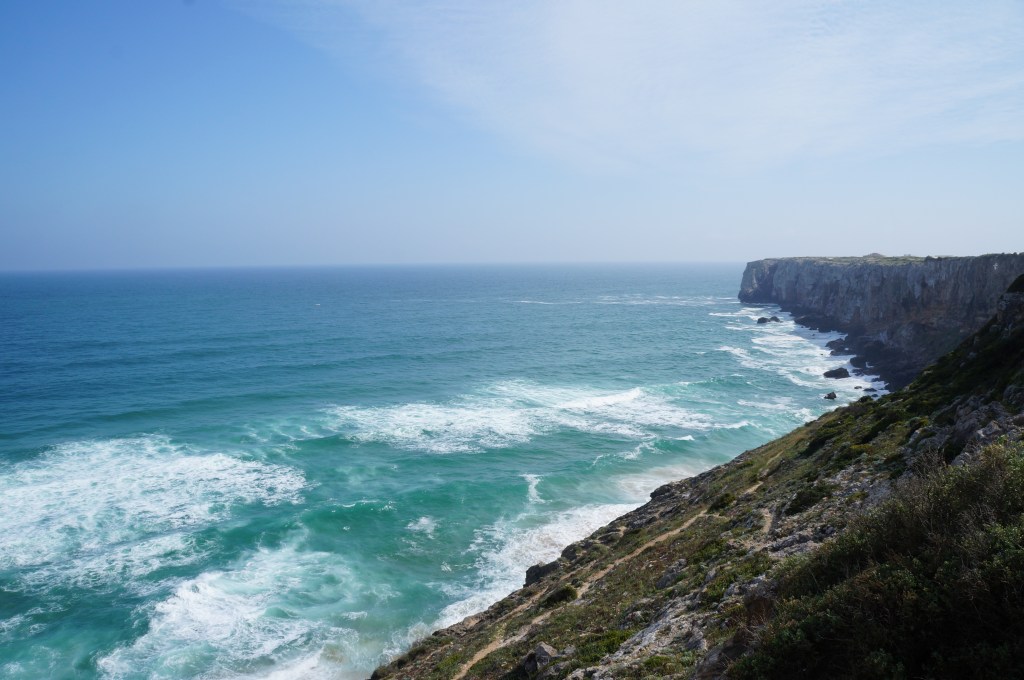
Sagres is the most south-west point of Portugal, with a large landmass that juts out into the ocean. The Fort of Sagres occupies this space, a place connected to Portugal’s history of exploration. The Fort may or may not have been connected to the work for Portuguese Prince Henry the Navigator:
It is traditionally suggested that Henry gathered at his villa on the Sagres peninsula a school of navigators and map-makers. However modern historians hold this to be a misconception. He did employ some cartographers to chart the coast of Mauritania after the voyages he sent there, but there was no center of navigation science or observatory in the modern sense of the word, nor was there an organized navigational center.[7]
Referring to Sagres, sixteenth century Portuguese mathematician and cosmographer, Pedro Nunes, remarked, “”from it our sailors went out well taught and provided with instruments and rules which all map makers and navigators should know.”[8]
The view that Henry’s court rapidly grew into the technological base for exploration, with a naval arsenal and an observatory, etc., although repeated in popular culture, has never been established.[9][10][11] Henry did possess geographical curiosity, and employed cartographers. Jehuda Cresques, a noted cartographer, has been said to have accepted an invitation to come to Portugal to make maps for the infante. This last incident probably accounts for the legend of the School of Sagres, which is now discredited. (Wikipedia)
The location was stunning. Walking along the cliffs, watching birds fly above the waves, and looking back at the rather flat, open space of the fort, it was a beautiful scene. As far as museums go, it was fairly unimpressive. Very little information was offered about what we were looking at, though Wikipedia has suggested that the Fort’s importance is up for debate, which may explain the lack of concrete information at the site.
In either case, it was a lovely day, made even better by a really fantastic seafood lunch. We dined at A Sagres, the closest restaurant to the Fort. While those around us were eating spaghetti and other such nonsense, we requested the daily specials, and were treated to an amazing seafood stew and freshly caught fish.
On the way home we took a scenic route along the coast. We stopped at a beautiful beach, and took a detour for a supposed ‘archaeological site of interest’ that was actually just a field.
Check out our photos to enjoy the view:
but first, we lunch. Clams to start!
seafod stew!
sea bream!
deliciously fresh fish
taking in the scene
walking on a nearby beach as part of our scenic route home
Ok, so the last few posts have detailed some fairly magical sights. But to be honest, there’s more to come here. This trip was pretty surreal, and we saw many memorable places.
The driving on the trip may also have been a bit much, but in this case it turned out to be worth it. After driving 2.5 hours to Piodao, we spent a couple of hours exploring this small yet remarkable village. And then we got back in the truck and Kevin drove us another 3 hours to Marvao, a city on a hill right on the border of Portugal and Spain. About an hour into this trip, I was really questioning this decision, but when we drove up to this walled-city on a foggy night, all doubts were forgotten.
Here’s what you need to know about Marvao (courtesy of Wikipedia):
Commanding spectacular views across the Tagus basin (the same river to connects Lisbon to the Atlantic) and Serra de Estrela (highest point in Portugal) to the north, the fortified rock of Marvão has been a site of significant strategic importance since the earliest human settlements. Today lying on the ‘raia’ that divides Portugal and Spain, Marvão has consistently stood on a frontier zone between peoples: Celtici, Vettones and Lusitani (4th-2nd century BCE); Lusitanians and the Romans ofHispania Ulterior (2nd-1st century BCE); migratory Suevi, Alans, Vandals and Visigoths (5th-7th century CE); conquering moors and Visigoths (8th century); muwallad rebels and the Cordoban emirate (9th-10th century); Portuguese nation-builders and Moors (12th-13th century); Templars and Hospitallers (12th-14th century); Portuguese and Castilians (12th century-present day); Liberals and Absolutists (19th century); the fascist regimes of Salazar and Franco (20th century).
Marvão’s natural assets have contributed to the ‘uniqueness’ of this remote village as perceived by visitors today: (i) as nigh-impregnable ‘eagle’s nest’ fortress – perched high on a granite crag, and bordered on the south and west by the Sever river; (ii) as vital lookout-point towards the Alcántara Bridge (70 km (43 mi) away), a wide stretch of the Tagus basin and the Serra de Estrela; (iii) as a gateway to Portugal from Spain via the Porta da Espada (‘Sword Gate’) mountain pass of the Serra de São Mamede. These assets have ensured its status as the ‘Mui Nobre e Sempre Leal Vila de Marvão’ (Very Noble and Ever-Loyal Town) into the present day.
As with other 11th-13th-century castles, the early medieval improvements and development of Marvão castle reflect the innovations brought back by crusading orders from the near east (notably the highly influential Hospitaller castle in Syria, the Krak des Chevaliers). The medieval castle seen in Marvão today mostly post-dates the year 1299, and features numerous characteristic features of a crusader-era castle: a tall central keep with raised entrance on the first floor; a series of lower, outlying turrets (some semi-circular); high-placed arrow-slits; open spaces to aid the sheltering and assembly of villagers and troops; a well, and huge rain-collecting cistern to supply water to both keep and the wider castle in the event of siege; bent entrances (both on the village and castle gates) to slow down invaders in the event of breached gates; a series of narrow killing zones (notably, in the triple gate on the village-side of the castle); extensive crenellated battlements and curtain walls that enhanced the natural defences provided by the escarpments of Marvão’s rock.[22]
That’s only a smattering of interesting information about Marvao, as this place is filled with historical significance. When we arrived at night fog filled the town, we had to park the truck just outside of the gates in order to walk to our hotel (we stayed and ate at the the Casa do Alentejo, where we were welcomed with the traditional and impressive Alentejo hospitality). With the characteristic preservation of the buildings’ historical style, it felt like we were walking back in time. After a lengthy dinner, we got some sleep, then woke up early for breakfast and further touring. We explored all through the town and the castle, and were constantly in awe of the view and the spirit of the region. Similar to Sintra, looking across the hills you could easily imagine what it was like to look across that view 1000 years ago. A very cool feeling that won’t soon be forgotten.
Check out our photos below!
Surprisingly, this is the only photo I have of Marvao at night!
If you’ve ever read this blog, you know that we typically take our travel slowly. Even if that means we miss out on some possible sites, we always try to spend the maximum amount of time in our travel pursuits, in an attempt to really understand where it is that we’re visiting. Clearly we didn’t quite take that approach on our road trip, where we packed quite a bit of stuff in. I mean, we’re now 3 posts into Day 1 of our Sintra road trip, and yet we still drove another 2+ hours on this day!
Our wonderful friend, Soledad, insisted that we visit “Quinta da Regaleira”. It roughly translates to being “Estate of Regaleira” (the land was once owned by the wealthy Regaleira family from Northern Portugal). Soledad told us that this was her favourite place in the world, and once we arrived we realized why. We also very much regretted not budgeting more time to be here. There was so much to see, and we certainly didn’t let the rain slow us down!
The Quinta da Regaleira is essentially an estate that was once owned by a rich guy with big dreams of making something fancy. And this guy, António Carvalho Monteiro (actually nicknamed Moneybags Monteiro) sure achieved his goal. He was an eccentric guy who leveraged his family fortune to become a coffee tycoon in Brazil, then returned to Portugal study everything from law to bugs.
After purchasing the land in 1892, he spent until 1910 creating a magical villa and gardens, a neo-Manueline extravaganza all dreamed up by Italian opera-set designer Luigi Manini (Lonely Planet).
Despite the rain, we spent most of our time exploring the extensive gardens. This place is a landscape architect’s dream, boasting arches, gazebos, grottos, aquariums, gardens, patios, paths, fountains, tunnels, bridges, and more. The highlight is almost certainly what’s known as the “Initiation Wells”. We spent at least 30 minutes trying to find them, and it was well worth the effort. Here’s some background info, courtesy of our friends at Ancient-Origins.net:
The pair of wells, known as the ‘Initiation Wells’ or ‘Inverted Towers’, consist of ‘winding stair’ architecture, which carries symbolic meaning including the death/rebirth allegory common to many hermetic traditions.
One of the wells contains nine platforms, which are said to be “reminiscent of the Divine Comedy by Dante and the nine circles of Hell, the nine sections of Purgatory and the nine skies which constitute Paradise.” A smaller well, called the “Unfinished Well,” contains a set of straight staircases, connecting the ring-shaped floors to one another. It is believed that the spacing of the landings, as well as the number of steps in between were dictated by Masonic principles.
The two wells are connected to a series of underground tunnels and caves. Once we entered the primary initiation well, we descended deep underground.
To our great delight, we ended up in passing through the other well and entering a grotto/lake/waterfall area. We were beyond thrilled at this turn of events. We’d been freaking out about the beauty of this site all day, but this discovery topped them all, and we immediately agreed that Soledad was right about this place.
The inside of the mansion was pretty cool as well, but nothing close to the outdoor gardens and its secrets. If you plan to visit this site, give yourself at least 3 hours to see everything!
Check out the photos to see all this beauty for yourself (some are a bit blurry due to the rain – we were completely soaked, as was the phone!):
We began our adventure on the edge of the gardens
This level of detail and beauty existed throughout
soaking wet and trying to read our map as it falls apart
From the top of the initation well!
down, down, down…
…down, down, down…
at the bottom!
as we make our way through the tunnels, we see the light!
and hear we are!
we then crossed the lake!
we passed a fountain…
…and made our way to the castle
the view was stunning!
This chapel was built in Italy and then transported to Portugal
We typically take our sweet, sweet time when doing anything, but because we were on a road trip, we had certain goals for where to be and when to be there by. We were also exploring unfamiliar territory, and perhaps underestimated how much time we’d want to spend in certain places.
That said, everything that we saw on the first day of our Road trip was within the magical area known as Sintra, where castles and natural beauty abound. There are tons and tons of incredible sites to see in Sintra, but we oriented our trip to the advice of our friend Soledad, and selected those she described as ‘must-see’ items.
We visited 2 different castles on that day, and they couldn’t have been more different: The Moorish Castle, and Palace of Pena.
Let’s start with the Moorish Castle.
The Moorish Castle was the decidedly more ruin-y of the two. It is a military fort built around the 10th century by the Muslim populations that occupied the Iberian peninsula. It acted as a control tower for the Atlantic coast and land to the north, serving as an outpost for the city of Lisbon.
For a building that’s more than 1000 years old, it was in pretty decent shape. All of the exterior castle walls remain, and we were able to walk up, down, all around, and catch amazing views throughout. From the top of the castle walls, you can see all that’s built up in the Park in the centuries since: a town, castles, mansions, etc. And yet, you can imagine how it felt 1000 years ago to look out and see no evidence of other people. Placed atop a large hill, this place is definitely an impressive and well planned military location.
And not *just* military either. After the large castle walls had been built, people began to settle just outside of them. A “second circle of walls” was later built to protect these settlements.
If you’re interested in the nitty gritty history timeline for the Castle of the Moors, check out Wikipedia.
After the Castle of the Moors, we headed to the Palace of Pena.
While it was cool, the Palace of Pena (Palacio da Pena) is one road trip stop we could’ve done without. We crammed a lot of sites into this road trip. That’s not usually our style, but we went a bit overboard with expectations for what we wanted to see. In its defense, it’s part of a large garden complex, but we only saw the castle itself, because it was raining and we were rushing to see another place afterwards (more on that later this week!). By rushing to see the Palacio, we cost ourself some appreciation of its history. The routinely under-informational museum pamphlet also didn’t give us the full story of site.
The palace’s history started in the Middle Ages when a chapel dedicated to Our Lady of Pena was built on the top of the hill above Sintra. According to tradition, construction occurred after an apparition of the Virgin Mary.
In 1493, King John II, accompanied by his wife Queen Leonor, made a pilgrimage to the site to fulfill a vow. His successor, King Manuel I, was also very fond of this sanctuary, and ordered the construction of a monastery on this site which was donated to the Order of Saint Jerome. For centuries Pena was a small, quiet place for meditation, housing a maximum of eighteen monks.
In the 18th century the monastery was severely damaged by lightning. However, it was the Great Lisbon Earthquake of 1755, occurring shortly afterwards, that took the heaviest toll on the monastery, reducing it to ruins. Nonetheless, the chapel escaped without significant damage.
For many decades the ruins remained untouched, but they still astonished young prince Ferdinand. In 1838, as King consort Ferdinand II, he decided to acquire the old monastery, all of the surrounding lands, the nearby Castle of the Moors and a few other estates in the area. King Ferdinand then set out to transform the remains of the monastery into a palace that would serve as a summer residence for the Portuguese royal family. The commission for the Romantic style rebuilding was given to Lieutenant-General and mining engineer Baron Wilhelm Ludwig von Eschwege. Eschwege, a German amateur architect, was much traveled and likely had knowledge of several castles along the Rhine river. The construction took place between 1842–1854, although it was almost completed in 1847: King Ferdinand and Queen Maria II intervened decisively on matters of decoration and symbolism. Among others, the King suggested vaul tarches, Medieval and Islamic elements be included, and he also designed an ornate window for the main façade (inspired by the chapter house window of the Convent of the Order of Christ in Tomar).
Having done my Wikipedia research, it’s clear that this place’s history actually fits well with many of the other sites that we saw in Sintra and in Tomar. That information was definitely not in the pamphlet we received upon entering, but either way we had a fun time. It’s by far the most colourful castle I’ve ever seen, which gives it an almost-comical appearance.
All this site-seeing constituted just part of our day. Enjoy the photos below, there’s more to come from our final (and favourite!) stop coming soon.
The Moorish Castle is super old and sits atop a hill
As you can see, the view is amazing.
So is the wind!
The stairs are also quite something!
we found a cat, of course.
view of Sintra from the Moorish Castle!
From the Moorish Castle, we could see Palacio da Pena
Then we drove there, and Kevin sniped this wicked parking spot directly in front of the entrance
not a bad welcoming start, right?
you can’t tell from the photos, but this place was pretty packed with tourists. We complained about them constantly because we’re a bunch of spoiled snobs who don’t like others getting in the way of our jokes at historical sites.
oh hey there!
checking out the view!
and here’s that view I was checking out!
now I’m the one getting checked out!
the great thing about travelling with Kevin is that he always takes your photo, and they’re never blurry.
the tiling in the room was pretty next level
and just look at that plant holder! everything in this place was intensely detailed!
great view, right?
some type of old-school phone
art!
more art! #selfiegamestrong
couldn’t resist a photo of these hip cats!
who doesn’t want a violin + matching vase. Tons of these on kijiji for sure!
I made Tyler take a photo of this because I really want this wall paper in my house one day. Obviously it’s perfect.
the detail of the design here is pretty bonkers – this is just a simple handrail on a staircase!
I thought it was cool that they had a proper running water situation happening up here. If memory serves, it was one of the first of its kind.
inside the castle there’s a museum-type route that takes you through various rooms
The moment I told Kevin I’d booked my flight, he went into trip planning mode. Two weeks was a lot of time to fill, but it got booked up fairly quickly. We considered and rejected visiting the North & Porto (too far), some additional castles (I rolled my ankle), another historical town (Heather got sick), and a winery (we slept in). But still we ended up seeing a lot. A couple days sightseeing in Lisbon, a few days on the road being steeped in history, and finally a full week exploring the Algarve.
As Heather has recapped some of the Lisbon tour and the road trip, I’ll share a couple of our day trips exploring the Algarve.
Avo Olimpia & Exploring Town
Because Heather works remotely and at night (Australia hours) we usually get a pretty late start our day. We typically didn’t wake up, shower, have breakfast (a Canadian tradition apparently) and a cafe [Editor’s note, we now refer to ‘coffee’ in Portuguese, hence ‘cafe’], and head out until at least noon. Avo Olimpia, on the other hand, is much busier in the morning. Everyday when I would wander downstairs to scrounge up some breakfast around 10am, she would be well into her day – a trip to the market complete, laundry washed-dried-folded, and soap-opera watched. I’d get a “bon dia, bread’s on the table” and she’d be off yet again, now to the cafe with friends. She’s always on the move, and we rarely knew where to.
One day I got the grand tour of the town and Kevin’s childhood playground. We walked to the pool, fed ducks in the creek, and saw the old-old church, the new-old church and pointed out every coffee place in town (there were many). There were some really cool sights too! Other than the history (“so the Romans built those walls”, “this buidling pre-dates Canada” etc.) my favourite sight was the giant Portuguese flag overlooking the entire town. Apparently during a previous World Cup (soccer…er I mean, football) some kids had scaled a nearby hill and painted a Portugese flag to cheer on their nation. This act of fan-dalism has since remained, and honestly looks pretty great!
I thought Grimsby (pop 20,000) was a small town where everyone knows everyone, but Alte puts it to shame. Throughout the week of exploring we rarely walked down the street without stopping to chat with a neighbour, old friend, or relative because everyone knows each other. Case in point: Alte, it turns out, is so small you can accidently run into family. On one of our urban tours we stumbled upon Avo. We chatted for a bit with her friends (all in Portuguese so have no idea what was said, but assume my height and fair skin were questioned) but she was too busy for us (going dancing?) and we each continued on our separate ways.
All in all I enjoyed seeing this small town.
The river winds all the way through town. Fills the pool, and many houses back onto it
Some locals painted Portuguese flag a couple years ago for FIFA World Cup
River fed grainery
Bumped into Avo!
Basically the centre of town
The old-new church or the old-old church. Can’t recall
Avo Maria, The Farm, and the old House
While we spent the week with Avo Olimpia, one of our day trips included a visit to see Avo Maria and some of the family farm land. If it was nice having fruit trees in the yard for fresh juice, then visiting Avo Maria was a delight. She has fruit trees as far you can see – grapefruits, oranges, lemons, limes, whatever – just sitting there ready to be picked! I got a tour of the farm (included more Kevin stories “used to climb this tree”, “had a tire swing here”) and we loaded up on fruit, all while dodging chickens underfoot.
The most hilarious part of this day trip was meeting Daisy. Daisy is Avo Maria’s older but still very much active dog. She followed us around for the whole tour, chasing chickens and keeping us entertained. As we got back to the house though, she surprised all of us by hunting down and catching a pigeon out of mid-air before scampering off to finish her treat!
Playing chicken
Used to have a tire swing
Something something this is a fruit tree
Meet Daisy
Our Haul for the day
Getting the tour
The old family estate. Kevin’s great-great grandfather built this house, and it’s the same house where his grandfather grew up. There used to be a cement bench beside that door, where his grandmother would sit when she came over.
The old backyard!
The Beach
One of my favourite Algarve day trips included visiting a beach hidden from the mainroads and mostly known to locals. Here we got to walk the beach for a little while with the sand, sun, and ocean breeze all to ourselves. Kevin knows about the place because he used to visit with his grandfather and fish for clams in the summer. We got a full theatrical explanation of how he would walk in neck deep water (“it was up to here!”) trying to keep up with his grandfather while fighting the ocean (“current was trying to suck me out the whole time!”) so they could eat fresh seafood for dinner. It was a neat story which gave a beautiful pit-stop all the more meaning.
Had the beach to ourselves
These people
We saw a bus eating a car…
As were leaving the beach we noticed it had rained earlier (sidenote – apparently it rained so much during my visit I’m not allowed back, bad luck) and the dirt parking lot was now filled with mud. So while Heather rolled her eyes Kevin and I hooked up the camera and drove circles through the mud having a blast! Check it out:
When it was a bit chilly, Kevin and I drove east to see the Palace of Estoi. A few weeks later, on one of the first truly warm days this year, Kevin and I drove west to see the Castle of Silves.
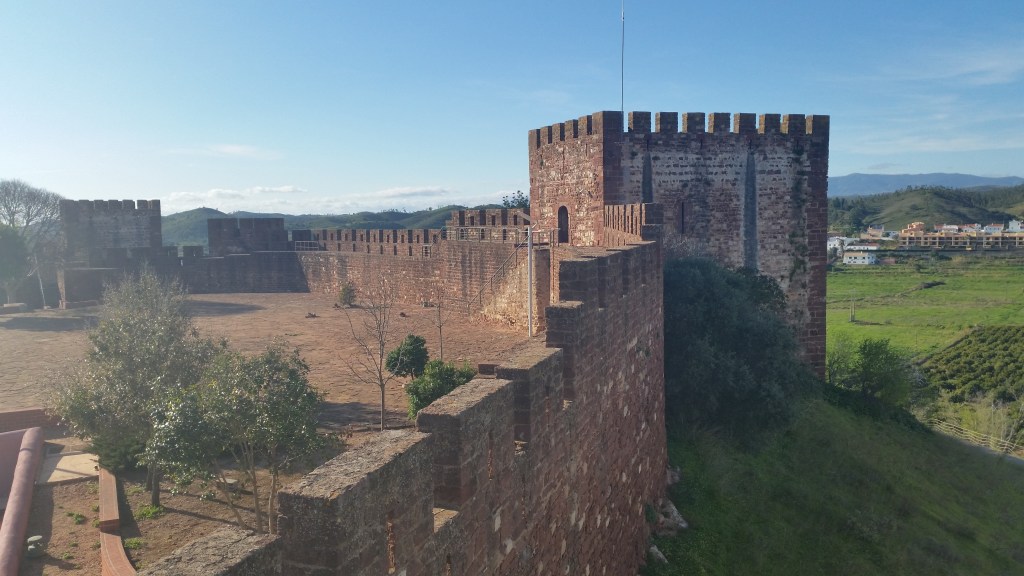
The Castle of Silves is stunning. I’d seen it many times, lit up at night, while driving through Silves to have dinner somewhere. This day was the first time Kevin and I had been there, and we were quite impressed. The Palacio do Estoi is pretty, but the Castelo de Silves is, like, a really serious/big piece of history in this region. according to Wikipedia:
“Built between the 8th and 13th century, the castle is one of the best preserved of the Moorish fortifications in Portugal … from archaeological excavations, it is assumed that the first fortress on this site consisted of a Lusitanian castro. It is believed that Phoenicans, Greeks and Carthaginians traversed the site at one time, but that around 201 B.C. the Romans conquered Silves, transforming it into a citadel of their occupation, and commercial center that prospered for the next five centuries.
Around 716, the Visigothic citadel was conquered by the Umayyad Caliphate who reinforced the existing fortifications with a new series of walls. This new period resulted in a great period of development, under the Moorish occupiers, that include the extensive walls in the west.In 1160, it was sacked by Ferdinand I of León and Castile, but remained only for a short time in the hand of the Christians: it was quickly recaptured by the Moors. King Sancho I of Portugal, supported by the powerful Crusader army, conquered the city, after a prolong encirclement in 1189. But, a grande army, under orders from Amir al-Mu’minin, in 1191, retook the city. The buildings of the Taifa kingdoms of the 11th century, which includes the Palace of Balconies (where Al-Mutamid lived as the poet Ibn Amarhe) progressed in the 11th century. The walls and towers that today represent the Castle of Silves came from these campaigns and public works by Almoravides and Almohads in the 12th and 13th centuries. The castles internal water catchment, and large rain fed underground cistern were used to provide freshwater for the surrounding dwellings (to as late as the 1920s). It would only be in the 13th century, during the reign of Afonso III of Portugal, that forces under the command of D. Paio Peres Correia, would definitively take the fortress.
So yeah, more than 2000 years ago, the site of Silves Castle was established by Moorish forces, who then passed it back and forth with Christian conquerors for 1400 years, until the Portuguese finally took hold of the whole thing.
When you’re inside the castle walls, you can see why it was chosen as the location for a massive fortification. It sits atop a hill, and you can see everything for miles. You can’t quite see the ocean, but any invading ocean forces would be held up by and easily visible crossing a natural geographic barrier – the sierra hills south of the castle.
Other than a cafe, there’s not much in the way of an organized presentation of information at the castle, but we had fun walking around the massive site, checking out the views from every angle and trying to interpret the map we had.
There was one exhibit in the room that used to be for water storage. It described the Iberian Lynx, a beautiful animal on the verge of extinction, native to Spain & Portugal.
Take a look at our photos below. It was a really beautiful day!
at the cafe, trying to understand what this map is saying
this is the backdoor entrance to this place. I got as far as that, then screamed “EW! Bugs!”, posed for a photo, and rushed away.
View from the castle walls
an old timey garden and an artistic shot 😉
Me, thinking WTF? Which way to the lost secondary water chamber?
diagrams of the endangered Iberian Lynx
RAWR!
Pretty sure those palm trees aren’t native
Not sure if the Moorish men were actually this tall, but this is me and a statue outside.
A view of the Silves Castle at night (on the right)
Kevin gets pretty into his photo angles.
And I got to take this one, because of course he was petting the cat!
Sometimes being in Portugal with Kevin feels like being on a non-stop field trip. That is to say, he’s always cooking up new ideas and trips and adventures to keep me entertained. Back in February, Kevin planned a whole-day outing for us to see the Palacio do Estoi (aka the Palace of Estoi). Our drive to Estoi wasn’t your regular ol’ highway drive. Kevin chose the most scenic route possible, and included a stop in the nearby town of Salir, where a sign promised us castle ruins.
Salir really was beautiful, and as it sits on a top of a hill, it cuts a lovely view. The ruins were a bit disappointing, but as you’ll see below, meeting a cute cat more than made up for it.
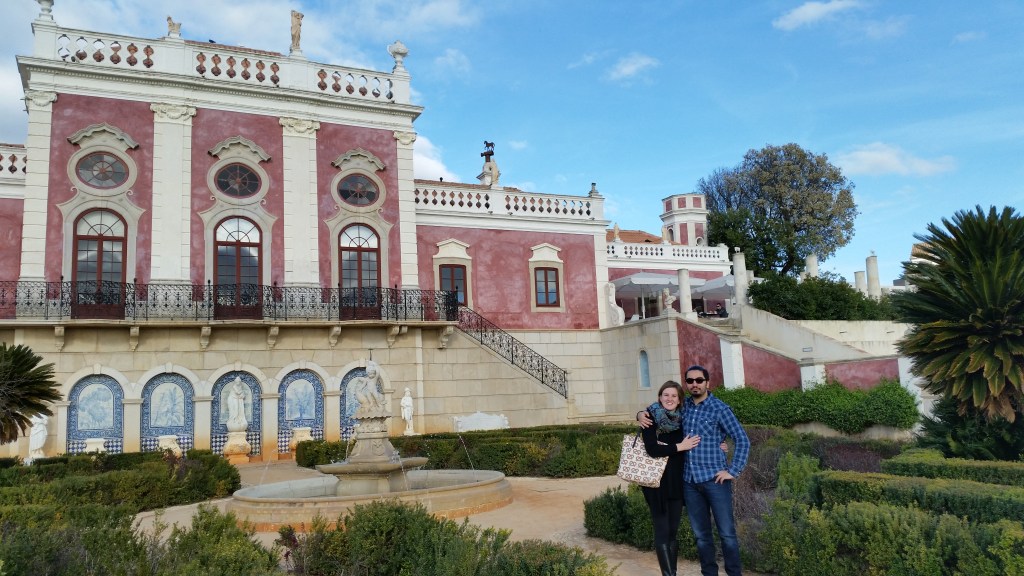
Our next stop was the Palacio do Estoi. It’s a palace built by a rich guy in the late 1800s and it’s a great example of the Rococo style. It’s also probably one of the only examples of Rococo style to be found in the Algarve.
Recently, it was acquired by a hotel chain that specializes in unique properties. They’ve added an expansion to the palace that contains a pool and accommodations. As for the original palace, they’ve kept it mostly as-is, operating 2 restaurants out of the building. As a guest or a visitor you can explore various gardens and sitting rooms, all of which maintain their original beautiful style.
The patio outside is part of the restaurant, and that’s where we sat, enjoying a light lunch, a bottle of “vinho verde” (green wine), an ocean view, and a stunning sunset. Despite being an old beautiful palace-turned-hotel, it maintains a casual atmosphere that makes anyone feel welcome.
It was a simple day, visiting a simple site, and it was all wonderful. If you make it to Portugal, this is a site worth seeing.
Making a quick stop in Salir to see some castle ruins
great view!
Inside one of the sitting rooms.
the walls around the palace
From the mural inside. Kevin sent this to my parents and said it was the two of us.
Kevin & I, looking fab.
me and Kevin
view from the cafe on the patio
view from one of the balconies
checking out someone’s wheels
me in the palace gardens
view of the inaccessible, wild gardens, from the gardens close to the palace
enjoying lunch/wine and the sunset. As you can see, Kevin insists on places his lips on a fresh spot for each sip.
My week in Canterbury was one of the most unique and special trips I’ve ever been on. I don’t think that I’d spent so much uninterrupted ‘grandparent time’ since I was a kid, and as a kid I rarely saw the adults being anything other than a caretaker/entertainer for me.Having this one-on-one time was really the best, because we were able to explore Canterbury through each other’s eyes, and there’s no more enjoyable way to connect with someone than by exploring a shared interest. My Nana Ev has now taken 3 winterly sojourns to this beautiful town, in a beautiful apartment. It goes without saying, this place and this experience are meaningful for her, and I can certainly see why. The youthfulness of the energy in Canterbury, combined with the freedom of living in a truly walkable city is a perfect reflection of the life she lives. For those of you who don’t know my Nana Ev, she is truly on fire with regards to living life. She’s one of the busiest, strongest, and most independent women that I’ve ever known. Visiting her in this special place, taking the time to connect about our family and our lives, taught me so much about much grandmother and my grandfather and who they are as people. It was a really special glimpse into who I might become one day, and I’m so grateful that I had the opportunity to make this trip.
Our time in Portugal has given Kevin a similar opportunity to reconnect with his grandmothers, both of whom retired to the Algarve after years of working in Toronto. Similar to me, Kevin spent a lot of time with his grandparents growing up, but as he went away to school, began his career, etc, those opportunities for grandparent-ly connections became less and less frequent. Now, we live with one of his grandmothers and regularly visit the other. While the suffering of Kevin’s dental injury is very real, he recognizes and appreciates this unique trip and the time he’s been able to spend with his grandmothers, exploring his family history and his own connection to the Algarve.
He’ll be on here once in a while with his own posts about our experiences here in the Algarve, but it’s safe to say that we’re both feeling incredibly lucky to spend so much long, uninterrupted time with the people that we love. If you take anything away from this blog post, it’s that time with family is important. Life can be crazy busy, but I promise you that it’s worth it to take the time to connect with your grandparents. I know that I’m already looking very forward to the next time I can get back to Canada and see mine!
phone booth #selfie (our selfie game is getting good, non?)
Dover Castle #Selfie
Nana said we were related to this guy, so we took a #familyselfie
















 the stories that I'm telling.