Tag: Madrid

  • Days 6 and 7 in Spain – Cordoba for the Weekend!

    Days 6 and 7 in Spain – Cordoba for the Weekend!

    In my experience, people of means who live in Europe tend to spend a lot of time travelling on the weekends. In an area that has so much concentrated history, plus cheap flights and train tickets, a weekend away is the common tradition. And from keeping in touch with Zoya, I knew already that she and her friends, and her partner Shripal, often organized weekend group trips. It just so happened that they organized one such trip while we were in Madrid, and so we tagged along!

    Because my work schedule was so flexible, Kevin and I didn’t do weekend trips while we were in Portugal, so this was our first experience of what I consider to be a mainstay of middle to upper middle class European culture.

    Kevin and I have a good routine that we follow when travelling, and I was admittedly nervous to jump into a 10 person travel group, but we had a really great time and I’d do it again in a heartbeat.

    Spain has one of the most thorough rail networks in the world, including several high speed rail corridors. This makes it easy for those living in Spain to get from city to city. Zoya and Shripal and their friends have thus visited many of the historic towns and cities in Spain, and Cordoba was next on their ‘to-do’ list.

    Logistically, Shripal lead the way. He researched food options and booked our reservations. He also managed “the kitty”, our group fund. We all put an equal amount of cash into the kitty at the start of our trip, and all group meals and drinks were paid from this fund. When the kitty got low, we all topped it up equally. A simple concept, expertly managed by Shripal, that made all our group outings as simple as could be imagined.

    This was also probably the most sleep deprived weekend of our lives. Our Friday night outing quickly bled into Saturday morning. Most of our group had gone out together the night before, and didn’t go home until after 5am. We then had to meet at the train station around 9am for our train ride to Cordoba. To say we were all tired would be a major understatement.

    Surprisingly, we all rallied and made it through most of our train ride without sleeping. That says a lot of how much fun we were all having together.

    After we arrived, we checked into our rooms. There was a bit of drama with mine and Kevin’s AirBnB, but Zoya helped us get booked into a new location right away, helped me move our stuff, and AirBnB gave us a full refund. It was a rocky start, but things picked up as soon as the vermouth and tapas started flowing.

    And did they ever. We were all tired, but still managed to spend nearly 3 hours in the sun sipping vermouth and snacking on an incredible selection of tapas dishes.

    That afternoon we all napped, and then reconvened for a typically-European late night dinner, following by several hours of drinking and dancing in a club on the waterfront. Day 1 of the weekend was officially a success.


  • Day 5 in Madrid – Friday Night! Party time!

    Day 5 in Madrid – Friday Night! Party time!

    After our day at the museum, we squeezed in a bit of shopping to help top up Kevin’s wardrobe. Then we headed off to meet up with Zoya. We met up at her apartment where we enjoyed wine in the sunshine of her back patio. It had finally stopped raining!

    On the way to dinner, Zoya took us to a couple of memorable spots. First, we went to La Conservera Delistore&Tapas, a store run by the brand Frinsa. Frinsa is one of the largest European manufacturers of canned tuna fish and seafood, and was founded in Galicia, Spain. And you can actually order their stuff online!

    We were able to sample a bunch of things – clams, tuna, sardines, and razor clams. They were incredibly delicious and high quality. That type of food isn’t that popular in Canada, so we’d be hard pressed to find anything like it at home. It was the perfect souvenir from our trip.

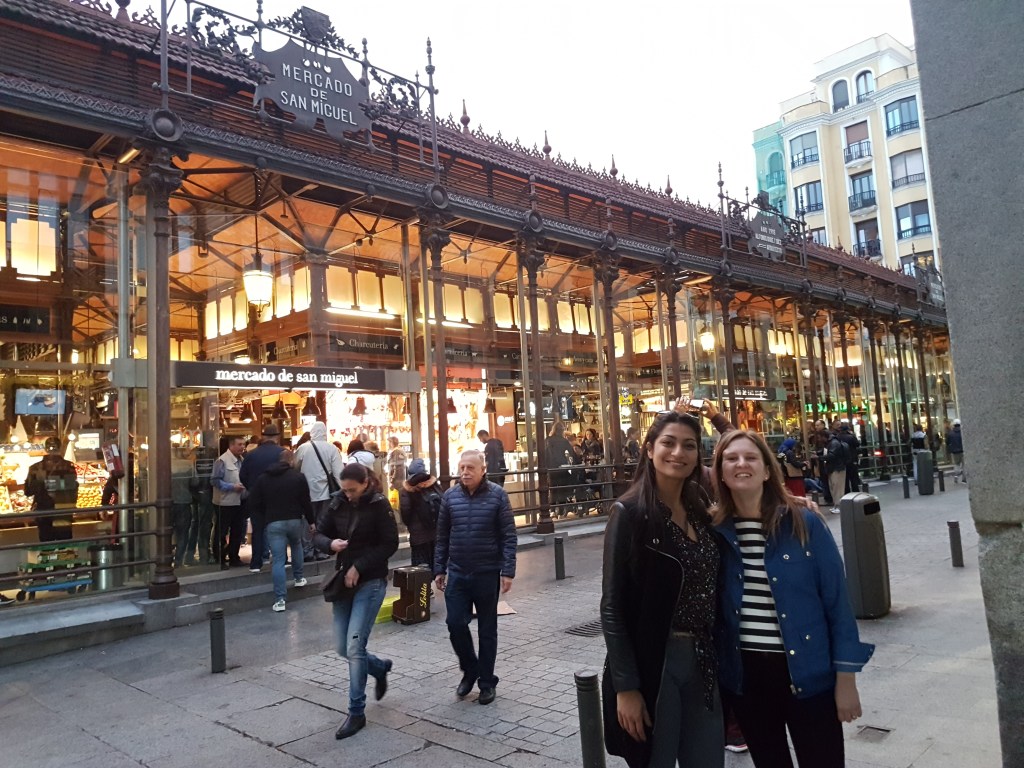
    After stocking up on seafood preserves, we headed across the street to the Mercado de San Miguel. Kevin and I didn’t love our earlier ‘mercado’ experience, so we hadn’t tried this one. However, it ended up being one my highlights from the week!

    Okay, so what actually is the “Market of San Miguel”? Here are the Wikipedia details:

    The Market of San Miguel (SpanishMercado de San Miguel) is a covered market located in MadridSpain. Originally built in 1916, it was purchased by private investors in 2003 who renovated the iron structure and reopened it in 2009.[1]

    San Miguel Market is the most popular market in Madrid among tourists since it is located in the center of Madrid, within walking distance from Plaza Mayor. The market is not a traditional grocery market but a gourmet tapas market, with over 30 different vendors selling a wide variety of freshly prepared tapas, hams, olives, baked goods and other foods. Beer, wine and champagne are also available.[1][2]

    The other market we’d been to was clearly more oriented at locals and other people interested in eating a full meal. The Mercado de San Miguel embraces the spirit of tapas, encouraging you to pick up a variety of little snacks at different stations, and then grab a standup table to snack and drink. Within minutes of arriving we were drinking glasses of vermouth and snacking on an assortment of olives, preserves, and and much more.

    The market was packed, and is clearly a favourite destination for tourists, so it’s both hard to move around, and easy to get jostled by others. If that’s not your jam, I’d stay away from this place. However, if you’re looking for place to stop and experience great energy and excitement as you get ready for a long night out, then I highly recommend stopping by the Mercado de San Miguel!

    After the market, on to dinner!

    That night we dined with Zoya and Shripal, and two of their friends (who later came with us to Cordoba), including the friend who introduced them in the first place! We ate dinner at a place called Parrila Del Mago, famous for their barbecue, steaks in particular. The food was great and the company was even better. Since it was Kevin’s birthday, we embarrassed him with a loud rendition of ‘happy birthday’ when dessert arrived.

    After dinner, onto dancing!

    We started out our evening at some kind of live rock show type bar. The music was so bad it was amazing, but we quickly left for a more ‘discotheque’ type experience. We loaded up with gin & tonics and hit the dancefloor to the latest in hip Spanish music, including the now-inescapable Despacito and this banger about bicycles from Shakira. Obviously they also played Drake, he’s everywhere!

    By 5am we realized we needed to get home and sleep before our train to Cordoba. Photos below of our Friday afternoon adventures!


  • Day 5 in Madrid – National Archaeological Museum of Spain!

    Day 5 in Madrid – National Archaeological Museum of Spain!

    Thursday night got a bit crazy, so Friday was a late start. We woke up late to a rainy day and also realized we’d left one of our host’s umbrellas at the bar the previous night. Oops!

    Anyways, sharing the one remaining umbrella we headed out to grab some breakfast before, obviously, going to a museum. It was our last day in Madrid, and we had plans that evening with Zoya and some friends, but we wanted to see the National Archaeological Museum of Spain. For the last 6 months or so Kevin has been on a deep dive into learning about Roman and Iberian history, so this seemed like the perfect place to spend our last day in Madrid, which also happened to be his birthday.

    Here’s what Wikipedia has to say about the museum:

    The museum was founded in 1867 by a Royal Decree of Isabella II as a depository for numismatic, archaeological, ethnographical and decorative art collections of the Spanish monarchs.

    The museum was originally located in the Embajadores district of Madrid. In 1895, it moved to a building designed specifically to house it, a neoclassical design by architect Francisco Jareño, built from 1866 to 1892. In 1968, renovation and extension works considerably increased its area. The museum closed for renovation in 2008 and reopened in April 2014.[1] The remodelled museum concentrates on its core archaeological role, rather than decorative arts.

    The collection includes, among others, PrehistoricEgyptianCelticIberianGreek and Roman antiquities and medieval(VisigothicIslamic Spanish and Christian) objects.

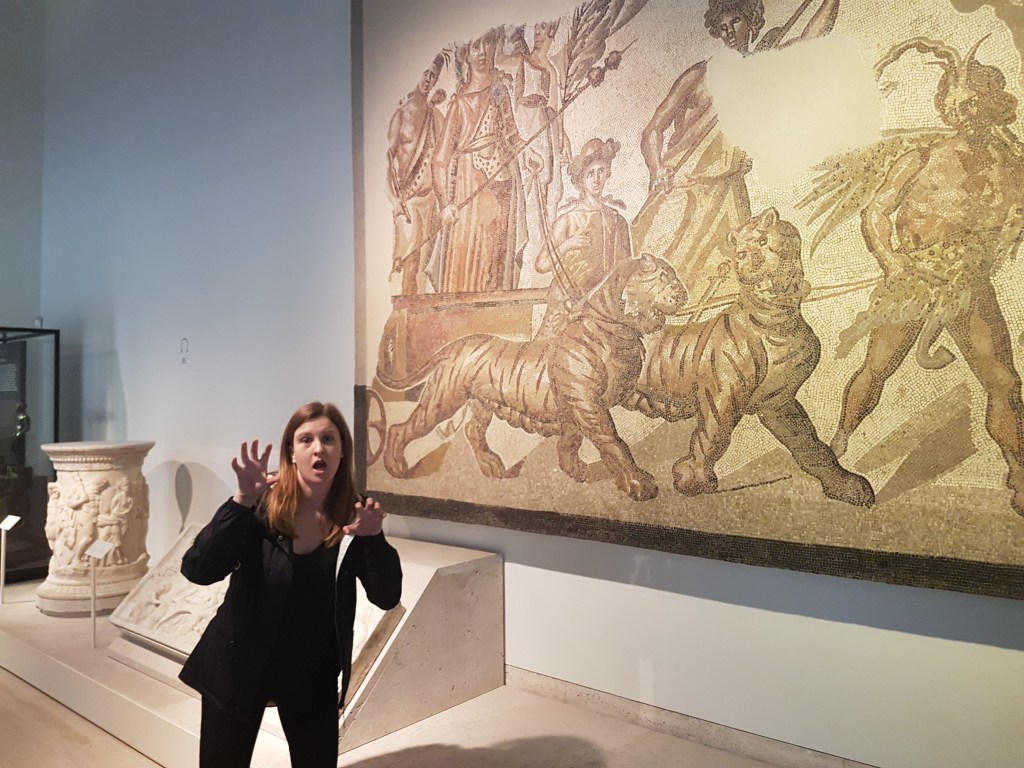
    This was one of the best no-art museums I’ve ever been to. The detail and expenses put into curating the collections are excellent. The impact of the most recent renovation is unmissable and it would be a great place for anyone with any level of pre-existing knowledge on Archaeology, including kids. The collections are extensive, and take you through the evolution of ancient western culture and civilizations.

    The use of visual guides, including audio visual content, was quite impressive. Each new time period and/or topic was introduced with a video that illustrated what the community would’ve looked like at the time. It was a great way to understand the context of the artifacts presented, particularly with respect to the geographic movement and interactions of people. You can learn more about their collection here and here.

    Check out the photos below, and add this one of your Madrid itinerary!


  • Day 4 in Madrid – Dinner & Drinks!

    Day 4 in Madrid – Dinner & Drinks!

    Included in Zoya’s guide to Madrid was this line:

    Sala Despiece – this place is a MUST. get there early (like 20 mins before it opens) cause the place gets packed. Easily the most interesting take on Spanish tapas. The carpaccio will take you to heaven and back

    After hours and hours in museums, we were ready for a long and indulgent dinner. As per Zoya’s instructions, we arrived a full 30 minutes early, and were fortunately the first in line. Waiting in line before a place opens is really not our style, and we were feeling pretty uncool, but it was worth getting there early. Within 10 minutes, there were 20 people in line behind us. When the doors finally opened, we scored a prime seat at the bar, and were able to watch the chefs in action all evening.

    The thing about tapas is that you’re supposed to eat many dishes of small amounts of food. Apparently ‘tapas crawls’ are the hip thing, where you go from restaurant to restaurant eating small amounts. Again, not our style. Instead, we settled in at Sala de Despiece and ordered almost every item on the menu.

    As promised, the food was excellent. The view we had was also great, though it gave perhaps a bit too much insight into the restaurant operations. At open, the entire staff and flow of the team were on fire, but by hour one, things started to slow down and taper off, and you could tell operations would become sloppier throughout the evening. So perhaps there’s some logic to tapas crawls.

    Everything we ordered is showcased in the photos below. The food definitely lived up to the hype, especially the beef carpaccio. We were surprised when again we were served a dish that required us to squeeze out the head of a shrimp. This time we caught it on video:

    After dinner, we attempted to explore the neighbourhood for a ‘tapas crawl’, but were truly too stuffed. We hopped into a cab and went to Macera Workshop Bar, a gin bar that Zoya had recommended. These guys infuse their own homemade gins, and when they first opened you could only order gin & tonics

    As regular gin drinkers, we’re fairly attached to our classic options. It was interesting to try to these artisanal gin options, but we quickly switched to cocktails. After several ‘pink panthers’, we were having a raging good time. We had a great spot at the bar, and watched place fill up with a typically European mix of people from all ages. If we’d realized how low the bill would be, we may have stayed even longer.

    As it was, we left the bar and headed to another Zoya recommendation, Bar Cock. This place looks like a stereotypical old timey bankers hangout. All wood decor, and basically in a back alley. We ordered a bottle of sparkling and ended our night right.

    And when we got home, I found out I’d been accepted to the MBA program at York University’s Schulich School of Business. It was the perfect way to end a long day and a great night.


  • Day 4 in Madrid: A Full Day of Museums

    Day 4 in Madrid: A Full Day of Museums

    When we woke up on Thursday, I knew we had to allocate much of the day to visiting museums, and we were particularly interested in visiting the Reina Sofia museum, aka the home of Picasso’s Guernica. I’d learned my lesson about waiting in line earlier in the week, and bought our tickets online ahead of time.

    The other lesson I’d learned was the importance of food before going into a museum. We grabbed a quick breakfast snack around the corner, and walked through Retiro Park on our way to the museum.

    We had a few museums on our list that day, but the Reina Sofia was our primary goal, so that’s where we started.

    Officially called the Museo Nacional Centro de Arte Reina Sofía, the Reina Sofia is Spain’s primary destination for 20th century art. The Prado, which we’d already visited, housed many historic Spanish pieces, but anything from the 1900s is in the Reina Sofia (there’s a separate museum for contemporary art, which unfortunately we didn’t have time for).

    The bulk of the collection is by Spanish artists, and the most famous pieces are by Pablo Picasso and Salvador Dali. We were keen to Picasso’s Guernica, and luckily for us the museum had on a special Guernica-themed exhibit that showcased much of Picasso’s works all in one space.

    The Reina Sofia is a very large museum, housed primarily in an old hospital, which means the layout lacks the typical ‘flow’ you encounter in museums. This, combined with incredible size of the museum, meant that by the time we had worked our way through the Guernica exhibit, we gave up on trying to see the regular collection.

    So, the Guernica exhibit. It was both educational and well curated. The exhibit starts out by discussing the 1937 World’s Fair in Paris, for which the painting was created, and then it dives into the history of the Spanish Civil War. Here’s what Wikipedia has to say:

    Guernica is a mural-sized oil painting on canvas by Spanish artist Pablo Picasso completed in June 1937,[1] at his home on Rue des Grands Augustins, in Paris. The painting, which uses a palette of gray, black, and white, is regarded by many art critics as one of the most moving and powerful anti-war paintings in history.[2] Standing at 3.49 meters (11 ft 5 in) tall and 7.76 meters (25 ft 6 in) wide, the large mural shows the suffering of people wrenched by violence and chaos. Prominent in the composition are a gored horse, a bull, and flames.

    The painting was created in response to the bombing of Guernica, a Basque Country village in northern Spain, by Nazi Germany and Fascist Italian warplanes at the request of the Spanish Nationalists. Upon completion, Guernica was exhibited at the Spanish display at the Exposition Internationale des Arts et Techniques dans la Vie Moderne (Paris International Exposition) in the 1937 World’s Fair in Paris and then at other venues around the world. The touring exhibition was used to raise funds for Spanish war relief.[3] The painting became famous and widely acclaimed, and it helped bring worldwide attention to the Spanish Civil War.

    As we learned, the Spanish government commissioned Picasso to create a work of art for the World’s Fair, and it was only after the fact that he decided to create this moving painting, in what could well be described as an act of protest:

    In January 1937, the Spanish Republican government commissioned Picasso to create a large mural for the Spanish display at the Exposition Internationale des Arts et Techniques dans la Vie Moderne at the 1937 World’s Fair in Paris. At the time, Picasso was living in Paris, where he had been named Honorary Director-in-Exile of the Prado Museum. He had last visited Spain in 1934 and never returned.[4] His initial sketches for the project, on which he worked somewhat dispassionately from January until late April, depicted his perennial theme of the artist’s studio.[1] Immediately upon hearing reports of the 26 April bombing of Guernica, the poet Juan Larrea visited Picasso and urged him to make the bombing his subject.[1] However, it was only on 1 May, having read George Steer‘s eyewitness account of the bombing (originally published in both The Times and The New York Times on 28 April), that he abandoned his initial project and started sketching a series of preliminary drawings for Guernica.[5]

    After the bombing, the work of the Basque and Republican sympathizer and The Times journalist George Steer propelled this event onto the international scene and brought it to Pablo Picasso’s attention. Steer’s eyewitness account was published on 28 April in both The Times and The New York Times, and on the 29th appeared in L’Humanité, a French Communist daily. Steer wrote:

    Guernica, the most ancient town of the Basques and the centre of their cultural tradition, was completely destroyed yesterday afternoon by insurgent air raiders. The bombardment of this open town far behind the lines occupied precisely three hours and a quarter, during which a powerful fleet of aeroplanes consisting of three types of German types, Junkers and Heinkel bombers, did not cease unloading on the town bombs weighing from 1,000 lbs. downwards and, it is calculated, more than 3,000 two-pounder aluminium incendiary projectiles. The fighters, meanwhile, plunged low from above the centre of the town to machinegun those of the civilian population who had taken refuge in the fields.”[12]

    We weren’t able to take photos in the exhibit, but here’s what Guernica looks like:
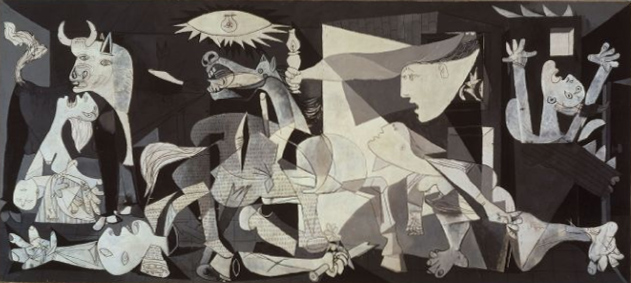
    PicassoGuernica

    Per Picasso’s wishes, the painting itself did not return to Spain until the country enjoyed a republic.

    I was quite excited to see this painting, and it definitely lived up to the hype. As the building used to be a hospital, the overall footprint was not laid out well, but this exhibit was so well curated and included so many incredible pieces from Picasso’s career that it was well worth the visit.

    After 3-4 hours of taking this in, we headed out to get something to eat before hitting up another museum.

    Before we came to Madrid, Zoya sent us a list of restaurants to check out. After ‘starring’ them on our map, we were always able to find a great spot to eat. And once we got there, we referenced her notes on what to order, where to sit, etc. For lunch on this day, we sat at the bar in Mercado de la Reina and ordered amazing tapas dishes that included shrimp and friend artichoke. It was a quick lunch, and one of my favourite spots of the week.

    From there we headed over to the Naval Museum of Madrid:

    The Museo Naval de Madrid —in English, Naval Museum of Madrid— is a national museum in Madrid, Spain. It shows the history of the Spanish Navy since the Catholic Monarchs, in the 15th century, up to the present. The displays set naval history in a wide context with information about Spanish rulers and the country’s former colonies. The collections include navigation instruments, weapons, maps and paintings.

    For a 3 euro entrance fee, this museum is a pretty good deal, but I won’t be rushing back. If you’re really interested in naval history, and models of boats and military seafaring are your thing, then this is the museum for you.

    However, as general students of history and politics, we found the museum a bit lacking.

    To give some context, here’s what Wikipedia has to say about the Spanish Navy:

    The Spanish Navy (Spanish: Armada Española), is the maritime branch of the Spanish Armed Forces and one of the oldest active naval forces in the world. The Spanish navy was responsible for a number of major historic achievements in navigation, the most famous being the discovery of America and the first global circumnavigation by Magellan and Elcano. For several centuries, it played a crucial logistical role in the Spanish Empire and defended a vast trade network across the Atlantic Ocean between the Americas and Europe and across the Pacific Ocean between Asia and the Americas.

    The Spanish Navy was one of the most powerful maritime forces in the world in the 16th and 17th centuries and possibly the world`s largest navy at the end of the 16th century and in the early 17th century. Reform under the Bourbon dynasty improved its logistical and military capacity in the 18th century, for most of which Spain possessed the world’s third largest navy. In the 19th century, the Spanish Navy built and operated the first military submarine, made important contributions in the development of destroyer warships, and achieved the first global circumnavigation by an ironclad vessel.

    The 1820s saw the loss of most of the Spanish Empire in the Americas. With the empire greatly reduced in size and Spain divided and unstable after its own war of independence, the navy lost its importance and shrank greatly.

    During the Spanish–American War in 1898, a badly supported and equipped Spanish fleet of four armored cruisers and two destroyers was overwhelmed by numerically and technically superior forces (three new battleships, one new second class battleship, and one large armored cruiser) as it tried to break out of an American blockade in the Battle of Santiago de Cuba. Admiral Cervera‘s squadron was overrun in an attempt to break a powerful American blockade off Cuba.

    In the Philippines, a squadron, made up of ageing ships, including some obsolete cruisers, had already been sacrificed in a token gesture in Manila Bay. The Battle of Manila Bay took place on 1 May 1898, during the Spanish–American War. The American Asiatic Squadron under Commodore George Dewey engaged and destroyed the Spanish Pacific Squadron under Admiral Patricio Montojo y Pasarón. The engagement took place in Manila Bay in the Philippines, and was the first major engagement of the Spanish–American War. This war marked the end for the Spanish Navy as a global maritime force.

    Currently, the Spanish ‘Armada’ is the third largest navy in Europe, after the British Royal Navy and the French Navy, and the sixth in the world ranking.

    For centuries, Spain was a major naval power, and the museum does a great job of showcasing their strengths. However, the museum does a perplexingly bad job of discussing the decline of the Spanish navy in the 1800s. Case in point? They effectively skip over the destruction of the Spanish Armada, and while they do discuss their colonial expansion, there’s no mention of struggles around decolonization, or of the decisive Spanish American war. If you didn’t know better, the museum would give you the impression that Spain is still a hard-hitting naval power.

    That said, there are approximately a gazillion boat models in this museum, and it’s 10x larger than it seems at  the outset, with over 30 rooms of boats, maps, and artifacts. If you’re even remotely interested in maritime history, this is worth checking out.

    That night, we had plans to eat dinner in northern neighbourhood in Madrid. On our way there, we stopped in at one last museum, the Sorolla Museum. Madrid has a series of museums about Spanish artists, primarily based in the historic home of said artist. In this case, we visited a museum in the home of Joaquin Sorolla:

    The building was originally the artist’s house and was converted into a museum after the death of his widow. Designed by Enrique María Repullés, it was declared Bien de Interés Cultural in 1962.[citation needed] The principal rooms continue to be furnished as they were during the artist’s life, including Sorolla’s large, well-lit studio, where the walls are filled with his canvasses. Other rooms are used as galleries to display Sorolla’s paintings, while the upstairs rooms are a gallery for special exhibitions.

    Our walk to the Sorolla Museum followed a variety of busy streets, which made the walled garden of the home feel like a true oasis. I always really enjoy exploring homes, and this museum didn’t disappoint. Sorolla painted in the impressionist style, and painted beautiful landscapes and portraits. The artwork in the museum showcased his love of painting his family, and of his skill painting light and water. For a small entry fee, the Sorolla Museum was well worth it.

    Dinner itself was a whole other experience, which I’ll save for the next post…

  • Day 3 in Madrid – Lunch at DSTAgE

    Day 3 in Madrid – Lunch at DSTAgE

    Before we came to Madrid, Zoya recommended we splurge on lunch at DSTAgE, a two Michelin star restaurant. She advised we’d need reservations, but when I tried to book us in, they were full.

    So what did Zoya do? She called them. She got us on the wait list for lunch everyday that we were in Madrid. On Tuesday, they called her back while we were in the museum, so we couldn’t go. But on Wednesday, they called her back just as we were waking up from a late slumber. Perfect timing. We got up, we got dressed, and we went to lunch at DSTAgE.

    Before we get into the amazing experience we had, a quick note on Michelin star restaurants.

    The Michelin Guide assigns star ratings (1, 2, or 3 stars) to top quality restaurants in select cities around the world. Receiving a Michelin star rating is considered rather prestigious, as the Michelin Guide is famed for its extremely high standards. Here’s where it all comes from, according to Wikipedia:

    In 1900, fewer than 3,000 cars graced the roads of France. To boost the demand for cars and, accordingly, car tires, brothers and car tire manufacturers Édouard and André Michelin published the first edition of a guide for French motorists, the Michelin Guide.[2] The brothers printed nearly 35,000 copies of this first, free edition of the Michelin Guide, which provided useful information to motorists, such as maps, tire repair and replacement instructions, car mechanics listings, hotels, and petrol stations throughout France. 

    Recognizing the growing popularity of the restaurant section of the guide, the brothers recruited a team of inspectors to visit and review restaurants, who were always careful in maintaining anonymity.[6]

    In 1926, the guide began to award stars for fine dining establishments. Initially, there was only a single star awarded. Then, in 1931, the hierarchy of zero, one, two, and three stars was introduced. Finally, In 1936, the criteria for the starred rankings were published:[3]

    • 1 Michelin star: “A very good restaurant in its category” (Une très bonne table dans sa catégorie)
    • 2 Michelin stars: “Excellent cooking, worth a detour” (Table excellente, mérite un détour)
    • 3 Michelin stars: “Exceptional cuisine, worth a special journey” (Une des meilleures tables, vaut le voyage).[6]

    Michelin reviewers (commonly called “inspectors”) are completely anonymous; they do not identify themselves, and their meals and expenses are paid for by the company founded by the Michelin brothers, never by a restaurant being reviewed.

    The French chef Paul Bocuse, one of the pioneers of nouvelle cuisine in the 1960s, said, “Michelin is the only guide that counts.”[11] In France, each year, at the time the guide is published, it sparks a media frenzy which has been compared to that for annual Academy Awards for films.

    So, that’s what the hype is all about. Accordingly, Michelin star restaurants are also quite expensive to eat at. Zoya and Shrip have found that, relative to other markets, Michelin star eating is a deal in Madrid, yet another reason why they encouraged us to try DSTAgE.

    So, what about DSTAgE itself? The restaurant is typically described as a ‘concept’ restaurant, and its known for experimentation and creativity. The owner and chef, Diego Guerrero, was previously the head chef at a different two Michelin star restaurant, and left to create his own restaurant in contrast to the uptight tradition and style of other high end restaurants in the city.

    According to the Michelin Guide:

    This restaurant has an urban and industrial look and a relaxed feel that reflects the personality of the chef. The name is an acronym of his core philosophy: ‘Days to Smell Taste Amaze Grow & Enjoy’. Discover cuisine that brings disparate cultures, ingredients and flavours together from Spain, Mexico and Japan.

    Now that you’re familiar with the concept of Michelin stars and with DSTAgE in particular, let’s talk about our experience.

    On Wednesday, we woke up to a call from Zoya about our reservation. From there, we got dressed and strolled across the city for lunch.

    One of the most interesting elements of our DSTAgE experience was how specifically everything was timed. When you arrive at the restaurant, you’re escorted to 1 of 2 stations at the bar of the open kitchen.

    There, you meet one of the cooks, who makes and serves you a palette opening dish, following by a palette cleansing drink. In our case, we had shrimps cooked over a Himalayan salt rock, served on a homemade cracker. It was bizarre and delicious, and hit every tastebud. Over the course of our meal, we watched every other group of patrons go through this experience as well.

    From there, you take a seat at your table, and decide how to tackle your meal. You can choose 12, 14, or 17 courses. You can also choose wine pairings for each course. We opted for 14 courses, without the pairings (it was lunch, after all!).

    Our first course was the seafood of the day: “razor clam with celeri dashi, almonds mild and coffee nectar”. The presentation was so cool that we took a video:


    When each course was brought to the table, our server explained how it was made, what is was, and how best to eat it.

    After the razor clams, we had something described to us as “Thailand in one bite”. It was pandan radish with pandan tea, and reminded us so much of the rice we had in Cambodia, which was often served with pandan leaves. Unfortunately we didn’t snap a picture of this one.

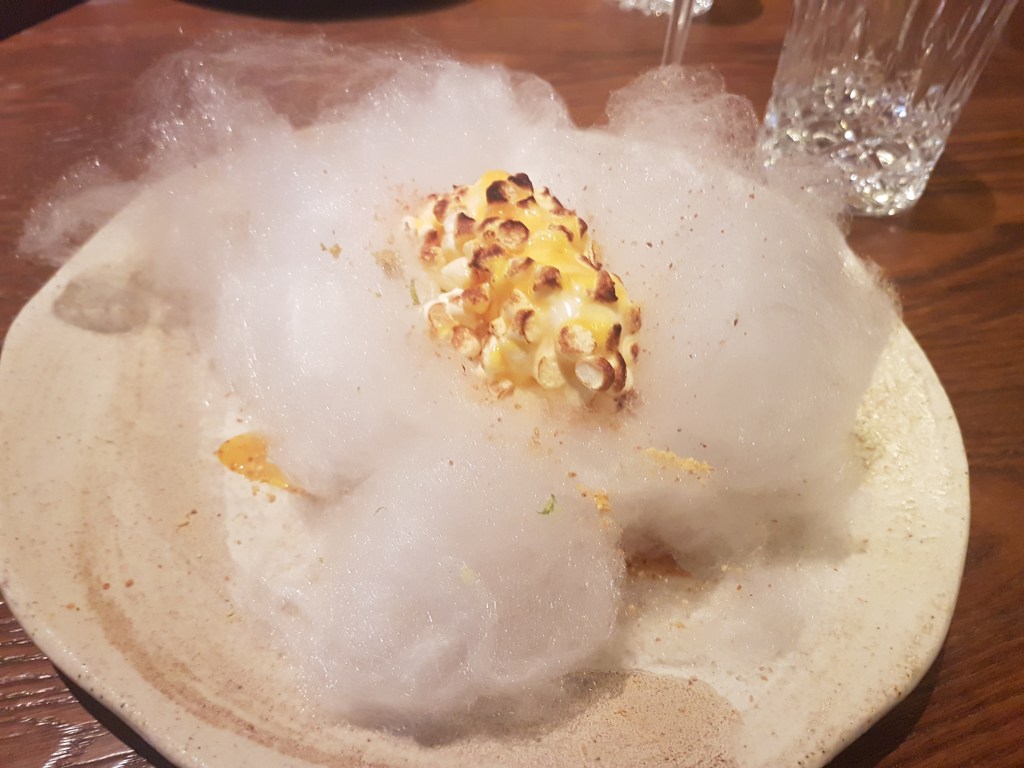
    However, we took photos of every other course, which you can check out below! I’ve added our notes on every dish below as well. As you can see, the amount and variety of food made for an intense experience, but it was absolutely worth it.

    See for yourself below… and then consider adding DSTAgE to the agenda when you’re next in Madrid!


  • Day 1 in Madrid: Naps & Vermouth & Tapas, Oh My!

    Day 1 in Madrid: Naps & Vermouth & Tapas, Oh My!

    On Sunday night we left Toronto, and arrived in Madrid on Monday morning. Unfortunately, we managed to sleep just two hours on the flight, so we were exhausted. We checked into our AirBnB and then proceeded to nap for the next few hours.

    Zoya and her partner, Shrip, worked late while we were visiting, so dinner was often late in the evening. This worked out perfectly because it gave us extra time to explore the city, which is precisely what we did upon waking up from our nap.

    When we arrive somewhere new, we like to hit the pavement ASAP, and get a sense of the city’s layout and walkability. We stayed in a really cool neighbourhood (according to Zoya) called Ibiza, just east of Buen Retiro Park. Also called El Retiro, this incredible park can be described as Madrid’s version of Central Park in New York City.

    According to Wikipedia

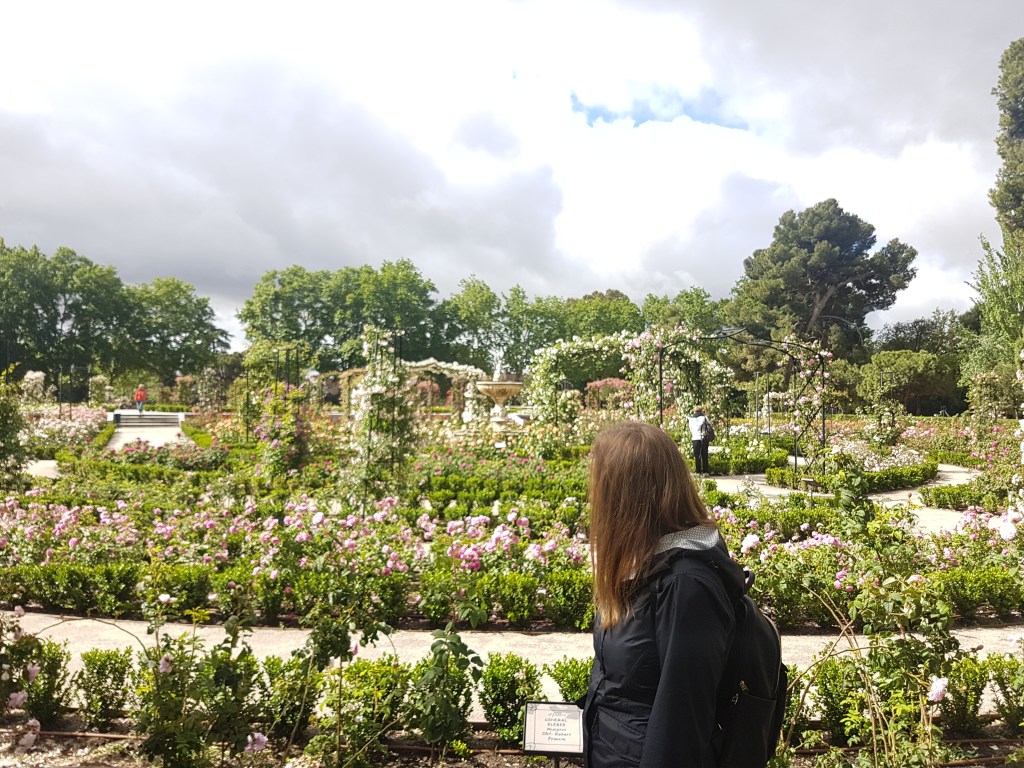
    The park belonged to the Spanish Monarchy until the late 19th century, when it became a public park. The Buen Retiro Park is a large and popular 1.4 km2 (350 acres) park at the edge of the city centre, very close to the Puerta de Alcalá and not far from the Prado Museum. A magnificent park, filled with beautiful sculpture and monuments, galleries, a peaceful lake and host to a variety of events, it is one of Madrid’s premier attractions. The park is entirely surrounded by the present-day city … For children there are multiple playground areas as well as ponds throughout the park with ducks you can feed.[8] The inside of the Palacio de Cristal has been modified to include the edition of a stone slide in the interior.[10] The major paths and walkways are used by families, runners, bikers and rollerbladers.

    We kicked off our city exploration with a walk through the park. Eventually we stepped out into a neighbourhood west of the park, near the Museo Del Prado. We walked the streets, saw many shops and interesting sites, and then met up with Zoya.

    Zoya took us back to the street we were staying on. Two of their favourite tapas restaurants were located just steps away from our AirBnB apartment. A quick note on tapas, since I’ll be writing about it a lot, coutersy of Wikipedia

    A tapa (Spanish pronunciation: [ˈtapa]), in Spanish cuisine, is an appetizer, or snack. It may be cold (such as mixed olives and cheese) or hot (such as chopitos, which are battered, fried baby squid). In select bars in Spain, tapas have evolved into an entire, sophisticated cuisine. In Spain, patrons of tapas can order many different tapas and combine them to make a full meal. In some Central American countries, such snacks are known as bocas. In Mexico, similar dishes are called botanas. According to The Joy of Cooking, the original tapas were thin slices of bread or meat which sherry drinkers in Andalusian taverns used to cover their glasses between sips. This was a practical measure meant to prevent fruit flies from hovering over the sweet sherry (see below for more explanations). The meat used to cover the sherry was normally ham or chorizo, which are both very salty and activate thirst. Because of this, bartenders and restaurant owners created a variety of snacks to serve with sherry, thus increasing their alcohol sales.[1] The tapas eventually became as important as the sherry.

    Needless to say, tapas is a big thing in Spain, and we ate quite a lot of it while we were there.

    On Monday, after a delightful reunion with Zoya, we started our night at a placed called La Castela. They serve vermouth on tap, which was both interesting and excellent. We drank a lot of vermouth in both Madrid and Cordoba because it’s a common, and often homemade, beverage.

    For tapas, we had a variety of “pincho” or “pintxo” dishes … aka small things that you eat with a giant toothpick. We had a beef cheeks, and some really intense/amazing cheeses. Once Shrip met up with us, we had one more round and headed out to another tapas place.

    Down the street was Taberna Laredo, one of Shrip’s favourite tapas restaurants. Again we had some really delicious dishes, including a beef tartare. We were a bit too tired to be taking many photos of dinner, but I do remember it all being top notch.

    See below for the many photos Kevin took on day one!