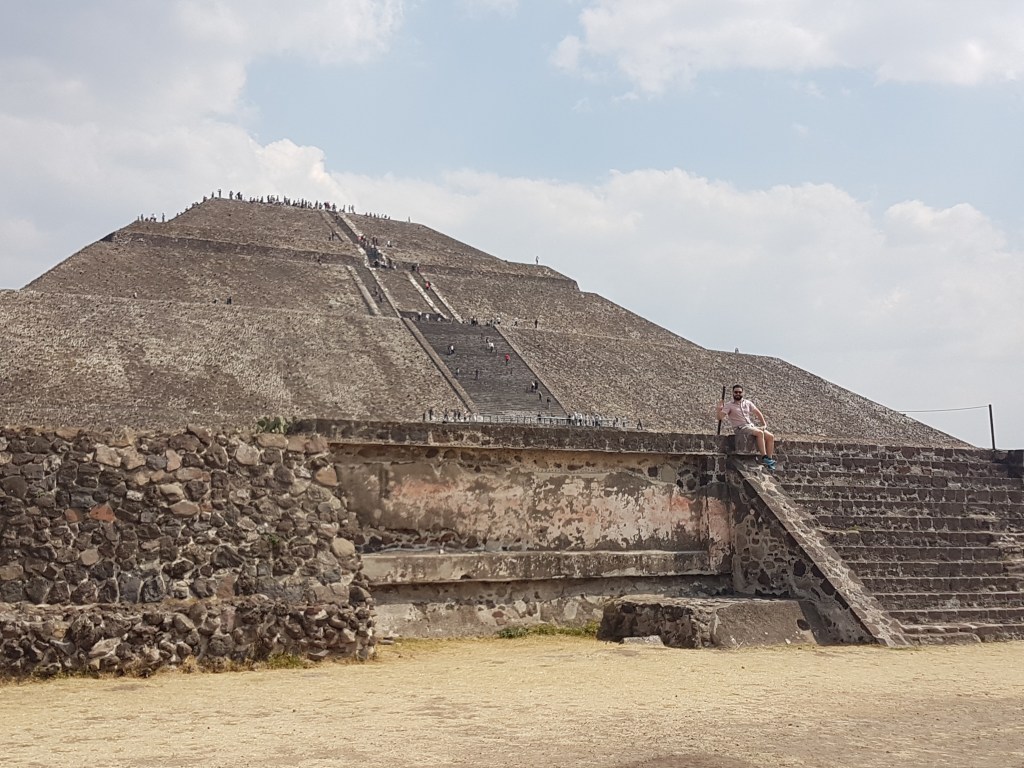
Kevin did 90% of the research for our trip to Mexico City, and I could tell it was going to be a good trip because of how excited he would get about what he was reading.
When he suggested that our trip include a day trip outside of the city I knew that we were in for something great because he’s well aware of my distaste for travelling within trips.
Indeed, our day visiting the ancient Mesoamerican city of Teotihuacan was well worth the trek to get there. It was also one of the first things we did on our trip, and it set us up well for a week of learning about the incredible culture and history that have occurred on the lands of present-day Mexico. We were able to Uber there, and then found another Uber to drive us back later.
Our day included a lot of walking and climbing, but you can easily enjoy the site without climbing the pyramids. If you go, be sure to bring a hat and some sunscreen. We also went on Monday so there were relatively few tourists. We’ve been told that Sunday is the busiest day to visit.
Around 1200 CE, the Mexica were moving in search of a new location where they could establish a settlement and build a city. Along the way they found the remarkable site of Teotihuacan and they claimed a common ancestry with the city’s ancient founders. So, that’s how ancient and significant Teotihuacan is: some 800 years ago a power community found it and were so impressed that they took on some of city’s mythology and worked it into their own origin story.
When most Canadians talk about pre-European peoples in Mesoamerica, the most prominent group mentioned is called “the Aztecs”. However, “Aztec” is a term coined by a European researcher. The Aztec Empire began as an alliance between 3 city-states in the Central Mexican Valley, and the most influential of these 3 group were actually known as the “Mexica” (pronounced May-Shee-Ka). The language that they spoke, Nahuatl, is still spoken in Mexico today, and many Nahuatl words have been incorporated into Mexican Spanish. In fact, some Nahuatl words are even spoken in the Philippines (more on that in a later post).
So, what’s all the hype about?
Well, before you ask, let me assure you that this site was not built by aliens.
Teotihuacan, founded approx 2000 years ago, is the site of the largest pyramids outside of Egypt and was once a city home to over 125,000 people (some estimates suggest closer to 250,000). Such a large city was hub for trading and exchange and its cultural and economic influence appears in archaeological digs and cultural sites across Mesoamerica.
Further details about its exact origins, who built it, etc are unclear, and there some different competing theories. However it is a rich archaeological site and researchers have been able to learn a lot about how life was live in this community. Their importances as a trading centre has helped researchers build a clear picture of the various groups living and trading across the Mesoamerican region at that time.
Here’s a map of the site. The arrows show the recommended route through the site, which is exactly what we did:
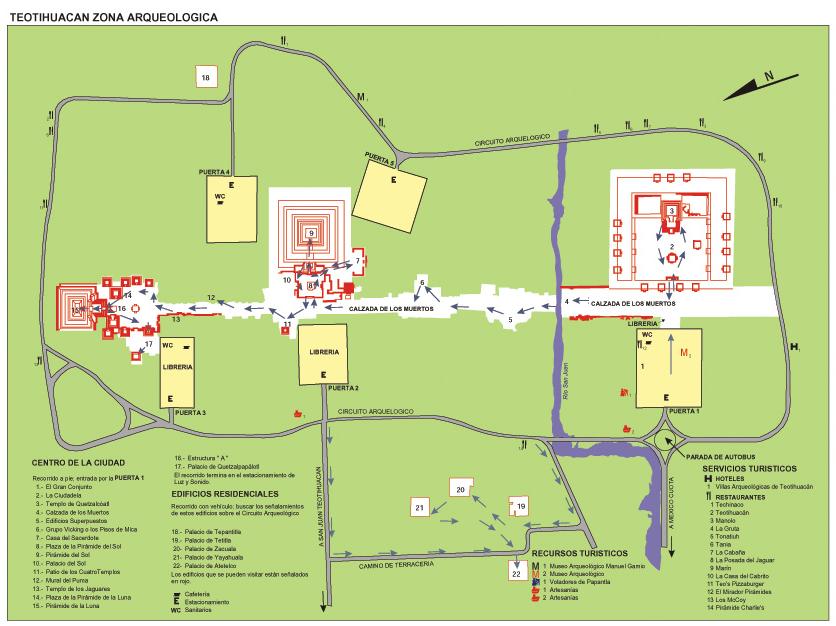
Here’s what Wikipedia has to say about the site layout and design.
The city’s broad central avenue, called “Avenue of the Dead” (a translation from its Nahuatl name Miccoatli), is flanked by impressive ceremonial architecture, including the immense Pyramid of the Sun (third largest in the World after the Great Pyramid of Cholula and the Great Pyramid of Giza). Pyramid of the Moon and The Ciudadela with Temple of the Feathered Serpent Quetzalcoatl are placed at the both ends of Avenue while Palace-museum Quetzalpapálot, fourth basic structure of site, situated between two main pyramids. Along the Avenue are many smaller talud-tablero platforms also. The Aztecs believed they were tombs, inspiring the name of the avenue. Scholars have now established that these were ceremonial platforms that were topped with temples.[citation needed]
The Avenue of the dead is roughly forty meters wide and four Kilometers long.[64] Further down the Avenue of the Dead, after small river, is the area known as the Citadel, containing the ruined Temple of the Feathered Serpent Quetzalcoatl. This area was a large plaza surrounded by temples that formed the religious and political center of the city. The name “Citadel” was given to it by the Spanish, who believed it was a fort. Most of the common people lived in large apartment buildings spread across the city. Many of the buildings contained workshops where artisans produced pottery and other goods.
While a lot is known about the site and its various inhabitants there is still much to learn. A recent discovery was made and we got to see the tent where they were continuing to explore it. Kevin insists that you read this article about it.
Our path through the site also included a journey through their museum, which helped us get a better understanding of what we were seeing. We were impressed with the breadth of material on display and how well it was curated.
Below you can see all of our photos from our visit to Teotihuacan, though it’s hard to do it justice. If you ever get the opportunity to go to Mexico City then I strong encourage you to make a trip out to visit this incredible historical gem!


 the stories that I'm telling.