Tag: moors

  • Road Trip Days 2 & 3: Visiting Marvao

    Road Trip Days 2 & 3: Visiting Marvao

    Ok, so the last few posts have detailed some fairly magical sights. But to be honest, there’s more to come here. This trip was pretty surreal, and we saw many memorable places.

    The driving on the trip may also have been a bit much, but in this case it turned out to be worth it. After driving 2.5 hours to Piodao, we spent a couple of hours exploring this small yet remarkable village. And then we got back in the truck and Kevin drove us another 3 hours to Marvao, a city on a hill right on the border of Portugal and Spain. About an hour into this trip, I was really questioning this decision, but when we drove up to this walled-city on a foggy night, all doubts were forgotten.

    Here’s what you need to know about Marvao (courtesy of Wikipedia):

    Commanding spectacular views across the Tagus basin (the same river to connects Lisbon to the Atlantic) and Serra de Estrela (highest point in Portugal) to the north, the fortified rock of Marvão has been a site of significant strategic importance since the earliest human settlements. Today lying on the ‘raia’ that divides Portugal and Spain, Marvão has consistently stood on a frontier zone between peoples: Celtici, Vettones and Lusitani (4th-2nd century BCE); Lusitanians and the Romans ofHispania Ulterior (2nd-1st century BCE); migratory Suevi, Alans, Vandals and Visigoths (5th-7th century CE); conquering moors and Visigoths (8th century); muwallad rebels and the Cordoban emirate (9th-10th century); Portuguese nation-builders and Moors (12th-13th century); Templars and Hospitallers (12th-14th century); Portuguese and Castilians (12th century-present day); Liberals and Absolutists (19th century); the fascist regimes of Salazar and Franco (20th century).

    Marvão’s natural assets have contributed to the ‘uniqueness’ of this remote village as perceived by visitors today: (i) as nigh-impregnable ‘eagle’s nest’ fortress – perched high on a granite crag, and bordered on the south and west by the Sever river; (ii) as vital lookout-point towards the Alcántara Bridge (70 km (43 mi) away), a wide stretch of the Tagus basin and the Serra de Estrela; (iii) as a gateway to Portugal from Spain via the Porta da Espada (‘Sword Gate’) mountain pass of the Serra de São Mamede. These assets have ensured its status as the ‘Mui Nobre e Sempre Leal Vila de Marvão’ (Very Noble and Ever-Loyal Town) into the present day.

    As with other 11th-13th-century castles, the early medieval improvements and development of Marvão castle reflect the innovations brought back by crusading orders from the near east (notably the highly influential Hospitaller castle in Syria, the Krak des Chevaliers). The medieval castle seen in Marvão today mostly post-dates the year 1299, and features numerous characteristic features of a crusader-era castle: a tall central keep with raised entrance on the first floor; a series of lower, outlying turrets (some semi-circular); high-placed arrow-slits; open spaces to aid the sheltering and assembly of villagers and troops; a well, and huge rain-collecting cistern to supply water to both keep and the wider castle in the event of siege; bent entrances (both on the village and castle gates) to slow down invaders in the event of breached gates; a series of narrow killing zones (notably, in the triple gate on the village-side of the castle); extensive crenellated battlements and curtain walls that enhanced the natural defences provided by the escarpments of Marvão’s rock.[22]

    That’s only a smattering of interesting information about Marvao, as this place is filled with historical significance. When we arrived at night fog filled the town, we had to park the truck just outside of the gates in order to walk to our hotel (we stayed and ate at the the Casa do Alentejo, where we were welcomed with the traditional and impressive Alentejo hospitality). With the characteristic preservation of the buildings’ historical style, it felt like we were walking back in time. After a lengthy dinner, we got some sleep, then woke up early for breakfast and further touring. We explored all through the town and the castle, and were constantly in awe of the view and the spirit of the region. Similar to Sintra, looking across the hills you could easily imagine what it was like to look across that view 1000 years ago. A very cool feeling that won’t soon be forgotten.

    Check out our photos below!

  • Roadtrip Day 2: Tomar and the Convent of Christ

    Roadtrip Day 2: Tomar and the Convent of Christ

    After our day of adventures in Sintra, we drove 2 hours to the city of Tomar.

    When planning this roadtrip, Kevin did quite a lot of research. All the places that we travelled to see made the list because of their unique history/beauty, making it almost impossibly to have a favourite site.

    The city of Tomar was originally founded in 1162 under an order of the Knights Templar, and it was actually the last Templar town to be commissioned for construction.

    Tomar then became the headquarters of the Order of the Knights Templar in Portugal. From this base, the Templars ruled a vast area of central Portugal, defending that territory from the Moors who ruled in the South. As the Catholic church became nervous of the power of the Templars, and then banned the order altogether, the Portuguese King negotiated to create a new “Order of Christ”, which took over the power and place of the Templar’s order. As such, Tomar is considered the last home of the Knights Templar in Portugal.

    This story got a bit more interesting when Henry the Navigator, the leader of Portuguese exploration, became the head of the Order of Christ (from Wikipedia):

    Henry the Navigator was made the Governor of the Order, and it is believed that he used the resources and knowledge of the Order to succeed in his enterprises in Africa and in the Atlantic. The cross of the Order of Christ that was painted in the sails of the caravels that crossed the seas, and the Catholic missions in the new lands were under the authority of the Tomar clerics until 1514. Henry, enriched by his overseas enterprises, was the first ruler to ameliorate the buildings of the Convento de Cristo since its construction by Gualdim Pais. He also ordered dams to be built to control the river Nabão and swamps to be drained. This allowed the burgeoning town to attract more settlers. Henry ordered the new streets to be designed in a rational, geometrical fashion, as they can still be seen today.

    Interestingly, this time in Portuguese history was also an important time in Jewish history:

    Just after 1492 with the expulsion of the Jews from Spain, the town increased further with Jewish refugee artisans and traders. The very large Jewish minority dynamized the city with new trades and skills. Their experience was vital in the success of the new trade routes with Africa. The original synagogue still stands.

    In the reign of Manuel I of Portugal the convent took its final form within the Manueline renaissance style. With the growing importance of the town as master of Portugal’s overseas empire, the leadership of the Order was granted to the King by the Pope.

    However, under pressure from the Monarchs of Spain, the King soon proclaimed by Edict that all the Jews remaining within the territory of Portugal would be after a short period considered Christians, although simultaneously he forbade them to leave, fearing that the exodus of Jewish men of knowledge and capital would harm Portugal’s burgeoning commercial empire. Jews were largely undisturbed as nominal Christians for several decades, until the establishment of a Tribunal of the Portuguese Inquisition by the initiative of the Catholic Clergy in the town. Under persecution, wealthier Jews fled, most others were forced to convert. Hundreds of both Jews and New Christians were arrested, tortured and burned at the stake in autos da fé, in a frenzy of persecution that peaked around 1550. Many others were expropriated of their property. Jewish ascendancy, more than Jewish religion, together with personal wealth determined whom would be persecuted, since the expropriations reverted to the institution of the Inquisition itself. The town lost then with the persecution of its merchants and professionals most of its relevance as a trading centre.

    Despite its great importance during the growth and expansion of Portugal and Europe, Tomar is now a town of just 20,000 people, quietly tucked away in Portugal. If you’re interested in knowing more about Jewish history in Portugal, I recommend you check out this Wikipedia article, as well as this article that talks about the town of Belmonte (by the way, home to some pretty good kosher olive oil!).

    Anyways, so as we were driving to Tomar, I was reading out all of these Wikipedia articles to Kevin and Tyler, getting all pumped up about our trip. We arrived late at night, grabbed dinner at a Knights-Templar-themed restaurant, and headed off to bed. With big plans for the next day, we got up early, ate breakfast in our family-run Pensao, and then headed up the hill to the Convent of Christ.

    If Tomar itself has some deep history going on, the Convent of Christ is right at the centre of the action. Built over hundreds of years, the building boasts a great variety of architectural and design styles. The level of detail is impressive, and we spent SO much time in the church flipping about how cool it was to be in the church built by Templar Knights.

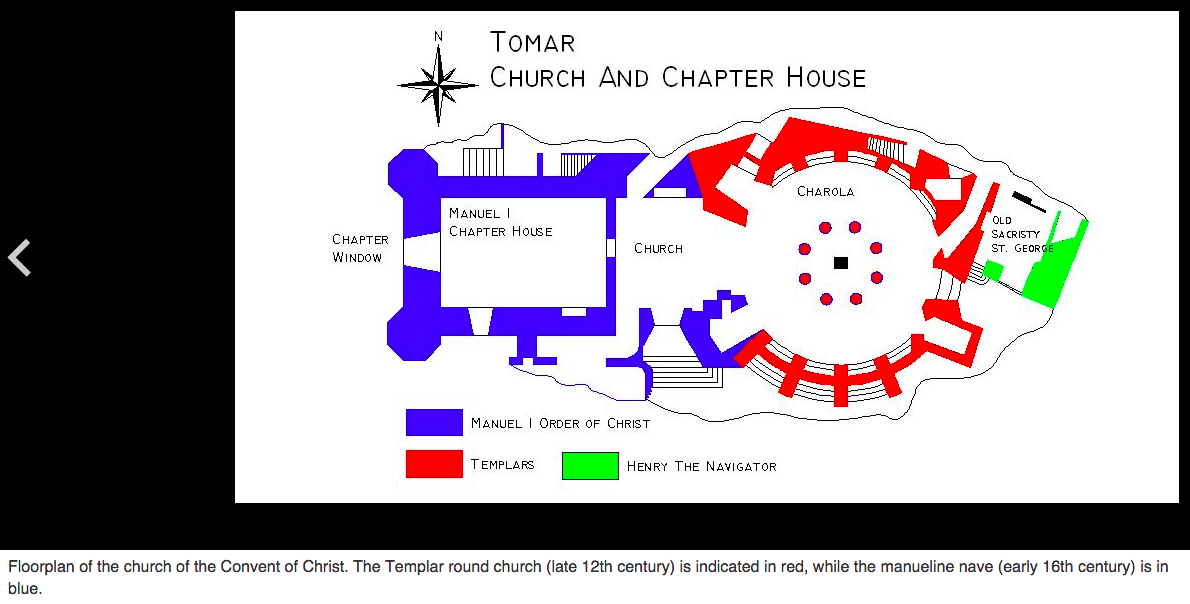
    To give you an idea of how the design of the church came to be, here’s a photo from Wikipedia:

    Screen Shot 2015-09-17 at 12.57.28 PM

    Similar to when I visited Canterbury earlier this year, it was really obvious that this place grew to become a great centre of activity in Tomar. What you see as blue in the above map is a truly massive set up, designed to house and feed those who lived and visited here. We entered in the oldest part of the building, shown above in green, and worked our way through to the chapter houses. We had only planned to spent 45 minutes here, but we ended up spending well over 2 hours exploring and taking photos.

    All in all, Tomar was a wonderful place to visit. We didn’t get to see all of the sites or explore all of the myths, but the Convent of Christ was itself worth the drive. We expected it to be cool, and still Tomar very much exceeded those high expectations. Enjoy our photos below, we had a lot of fun taking them!

  • Roadtrip Day 1: A Moorish Castle and Palace of Pena

    Roadtrip Day 1: A Moorish Castle and Palace of Pena

    We typically take our sweet, sweet time when doing anything, but because we were on a road trip, we had certain goals for where to be and when to be there by. We were also exploring unfamiliar territory, and perhaps underestimated how much time we’d want to spend in certain places.

    That said, everything that we saw on the first day of our Road trip was within the magical area known as Sintra, where castles and natural beauty abound. There are tons and tons of incredible sites to see in Sintra, but we oriented our trip to the advice of our friend Soledad, and selected those she described as ‘must-see’ items.

    We visited 2 different castles on that day, and they couldn’t have been more different: The Moorish Castle, and Palace of Pena.

    Let’s start with the Moorish Castle.

    The Moorish Castle was the decidedly more ruin-y of the two. It is a military fort built around the 10th century by the Muslim populations that occupied the Iberian peninsula. It acted as a control tower for the Atlantic coast and land to the north, serving as an outpost for the city of Lisbon.

    For a building that’s more than 1000 years old, it was in pretty decent shape. All of the exterior castle walls remain, and we were able to walk up, down, all around, and catch amazing views throughout. From the top of the castle walls, you can see all that’s built up in the Park in the centuries since: a town, castles, mansions, etc. And yet, you can imagine how it felt 1000 years ago to look out and see no evidence of other people. Placed atop a large hill, this place is definitely an impressive and well planned military location.

    And not *just* military either. After the large castle walls had been built, people began to settle just outside of them. A “second circle of walls” was later built to protect these settlements.

    If you’re interested in the nitty gritty history timeline for the Castle of the Moors, check out Wikipedia.

    After the Castle of the Moors, we headed to the Palace of Pena.

    While it was cool, the Palace of Pena (Palacio da Pena) is one road trip stop we could’ve done without. We crammed a lot of sites into this road trip. That’s not usually our style, but we went a bit overboard with expectations for what we wanted to see. In its defense, it’s part of a large garden complex, but we only saw the castle itself, because it was raining and we were rushing to see another place afterwards (more on that later this week!). By rushing to see the Palacio, we cost ourself some appreciation of its history. The routinely under-informational museum pamphlet also didn’t give us the full story of site.

    Here’s what Wikipedia has to say:

    The palace’s history started in the Middle Ages when a chapel dedicated to Our Lady of Pena was built on the top of the hill above Sintra. According to tradition, construction occurred after an apparition of the Virgin Mary.

    In 1493, King John II, accompanied by his wife Queen Leonor, made a pilgrimage to the site to fulfill a vow. His successor, King Manuel I, was also very fond of this sanctuary, and ordered the construction of a monastery on this site which was donated to the Order of Saint Jerome. For centuries Pena was a small, quiet place for meditation, housing a maximum of eighteen monks.

    In the 18th century the monastery was severely damaged by lightning. However, it was the Great Lisbon Earthquake of 1755, occurring shortly afterwards, that took the heaviest toll on the monastery, reducing it to ruins. Nonetheless, the chapel escaped without significant damage.

    For many decades the ruins remained untouched, but they still astonished young prince Ferdinand. In 1838, as King consort Ferdinand II, he decided to acquire the old monastery, all of the surrounding lands, the nearby Castle of the Moors and a few other estates in the area. King Ferdinand then set out to transform the remains of the monastery into a palace that would serve as a summer residence for the Portuguese royal family. The commission for the Romantic style rebuilding was given to Lieutenant-General and mining engineer Baron Wilhelm Ludwig von Eschwege. Eschwege, a German amateur architect, was much traveled and likely had knowledge of several castles along the Rhine river. The construction took place between 1842–1854, although it was almost completed in 1847: King Ferdinand and Queen Maria II intervened decisively on matters of decoration and symbolism. Among others, the King suggested vaul tarches, Medieval and Islamic elements be included, and he also designed an ornate window for the main façade (inspired by the chapter house window of the Convent of the Order of Christ in Tomar).

    Having done my Wikipedia research, it’s clear that this place’s history actually fits well with many of the other sites that we saw in Sintra and in Tomar. That information was definitely not in the pamphlet we received upon entering, but either way we had a fun time. It’s by far the most colourful castle I’ve ever seen, which gives it an almost-comical appearance.

    All this site-seeing constituted just part of our day. Enjoy the photos below, there’s more to come from our final (and favourite!) stop coming soon.


  • Castelo de Silves

    Castelo de Silves

    When it was a bit chilly, Kevin and I drove east to see the Palace of Estoi. A few weeks later, on one of the first truly warm days this year, Kevin and I drove west to see the Castle of Silves.

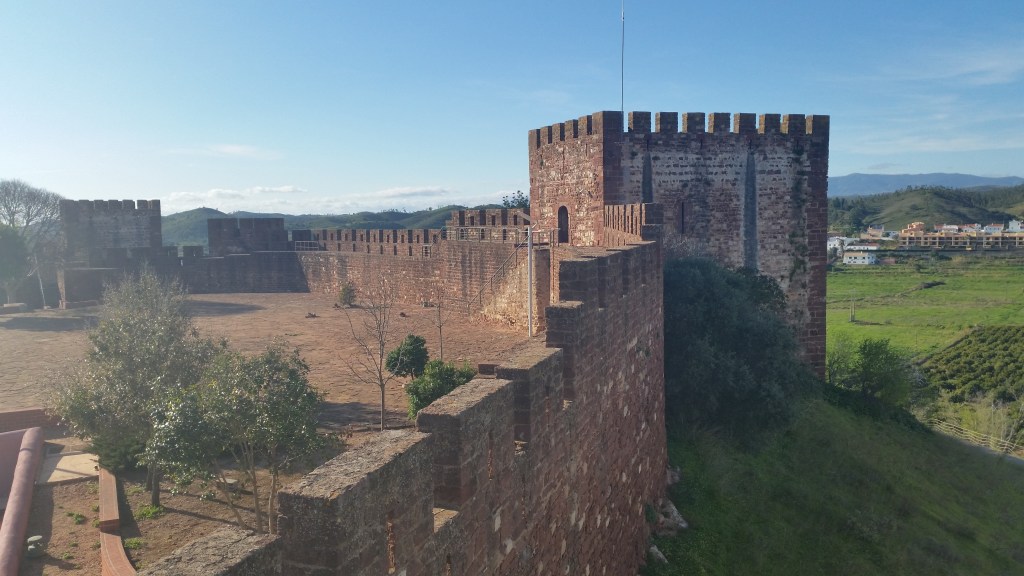
    The Castle of Silves is stunning. I’d seen it many times, lit up at night, while driving through Silves to have dinner somewhere. This day was the first time Kevin and I had been there, and we were quite impressed. The Palacio do Estoi is pretty, but the Castelo de Silves is, like, a really serious/big piece of history in this region. according to Wikipedia:

    “Built between the 8th and 13th century, the castle is one of the best preserved of the Moorish fortifications in Portugal … from archaeological excavations, it is assumed that the first fortress on this site consisted of a Lusitanian castro. It is believed that Phoenicans, Greeks and Carthaginians traversed the site at one time, but that around 201 B.C. the Romans conquered Silves, transforming it into a citadel of their occupation, and commercial center that prospered for the next five centuries.

    Around 716, the Visigothic citadel was conquered by the Umayyad Caliphate who reinforced the existing fortifications with a new series of walls. This new period resulted in a great period of development, under the Moorish occupiers, that include the extensive walls in the west. In 1160, it was sacked by Ferdinand I of León and Castile, but remained only for a short time in the hand of the Christians: it was quickly recaptured by the Moors. King Sancho I of Portugal, supported by the powerful Crusader army, conquered the city, after a prolong encirclement in 1189. But, a grande army, under orders from Amir al-Mu’minin, in 1191, retook the city. The buildings of the Taifa kingdoms of the 11th century, which includes the Palace of Balconies (where Al-Mutamid lived as the poet Ibn Amarhe) progressed in the 11th century. The walls and towers that today represent the Castle of Silves came from these campaigns and public works by Almoravides and Almohads in the 12th and 13th centuries. The castles internal water catchment, and large rain fed underground cistern were used to provide freshwater for the surrounding dwellings (to as late as the 1920s). It would only be in the 13th century, during the reign of Afonso III of Portugal, that forces under the command of D. Paio Peres Correia, would definitively take the fortress.

    So yeah, more than 2000 years ago, the site of Silves Castle was established by Moorish forces, who then passed it back and forth with Christian conquerors for 1400 years, until the Portuguese finally took hold of the whole thing.

    When you’re inside the castle walls, you can see why it was chosen as the location for a massive fortification. It sits atop a hill, and you can see everything for miles. You can’t quite see the ocean, but any invading ocean forces would be held up by and easily visible crossing a natural geographic barrier – the sierra hills south of the castle.

    Other than a cafe, there’s not much in the way of an organized presentation of information at the castle, but we had fun walking around the massive site, checking out the views from every angle and trying to interpret the map we had.

    There was one exhibit in the room that used to be for water storage. It described the Iberian Lynx, a beautiful animal on the verge of extinction, native to Spain & Portugal.

    Take a look at our photos below. It was a really beautiful day!