Tag: museum

  • Day 3 in Amsterdam – Walking Lots & Visiting the Foam Museum

    Day 3 in Amsterdam – Walking Lots & Visiting the Foam Museum

    Our last museum stop of the day was the “Foam” Museum, a well-reviewed photography museum.

    Before the museum though, we needed a lunch break. On the advice of Esther from the Hungry Birds Food Tour, we had lunch at Tomaz, an old restaurant in the old part of the city. When we asked where Dutch families might go out to eat together, this was the place she suggested. We had traditional Dutch beer with traditional Dutch food. The highlight was BitterBallen, little fried balls of meet & sauce & seasoning, best eaten with mustard and beer.

    Rested and fed, we headed back to Foam. Here’s how Wikipedia describes the museum:

    Foam or Fotografiemuseum Amsterdam is a photography museum located at the Keizersgracht in Amsterdam, the Netherlands. The museum has four different exhibitions at any given time in which different photographic genres are shown, such as documentary, art and fashion. Two notable shows were Henri Cartier-Bresson – A Retrospective, work by Henri Cartier-Bresson, and Richard Avedon – Photographs 1946 -2004, a major retrospective of Richard Avedon. In summer 2016 Foam will present a major Helmut Newton retrospective exhibition. Next to large exhibitions by well-known photographers, Foam also shows the work of young and upcoming photographers, in shorter running exhibitions. The museum contains a café, a library, a commercial gallery called FoamEditions and a bookshop.

    We didn’t take many photos, but we certainly saw plenty. The highlight was the exhibit of Gordon Parks’ photography. Gordon Parks was a American photographer between the 1950s and 1980s who captured American life, and was a regularly featured contributor in Life Magazine. His work often touched on themes of social justice and civil rights in the country. You can learn more about Gordon and this exhibit right here. If you live in North America, odds are good that you’ve seen his work already.

    Check out our photos from the day below!

  • Day 5 in Madrid – National Archaeological Museum of Spain!

    Day 5 in Madrid – National Archaeological Museum of Spain!

    Thursday night got a bit crazy, so Friday was a late start. We woke up late to a rainy day and also realized we’d left one of our host’s umbrellas at the bar the previous night. Oops!

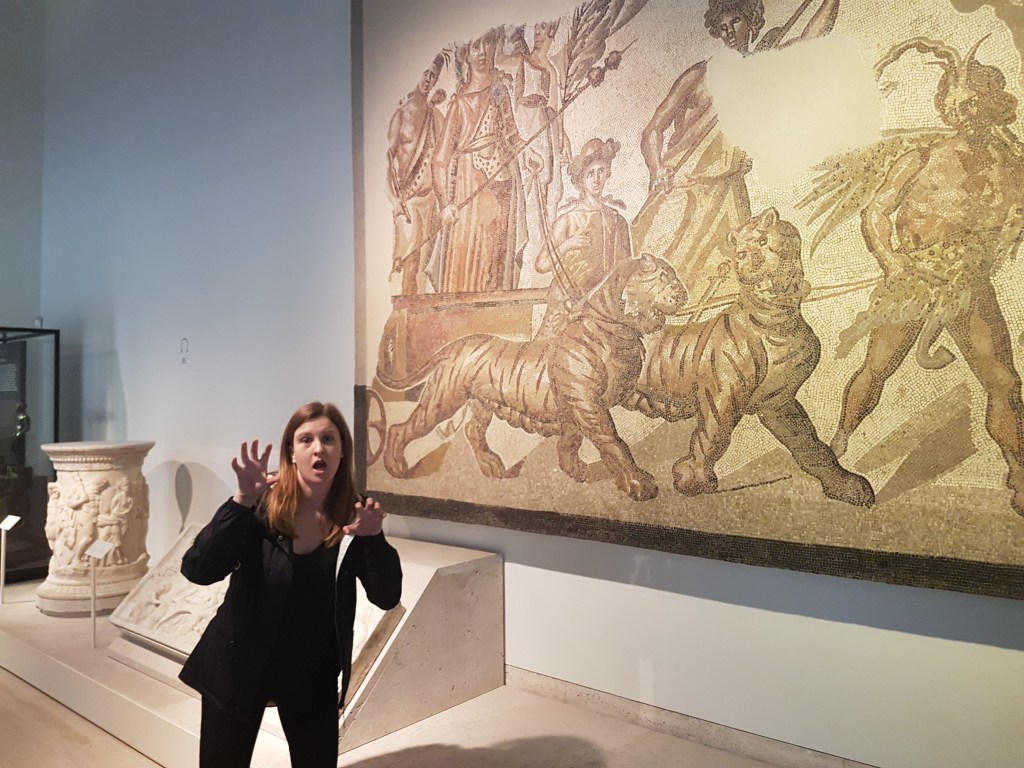
    Anyways, sharing the one remaining umbrella we headed out to grab some breakfast before, obviously, going to a museum. It was our last day in Madrid, and we had plans that evening with Zoya and some friends, but we wanted to see the National Archaeological Museum of Spain. For the last 6 months or so Kevin has been on a deep dive into learning about Roman and Iberian history, so this seemed like the perfect place to spend our last day in Madrid, which also happened to be his birthday.

    Here’s what Wikipedia has to say about the museum:

    The museum was founded in 1867 by a Royal Decree of Isabella II as a depository for numismatic, archaeological, ethnographical and decorative art collections of the Spanish monarchs.

    The museum was originally located in the Embajadores district of Madrid. In 1895, it moved to a building designed specifically to house it, a neoclassical design by architect Francisco Jareño, built from 1866 to 1892. In 1968, renovation and extension works considerably increased its area. The museum closed for renovation in 2008 and reopened in April 2014.[1] The remodelled museum concentrates on its core archaeological role, rather than decorative arts.

    The collection includes, among others, PrehistoricEgyptianCelticIberianGreek and Roman antiquities and medieval(VisigothicIslamic Spanish and Christian) objects.

    This was one of the best no-art museums I’ve ever been to. The detail and expenses put into curating the collections are excellent. The impact of the most recent renovation is unmissable and it would be a great place for anyone with any level of pre-existing knowledge on Archaeology, including kids. The collections are extensive, and take you through the evolution of ancient western culture and civilizations.

    The use of visual guides, including audio visual content, was quite impressive. Each new time period and/or topic was introduced with a video that illustrated what the community would’ve looked like at the time. It was a great way to understand the context of the artifacts presented, particularly with respect to the geographic movement and interactions of people. You can learn more about their collection here and here.

    Check out the photos below, and add this one of your Madrid itinerary!


  • Day 4 in Madrid: A Full Day of Museums

    Day 4 in Madrid: A Full Day of Museums

    When we woke up on Thursday, I knew we had to allocate much of the day to visiting museums, and we were particularly interested in visiting the Reina Sofia museum, aka the home of Picasso’s Guernica. I’d learned my lesson about waiting in line earlier in the week, and bought our tickets online ahead of time.

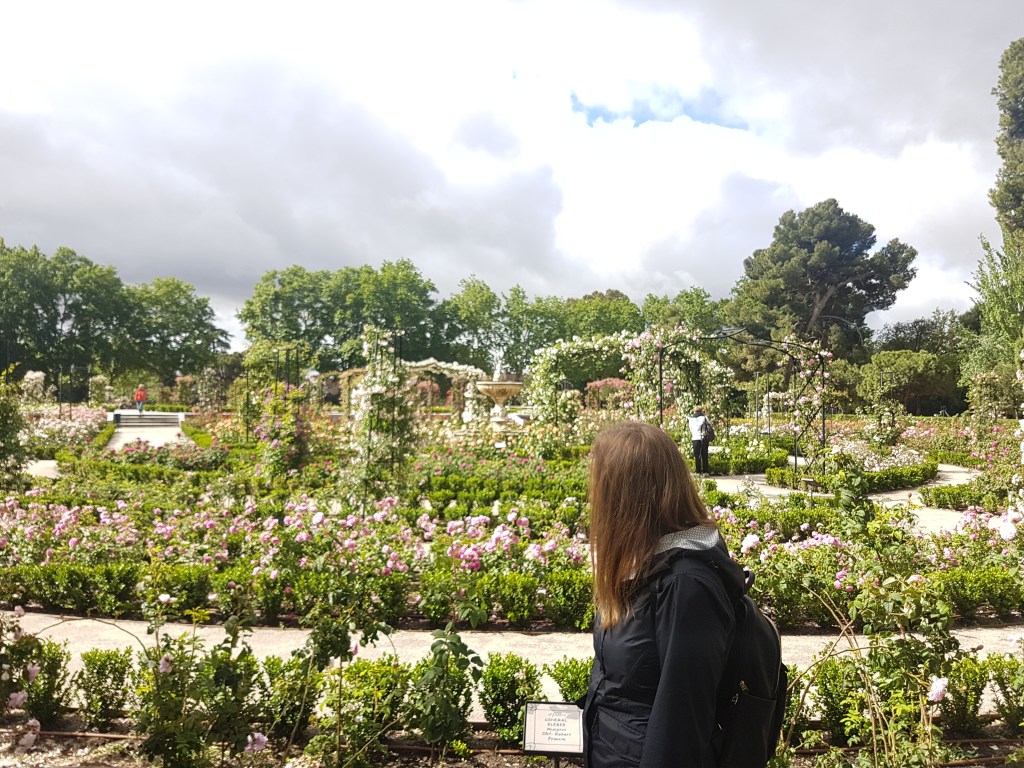
    The other lesson I’d learned was the importance of food before going into a museum. We grabbed a quick breakfast snack around the corner, and walked through Retiro Park on our way to the museum.

    We had a few museums on our list that day, but the Reina Sofia was our primary goal, so that’s where we started.

    Officially called the Museo Nacional Centro de Arte Reina Sofía, the Reina Sofia is Spain’s primary destination for 20th century art. The Prado, which we’d already visited, housed many historic Spanish pieces, but anything from the 1900s is in the Reina Sofia (there’s a separate museum for contemporary art, which unfortunately we didn’t have time for).

    The bulk of the collection is by Spanish artists, and the most famous pieces are by Pablo Picasso and Salvador Dali. We were keen to Picasso’s Guernica, and luckily for us the museum had on a special Guernica-themed exhibit that showcased much of Picasso’s works all in one space.

    The Reina Sofia is a very large museum, housed primarily in an old hospital, which means the layout lacks the typical ‘flow’ you encounter in museums. This, combined with incredible size of the museum, meant that by the time we had worked our way through the Guernica exhibit, we gave up on trying to see the regular collection.

    So, the Guernica exhibit. It was both educational and well curated. The exhibit starts out by discussing the 1937 World’s Fair in Paris, for which the painting was created, and then it dives into the history of the Spanish Civil War. Here’s what Wikipedia has to say:

    Guernica is a mural-sized oil painting on canvas by Spanish artist Pablo Picasso completed in June 1937,[1] at his home on Rue des Grands Augustins, in Paris. The painting, which uses a palette of gray, black, and white, is regarded by many art critics as one of the most moving and powerful anti-war paintings in history.[2] Standing at 3.49 meters (11 ft 5 in) tall and 7.76 meters (25 ft 6 in) wide, the large mural shows the suffering of people wrenched by violence and chaos. Prominent in the composition are a gored horse, a bull, and flames.

    The painting was created in response to the bombing of Guernica, a Basque Country village in northern Spain, by Nazi Germany and Fascist Italian warplanes at the request of the Spanish Nationalists. Upon completion, Guernica was exhibited at the Spanish display at the Exposition Internationale des Arts et Techniques dans la Vie Moderne (Paris International Exposition) in the 1937 World’s Fair in Paris and then at other venues around the world. The touring exhibition was used to raise funds for Spanish war relief.[3] The painting became famous and widely acclaimed, and it helped bring worldwide attention to the Spanish Civil War.

    As we learned, the Spanish government commissioned Picasso to create a work of art for the World’s Fair, and it was only after the fact that he decided to create this moving painting, in what could well be described as an act of protest:

    In January 1937, the Spanish Republican government commissioned Picasso to create a large mural for the Spanish display at the Exposition Internationale des Arts et Techniques dans la Vie Moderne at the 1937 World’s Fair in Paris. At the time, Picasso was living in Paris, where he had been named Honorary Director-in-Exile of the Prado Museum. He had last visited Spain in 1934 and never returned.[4] His initial sketches for the project, on which he worked somewhat dispassionately from January until late April, depicted his perennial theme of the artist’s studio.[1] Immediately upon hearing reports of the 26 April bombing of Guernica, the poet Juan Larrea visited Picasso and urged him to make the bombing his subject.[1] However, it was only on 1 May, having read George Steer‘s eyewitness account of the bombing (originally published in both The Times and The New York Times on 28 April), that he abandoned his initial project and started sketching a series of preliminary drawings for Guernica.[5]

    After the bombing, the work of the Basque and Republican sympathizer and The Times journalist George Steer propelled this event onto the international scene and brought it to Pablo Picasso’s attention. Steer’s eyewitness account was published on 28 April in both The Times and The New York Times, and on the 29th appeared in L’Humanité, a French Communist daily. Steer wrote:

    Guernica, the most ancient town of the Basques and the centre of their cultural tradition, was completely destroyed yesterday afternoon by insurgent air raiders. The bombardment of this open town far behind the lines occupied precisely three hours and a quarter, during which a powerful fleet of aeroplanes consisting of three types of German types, Junkers and Heinkel bombers, did not cease unloading on the town bombs weighing from 1,000 lbs. downwards and, it is calculated, more than 3,000 two-pounder aluminium incendiary projectiles. The fighters, meanwhile, plunged low from above the centre of the town to machinegun those of the civilian population who had taken refuge in the fields.”[12]

    We weren’t able to take photos in the exhibit, but here’s what Guernica looks like:
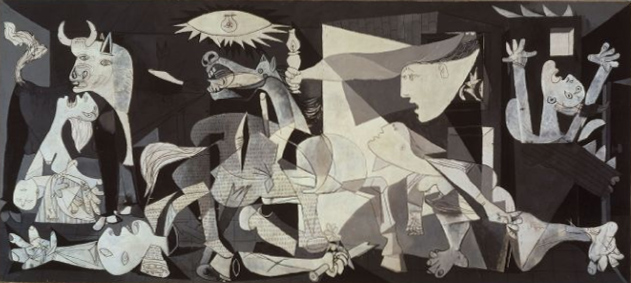
    PicassoGuernica

    Per Picasso’s wishes, the painting itself did not return to Spain until the country enjoyed a republic.

    I was quite excited to see this painting, and it definitely lived up to the hype. As the building used to be a hospital, the overall footprint was not laid out well, but this exhibit was so well curated and included so many incredible pieces from Picasso’s career that it was well worth the visit.

    After 3-4 hours of taking this in, we headed out to get something to eat before hitting up another museum.

    Before we came to Madrid, Zoya sent us a list of restaurants to check out. After ‘starring’ them on our map, we were always able to find a great spot to eat. And once we got there, we referenced her notes on what to order, where to sit, etc. For lunch on this day, we sat at the bar in Mercado de la Reina and ordered amazing tapas dishes that included shrimp and friend artichoke. It was a quick lunch, and one of my favourite spots of the week.

    From there we headed over to the Naval Museum of Madrid:

    The Museo Naval de Madrid —in English, Naval Museum of Madrid— is a national museum in Madrid, Spain. It shows the history of the Spanish Navy since the Catholic Monarchs, in the 15th century, up to the present. The displays set naval history in a wide context with information about Spanish rulers and the country’s former colonies. The collections include navigation instruments, weapons, maps and paintings.

    For a 3 euro entrance fee, this museum is a pretty good deal, but I won’t be rushing back. If you’re really interested in naval history, and models of boats and military seafaring are your thing, then this is the museum for you.

    However, as general students of history and politics, we found the museum a bit lacking.

    To give some context, here’s what Wikipedia has to say about the Spanish Navy:

    The Spanish Navy (Spanish: Armada Española), is the maritime branch of the Spanish Armed Forces and one of the oldest active naval forces in the world. The Spanish navy was responsible for a number of major historic achievements in navigation, the most famous being the discovery of America and the first global circumnavigation by Magellan and Elcano. For several centuries, it played a crucial logistical role in the Spanish Empire and defended a vast trade network across the Atlantic Ocean between the Americas and Europe and across the Pacific Ocean between Asia and the Americas.

    The Spanish Navy was one of the most powerful maritime forces in the world in the 16th and 17th centuries and possibly the world`s largest navy at the end of the 16th century and in the early 17th century. Reform under the Bourbon dynasty improved its logistical and military capacity in the 18th century, for most of which Spain possessed the world’s third largest navy. In the 19th century, the Spanish Navy built and operated the first military submarine, made important contributions in the development of destroyer warships, and achieved the first global circumnavigation by an ironclad vessel.

    The 1820s saw the loss of most of the Spanish Empire in the Americas. With the empire greatly reduced in size and Spain divided and unstable after its own war of independence, the navy lost its importance and shrank greatly.

    During the Spanish–American War in 1898, a badly supported and equipped Spanish fleet of four armored cruisers and two destroyers was overwhelmed by numerically and technically superior forces (three new battleships, one new second class battleship, and one large armored cruiser) as it tried to break out of an American blockade in the Battle of Santiago de Cuba. Admiral Cervera‘s squadron was overrun in an attempt to break a powerful American blockade off Cuba.

    In the Philippines, a squadron, made up of ageing ships, including some obsolete cruisers, had already been sacrificed in a token gesture in Manila Bay. The Battle of Manila Bay took place on 1 May 1898, during the Spanish–American War. The American Asiatic Squadron under Commodore George Dewey engaged and destroyed the Spanish Pacific Squadron under Admiral Patricio Montojo y Pasarón. The engagement took place in Manila Bay in the Philippines, and was the first major engagement of the Spanish–American War. This war marked the end for the Spanish Navy as a global maritime force.

    Currently, the Spanish ‘Armada’ is the third largest navy in Europe, after the British Royal Navy and the French Navy, and the sixth in the world ranking.

    For centuries, Spain was a major naval power, and the museum does a great job of showcasing their strengths. However, the museum does a perplexingly bad job of discussing the decline of the Spanish navy in the 1800s. Case in point? They effectively skip over the destruction of the Spanish Armada, and while they do discuss their colonial expansion, there’s no mention of struggles around decolonization, or of the decisive Spanish American war. If you didn’t know better, the museum would give you the impression that Spain is still a hard-hitting naval power.

    That said, there are approximately a gazillion boat models in this museum, and it’s 10x larger than it seems at  the outset, with over 30 rooms of boats, maps, and artifacts. If you’re even remotely interested in maritime history, this is worth checking out.

    That night, we had plans to eat dinner in northern neighbourhood in Madrid. On our way there, we stopped in at one last museum, the Sorolla Museum. Madrid has a series of museums about Spanish artists, primarily based in the historic home of said artist. In this case, we visited a museum in the home of Joaquin Sorolla:

    The building was originally the artist’s house and was converted into a museum after the death of his widow. Designed by Enrique María Repullés, it was declared Bien de Interés Cultural in 1962.[citation needed] The principal rooms continue to be furnished as they were during the artist’s life, including Sorolla’s large, well-lit studio, where the walls are filled with his canvasses. Other rooms are used as galleries to display Sorolla’s paintings, while the upstairs rooms are a gallery for special exhibitions.

    Our walk to the Sorolla Museum followed a variety of busy streets, which made the walled garden of the home feel like a true oasis. I always really enjoy exploring homes, and this museum didn’t disappoint. Sorolla painted in the impressionist style, and painted beautiful landscapes and portraits. The artwork in the museum showcased his love of painting his family, and of his skill painting light and water. For a small entry fee, the Sorolla Museum was well worth it.

    Dinner itself was a whole other experience, which I’ll save for the next post…

  • Roadtrip Day 1 (still!): Quinta da Regaleira

    Roadtrip Day 1 (still!): Quinta da Regaleira

    If you’ve ever read this blog, you know that we typically take our travel slowly. Even if that means we miss out on some possible sites, we always try to spend the maximum amount of time in our travel pursuits, in an attempt to really understand where it is that we’re visiting. Clearly we didn’t quite take that approach on our road trip, where we packed quite a bit of stuff in. I mean, we’re now 3 posts into Day 1 of our Sintra road trip, and yet we still drove another 2+ hours on this day!

    Our wonderful friend, Soledad, insisted that we visit “Quinta da Regaleira”. It roughly translates to being “Estate of Regaleira” (the land was once owned by the wealthy Regaleira family from Northern Portugal). Soledad told us that this was her favourite place in the world, and once we arrived we realized why. We also very much regretted not budgeting more time to be here. There was so much to see, and we certainly didn’t let the rain slow us down!

    The Quinta da Regaleira is essentially an estate that was once owned by a rich guy with big dreams of making something fancy. And this guy, António Carvalho Monteiro (actually nicknamed Moneybags Monteiro) sure achieved his goal. He was an eccentric guy who leveraged his family fortune to become a coffee tycoon in Brazil, then returned to Portugal study everything from law to bugs.

    After purchasing the land in 1892, he spent until 1910 creating a magical villa and gardens, a neo-Manueline extravaganza all dreamed up by Italian opera-set designer Luigi Manini (Lonely Planet).

    Despite the rain, we spent most of our time exploring the extensive gardens. This place is a landscape architect’s dream, boasting arches, gazebos, grottos, aquariums, gardens, patios, paths, fountains, tunnels, bridges, and more. The highlight is almost certainly what’s known as the “Initiation Wells”. We spent at least 30 minutes trying to find them, and it was well worth the effort. Here’s some background info, courtesy of our friends at Ancient-Origins.net:

    The pair of wells, known as the ‘Initiation Wells’ or ‘Inverted Towers’, consist of ‘winding stair’ architecture, which carries symbolic meaning including the death/rebirth allegory common to many hermetic traditions.

    One of the wells contains nine platforms, which are said to be “reminiscent of the Divine Comedy by Dante and the nine circles of Hell, the nine sections of Purgatory and the nine skies which constitute Paradise.” A smaller well, called the “Unfinished Well,” contains a set of straight staircases, connecting the ring-shaped floors to one another. It is believed that the spacing of the landings, as well as the number of steps in between were dictated by Masonic principles.

    The two wells are connected to a series of underground tunnels and caves. Once we entered the primary initiation well, we descended deep underground.

    To our great delight, we ended up in passing through the other well and entering a grotto/lake/waterfall area. We were beyond thrilled at this turn of events. We’d been freaking out about the beauty of this site all day, but this discovery topped them all, and we immediately agreed that Soledad was right about this place.

    The inside of the mansion was pretty cool as well, but nothing close to the outdoor gardens and its secrets. If you plan to visit this site, give yourself at least 3 hours to see everything!

    Check out the photos to see all this beauty for yourself (some are a bit blurry due to the rain – we were completely soaked, as was the phone!):


  • Imagining history at St Augustine’s Abbey

    Imagining history at St Augustine’s Abbey

    Thursday (2 weeks ago) was my last full day in Canterbury, and it was a good one.

    After sleeping in a bit, Nana Ev and I set off to see a site that neither she nor anyone else in my family had seen. It was a site of church ruins that had been closed and under renovation for the past couple of years.

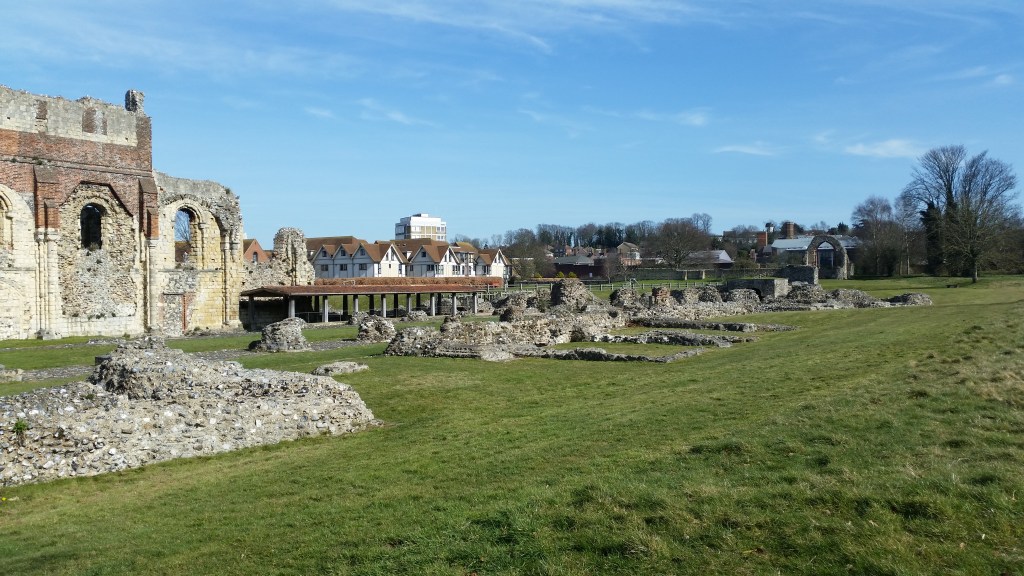
    We woke up to a bright, sunny day and walked across town to the ruins of St Augustine’s Abbey. When we got there, the museum was closed. However, the gate to the yard was open. Since we were more interested in seeing ruins than paying for admission or buying coffee cups, we walked through the open gate, feeling like a couple of rebels.

    As a total museum-loving nerd, I’m always interested to see how different exhibits are presented. That is, is the information helpful? Are there useful images? Is it clear what I should be looking at when? Has walking flow been taken into consideration? I’m pleased to say that this exhibit gets 5 stars across the board. Without a guide, without a pamphlet, and with very little preparatory knowledge, we were able to explore and understand the entire site. The exhibit was so well set up that we were able to complete envision what this site must have looked like back in its heyday.

    Wait a second, what’s the exhibit again?

    Right. Saint Augustine’s Abbey was an abbey built around the same time as the original old-timey sections of Canterbury Cathedral. Officially speaking, it was a Benedictine Monastery completed in 598 CE (that’s current era, for you old folks who are used to AD). As usual, Wikipedia breaks it down for us:

    In 597, Augustine arrived in Anglo-Saxon England, having been sent by the missionary-minded Pope Gregory I to convert the Anglo-Saxons. The King of Kent at this time was Æthelberht or Ethelbert. Although he worshipped in a pagan temple just outside the walls of Canterbury to the east of the city, Ethelbert was married to a Christian, Bertha. According to tradition, the king not only gave his temple and its precincts to St Augustine for a church and monastery, he also ordered that the church to be erected be of “becoming splendour, dedicated to the blessed apostles Peter and Paul, and endowed it with a variety of gifts.” One purpose of the foundation was to provide a residence for Augustine and his brother monks. As another, both King Ethelbert and Augustine foresaw the abbey as a burial place for abbots, archbishops, and kings of Kent.

    William Thorne, the 14th century chronicler of the abbey, records 598 as the year of the foundation. The monastic buildings were most likely wooden in the manner of Saxon construction, so they could be quickly built. However, building a church of solid masonry, like the churches Augustine had known in Rome, took longer. The church was completed and consecrated in 613. Ca. 624 a short distance to the east, Eadbald, son and successor of Ethelbert, founded a second church, dedicated to Saint Mary which also buried Kentish royalty. The abbey became known as St Augustine’s after the founder’s death.

    For two centuries after its founding, St Augustine’s was the only important religious house in the kingdom of Kent.[9] The historian G. F. Maclear characterized St Augustine’s as being a “missionary school” where “classical knowledge and English learning flourished.”

    The monastery was of fairly simple construction, and much smaller than what eventually sat on this site. Because of course the Normans eventually invaded. The liked to worship at church as well, but didn’t think that the existing Abbey was fancy enough to pay proper respects to God. And so they built a much larger and much fancier Romanesque building. There was great expansion and attention from the Pope at this time, during which “[t]he cloister, frater (refectory) and kitchen were totally rebuilt. A new abbot’s lodging and a great hall were added. In the early 14th century, land was acquired for a cellarer’s range (living and working quarters for the cellarer who was responsible for provisioning the abbey’s cellarium), a brewhouse, a bakehouse, and a new walled vineyard. A Lady chapel was built to the east of the church. (Wikipedia)

    This was all well and good until everyone’s least favourite, King Henry VIII, came along and replaced Catholicism with Anglicism. No Catholics means no Catholic Abbeys. In 1541, St Augustine’s was partially dismantled/sold off, and partially turned into a new royal residence for King Henry VIII himself. After being passed along as a royal residence, the estate here was eventually rented out to a series of Noblemen. As time separated this succession of residences from the history of this place, the old structures were further dismantled and the stone was sold off. New gardens were built over the original abbey, a lawn bowling green was installed, etc. As I’m sure someone said back then, “kids these days just don’t appreciate history”.

    It wasn’t until 1844 that one such kid did appreciate history, and he bought the property in order to conserve what was left, turning it into a school for missionaries. After a German Blitz, the buildings were so badly destroyed that the school closed.

    The King’s School now uses some of the existing structures, while the rest are cared for by English Heritage, and protected as a UNESCO World Heritage Site.

    Now, all these facts I confirmed with Wikipedia, but I was able to learn most of this stuff from our self-guided tour. Helpful and well-placed placards helped us understand how to interpret ruins upon ruins, while guiding us helpfully along. By the time we reached the end, we were really able to envision where the churches had been, and which parts of the landscape had continued as royal residences, and which parts had been covered over by gardens, etc. This was especially interesting to me: it was not just the history of the buildings that we were trying to interpret, but the history of the very landscape itself. As I realize more each time that I travel, the end landscape always is mother nature’s own garden. For me, that’s a nice idea.

    Take a look at the pictures from our day and see if you can see what we saw!

  • We went to Bletchley Park!

    We went to Bletchley Park!

    Friday night I arrived at the airport in London (did you know they have like a zillion different London airports!? seriously. look it up if you care about things like that). I was quickly shuttled down to Canterbury. Despite Kevin’s concerns, I was not abducted, and I made the trip in approximately 90 minutes. My Nana Ev met me outside and we headed into her lovely apartment for tea and conversation before going to bed.

    The next morning, we were up bright and early to go to Bletchley Park, the setting for this year’s rather famous movie, the Imitation Game, about Alan Turing and code breaking during WWII. The trip took around 3 hours, which was quite lovely as it gave Nana Ev and I lots of time to chat and catch up.

    When we arrived at Bletchley Park, we were joined by Sue & Bob, some family members that I hadn’t seen in ages. Sue is one of my dad’s cousins, as her mother was the sister of my Papa Don. I don’t get to see this side of the family too often, so this was a real treat.

    Since I went to Bletchley Park and you didn’t, I should probably tell you what the heck Bletchley Park is.

    For those of you who saw the Imitation Game, one of those Oscar-worthy-type movies that came out this year, you’re probably at least slightly familiar with Bletchley Park.

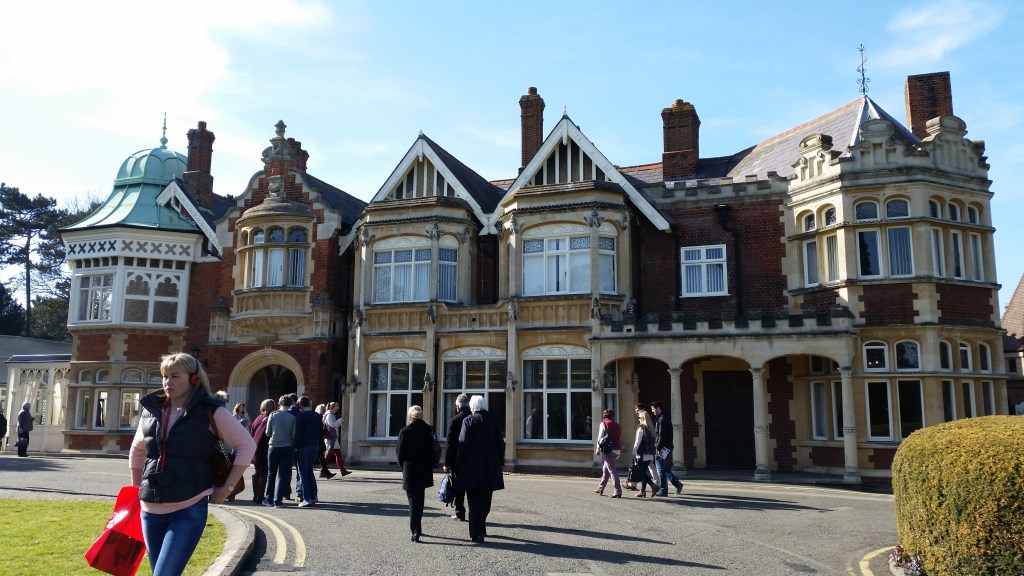
    Bletchley Park used to be a giant manor, in the middle of nowhere, owned by rich British people. In 1938, it was purchased by MI6 to be used as a research facility in the event of war. It’s located almost directly north of London, and is conveniently very close to a major rail line that connects it easily to London, Oxford, and Cambridge. Additionally, from overhead it looks like a giant manor for rich people and not like a government research facility. Convenient.

    Before and during WWII (because you don’t need a war to spy on people’s encrypted messages), Bletchley Park was the site where a group of researchers, codebreakers, and math-y geniuses came together to try to decipher the encrypted messages that various enemies (Italian, Japanese, Germans, etc) were sending about military and other plans. At the height of the war, aka the time when codes got most complicated and also the time when enemy info was most important, the Bletchley Park operation was rather large, and employed around 9000 men and women.

    The story in the Imitation Game was something like this: math nerds keep trying and failing to break any codes. They are very upset but keeping trying to same process over and over again with no success. Alan Turing arrives, tells them they’re idiots, starts building a computer-type machine named Christopher. Eventually, his machine works and helps them break the code. That one trick fixes all the problems, etc. The allies win the war. There’s a lot more about to the plot, but that’s the part that relates to Bletchley Park. You can learn more about the Imitation Game here, and more about Alan Turing here.

    Anyways, my trip to Bletchley Park was initially a bit confusing, as the placards I was reading weren’t lining up with what I thought I knew. In reality, Alan Turing was very, very smart (and truly visionary thinker), but at Bletchley Park he wasn’t some kind magical genius surrounded by fuddy-duddy fools. Essentially, there were a ton of different enigma machines being used to encipher messages being sent between various enemy groups. Germany alone had different enigmas for different branches of the military. They would encipher a message, turning it into gobbledy-goop. Then the recipient, who knew the code with which it was enciphered, would decipher the message and read it. The trick is to know the code that enciphers the message. Oh, and there are like a kajabillion options.

    A Polish researcher (turns out everyone was spying on everyone back then) had come up with a design for a machine that would help find the code with which a message was enciphered. As the war went on and Germany got wiser, the enigmas got more and more complicated. At various points in time, the codebreakers came up solutions that worked for awhile, until the enemy switched to a better/more complicated enigma machine. However, building on these initial Polish designs and ideas, Turing worked with a fellow codebreaker to design a machine that would be able to quickly find the needed code by testing possible options at a rapid rate. An engineer from a technology company then helped build this machine, known as the Bombe.

    Beyond that, another thing the movie didn’t really touch on is the extent to which the process of codebreaking was a major operation. That is, it wasn’t just some smart people breaking codes. It was smart people figuring out how to break codes, and then tons of still very smart people making that process happen. Women worked standing all day in huts filled with hundreds of Bombes, while code possibilities were tested. When a match was found, it was passed to another hut, where someone used the code the translate those messages via Enigma. Next, the German in those messages was cleaned up. And then, it was translated into English. And then some high level British secret service operatives figured out how to turn these messages into military instructions without letting anyone realize that they were deciphering messages. Sound like a lot? It was. And I’m sure I’ve gotten some of it wrong and left out some information.

    The point is, Bletchley Park, which was closed after WWII and left in disrepair for 50 years, was once a bustling spot where lots of smart women and men worked hard to solve problems.

    Considering all that’s really left is the buildings, the exhibits were very impressive. The huts were outfitted with audio-visual elements that let you see and hear the men and women who would’ve worked there. Each room had video projectors of someone working there, so that when you walked in the hallway you could hear the voices coming from each room, quite like it might have been back then. The lighting and decor were all done up to show you what the huts would’ve looked and felt like. I was quite impressed. This could very easily have been an extremely boring exhibit, but great care and planning were given to make it interesting. I would very much recommend a visit to Bletchley Park if you ever get the chance.

    Aside from all that I learned, my company was great. We enjoyed the beautiful weather as we walked around checking out the exhibits. We stopped for lunch and had tea later in the afternoon. It was a rather British day with my British family, and I am so glad that it happened.

    Check out my photos below: