Tag: road trip

  • Exploring DC – Day 1 of Adventures

    Exploring DC – Day 1 of Adventures

    We went to Washington, DC to watch my friend Komal’s documentary, Dream, Girl, at the White House, but we also took the opportunity to spend a few days on holidays in DC. My mom and I had been before, but Kevin and my dad had never seen any of the Washington, DC attractions, so we got to work quickly on our tourist experience.

    Morning Adventures

    We stayed at a hotel within walking distance to Capitol Hill, which also put us within a short distance of the Washington Mall.

    If you’re not familiar with Washington, DC, here’s how Wikipedia describes the National Mall:

    The National Mall is a national park in downtownWashington, D.C., the capital of the United States. The National Park Service (NPS) administers the National Mall, which is part of its National Mall and Memorial Parks unit.[2] The term National Mall commonly includes areas that are officially part of West Potomac Park and Constitution Gardensto the west, and often is taken to refer to the entire area between the Lincoln Memorial and the United States Capitol, with the Washington Monument dividing the area slightly west of its midpoint.[3] The National Mall receives approximately 24 million visitors each year.[4]

    Here’s a photo of the National Mall, and some notes on different landmarks, relative to our hotel.
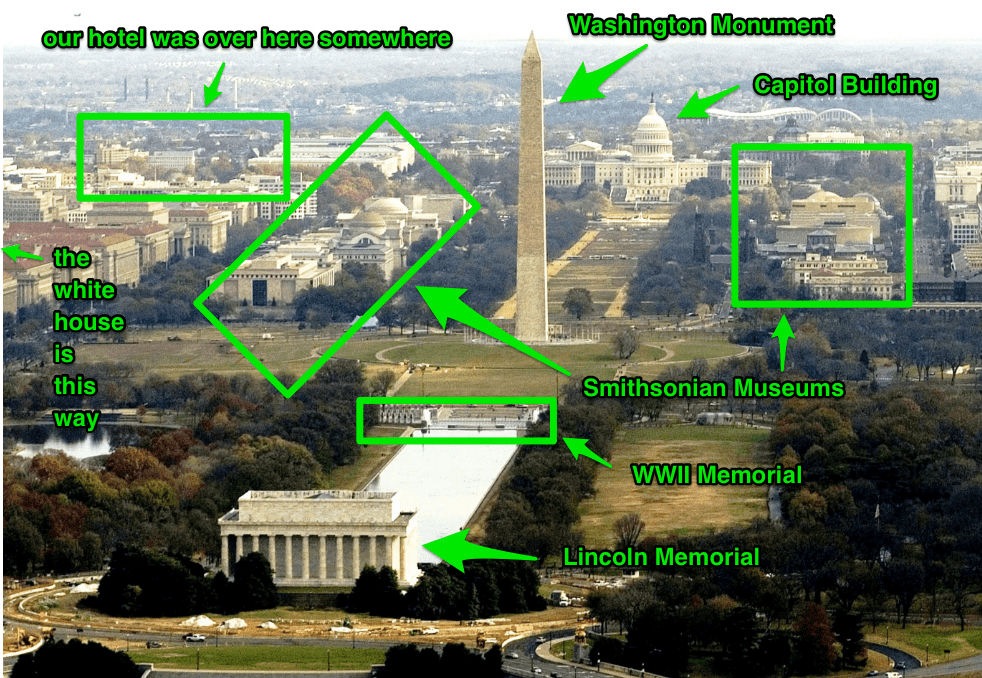
    dcnationalmall

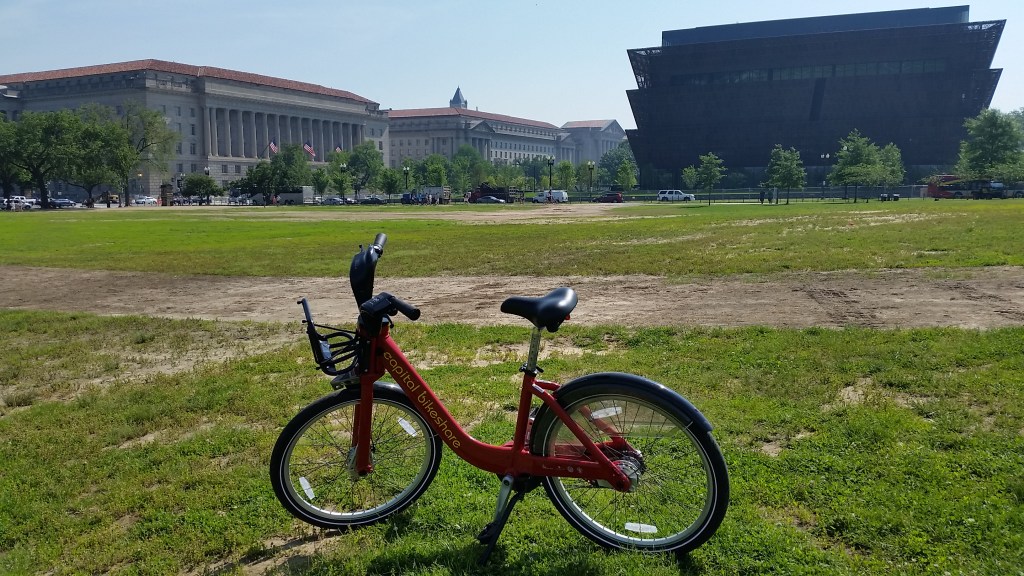
    We started early in the morning with a quick breakfast and a walk around the Capitol Building. The heat was pretty intense, so my parents opted for a relaxed, air-conditioned morning at the hotel while Kevin and I rented some Capital Bixi bikes, and biked down the Washington Mall to see the Lincoln Memorial.

    With Tony & Judy relaxing, Kevin and I bike in the sun along the Mall, past the Smithsonian museums. We stopped for a photo op at the Washington Monument, and then carried on to the WWII memorial. I’d seen all of this before, but it was great to see it again. The size and beauty of the National Mall is always impressive, and even Kevin agreed with that, so it was fun to see him enjoying himself so much.

    The WWII Memorial in particular includes such great attention to detail. Between the carvings, and the sounds of the fountains, it’s truly a work of art.

    The weather was nice and hot, but it was too early in the year for DC’s infamous humidity, so we enjoyed the sun as we biked along the reflecting pool and then climbed the steps to the Lincoln Memorial.

    Because we were in DC for Memorial Day weekend, it was an especially busy spot. At every memorial and landmark, we saw different veterans and veteran groups, which added a bit of extra meaning and context to all that we were seeing. As a Canadian, American politics can sometimes be a bit bewildering, so it was interesting to see Americans expressing their meaningful politics on this set of national landmarks.

    After the Lincoln Memorial we saw the Vietnam War Memorial. It’s one of my favourite things to see in DC because it’s so different from typical war memorials. Rather than celebrating achievements or supposedly high minded ideals, this memorial is a wall of stone, cut into a hill, with all the names of the American soldiers lost in Vietnam carved into it. Rather than celebrating the state, it recognizes the American soldiers who were lost in the war. It’s rather emotional to walk along, even more so when you’re walking behind and in front of Vietnam war veterans.

    On our way back to the other end of the mall, we stopped for a photo op near the White House, then headed to the Museum of Native American History for lunch (which was excellent).

    Afternoon Adventures

    After lunch we met up with my parents at the National Air and Space Museum. The Smithsonian has a really impressive collection of things in general, and this museum was no different. We saw exhibits covering the first attempts at flight, the first launches into space, and real pieces of modern spaces stations and technology. It was a great way to see and understand the progress of travel over the last few generations.

    Kevin was pretty bummed to not see Cape Canaveral when we went to Florida, so he was quite thrilled to see some spaces ships, rovers, etc at the Smithsonian.

    Next up we went to the National Gallery of Art. We only had time to see the basement floor, but we stumbled upon some Mark Rothko paintings, so we were quite excited. All in all, we had a great time on our first day exploring DC!

    Evening Adventures

    After the museums closed, we headed back to the hotel to shower off all the sweat and sunscreen of our day. After changing, I headed out with Kevin and my Dad. Unfortunately, my mom wasn’t feeling well so she stayed back in the room to sleep.

    Before going to dinner, we went to the Sculpture Garden at the National Gallery of Art. It was “Jazz in the Garden” night, which I thought meant that it would be full of stuffy rich people doing the polite golf clap while listening to jazz. I could not have been more wrong. By the time we got there, the garden was completely full. We found a line up, bought pitchers of beer and sangria, and stood in the garden to listen to the music and enjoy the energy of the crowd. It was a great crowd of people of all ages, gathering for what was clearly a very popular Friday night social event. It also helped that we were at the season debut. If you’re in DC on a Friday night, I highly suggest you check out this awesome free event!

    Next up we headed to a wine bar for dinner. I did some heavy research on WikiTravel for this trip, as I’d been advised that good restaurants were hard to find in DC due to the high amount of touristy/business-y nonsense restaurants. Fortunately, I found a great list of places, and we didn’t have a single bad meal.

    On Friday night we ate at Proof. The food was excellent, and the wine was also great. The wine list wasn’t as varied as I’d been hoping, but everything we ate and drank was delicious. Unfortunately, the aesthetic of the restaurant includes lighting so lacking that you can’t even read the menu. I found this to be completely pointless, and annoying. Otherwise, it’s a top notch experience, but eating in the dark is just plain weird. That said, we ate some of the most delicious charcuterie of all time there, so it was worth going to. Still, it was the weak point of meals over our weekend, which likely says more about how well we ate in DC.

    Photos are below, in reverse order for some reason:

  • Road Trip Day 3: Evora & Illness & the Algarve

    Road Trip Day 3: Evora & Illness & the Algarve

    After waking up in Marvao and spending our morning exploring, we set off to Evora. Of course, Tyler rolled his ankle on those beautiful cobblestone streets the night before, and I woke up feeling the beginning of a fever. Still, we had 2 more stops on our road trip, beginning with the city of Evora, followed by the nearby Monsaraz, then the city of Beja. By the time we had lunch, Kevin realized his couple of Pages were too ill, and he promptly drove us the last 3 hours home to the Algarve.

    Before our trip was cut short, we did get to explore Evora. We also had an incredible lunch at a restaurant that only serves 9 people at a time. “Botequim da Mouraria” is run by a welcoming Portuguese couple. In their small restaurant, there’s bar seating only, which means that we were incredibly lucky to arrive in time for lunch and find 3 empty chairs waiting for us. The service and the food were excellent. This was one of those places Kevin had found in the course of his detailed research, and it was very much worth the hype.

    After lunch, we explored Evora and its incredible history. A very old city, Evora still has Roman ruins and an incredible variety of historic architecture. On all our other stops, I read aloud to the guys various historical fun facts. Being sick in Evora meant that I didn’t really do this, and so we learned a bit less there than everywhere else. The city is more than 2000 years old, and was occupied by the Celts and the Moors before becoming the #2 city in Portugal for a time, becoming the site of much lavish spending on the behalf of Portuguese rulers.

    Here are a couple of other fun facts about Evora:

    Évora has a history dating back more than two millennia.

    It was known as Ebora by the Celts, a tribal confederacy, south of the Lusitanians (and of Tagus river), who made the town their regional capital.

    The etymological origin of the name Ebora is from the ancient Celtic word ebora/ebura, plural genitive of the word eburos (yew), name of a species of tree, so its name means “of yew tree.” The city of York, in northern England, at the time of the Roman Empire, was called Eboracum/Eburacum, named after the ancient Celtic place name Ebora Kon (Place of Yew Trees), so the old name of York is etymologically related to the city of Évora.[6]

    (Wikipedia)

    Évora is also remarkable for reasons other than its monumental heritage related to significant historic events. The 16th century was a time of major urban planning and great intellectual and religious influence. While Évora also has many noteworthy 16th-century patrician houses (Cordovil house, the house of Garcia de Resende), the unique quality of the city arises from the coherence of the minor architecture of the 16th, 17th and 18th centuries. This unity finds its overall expression in the form of numerous low whitewashed houses, decorated with Dutch tiles and wrought-iron balconies and covered with tile roofs or terraces which line narrow streets of medieval configuration and which in other areas bears witness to the concentric growth of the town until the 17th century. It also served to strengthen the fundamental unity of a type of architecture that is perfectly adapted to the climate and the location.

    Évora remained mainly undamaged by the great earthquake of 1755 that destroyed many towns in Portugal, including Lisbon. The monuments of the Historic Centre of Évora bear witness to their profound influence on Portuguese architecture in Brazil.

    (UNESCO)

    In retrospect, while we recognized how beautiful Evora was, I was a bit too sick to recognize and appreciate the signs of its long storied history. It was also clearly packed with tourists from all of the world, which became a bit of a distraction itself. All the same, we managed to take a few photos. Enjoy!


  • Road Trip Days 2 & 3: Visiting Marvao

    Road Trip Days 2 & 3: Visiting Marvao

    Ok, so the last few posts have detailed some fairly magical sights. But to be honest, there’s more to come here. This trip was pretty surreal, and we saw many memorable places.

    The driving on the trip may also have been a bit much, but in this case it turned out to be worth it. After driving 2.5 hours to Piodao, we spent a couple of hours exploring this small yet remarkable village. And then we got back in the truck and Kevin drove us another 3 hours to Marvao, a city on a hill right on the border of Portugal and Spain. About an hour into this trip, I was really questioning this decision, but when we drove up to this walled-city on a foggy night, all doubts were forgotten.

    Here’s what you need to know about Marvao (courtesy of Wikipedia):

    Commanding spectacular views across the Tagus basin (the same river to connects Lisbon to the Atlantic) and Serra de Estrela (highest point in Portugal) to the north, the fortified rock of Marvão has been a site of significant strategic importance since the earliest human settlements. Today lying on the ‘raia’ that divides Portugal and Spain, Marvão has consistently stood on a frontier zone between peoples: Celtici, Vettones and Lusitani (4th-2nd century BCE); Lusitanians and the Romans ofHispania Ulterior (2nd-1st century BCE); migratory Suevi, Alans, Vandals and Visigoths (5th-7th century CE); conquering moors and Visigoths (8th century); muwallad rebels and the Cordoban emirate (9th-10th century); Portuguese nation-builders and Moors (12th-13th century); Templars and Hospitallers (12th-14th century); Portuguese and Castilians (12th century-present day); Liberals and Absolutists (19th century); the fascist regimes of Salazar and Franco (20th century).

    Marvão’s natural assets have contributed to the ‘uniqueness’ of this remote village as perceived by visitors today: (i) as nigh-impregnable ‘eagle’s nest’ fortress – perched high on a granite crag, and bordered on the south and west by the Sever river; (ii) as vital lookout-point towards the Alcántara Bridge (70 km (43 mi) away), a wide stretch of the Tagus basin and the Serra de Estrela; (iii) as a gateway to Portugal from Spain via the Porta da Espada (‘Sword Gate’) mountain pass of the Serra de São Mamede. These assets have ensured its status as the ‘Mui Nobre e Sempre Leal Vila de Marvão’ (Very Noble and Ever-Loyal Town) into the present day.

    As with other 11th-13th-century castles, the early medieval improvements and development of Marvão castle reflect the innovations brought back by crusading orders from the near east (notably the highly influential Hospitaller castle in Syria, the Krak des Chevaliers). The medieval castle seen in Marvão today mostly post-dates the year 1299, and features numerous characteristic features of a crusader-era castle: a tall central keep with raised entrance on the first floor; a series of lower, outlying turrets (some semi-circular); high-placed arrow-slits; open spaces to aid the sheltering and assembly of villagers and troops; a well, and huge rain-collecting cistern to supply water to both keep and the wider castle in the event of siege; bent entrances (both on the village and castle gates) to slow down invaders in the event of breached gates; a series of narrow killing zones (notably, in the triple gate on the village-side of the castle); extensive crenellated battlements and curtain walls that enhanced the natural defences provided by the escarpments of Marvão’s rock.[22]

    That’s only a smattering of interesting information about Marvao, as this place is filled with historical significance. When we arrived at night fog filled the town, we had to park the truck just outside of the gates in order to walk to our hotel (we stayed and ate at the the Casa do Alentejo, where we were welcomed with the traditional and impressive Alentejo hospitality). With the characteristic preservation of the buildings’ historical style, it felt like we were walking back in time. After a lengthy dinner, we got some sleep, then woke up early for breakfast and further touring. We explored all through the town and the castle, and were constantly in awe of the view and the spirit of the region. Similar to Sintra, looking across the hills you could easily imagine what it was like to look across that view 1000 years ago. A very cool feeling that won’t soon be forgotten.

    Check out our photos below!

  • Roadtrip Day 2: Piodao

    Roadtrip Day 2: Piodao

    When I say that Kevin researched and planned our road trip with Tyler, I don’t mean that lightly. As soon as Tyler booked his tickets to visit, the research began. And not just some simple google searches of ‘best sights in Portugal’. If Kevin has ever helped you with anything, you know that his research-style is all-in and he stops at nothing to get the best possible outcome. Nothing exemplifies this more than our stop off in Piodao.

    A few weeks before the trip, Kevin showed me a photo of a place that looked amazing, and told me that it was a must-do stop. When I convinced him to shorten the road trip from 6 days to 3, Piodao was one of those places that was a must-see, not to be compromised. And he was so, so right.

    After our morning at the Knights Templar’s Convent of Christ in Tomar, we got back into the truck and embarked on what I can honestly say is the wildest, most breathtaking and most nerve-racking road trip of my life. Before I get into too many road trip details, let’s talk about why Piodao is special and worth seeing.

    Piodao, known as the “nativity village” is a small collection of stone buildings, tucked into a mountain side. Unlike most of the places we’ve visited on this trip, Piodao, due to its remote geographic location, was almost entirely disconnected from Portuguese history. How disconnected? This village didn’t have electricity until the 1970s. This geographic isolation is what makes Piodao so unique – because they were limited to local resources, which is reflected in the architecture of the town itself, their traditions were well-preserved over the years, due to a lack of outside influences. Entering Piodao, picturesquely placed in between 2 hills in a mountain range, feels like entering a fairy tale. As you stand on the hillside, you can even hear the echo of jingling bells from the goat herds. My only regret of this entire trip is that we didn’t stay longer.

    Now, about that road trip. It was long and a bit harrowing. And as the trip went on, we felt increasingly alone. There were long stretches (on this 2.5 hour drive) without seeing other people and cars, though we did see a herd of goats crossing the road. We climbed up into the mountaintops, driving along winding roads, on the edge of cliffs, surrounded by clouds. I was both in awe of the view and in awe of Kevin’s patience & composure while navigating these roads. There’s absolutely no way that a bus could have made this journey.

    Visiting Piodao was a truly surreal and magical experience. I recommend it very much. And beyond being beautiful, the town itself offers great food and friendly people. Check out our many photos below!

  • Roadtrip Day 2: An Aqueduct “just around the corner”

    Roadtrip Day 2: An Aqueduct “just around the corner”

    While we were visiting the Convent of Christ in Tomar, the map of the site said that there was an aqueduct attached. Tyler was pretty excited about this, never having seen a real aqueduct. Kevin and I had seen some in Lisbon, but agreed that it was pretty cool.

    While Tyler and I searched for the aqueduct ruins (which we found outside, attached to the Castle of Tomar), Kevin searched on Google. When we were done at the Castle/Convent, Kevin said he had one more stop he wanted to make. He handed me the phone with a seemingly random spot marked on the map nearby. He told me what we were up to but hadn’t said anything yet to Tyler.

    5 minutes of driving later, we came to the Pegoes Aqueduct, to which the aqueduct ruins at the castle were attached.

    But rather than just a couple of arches, what we saw was a full aqueduct crossing a valley. And the best part? It was open and also empty! From where we parked, we walked just a few steps to climb up onto the aqueduct through an old water inspection station. In the silent countryside, we walked along an ancient aqueduct, just the 3 of us.

    A quick little surprise, and one of the highlights of our trip. Enjoy the photos below!

  • Roadtrip Day 2: Tomar and the Convent of Christ

    Roadtrip Day 2: Tomar and the Convent of Christ

    After our day of adventures in Sintra, we drove 2 hours to the city of Tomar.

    When planning this roadtrip, Kevin did quite a lot of research. All the places that we travelled to see made the list because of their unique history/beauty, making it almost impossibly to have a favourite site.

    The city of Tomar was originally founded in 1162 under an order of the Knights Templar, and it was actually the last Templar town to be commissioned for construction.

    Tomar then became the headquarters of the Order of the Knights Templar in Portugal. From this base, the Templars ruled a vast area of central Portugal, defending that territory from the Moors who ruled in the South. As the Catholic church became nervous of the power of the Templars, and then banned the order altogether, the Portuguese King negotiated to create a new “Order of Christ”, which took over the power and place of the Templar’s order. As such, Tomar is considered the last home of the Knights Templar in Portugal.

    This story got a bit more interesting when Henry the Navigator, the leader of Portuguese exploration, became the head of the Order of Christ (from Wikipedia):

    Henry the Navigator was made the Governor of the Order, and it is believed that he used the resources and knowledge of the Order to succeed in his enterprises in Africa and in the Atlantic. The cross of the Order of Christ that was painted in the sails of the caravels that crossed the seas, and the Catholic missions in the new lands were under the authority of the Tomar clerics until 1514. Henry, enriched by his overseas enterprises, was the first ruler to ameliorate the buildings of the Convento de Cristo since its construction by Gualdim Pais. He also ordered dams to be built to control the river Nabão and swamps to be drained. This allowed the burgeoning town to attract more settlers. Henry ordered the new streets to be designed in a rational, geometrical fashion, as they can still be seen today.

    Interestingly, this time in Portuguese history was also an important time in Jewish history:

    Just after 1492 with the expulsion of the Jews from Spain, the town increased further with Jewish refugee artisans and traders. The very large Jewish minority dynamized the city with new trades and skills. Their experience was vital in the success of the new trade routes with Africa. The original synagogue still stands.

    In the reign of Manuel I of Portugal the convent took its final form within the Manueline renaissance style. With the growing importance of the town as master of Portugal’s overseas empire, the leadership of the Order was granted to the King by the Pope.

    However, under pressure from the Monarchs of Spain, the King soon proclaimed by Edict that all the Jews remaining within the territory of Portugal would be after a short period considered Christians, although simultaneously he forbade them to leave, fearing that the exodus of Jewish men of knowledge and capital would harm Portugal’s burgeoning commercial empire. Jews were largely undisturbed as nominal Christians for several decades, until the establishment of a Tribunal of the Portuguese Inquisition by the initiative of the Catholic Clergy in the town. Under persecution, wealthier Jews fled, most others were forced to convert. Hundreds of both Jews and New Christians were arrested, tortured and burned at the stake in autos da fé, in a frenzy of persecution that peaked around 1550. Many others were expropriated of their property. Jewish ascendancy, more than Jewish religion, together with personal wealth determined whom would be persecuted, since the expropriations reverted to the institution of the Inquisition itself. The town lost then with the persecution of its merchants and professionals most of its relevance as a trading centre.

    Despite its great importance during the growth and expansion of Portugal and Europe, Tomar is now a town of just 20,000 people, quietly tucked away in Portugal. If you’re interested in knowing more about Jewish history in Portugal, I recommend you check out this Wikipedia article, as well as this article that talks about the town of Belmonte (by the way, home to some pretty good kosher olive oil!).

    Anyways, so as we were driving to Tomar, I was reading out all of these Wikipedia articles to Kevin and Tyler, getting all pumped up about our trip. We arrived late at night, grabbed dinner at a Knights-Templar-themed restaurant, and headed off to bed. With big plans for the next day, we got up early, ate breakfast in our family-run Pensao, and then headed up the hill to the Convent of Christ.

    If Tomar itself has some deep history going on, the Convent of Christ is right at the centre of the action. Built over hundreds of years, the building boasts a great variety of architectural and design styles. The level of detail is impressive, and we spent SO much time in the church flipping about how cool it was to be in the church built by Templar Knights.

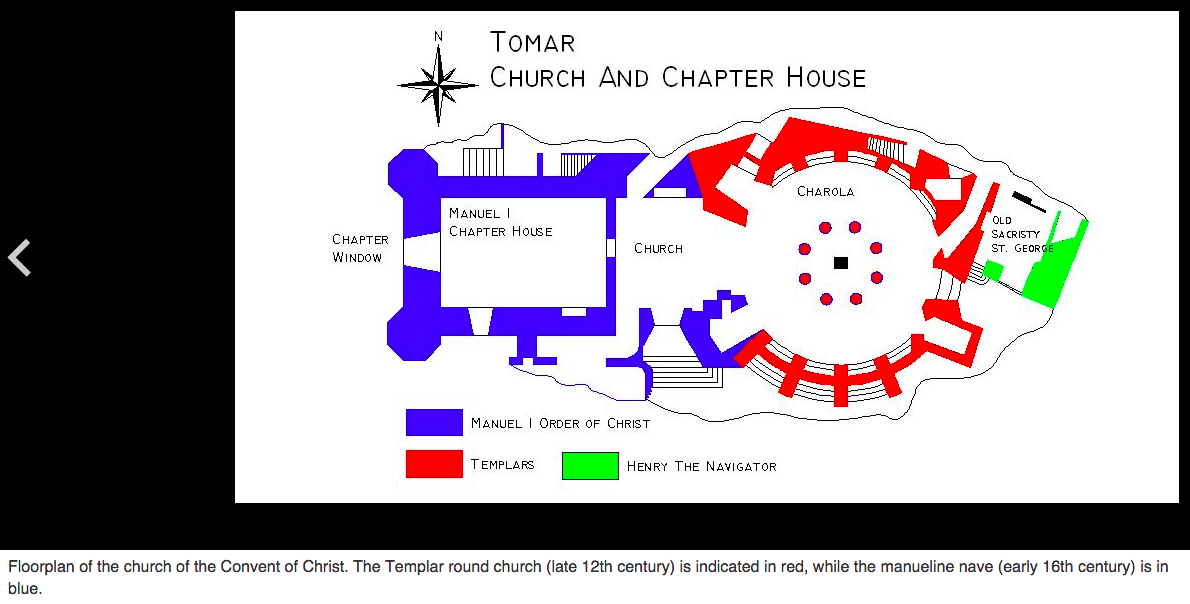
    To give you an idea of how the design of the church came to be, here’s a photo from Wikipedia:

    Screen Shot 2015-09-17 at 12.57.28 PM

    Similar to when I visited Canterbury earlier this year, it was really obvious that this place grew to become a great centre of activity in Tomar. What you see as blue in the above map is a truly massive set up, designed to house and feed those who lived and visited here. We entered in the oldest part of the building, shown above in green, and worked our way through to the chapter houses. We had only planned to spent 45 minutes here, but we ended up spending well over 2 hours exploring and taking photos.

    All in all, Tomar was a wonderful place to visit. We didn’t get to see all of the sites or explore all of the myths, but the Convent of Christ was itself worth the drive. We expected it to be cool, and still Tomar very much exceeded those high expectations. Enjoy our photos below, we had a lot of fun taking them!

  • Roadtrip Day 1 (still!): Quinta da Regaleira

    Roadtrip Day 1 (still!): Quinta da Regaleira

    If you’ve ever read this blog, you know that we typically take our travel slowly. Even if that means we miss out on some possible sites, we always try to spend the maximum amount of time in our travel pursuits, in an attempt to really understand where it is that we’re visiting. Clearly we didn’t quite take that approach on our road trip, where we packed quite a bit of stuff in. I mean, we’re now 3 posts into Day 1 of our Sintra road trip, and yet we still drove another 2+ hours on this day!

    Our wonderful friend, Soledad, insisted that we visit “Quinta da Regaleira”. It roughly translates to being “Estate of Regaleira” (the land was once owned by the wealthy Regaleira family from Northern Portugal). Soledad told us that this was her favourite place in the world, and once we arrived we realized why. We also very much regretted not budgeting more time to be here. There was so much to see, and we certainly didn’t let the rain slow us down!

    The Quinta da Regaleira is essentially an estate that was once owned by a rich guy with big dreams of making something fancy. And this guy, António Carvalho Monteiro (actually nicknamed Moneybags Monteiro) sure achieved his goal. He was an eccentric guy who leveraged his family fortune to become a coffee tycoon in Brazil, then returned to Portugal study everything from law to bugs.

    After purchasing the land in 1892, he spent until 1910 creating a magical villa and gardens, a neo-Manueline extravaganza all dreamed up by Italian opera-set designer Luigi Manini (Lonely Planet).

    Despite the rain, we spent most of our time exploring the extensive gardens. This place is a landscape architect’s dream, boasting arches, gazebos, grottos, aquariums, gardens, patios, paths, fountains, tunnels, bridges, and more. The highlight is almost certainly what’s known as the “Initiation Wells”. We spent at least 30 minutes trying to find them, and it was well worth the effort. Here’s some background info, courtesy of our friends at Ancient-Origins.net:

    The pair of wells, known as the ‘Initiation Wells’ or ‘Inverted Towers’, consist of ‘winding stair’ architecture, which carries symbolic meaning including the death/rebirth allegory common to many hermetic traditions.

    One of the wells contains nine platforms, which are said to be “reminiscent of the Divine Comedy by Dante and the nine circles of Hell, the nine sections of Purgatory and the nine skies which constitute Paradise.” A smaller well, called the “Unfinished Well,” contains a set of straight staircases, connecting the ring-shaped floors to one another. It is believed that the spacing of the landings, as well as the number of steps in between were dictated by Masonic principles.

    The two wells are connected to a series of underground tunnels and caves. Once we entered the primary initiation well, we descended deep underground.

    To our great delight, we ended up in passing through the other well and entering a grotto/lake/waterfall area. We were beyond thrilled at this turn of events. We’d been freaking out about the beauty of this site all day, but this discovery topped them all, and we immediately agreed that Soledad was right about this place.

    The inside of the mansion was pretty cool as well, but nothing close to the outdoor gardens and its secrets. If you plan to visit this site, give yourself at least 3 hours to see everything!

    Check out the photos to see all this beauty for yourself (some are a bit blurry due to the rain – we were completely soaked, as was the phone!):


  • Roadtrip Day 1: A Moorish Castle and Palace of Pena

    Roadtrip Day 1: A Moorish Castle and Palace of Pena

    We typically take our sweet, sweet time when doing anything, but because we were on a road trip, we had certain goals for where to be and when to be there by. We were also exploring unfamiliar territory, and perhaps underestimated how much time we’d want to spend in certain places.

    That said, everything that we saw on the first day of our Road trip was within the magical area known as Sintra, where castles and natural beauty abound. There are tons and tons of incredible sites to see in Sintra, but we oriented our trip to the advice of our friend Soledad, and selected those she described as ‘must-see’ items.

    We visited 2 different castles on that day, and they couldn’t have been more different: The Moorish Castle, and Palace of Pena.

    Let’s start with the Moorish Castle.

    The Moorish Castle was the decidedly more ruin-y of the two. It is a military fort built around the 10th century by the Muslim populations that occupied the Iberian peninsula. It acted as a control tower for the Atlantic coast and land to the north, serving as an outpost for the city of Lisbon.

    For a building that’s more than 1000 years old, it was in pretty decent shape. All of the exterior castle walls remain, and we were able to walk up, down, all around, and catch amazing views throughout. From the top of the castle walls, you can see all that’s built up in the Park in the centuries since: a town, castles, mansions, etc. And yet, you can imagine how it felt 1000 years ago to look out and see no evidence of other people. Placed atop a large hill, this place is definitely an impressive and well planned military location.

    And not *just* military either. After the large castle walls had been built, people began to settle just outside of them. A “second circle of walls” was later built to protect these settlements.

    If you’re interested in the nitty gritty history timeline for the Castle of the Moors, check out Wikipedia.

    After the Castle of the Moors, we headed to the Palace of Pena.

    While it was cool, the Palace of Pena (Palacio da Pena) is one road trip stop we could’ve done without. We crammed a lot of sites into this road trip. That’s not usually our style, but we went a bit overboard with expectations for what we wanted to see. In its defense, it’s part of a large garden complex, but we only saw the castle itself, because it was raining and we were rushing to see another place afterwards (more on that later this week!). By rushing to see the Palacio, we cost ourself some appreciation of its history. The routinely under-informational museum pamphlet also didn’t give us the full story of site.

    Here’s what Wikipedia has to say:

    The palace’s history started in the Middle Ages when a chapel dedicated to Our Lady of Pena was built on the top of the hill above Sintra. According to tradition, construction occurred after an apparition of the Virgin Mary.

    In 1493, King John II, accompanied by his wife Queen Leonor, made a pilgrimage to the site to fulfill a vow. His successor, King Manuel I, was also very fond of this sanctuary, and ordered the construction of a monastery on this site which was donated to the Order of Saint Jerome. For centuries Pena was a small, quiet place for meditation, housing a maximum of eighteen monks.

    In the 18th century the monastery was severely damaged by lightning. However, it was the Great Lisbon Earthquake of 1755, occurring shortly afterwards, that took the heaviest toll on the monastery, reducing it to ruins. Nonetheless, the chapel escaped without significant damage.

    For many decades the ruins remained untouched, but they still astonished young prince Ferdinand. In 1838, as King consort Ferdinand II, he decided to acquire the old monastery, all of the surrounding lands, the nearby Castle of the Moors and a few other estates in the area. King Ferdinand then set out to transform the remains of the monastery into a palace that would serve as a summer residence for the Portuguese royal family. The commission for the Romantic style rebuilding was given to Lieutenant-General and mining engineer Baron Wilhelm Ludwig von Eschwege. Eschwege, a German amateur architect, was much traveled and likely had knowledge of several castles along the Rhine river. The construction took place between 1842–1854, although it was almost completed in 1847: King Ferdinand and Queen Maria II intervened decisively on matters of decoration and symbolism. Among others, the King suggested vaul tarches, Medieval and Islamic elements be included, and he also designed an ornate window for the main façade (inspired by the chapter house window of the Convent of the Order of Christ in Tomar).

    Having done my Wikipedia research, it’s clear that this place’s history actually fits well with many of the other sites that we saw in Sintra and in Tomar. That information was definitely not in the pamphlet we received upon entering, but either way we had a fun time. It’s by far the most colourful castle I’ve ever seen, which gives it an almost-comical appearance.

    All this site-seeing constituted just part of our day. Enjoy the photos below, there’s more to come from our final (and favourite!) stop coming soon.


  • Roadtrip Day 1: Exploring the Convent of the Capuchos

    Roadtrip Day 1: Exploring the Convent of the Capuchos

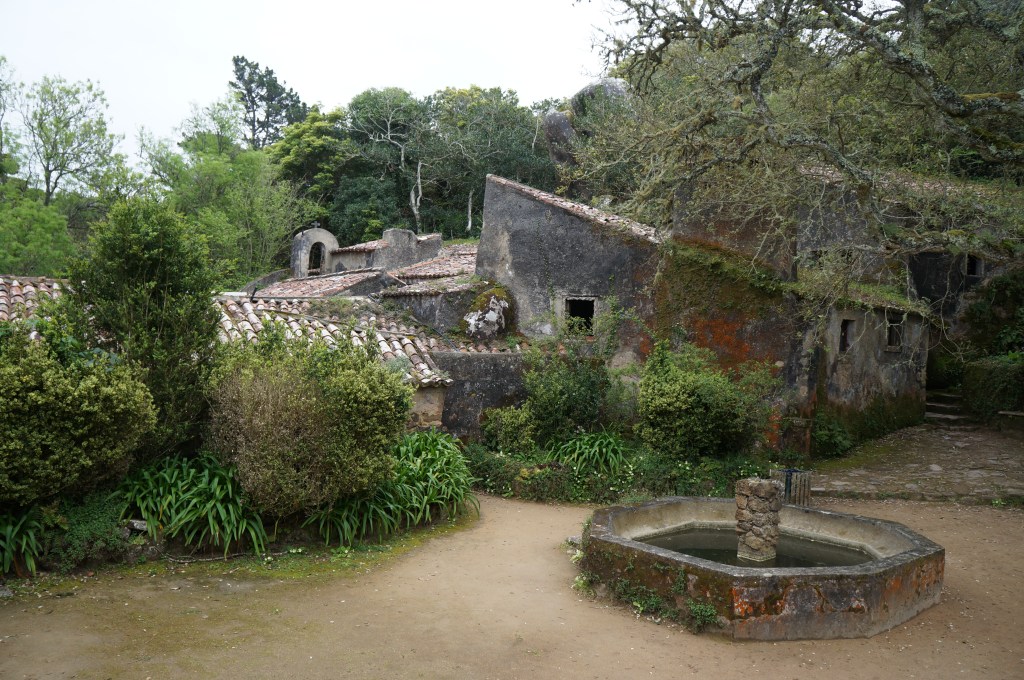
    After stopping at the Cabo da Roca, we drove back into the Sintra-Cascais Natural Park. The drive alone was incredible: beautiful trees, winding roads that twisted up a hillside. Our next stop was at ruins of the centuries old Convent of the Capuchos.

    Literally translating to the “Cork Convent”, its name comes from the insulation used in the construction of the buildings here. It was first formed in the mid-1500s, and according to the lovely brochure that I’ve been saving for this exact occasion,

    The Cork Convent was built in accordance with a philosophy that stressed harmony between human and divine works, for which reason the building merges inseparably with nature and the surrounding vegetation, incorporation enormous granite boulders. Through the exercise of contemplation, fulfilling the teachings of Saint Francis of Assisi, the friars worshipped the Creator through what they considered to be His greatest work; the natural world”

    Though the convent has ceased to be operated as such, and is now simply a series of ruins to be toured by visitors, you can easily see the convent’s philosophy at work. It’s impossible to wander through the small buildings, built into the side of a hill, without reflecting on the beauty and calming effects of nature. The smell and feel in the air of so much nature all in one place was truly magical. And this magical place really was the perfect start to a magical day in magical Sintra.

    We spent about an hour exploring all the nooks and crannies of these small, simple buildings. We snapped some great photos, and also some “band photos”. There were lots of laughs at this early point in our roadtrip, and that continued on throughout the day.

    Check out the photos below!

  • A Trip to the Algarve – A Culinary Experience

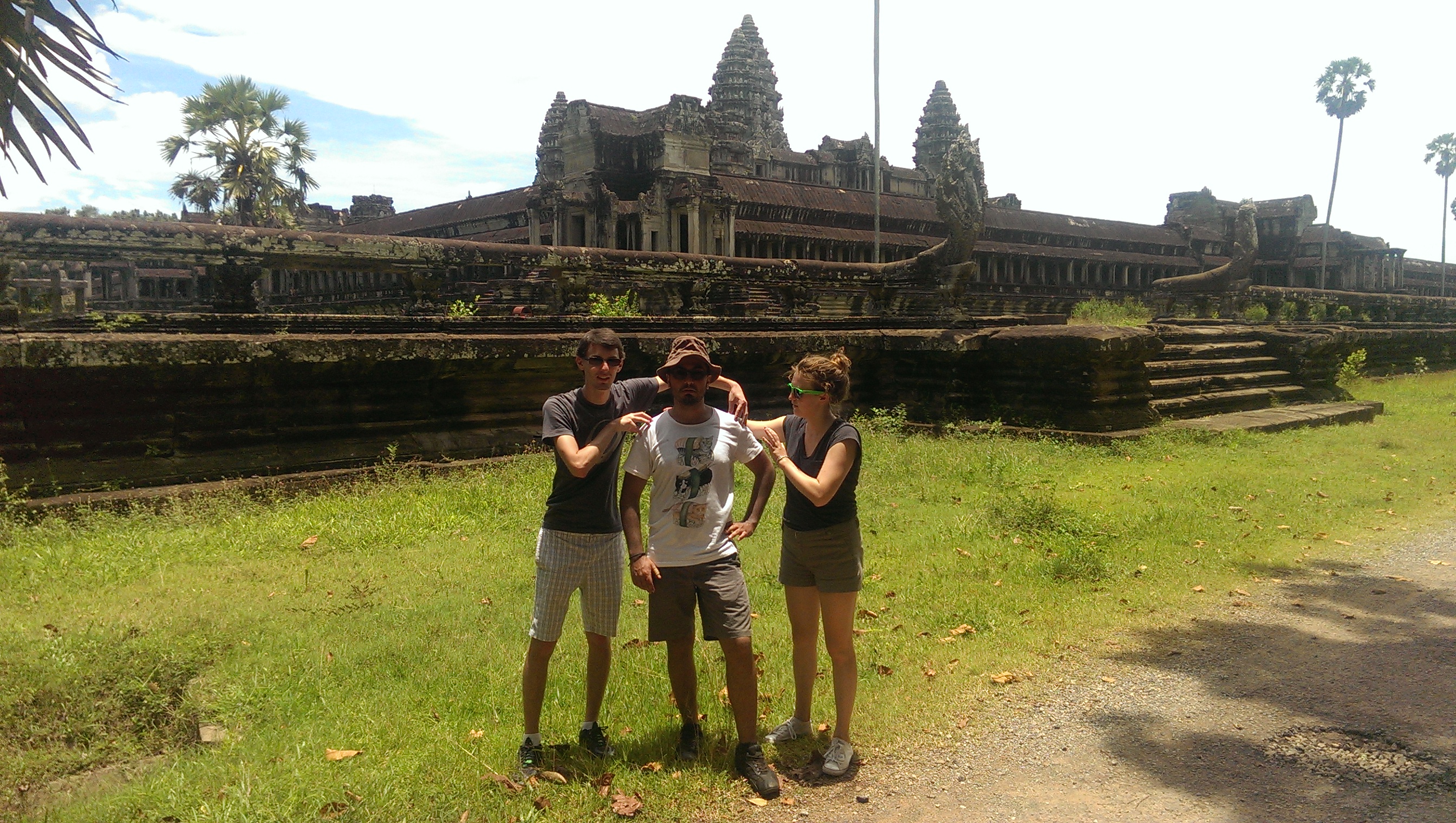
    So…hey there. I’m Tyler, one of Heather’s (decidedly larger) little brothers. Last year when Heather was on her Asian tour I stopped by for a visit in Cambodia. And here’s the thing, if you ever get the chance to vacation with Heather and Kevin, take it! A trip with these two is truly a vacation experience. They find all the most interesting people, order the best food, plan the best day trips, and before you know it you’re staging ridiculous photo-ops in front of Ancient World Wonders.

    2014-08-23 01.22.36
    Angkor Watt with these two (and KP), a world away – nice hat Kevin

    So when I got the offer to come visit in Alte, I took it! And in April, I met Heather and Kevin in Lisbon, kicking off a two week adventure of history, roadtrips, and wine.

    And what a trip. These two know road-trips. In Cambodia it involved a motorcycle ride through the dusty backroads to Angkor Watt. For Portugal it was slightly more tame but just as scenic; stops in Sintra (possibly my favourite place on Earth), Piodao (an incredible mountain town lost in time) and Marvao (where I rolled my ankle, but still got to see a medieval style castle), driving over mountains and through clouds, with Kanye West on repeat for 2 days, before finally arriving in Alte.

    While the road-trip was great (and Heather can discuss more), spending a week in the Algarve with Kevin was the most uniquely relaxing time I’ve ever had. We explored the area (which I’ll talk more about later) learning a good deal about Alte, the Algarve, Kevin’s family, and in true European fashion, we ate some great food along the way!

    2015-04-15 17.14.18

    You may recall previous concerns about picky eating, and they’re fairly justified. I’ve never really been described as “vegetable friendly” or “likes to try new food”, nope, just pizza and peanut butter please and thank you! However, travelling with Heather and Kevin involves visiting some pretty great restaurants, as they take their reviewing pretty seriously, so we worked on expanding our horizons…or waistlines. Here are some the things I picked up along the way:

    1. Portuguese take their french fries seriously

    Spending the week in the Algarve we visited a few local, family owned restaurants. All the food is freshly caught or hunted and cooked, the wines are usually local, service is friendly (helps that Kevin knows everyone). One thing stood out – the fries are delicious. These aren’t you’re frozen then deepfried run-of-the-mill fries; no, every cook here has their own recipe and technique. At one meal we even ended up in a 30 minute discussion on the finer points of potato choice, oil temperature, and crispness. Lines were drawn. Sides were chosen. Accusations were flung. We all had some more wine. Very serious indeed.

    2. Always order the special

    We travelled out to the coast one morning (afternoon) to see Henry the Navigator’s navigation school, and stopped for lunch at a nearby restaurant. The restaurant, being right across from the ocean, was of course a seafood restaurant and the special was whatever they caught that morning. I believe we had originally wanted goose barnacles (percebes), but the water had been choppy that morning so none were caught. So we made due with what was available.

    While people around us enjoyed chicken fingers and spaghetti (tourists!) we were treated to clams (in garlic & butter – awesome!), prawn stew, fresh fish (Dourada aka Sea Bream), and some wine. Everything was fantastic. The clams disappeared quickly, Kevin de-boned the fish for us, and even the prawns (despite looking gross) were delicious. We even ended up ordering dessert!

    We must have made a scene enjoying everything, enough so that eventually the owner took notice and paid us a visit. Evidently he was glad to see someone enjoying his food so much, and, when he found Kevin was from Alte, even had drink with us (his own medronho – Portuguese moonshine – cleared Heather’s migraine real quick), and let us know we were the “table of the day”! It was a pretty cool meal, and a great introduction to seafood.

    3. Crab is delicious…

    …but a lot of work. On one of our last Algarve meals we made a two-hour trek to yet another seafood place, right on the coast. It’s fairly popular among locals, so we were lucky to get in without a reservation, and it turned out to be another meal worth the adventure! We enjoyed clams again (I’m a lifetime fan now), and some shrimp (had to actually tear them apart ourselves – gross!) to start.

    For our main course, we actually got to pick which crab we wanted to eat (sort of morbid) and they served it fresh! [side note: up to this point Kevin had been telling me at every meal to use a fork & knife, not fingers, lest I embarrass him] I’d never had crab before, but got a quick run down: crack open the legs, pull out the meat, eat it quick before Kevin takes all the good parts! I was surprised at first because every other meal involved taking a lot more care, but eating crab was a messy, delicious, affair. At different points crab leg bits ended hitting Kevin in the face (he retaliated, and I got hit too), the table, the floor, a different table, and a window. Worth it.