Tag: siblings

  • Canadian Thanksgiving traditions in Grimsby

    Canadian Thanksgiving traditions in Grimsby

    It’s American Thanksgiving, so it’s as good a time as any to write about our adventures during the Canadian Thanksgiving weekend.

    A couple of years ago, I went to Ottawa and spent Thanksgiving weekend with Kevin. While there, I ate the most delicious Thanksgiving dinner that I’d ever had. Since we’re back in Grimsby, room-mating it up with my parents, we cried “dibs” pretty immediately on preparing Thanksgiving dinner. My mom was away for a wedding that weekend, so we had free reign over the kitchen. Of course, there were some other antics afoot before we got the oven running.

    We were making our Thanksgiving dinner on Sunday, so on Friday I set out to buy a turkey. I’d attempted to purchase a turkey on Thursday, to no avail. Apparently everyone buys their turkey at least 2 weeks early, and I had missed the memo. On Friday morning, Kevin told me “go to Lococo’s, they’ll have a 10kg Butterball for sure”. With Thursday’s empty turkey freezers in mind, I drove my parents to the airport on Friday, and proceeded to spend 3 hours driving all around Mississauga and Oakville in search of a 10kg+ Butterball turkey. I could barely find a 7kg turkey, let alone a butterball, so I began to panic. I bought the first 10kg turkey I could find, Butterball be damned.

    Then, to stock up on veggies and stuffing and all that other Thanksgiving goodness, I went to Lococo’s. As Kevin had promised, they had multiple Butterballs over 10kg. So what did I do? I bought one. As of today, we still have an extra turkey just waiting it out in our basement freezer.

    Double turkey purchases aside, Thanksgiving weekend in Grimsby involves just one tradition: Attending the Balls Falls Craft Show. So before we got to cooking, Kevin agreed to indulge me and attend the craft show. Balls Falls is a conservation area in Vineland, ON, that also happens to be the home of several old/historic buildings. It’s a wedding hotspot these days, which makes sense because it’s quite lovely.

    Fortunately, the craft show is not just about crafts. There are several historical displays that showcase 20th century technologies. There was also a “raptor” display, where we saw some really cool birds, most importantly, a Bald Eagle!!!! The next best thing to a Bald Eagle was seeing a genuine Military Band Organ from 1911. Still in full working order, this was a pretty cool site to see. It was restored and maintained by a gentleman named Captain John Leonard, who toured it all around the great lakes regions, in the United States and Canada. Though Captain John has since passed away, his wife and and his friend continue this great tradition, bringing a taste of early 20th century musical technology to the masses.

    Here’s a quick video of what the inner workings of the machine, as seen through the back, looks like:

    Surprisingly, we got quite into the whole craft scene, and went through to see every vendor there. While I’d planned to check out the festival for 30 minutes, once we saw the food tent, we got sucked in, and ended up spending more than 2 hours crafting about. I’ve been to this festival in some terrible weather, so the bright sunny day was a real treat.

    The next day, guided by some tips from Gordon Ramsay, we embarked on our Thanksgiving cooking extravaganza. With Kevin leading, me sous-chefing, and my brothers assisting, it was a pretty big production. I can honestly say that we could not have pulled this off without the help of Tyler and Kristopher, who helped with all the preparation, and made dessert. Tyler also ran point on serving the wine, which is essential for family holidays. We kicked off dinner by toasting with a glass of sparkling wine for everyone at the table, then proceeded to dig in.

    The menu included:

    • A 10 kg turkey, perfectly prepared
    • Garlic mashed potatoes
    • Green beans with bacon
    • 3 types of gravy
    • Stovetop Stuffing (yes, from the box – don’t mess with a classic!)
    • Gwyneth’s roasted cauliflower and chickpeas
    • Pumpkin pie
    • Homemade Gingerbread Cookies
    • Homemade Lemon Meringue Pie (courtesy of Nana Ev)
    • Wine, wine, and more wine (all from Niagara’s 20 Valley Region, of course)

    And that’s it. The secret to a great Thanksgiving weekend? Wine and teamwork. Hopefully Christmas will be similar entertaining! Check out the various photos of our Canadian Thanksgiving weekend, below:

  • Roadtrip Day 1: A Moorish Castle and Palace of Pena

    Roadtrip Day 1: A Moorish Castle and Palace of Pena

    We typically take our sweet, sweet time when doing anything, but because we were on a road trip, we had certain goals for where to be and when to be there by. We were also exploring unfamiliar territory, and perhaps underestimated how much time we’d want to spend in certain places.

    That said, everything that we saw on the first day of our Road trip was within the magical area known as Sintra, where castles and natural beauty abound. There are tons and tons of incredible sites to see in Sintra, but we oriented our trip to the advice of our friend Soledad, and selected those she described as ‘must-see’ items.

    We visited 2 different castles on that day, and they couldn’t have been more different: The Moorish Castle, and Palace of Pena.

    Let’s start with the Moorish Castle.

    The Moorish Castle was the decidedly more ruin-y of the two. It is a military fort built around the 10th century by the Muslim populations that occupied the Iberian peninsula. It acted as a control tower for the Atlantic coast and land to the north, serving as an outpost for the city of Lisbon.

    For a building that’s more than 1000 years old, it was in pretty decent shape. All of the exterior castle walls remain, and we were able to walk up, down, all around, and catch amazing views throughout. From the top of the castle walls, you can see all that’s built up in the Park in the centuries since: a town, castles, mansions, etc. And yet, you can imagine how it felt 1000 years ago to look out and see no evidence of other people. Placed atop a large hill, this place is definitely an impressive and well planned military location.

    And not *just* military either. After the large castle walls had been built, people began to settle just outside of them. A “second circle of walls” was later built to protect these settlements.

    If you’re interested in the nitty gritty history timeline for the Castle of the Moors, check out Wikipedia.

    After the Castle of the Moors, we headed to the Palace of Pena.

    While it was cool, the Palace of Pena (Palacio da Pena) is one road trip stop we could’ve done without. We crammed a lot of sites into this road trip. That’s not usually our style, but we went a bit overboard with expectations for what we wanted to see. In its defense, it’s part of a large garden complex, but we only saw the castle itself, because it was raining and we were rushing to see another place afterwards (more on that later this week!). By rushing to see the Palacio, we cost ourself some appreciation of its history. The routinely under-informational museum pamphlet also didn’t give us the full story of site.

    Here’s what Wikipedia has to say:

    The palace’s history started in the Middle Ages when a chapel dedicated to Our Lady of Pena was built on the top of the hill above Sintra. According to tradition, construction occurred after an apparition of the Virgin Mary.

    In 1493, King John II, accompanied by his wife Queen Leonor, made a pilgrimage to the site to fulfill a vow. His successor, King Manuel I, was also very fond of this sanctuary, and ordered the construction of a monastery on this site which was donated to the Order of Saint Jerome. For centuries Pena was a small, quiet place for meditation, housing a maximum of eighteen monks.

    In the 18th century the monastery was severely damaged by lightning. However, it was the Great Lisbon Earthquake of 1755, occurring shortly afterwards, that took the heaviest toll on the monastery, reducing it to ruins. Nonetheless, the chapel escaped without significant damage.

    For many decades the ruins remained untouched, but they still astonished young prince Ferdinand. In 1838, as King consort Ferdinand II, he decided to acquire the old monastery, all of the surrounding lands, the nearby Castle of the Moors and a few other estates in the area. King Ferdinand then set out to transform the remains of the monastery into a palace that would serve as a summer residence for the Portuguese royal family. The commission for the Romantic style rebuilding was given to Lieutenant-General and mining engineer Baron Wilhelm Ludwig von Eschwege. Eschwege, a German amateur architect, was much traveled and likely had knowledge of several castles along the Rhine river. The construction took place between 1842–1854, although it was almost completed in 1847: King Ferdinand and Queen Maria II intervened decisively on matters of decoration and symbolism. Among others, the King suggested vaul tarches, Medieval and Islamic elements be included, and he also designed an ornate window for the main façade (inspired by the chapter house window of the Convent of the Order of Christ in Tomar).

    Having done my Wikipedia research, it’s clear that this place’s history actually fits well with many of the other sites that we saw in Sintra and in Tomar. That information was definitely not in the pamphlet we received upon entering, but either way we had a fun time. It’s by far the most colourful castle I’ve ever seen, which gives it an almost-comical appearance.

    All this site-seeing constituted just part of our day. Enjoy the photos below, there’s more to come from our final (and favourite!) stop coming soon.


  • Beng Mealea – a true jungle temple

    Beng Mealea – a true jungle temple

    On our second day in Siem Reap, we decided to go on an adventure off the beaten trail. Kevin had done his research (as per usual), and he lead us on an adventure to a remote and unique temple called Beng Mealea. Remote because it’s approx. 60km away from Siem Reap, and unique because it’s in a far more ruinous state, despite being quite a large and impressive site.

    Here’s a bit of background on Beng Mealea, brought to you by the Boston Globe’s David Abel:

    A precursor to the temples throughout the Angkor Wat complex, Beng Mealea spreads over several acres of jungle, with a series of so-called libraries, courtyards, and other chambers that surround a sanctuary, much of which are covered in carvings from Hindu and Buddhist mythology.

    Unlike Angkor Wat, the remains here have been neither renovated nor preserved. As a result, most of the buildings have been reduced to large piles of moss-covered stones, with trees and ferns rising through the yawning crevices where the foundation once stood. The columns have been reduced to rubble, and the entire area is a danger zone of sharp edges and knotty roots twisting over the stone.

    There are no signs explaining why the temple remains in such decrepitude, but there are many guides eager to offer their explanations and provide private tours. (Abel, Boston Globe)

    We were picked up by one such guide: an older, yet very spry woman who practically held my hand the entire time, as we climbed up and down the ruins of Beng Mealea. Most of the temples we’d already seen had been largely intact, or at least so intact that one wouldn’t consider walking on the more treacherous parts. Sometimes the more fallen-down parts of the temples had been blocked off as a no-walking zone. As we entered Beng Mealea, I spotted a raised bridge, with ruins below. I started along the bridge, thinking that we’d just walk above the ruins – ha. Not so fast.

    Our guide quickly guided us off the bridge, to instead walk along a ledge around the side of the temple. She then pointed us to walk INSIDE the temple, crawling across, up, and down the piles of stones all throughout the ruins. Our tour continued like this the whole time. This place was just incredible. The size alone is stunning, but the level of detail, the fact that it’s so old, and you’re walking around inside literally incredible history – it’s all just too much. And just when you’re completely blown away by the man-made structures, you notice the out-of-this-world trees that are slowly taking over, growing in the most incredible and beautiful ways. Seriously. I have never seen such amazing trees as I did at Beng Mealea.

    In all of this, we were very lucky to have a guide, as she led us to many beautiful sites we’d have missed on our own. After the tour, she then pointed us in a direction where we could continue to adventure. That’s also when Kevin pointed out that the 60+ year old woman who had to help me climb around this whole temple actually had a prosthetic leg. I really reevaluated by ability to carry myself around at that point in time – being less able to climb things than a one-legged grandma is a bit of a wake up call. Still, without her to hold my hand and help me up and down, I instead relied on Tyler to coach me through the places I was nervous about walking, so I didn’t adventure quite as far as Kevin and my brothers. Instead, I was able to sit and just take in the beauty and solitude of my surroundings.

    There aren’t really words to describe this place, so just take a look at the photos below, and then book your own ticket and see it for yourself!


  • Rollin’ on the River (Tonle Sap River, that is)

    Rollin’ on the River (Tonle Sap River, that is)

    Before my brothers arrived, we’d been really saving up the “touristy” activities that we wanted to do, so that the four of us could experience such things with maximum enthusiasm.

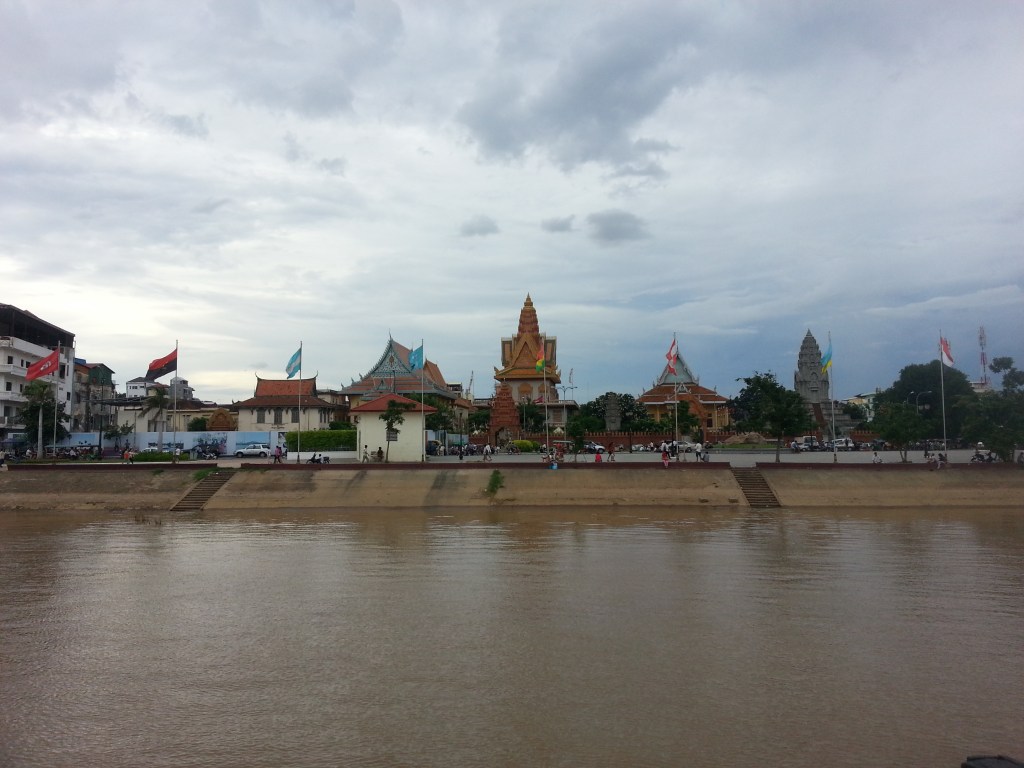
    One of the things we’d been most looking forward to was a boat tour on the Tonle Sap and Mekong rivers. Kevin did his usual helpful research and found us a great yet simple boat tour – 1.5 hours, free beer, on a boat just before sunset.

    We stood on the roof of a lovely boat with our two tour guides, who told us all about the culture, architecture, changes, and politics of Phnom Penh and the surrounding waterfront communities along the rivers. We were also able to see the Floating Village on the Mekong – houses that sit on bamboo and which rise and lower with the tide. Very cool stuff.

    We did our boat tour with Memorable Cambodia, and I’d recommend them to anyone. You can check out their website right here.

    Check out the photos we took of us on our tour: