Tag: UK

  • Final thoughts and photos from my lovely trip to Canterbury

    Final thoughts and photos from my lovely trip to Canterbury

    My week in Canterbury was one of the most unique and special trips I’ve ever been on. I don’t think that I’d spent so much uninterrupted ‘grandparent time’ since I was a kid, and as a kid I rarely saw the adults being anything other than a caretaker/entertainer for me.Having this one-on-one time was really the best, because we were able to explore Canterbury through each other’s eyes, and there’s no more enjoyable way to connect with someone than by exploring a shared interest. My Nana Ev has now taken 3 winterly sojourns to this beautiful town, in a beautiful apartment. It goes without saying, this place and this experience are meaningful for her, and I can certainly see why. The youthfulness of the energy in Canterbury, combined with the freedom of living in a truly walkable city is a perfect reflection of the life she lives. For those of you who don’t know my Nana Ev, she is truly on fire with regards to living life. She’s one of the busiest, strongest, and most independent women that I’ve ever known. Visiting her in this special place, taking the time to connect about our family and our lives, taught me so much about much grandmother and my grandfather and who they are as people. It was a really special glimpse into who I might become one day, and I’m so grateful that I had the opportunity to make this trip.

    Our time in Portugal has given Kevin a similar opportunity to reconnect with his grandmothers, both of whom retired to the Algarve after years of working in Toronto. Similar to me, Kevin spent a lot of time with his grandparents growing up, but as he went away to school, began his career, etc, those opportunities for grandparent-ly connections became less and less frequent. Now, we live with one of his grandmothers and regularly visit the other. While the suffering of Kevin’s dental injury is very real, he recognizes and appreciates this unique trip and the time he’s been able to spend with his grandmothers, exploring his family history and his own connection to the Algarve.

    He’ll be on here once in a while with his own posts about our experiences here in the Algarve, but it’s safe to say that we’re both feeling incredibly lucky to spend so much long, uninterrupted time with the people that we love. If you take anything away from this blog post, it’s that time with family is important. Life can be crazy busy, but I promise you that it’s worth it to take the time to connect with your grandparents. I know that I’m already looking very forward to the next time I can get back to Canada and see mine!

  • Imagining history at St Augustine’s Abbey

    Imagining history at St Augustine’s Abbey

    Thursday (2 weeks ago) was my last full day in Canterbury, and it was a good one.

    After sleeping in a bit, Nana Ev and I set off to see a site that neither she nor anyone else in my family had seen. It was a site of church ruins that had been closed and under renovation for the past couple of years.

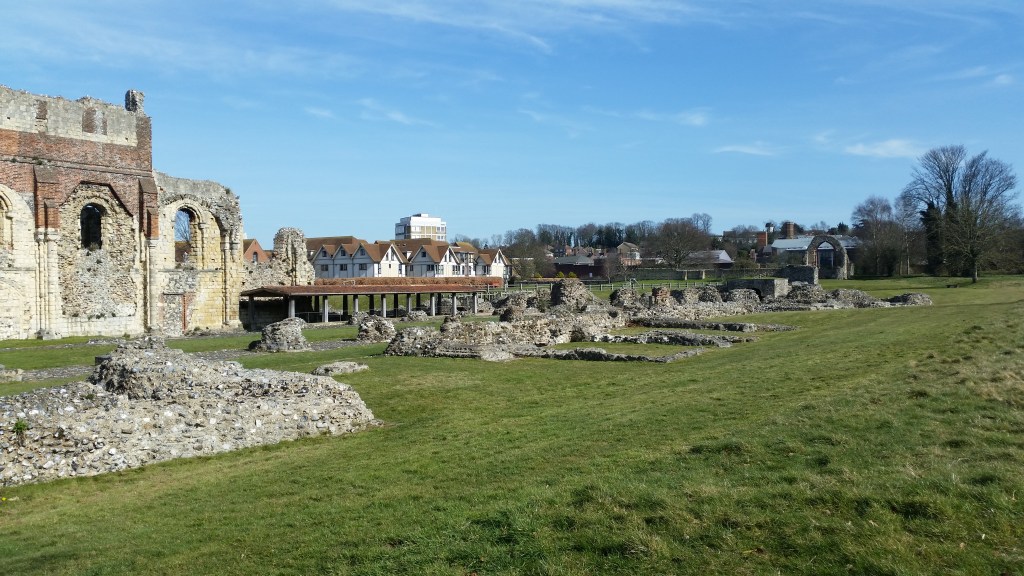
    We woke up to a bright, sunny day and walked across town to the ruins of St Augustine’s Abbey. When we got there, the museum was closed. However, the gate to the yard was open. Since we were more interested in seeing ruins than paying for admission or buying coffee cups, we walked through the open gate, feeling like a couple of rebels.

    As a total museum-loving nerd, I’m always interested to see how different exhibits are presented. That is, is the information helpful? Are there useful images? Is it clear what I should be looking at when? Has walking flow been taken into consideration? I’m pleased to say that this exhibit gets 5 stars across the board. Without a guide, without a pamphlet, and with very little preparatory knowledge, we were able to explore and understand the entire site. The exhibit was so well set up that we were able to complete envision what this site must have looked like back in its heyday.

    Wait a second, what’s the exhibit again?

    Right. Saint Augustine’s Abbey was an abbey built around the same time as the original old-timey sections of Canterbury Cathedral. Officially speaking, it was a Benedictine Monastery completed in 598 CE (that’s current era, for you old folks who are used to AD). As usual, Wikipedia breaks it down for us:

    In 597, Augustine arrived in Anglo-Saxon England, having been sent by the missionary-minded Pope Gregory I to convert the Anglo-Saxons. The King of Kent at this time was Æthelberht or Ethelbert. Although he worshipped in a pagan temple just outside the walls of Canterbury to the east of the city, Ethelbert was married to a Christian, Bertha. According to tradition, the king not only gave his temple and its precincts to St Augustine for a church and monastery, he also ordered that the church to be erected be of “becoming splendour, dedicated to the blessed apostles Peter and Paul, and endowed it with a variety of gifts.” One purpose of the foundation was to provide a residence for Augustine and his brother monks. As another, both King Ethelbert and Augustine foresaw the abbey as a burial place for abbots, archbishops, and kings of Kent.

    William Thorne, the 14th century chronicler of the abbey, records 598 as the year of the foundation. The monastic buildings were most likely wooden in the manner of Saxon construction, so they could be quickly built. However, building a church of solid masonry, like the churches Augustine had known in Rome, took longer. The church was completed and consecrated in 613. Ca. 624 a short distance to the east, Eadbald, son and successor of Ethelbert, founded a second church, dedicated to Saint Mary which also buried Kentish royalty. The abbey became known as St Augustine’s after the founder’s death.

    For two centuries after its founding, St Augustine’s was the only important religious house in the kingdom of Kent.[9] The historian G. F. Maclear characterized St Augustine’s as being a “missionary school” where “classical knowledge and English learning flourished.”

    The monastery was of fairly simple construction, and much smaller than what eventually sat on this site. Because of course the Normans eventually invaded. The liked to worship at church as well, but didn’t think that the existing Abbey was fancy enough to pay proper respects to God. And so they built a much larger and much fancier Romanesque building. There was great expansion and attention from the Pope at this time, during which “[t]he cloister, frater (refectory) and kitchen were totally rebuilt. A new abbot’s lodging and a great hall were added. In the early 14th century, land was acquired for a cellarer’s range (living and working quarters for the cellarer who was responsible for provisioning the abbey’s cellarium), a brewhouse, a bakehouse, and a new walled vineyard. A Lady chapel was built to the east of the church. (Wikipedia)

    This was all well and good until everyone’s least favourite, King Henry VIII, came along and replaced Catholicism with Anglicism. No Catholics means no Catholic Abbeys. In 1541, St Augustine’s was partially dismantled/sold off, and partially turned into a new royal residence for King Henry VIII himself. After being passed along as a royal residence, the estate here was eventually rented out to a series of Noblemen. As time separated this succession of residences from the history of this place, the old structures were further dismantled and the stone was sold off. New gardens were built over the original abbey, a lawn bowling green was installed, etc. As I’m sure someone said back then, “kids these days just don’t appreciate history”.

    It wasn’t until 1844 that one such kid did appreciate history, and he bought the property in order to conserve what was left, turning it into a school for missionaries. After a German Blitz, the buildings were so badly destroyed that the school closed.

    The King’s School now uses some of the existing structures, while the rest are cared for by English Heritage, and protected as a UNESCO World Heritage Site.

    Now, all these facts I confirmed with Wikipedia, but I was able to learn most of this stuff from our self-guided tour. Helpful and well-placed placards helped us understand how to interpret ruins upon ruins, while guiding us helpfully along. By the time we reached the end, we were really able to envision where the churches had been, and which parts of the landscape had continued as royal residences, and which parts had been covered over by gardens, etc. This was especially interesting to me: it was not just the history of the buildings that we were trying to interpret, but the history of the very landscape itself. As I realize more each time that I travel, the end landscape always is mother nature’s own garden. For me, that’s a nice idea.

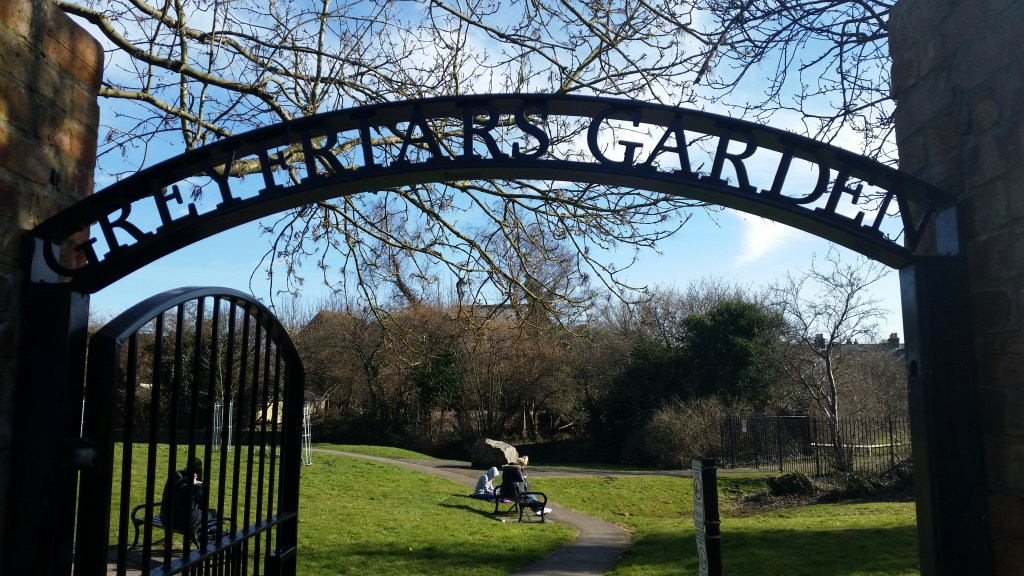
    Take a look at the pictures from our day and see if you can see what we saw!

  • The wall around Canterbury and the old castle

    The wall around Canterbury and the old castle

    Remember when we tried to go to Dover Castle? When we took a bus, walked up and down hills, and walked across the town of Dover to get a bus back to Canterbury? Yeah, that was only the first half of our adventures that day.

    Once we arrived back in Canterbury, it was time for a lunch break. We went to lunch at a restaurant we’d never been to before, called Deeson’s Restaurant. It was a delight. Wanting to treat ourselves, but not being that hungry, we opted for light appetizers, along with some very lovely desserts. The food was creative and delicious. Considering what you got on your plate, it was a bit over priced, but a tasty meal is a tasty meal. And dessert! Oh, dessert! In Portugal they make something called “pera bebde” which translates to “drunken pear”. Deeson’s Restaurant made a version of this that was oh so fancy and oh so delicious: a pear soaked in mulled wine, served with crunchy toffee, salted caramel, and a brownie! See the photo for full effect.

    And after lunch, we kept going, as we do. We walked along the ancient city walls, and explored the ruins of a castle was built hundreds of years ago, and was part of the inner city walls.

    The Canterbury city walls are another thing that dates back to the days of the Romans. While little of the Roman construction remains today, the location of the Roman walls was maintained as later medieval and modern civilizations built and re-built the walls in the same spots. Here’s what Wikipedia has to say:

    Canterbury city walls are a sequence of defensive walls built around the city of Canterbury in Kent, England. The first city walls were built by the Romans, probably between 270 and 280 AD. These walls were constructed from stone on top of an earth bank, and protected by a ditch and wall towers … With the collapse of Roman Britain, Canterbury went into decline but the walls remained, and may have influenced the decision of Augustine to settle in the city at the end of the 6th century. The Anglo-Saxons retained the defensive walls, building chapels over most of the gates and using them to defend Canterbury against Viking incursions.

    The Norman invaders of the 11th century took the city without resistance, and by the 12th century the walls were ill-maintained and of little military value. Fears of a French invasion during the Hundred Years’ War led to an enquiry into Canterbury’s defences in 1363. The decision was taken to restore the city walls and for around the next thirty years the old Roman defences were freshly rebuilt in stone, incorporating the older walls where they still remained … Parts of the wall were deliberately damaged by Parliament during the English Civil War of the 17th century and the doors to the city’s gates burnt; with the restoration of Charles II in 1660, new doors were reinstalled.

    During the 18th and 19th centuries, Canterbury’s city walls came under extensive pressure from urban development. All the gates but one, West Gate, were destroyed and extensive parts of the walled circuit were knocked down to make way for new roads and buildings. German bombing during the Second World War caused further damage. Despite this, the remaining walls and gatehouse survived post-war redevelopment intact and some portions were rebuilt entirely. Over half the original circuit survives, enclosing an area of 130 acres (53 ha), and historians Oliver Creighton and Robert Higham consider the city wall to be “one of the most magnificent in Britain”.

    Again, that’s some pretty old stuff! After lunch we walked through a lovely park to reach the walls, and then walked along the walls towards the ruins of an old castle. On the way there, I took a quick detour to walk up the Dane John Mound. A former Roman cemetery, it’s now a mound/mini-hill in a lovely park. I jaunted up to the top of the mound to catch a good view, but as you’ll see in the photos, it was  mostly a view of surrounding suburbs on the one side, and then a view of Canterbury (and the cathedral,obviously) on the other. As a tourist destination, it wasn’t great, but it was obviously a favourite relaxation spot with the locals, because it was packed with students hanging out and enjoying the view.

    From there, we carried along on our walk. We walked all the way to the ruins of Canterbury Castle. Fortunately, this one was open. Canterbury Castle is a Norman castle that dates back to 1066, when William the Conqueror (according to my Nana Ev’s research, my 82nd great grandfather) was busy conquering England. King Henry I then turned that lowly wooden castle into the fancy stone castle that stands today.

    Of course, it’s not standing too fancy, and here’s one of the reasons why:

    By the 19th century it had been obtained by a gas company and used as a storage centre for gas for many years, during which time the top floor was destroyed.

    Yikes. Smooth move, gas company.

    Anyways, the castle ruins are open, which means we were able to walk around inside, seeing the remnants of a well which brought water throughout the castle; the remaining few stairs to once took you to the top of the castle, and I even climbed the last remaining sets of stairs, enjoying a heightened view of the whole place. All that and more in the photos below!


  • We went to Dover Castle … sort of.

    We went to Dover Castle … sort of.

    On Friday, I arrived in Canterbury. I emailed my family a photo of Nana and I together, letting them know I’d arrived safely. Everyone responded quickly with well wishes, and suggestions for all the things I should do while there (context: this is the third year that Nana Ev has come to stay in Canterbury for several weeks. Both my aunt and my parents have previously visited during this trip).

    On Saturday, Nana Ev and I FaceTimed with my parents and Kristopher. On Sunday we FaceTimed with my Aunt Elaine and Uncle Joe.

    On both calls, we were asked a variation of this question: “so, have you done [insert activity] yet?” “did you go [insert location] here yet”.

    Nana and I could not stop laughing. These questions were hilariously ill-timed, considering I’d barely just arrived.

    In their enthusiasm about the many things to do in Canterbury, my Dad absolutely insisted that we must go to Dover Castle. We hadn’t initially planned to do this, because it was a bit more complicated to get to Dover without a car, but since my Dad insisted it was such a must-do activity, we figured out how to take the bus there.

    So, this morning we got up bright and early. We got on the bus, and headed for Dover Castle, a lovely 40 minute ride away.

    Quick facts on Dover Castle, courtesy of my fave, Wikipedia:

    Dover Castle is a medieval castle in Dover, Kent. It was founded in the 12th century and has been described as the “Key to England” due to its defensive significance throughout history. It is the largest castle in England.

    The site may have been fortified with earthworks in the Iron Age or earlier, before the Romans invaded in AD43. This is suggested on the basis of the unusual pattern of the earthworks which does not seem to be a perfect fit for the medieval castle. Excavations have provided evidence of Iron Age occupation within the locality of the castle, but it is not certain whether this is associated with the hillfort. There have also been excavations on the mound which the church and Roman Pharos are situated on, which has been discovered to be a Bronze Age mound.

    Our bus driver let us know when to get off the bus, and told us we had to walk a bit down the hill to get to the entrance (Keep in mind that Dover Castle sits atop a massive hill, which is why we were skeptical of making this trip sans car). Needless to say, when the bus driver said that the return bus stop was further up the hill, while the entrance to the castle was further down, we weren’t impressed.

    Thus, we walked down the hill, only to find another hill we needed to walk up in order to reach the castle. As we approached the gate, I began to question our decisions. The gate looked closed. I thought perhaps I wasn’t seeing things right, until I was standing in front of the locked gate, looking at a ticket booth that was very much closed.

    Well, shit. Now what? We sure didn’t see this coming. We also weren’t sure if the Castle was closed, or if just that particular entrance. We decided to walk further down the hill to reach the car entrance, hoping that might be open. Turns out, it wasn’t. The “Closed” sign was well visible from across the street.

    Not wanting to walk back up that darn hill, we continued to walk down. Eventually we were back in the lovely town of Dover. Also, we had no real idea where we were going, other than knowing we needed to get back on a bus. After asking a couple of people for directions (all of whom confirmed that it was unusual for the castle to be closed), we eventually found a bus stop. When we asked the bus driver if his particular bus would take us to the main station, he told us that it would, but so would a 5 minute walk through the park behind us. Obviously, we opted for the latter.

    Another 10 minutes of waiting, and we were back on the bus to Canterbury! As soon as we were in wifi range, we looked up Dover Castle’s hour. Indeed, it is only open on the weekends this month. Truly bizarre, because the sign on site said otherwise.

    Anyways, here are the pictures we took on our adventure to see Dover Castle. We did the Castle, though we didn’t get inside. Consider it the unsuccessful invaders’ version of the tour. Tres vintage.


  • Roman Ruins in Canterbury

    Roman Ruins in Canterbury

    Did you know that the romans used to have a giant empire? And did you know that it included a sizeable chunk of the present-day UK? Here’s a map:

    roman_emp

    The earliest history of Canterbury actually goes back even further than the Romans, but they seem to have left the largest footprint. Here’s what Wikipedia has to say about it:

    The Canterbury area has been inhabited since prehistoric times. Lower Paleolithic axes, and Neolithic and Bronze Age pots have been found in the area. Canterbury was first recorded as the main settlement of the Celtic tribe of the Cantiaci, which inhabited most of modern day Kent. In the 1st century AD, the Romans captured the settlement and named it Durovernum Cantiacorum. The Romans rebuilt the city, with new streets in a grid pattern, a theatre, a temple, a forum, and public baths. In the late 3rd century, to defend against attack from barbarians, the Romans built an earth bank around the city and a wall with seven gates, which enclosed an area of 130 acres (53 ha).

    Despite being counted as one of the 28 cities of Sub-Roman Britain, it seems that after the Romans left Britain in 410 Durovernum Cantiacorum was abandoned except by a few farmers and gradually decayed.[12] Over the next 100 years, an Anglo-Saxon community formed within the city walls, as Jutish refugees arrived, possibly intermarrying with the locals.[13] In 597, Pope Gregory the Great sent Augustine to convert its King Æthelberht to Christianity. After the conversion, Canterbury, being a Roman town, was chosen by Augustine as the centre for his episcopal see in Kent, and an abbey and cathedral were built. Augustine thus became the first Archbishop of Canterbury.[14] The town’s new importance led to its revival, and trades developed in pottery, textiles, and leather. By 630, gold coins were being struck at the Canterbury mint. In 672, the Synod of Hertford gave the see of Canterbury authority over the entire English Church.

    In 842 and 851, Canterbury suffered great loss of life during Danish raids. In 978, Archbishop Dunstan refounded the abbey built by Augustine, and named it St Augustine’s Abbey. A second wave of Danish attacks began in 991, and in 1011 the cathedral was burnt and Archbishop Alphege was killed in 1012. Remembering the destruction caused by the Danes, the inhabitants of Canterbury did not resist William the Conqueror’s invasion in 1066.

    So, things and buildings in Britain are super old. However, once in awhile, modern people try to do some remodeling of one of these 500+ year old buildings. When they do, they have to dig. And sometimes they find the remnants of buildings and places that were built by Romans, 800+ years ago. So, ya, that’s pretty wild.

    And so, because it’s usually better to remember history than just build parkings lots and condos over top of it (I’m looking at you, Toronto), there are a couple of places in Canterbury where you can see the discovered ruins of Roman civilization. In one case, there’s an entire museum about Roman history in Canterbury. In another location, a section of ruins is preserved in a glassed-in room in the basement of a bookstore.

    Nana Ev and I went to see both!

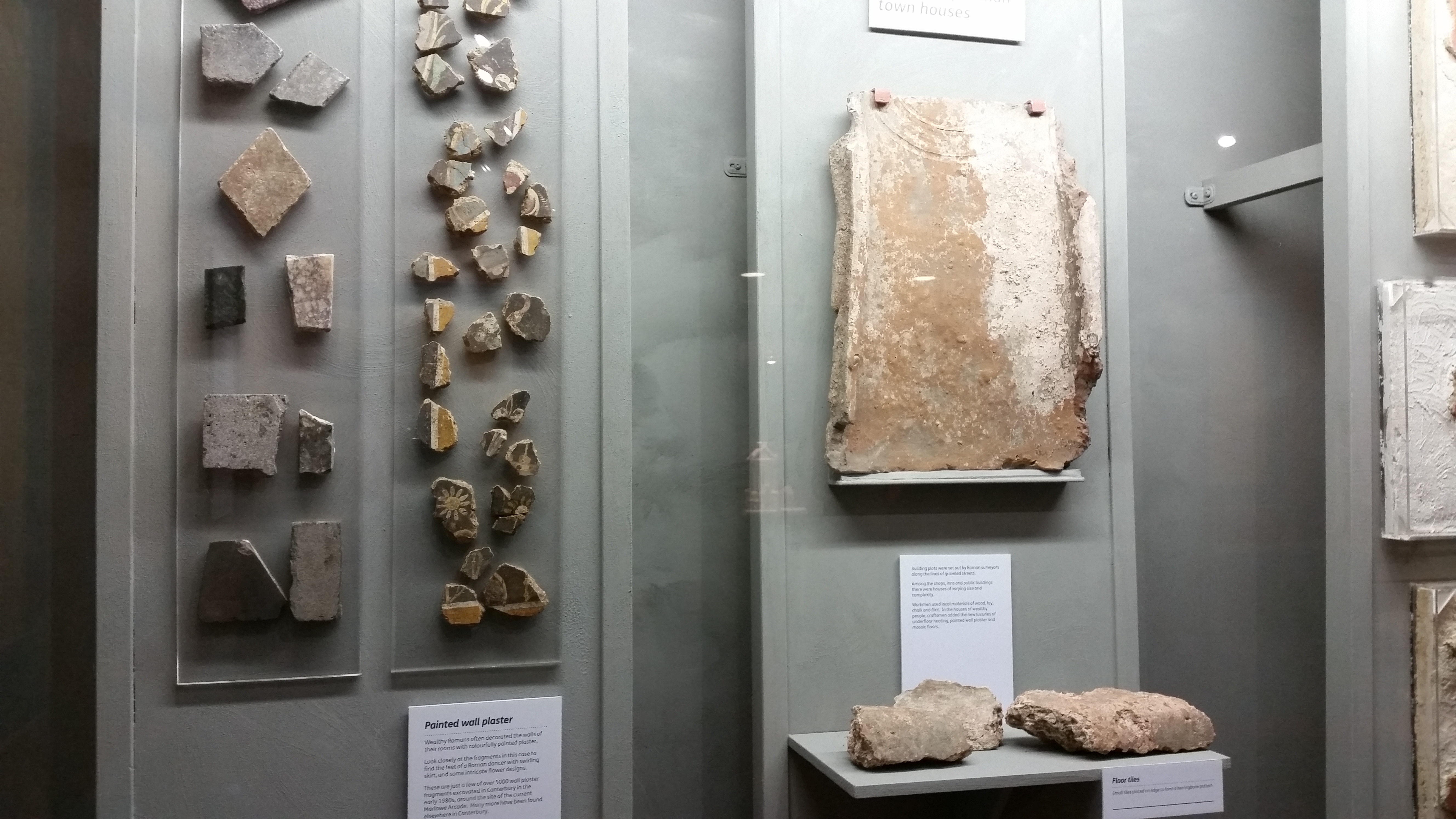
    The bookstore was cool in a this-is-neat-to-see kind of way, but the museum found and preserved a fairly significant portion of a Roman bath, including a long hallway and the pipes that heated the baths, various floors, and walls.

    There’s not much to be said, so I’ll get out of your way and you can look at the pictures. The museum also showcased a ton of artifacts, including jewellery, glass jugs, and bowls. Enjoy!


  • Exploring Canterbury Cathedral

    Exploring Canterbury Cathedral

    Canterbury Cathedral is arguably the most famous thing in Canterbury. When Nana Ev and I sit in her apartment and drink tea in the afternoon and the evening (that’s in addition to the tea we have in a local cafe – this is Britain, people!), we can see the cathedral as it towards above the surrounding buildings. When we go outside in the morning, it’s the first thing we see, as it’s approximately 20 metres away from Nana’s front door.

    So, of course, visiting the Cathedral was a must-do for my trip. And so we went to Canterbury Cathedral. Not once, but twice!

    First, here’s some interesting historical background on Canterbury Cathedral, courtesy of Wikipedia:

    Canterbury Cathedral in Canterbury, Kent, is one of the oldest and most famous Christian structures in England and forms part of a World Heritage Site. It is the cathedral of the Archbishop of Canterbury, leader of the Church of England and symbolic leader of the worldwide Anglican Communion …

    Founded in 597, the cathedral was completely rebuilt from 1070 to 1077. The east end was greatly enlarged at the beginning of the twelfth century, and largely rebuilt in the Gothic style following a fire in 1174, with significant eastward extensions to accommodate the flow of pilgrims visiting the shrine of Thomas Becket, the archbishop who was murdered in the cathedral in 1170. The Norman nave and transepts survived until the late fourteenth century, when they were demolished to make way for the present structures.

    As with most of Europe, stuff here is crazy amounts of old. How old? Sold old that it has a history dating back to the Roman presence in Britain. Here’s what Wikipedia has to say about the various occupants/builders of the cathedral:

    Roman

    Christianity had started to become powerful in the Roman Empire around the third century, particularly after Augustine of Hippo converted to the religion in the 4th century. The cathedral’s first archbishop was Augustine of Canterbury, previously abbot of St. Andrew’s Benedictine Abbey in Rome. He was sent by Pope Gregory the Great in 596 as a missionary to the Anglo-Saxons. Augustine founded the cathedral in 597 and dedicated it to Jesus Christ, the Holy Saviour.

    Anglo-Saxon

    [The historian] Bede recorded that Augustine reused a former Roman church. The oldest remains found during excavations beneath the present nave in 1993 were, however, parts of the foundations of an Anglo-Saxon building, which had been constructed across a Roman road. They indicate that the original church consisted of a nave, possibly with a narthex, and side-chapels to the north and south. A smaller subsidiary building was found to the south-west of these foundations. During the ninth or tenth century this church was replaced by a larger structure (49 m. by 23 m.) with a squared west end.

    The cathedral was badly damaged during Danish raids on Canterbury in 1011. The Archbishop, Alphege, was taken hostage by the raiders and eventually killed at Greenwich on 19 April 1012, the first of Canterbury’s five martyred archbishops. After this a western apse was added as an oratory of St. Mary, probably during the archbishopric of Lyfing (1013–1020) or Aethelnoth (1020–1038).

    Norman

    The cathedral was destroyed by fire in 1067, a year after the Norman Conquest. Rebuilding began in 1070 under the first Norman archbishop, Lanfranc (1070–77). He cleared the ruins and reconstructed the cathedral to a design based closely on that of the Abbey of St. Etienne in Caen, where he had previously been abbot, using stone brought from France. The new church, its central axis about 5m south of that of its predecessor,[6]was a cruciform building, with an aisled nave of nine bays, a pair of towers at the west end, aiseless transepts with apsidal chapels, a low crossing tower, and a short choir ending in three apses. It was dedicated in 1077.

    As with many Romanesque church buildings, the interior of the choir was richly embellished.[14]William of Malmesbury wrote: “Nothing like it could be seen in England either for the light of its glass windows, the gleaming of its marble pavements, or the many-coloured paintings which led the eyes to the panelled ceiling above.”[14]

    As is typical with gigantic old churches, its history is primarily a history of being built. Over centuries and over generations, it was build, torn down, damaged, re-built, refined, until it reached its current state of beauty. In fact, some parts of the Cathedral were even destroyed during WWII. This included the library (don’t worry, they were hiding the books in the basement of the church) and also some of the residence buildings for church-people. I can’t be certain, because this place is sparse on signs that don’t describe dead people, but I think some of the remains of these old bombed out buildings have been left, as there were single walls and arches in one of the gardens we explored.

    One of the most important things that happened here is the murder of Thomas Becket, the Archbishop of Canterbury. He was caught up in the classic church-vs-state struggle. That is, he was the most powerful person in the church, and he used those powers to ex-communicate people who weren’t following the church’s rules. The state (aka King Henry II) didn’t like that so much. As the story goes, King Henry II yelled out “will nobody rid me of this turbulent man?!”. His guards overheard, and were obviously a bunch of ass-kissing keeners, because they hustled on down to Canterbury and murdered Thomas Becket in the Cathedral.

    This was a fairly dramatic event. People totally flipped out, the Pope made this guy a saint (perhaps ex-communicating fools was considered a miracle back then) and people began to embark on pilgrimages from all across the country in order to visit the shrine of Thomas Becket. This massive influx of visitors created great wealth, and thus funded the continued growth and expansion of the church.

    And let me tell you, there must have been an insane amount people visiting this site, because the church is massive. There is a truly remarkable amount of space for worship. It’s like 10 churches in 1. I can only imagine what the church would’ve been like at its heyday, when it was filled with pilgrims offering devotion. The crypt, as the oldest part of the church, was particularly memorable. I wasn’t allowed to take any photos down there, so google it.

    Ok, I’ll calm down with all the history. Let’s talk about me and Nana Ev. On Sunday afternoon, Nana Ev and went to Canterbury Cathedral for Evensong. Evensong is basically the Sunday church service, but more singing and no communion. Those choirboys were wonderful singers, and their talents were beautifully highlighted by acoustics of the cathedral. It was a really special experience.

    The next day, we went back to Canterbury Cathedral to take a tour and explore the grounds. Here’s an overhead view of the grounds. We basically saw it all, including the nearby campus of the King’s School. We walked and walked and walked. We probably spent close to 2 hours there, and could have easily spent more if lunch hadn’t been calling. It’s a truly beautiful place, with centuries history that would truly take years to explore. The ceilings, the windows, the walls, the gardens. All of it was lovely. There were also a lot of people buried within the cathedral, including King Henry IV, to whom my family is apparently related. We took a #familyselfie. Check the photos below for that gem 🙂
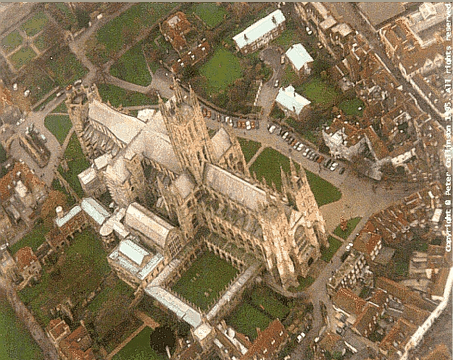
    Screen Shot 2015-03-10 at 8.36.35 PM

    It’s certainly not the centre of the community that it once was, but it’s very clearly still a beehive of historical and religious activity. And no matter where you go, you can always catch a glimpse of it in the skyline. If you’re ever in Canterbury, you’d be a complete fool if you didn’t go to the Cathedral.

    Check out the photos I took on our Canterbury Cathedral adventures. If you’ve ever taken photos in a church, you know that it’s an effort in vain, but there they are anyway:


  • We went to Bletchley Park!

    We went to Bletchley Park!

    Friday night I arrived at the airport in London (did you know they have like a zillion different London airports!? seriously. look it up if you care about things like that). I was quickly shuttled down to Canterbury. Despite Kevin’s concerns, I was not abducted, and I made the trip in approximately 90 minutes. My Nana Ev met me outside and we headed into her lovely apartment for tea and conversation before going to bed.

    The next morning, we were up bright and early to go to Bletchley Park, the setting for this year’s rather famous movie, the Imitation Game, about Alan Turing and code breaking during WWII. The trip took around 3 hours, which was quite lovely as it gave Nana Ev and I lots of time to chat and catch up.

    When we arrived at Bletchley Park, we were joined by Sue & Bob, some family members that I hadn’t seen in ages. Sue is one of my dad’s cousins, as her mother was the sister of my Papa Don. I don’t get to see this side of the family too often, so this was a real treat.

    Since I went to Bletchley Park and you didn’t, I should probably tell you what the heck Bletchley Park is.

    For those of you who saw the Imitation Game, one of those Oscar-worthy-type movies that came out this year, you’re probably at least slightly familiar with Bletchley Park.

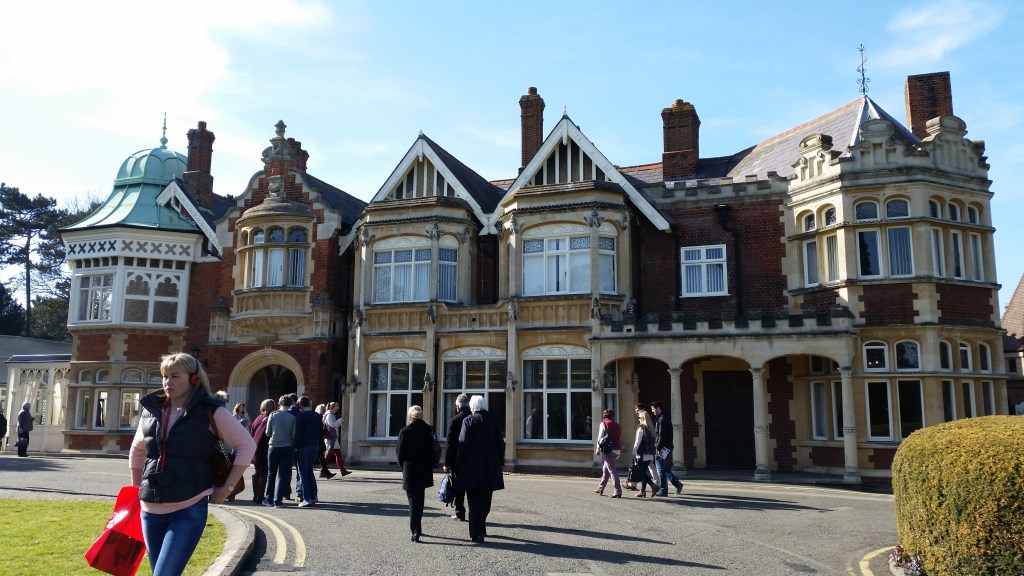
    Bletchley Park used to be a giant manor, in the middle of nowhere, owned by rich British people. In 1938, it was purchased by MI6 to be used as a research facility in the event of war. It’s located almost directly north of London, and is conveniently very close to a major rail line that connects it easily to London, Oxford, and Cambridge. Additionally, from overhead it looks like a giant manor for rich people and not like a government research facility. Convenient.

    Before and during WWII (because you don’t need a war to spy on people’s encrypted messages), Bletchley Park was the site where a group of researchers, codebreakers, and math-y geniuses came together to try to decipher the encrypted messages that various enemies (Italian, Japanese, Germans, etc) were sending about military and other plans. At the height of the war, aka the time when codes got most complicated and also the time when enemy info was most important, the Bletchley Park operation was rather large, and employed around 9000 men and women.

    The story in the Imitation Game was something like this: math nerds keep trying and failing to break any codes. They are very upset but keeping trying to same process over and over again with no success. Alan Turing arrives, tells them they’re idiots, starts building a computer-type machine named Christopher. Eventually, his machine works and helps them break the code. That one trick fixes all the problems, etc. The allies win the war. There’s a lot more about to the plot, but that’s the part that relates to Bletchley Park. You can learn more about the Imitation Game here, and more about Alan Turing here.

    Anyways, my trip to Bletchley Park was initially a bit confusing, as the placards I was reading weren’t lining up with what I thought I knew. In reality, Alan Turing was very, very smart (and truly visionary thinker), but at Bletchley Park he wasn’t some kind magical genius surrounded by fuddy-duddy fools. Essentially, there were a ton of different enigma machines being used to encipher messages being sent between various enemy groups. Germany alone had different enigmas for different branches of the military. They would encipher a message, turning it into gobbledy-goop. Then the recipient, who knew the code with which it was enciphered, would decipher the message and read it. The trick is to know the code that enciphers the message. Oh, and there are like a kajabillion options.

    A Polish researcher (turns out everyone was spying on everyone back then) had come up with a design for a machine that would help find the code with which a message was enciphered. As the war went on and Germany got wiser, the enigmas got more and more complicated. At various points in time, the codebreakers came up solutions that worked for awhile, until the enemy switched to a better/more complicated enigma machine. However, building on these initial Polish designs and ideas, Turing worked with a fellow codebreaker to design a machine that would be able to quickly find the needed code by testing possible options at a rapid rate. An engineer from a technology company then helped build this machine, known as the Bombe.

    Beyond that, another thing the movie didn’t really touch on is the extent to which the process of codebreaking was a major operation. That is, it wasn’t just some smart people breaking codes. It was smart people figuring out how to break codes, and then tons of still very smart people making that process happen. Women worked standing all day in huts filled with hundreds of Bombes, while code possibilities were tested. When a match was found, it was passed to another hut, where someone used the code the translate those messages via Enigma. Next, the German in those messages was cleaned up. And then, it was translated into English. And then some high level British secret service operatives figured out how to turn these messages into military instructions without letting anyone realize that they were deciphering messages. Sound like a lot? It was. And I’m sure I’ve gotten some of it wrong and left out some information.

    The point is, Bletchley Park, which was closed after WWII and left in disrepair for 50 years, was once a bustling spot where lots of smart women and men worked hard to solve problems.

    Considering all that’s really left is the buildings, the exhibits were very impressive. The huts were outfitted with audio-visual elements that let you see and hear the men and women who would’ve worked there. Each room had video projectors of someone working there, so that when you walked in the hallway you could hear the voices coming from each room, quite like it might have been back then. The lighting and decor were all done up to show you what the huts would’ve looked and felt like. I was quite impressed. This could very easily have been an extremely boring exhibit, but great care and planning were given to make it interesting. I would very much recommend a visit to Bletchley Park if you ever get the chance.

    Aside from all that I learned, my company was great. We enjoyed the beautiful weather as we walked around checking out the exhibits. We stopped for lunch and had tea later in the afternoon. It was a rather British day with my British family, and I am so glad that it happened.

    Check out my photos below: