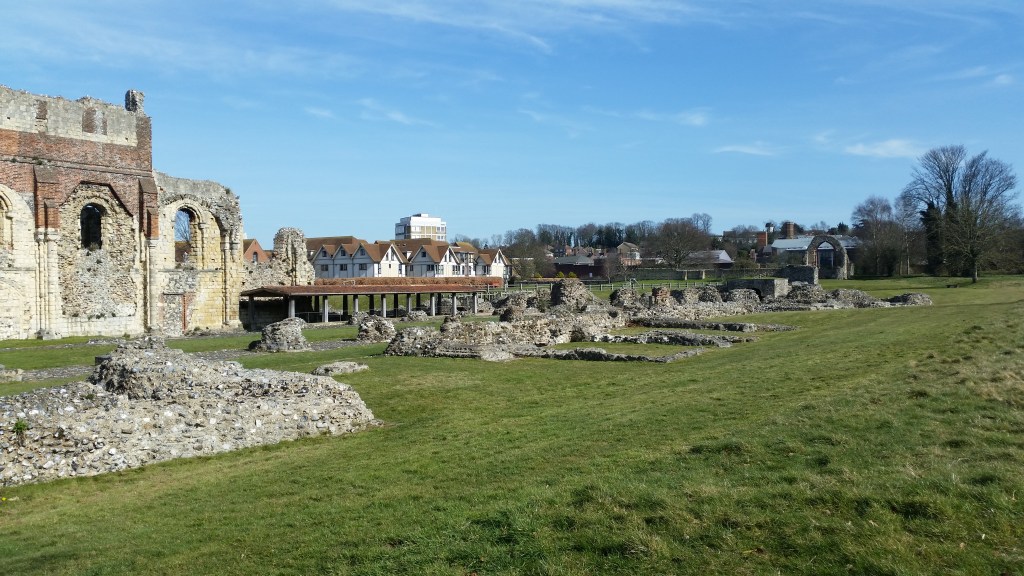
Thursday (2 weeks ago) was my last full day in Canterbury, and it was a good one.
After sleeping in a bit, Nana Ev and I set off to see a site that neither she nor anyone else in my family had seen. It was a site of church ruins that had been closed and under renovation for the past couple of years.
We woke up to a bright, sunny day and walked across town to the ruins of St Augustine’s Abbey. When we got there, the museum was closed. However, the gate to the yard was open. Since we were more interested in seeing ruins than paying for admission or buying coffee cups, we walked through the open gate, feeling like a couple of rebels.
As a total museum-loving nerd, I’m always interested to see how different exhibits are presented. That is, is the information helpful? Are there useful images? Is it clear what I should be looking at when? Has walking flow been taken into consideration? I’m pleased to say that this exhibit gets 5 stars across the board. Without a guide, without a pamphlet, and with very little preparatory knowledge, we were able to explore and understand the entire site. The exhibit was so well set up that we were able to complete envision what this site must have looked like back in its heyday.
Wait a second, what’s the exhibit again?
Right. Saint Augustine’s Abbey was an abbey built around the same time as the original old-timey sections of Canterbury Cathedral. Officially speaking, it was a Benedictine Monastery completed in 598 CE (that’s current era, for you old folks who are used to AD). As usual, Wikipedia breaks it down for us:
In 597, Augustine arrived in Anglo-Saxon England, having been sent by the missionary-minded Pope Gregory I to convert the Anglo-Saxons. The King of Kent at this time was Æthelberht or Ethelbert. Although he worshipped in a pagan temple just outside the walls of Canterbury to the east of the city, Ethelbert was married to a Christian, Bertha. According to tradition, the king not only gave his temple and its precincts to St Augustine for a church and monastery, he also ordered that the church to be erected be of “becoming splendour, dedicated to the blessed apostles Peter and Paul, and endowed it with a variety of gifts.” One purpose of the foundation was to provide a residence for Augustine and his brother monks. As another, both King Ethelbert and Augustine foresaw the abbey as a burial place for abbots, archbishops, and kings of Kent.
William Thorne, the 14th century chronicler of the abbey, records 598 as the year of the foundation. The monastic buildings were most likely wooden in the manner of Saxon construction, so they could be quickly built. However, building a church of solid masonry, like the churches Augustine had known in Rome, took longer. The church was completed and consecrated in 613. Ca. 624 a short distance to the east, Eadbald, son and successor of Ethelbert, founded a second church, dedicated to Saint Mary which also buried Kentish royalty. The abbey became known as St Augustine’s after the founder’s death.
For two centuries after its founding, St Augustine’s was the only important religious house in the kingdom of Kent.[9] The historian G. F. Maclear characterized St Augustine’s as being a “missionary school” where “classical knowledge and English learning flourished.”
The monastery was of fairly simple construction, and much smaller than what eventually sat on this site. Because of course the Normans eventually invaded. The liked to worship at church as well, but didn’t think that the existing Abbey was fancy enough to pay proper respects to God. And so they built a much larger and much fancier Romanesque building. There was great expansion and attention from the Pope at this time, during which “[t]he cloister, frater (refectory) and kitchen were totally rebuilt. A new abbot’s lodging and a great hall were added. In the early 14th century, land was acquired for a cellarer’s range (living and working quarters for the cellarer who was responsible for provisioning the abbey’s cellarium), a brewhouse, a bakehouse, and a new walled vineyard. A Lady chapel was built to the east of the church.“ (Wikipedia)
This was all well and good until everyone’s least favourite, King Henry VIII, came along and replaced Catholicism with Anglicism. No Catholics means no Catholic Abbeys. In 1541, St Augustine’s was partially dismantled/sold off, and partially turned into a new royal residence for King Henry VIII himself. After being passed along as a royal residence, the estate here was eventually rented out to a series of Noblemen. As time separated this succession of residences from the history of this place, the old structures were further dismantled and the stone was sold off. New gardens were built over the original abbey, a lawn bowling green was installed, etc. As I’m sure someone said back then, “kids these days just don’t appreciate history”.
It wasn’t until 1844 that one such kid did appreciate history, and he bought the property in order to conserve what was left, turning it into a school for missionaries. After a German Blitz, the buildings were so badly destroyed that the school closed.
The King’s School now uses some of the existing structures, while the rest are cared for by English Heritage, and protected as a UNESCO World Heritage Site.
Now, all these facts I confirmed with Wikipedia, but I was able to learn most of this stuff from our self-guided tour. Helpful and well-placed placards helped us understand how to interpret ruins upon ruins, while guiding us helpfully along. By the time we reached the end, we were really able to envision where the churches had been, and which parts of the landscape had continued as royal residences, and which parts had been covered over by gardens, etc. This was especially interesting to me: it was not just the history of the buildings that we were trying to interpret, but the history of the very landscape itself. As I realize more each time that I travel, the end landscape always is mother nature’s own garden. For me, that’s a nice idea.
Take a look at the pictures from our day and see if you can see what we saw!


 the stories that I'm telling.