When we woke up on Thursday, I knew we had to allocate much of the day to visiting museums, and we were particularly interested in visiting the Reina Sofia museum, aka the home of Picasso’s Guernica. I’d learned my lesson about waiting in line earlier in the week, and bought our tickets online ahead of time.
The other lesson I’d learned was the importance of food before going into a museum. We grabbed a quick breakfast snack around the corner, and walked through Retiro Park on our way to the museum.
We had a few museums on our list that day, but the Reina Sofia was our primary goal, so that’s where we started.
Officially called the Museo Nacional Centro de Arte Reina Sofía, the Reina Sofia is Spain’s primary destination for 20th century art. The Prado, which we’d already visited, housed many historic Spanish pieces, but anything from the 1900s is in the Reina Sofia (there’s a separate museum for contemporary art, which unfortunately we didn’t have time for).
The bulk of the collection is by Spanish artists, and the most famous pieces are by Pablo Picasso and Salvador Dali. We were keen to Picasso’s Guernica, and luckily for us the museum had on a special Guernica-themed exhibit that showcased much of Picasso’s works all in one space.
The Reina Sofia is a very large museum, housed primarily in an old hospital, which means the layout lacks the typical ‘flow’ you encounter in museums. This, combined with incredible size of the museum, meant that by the time we had worked our way through the Guernica exhibit, we gave up on trying to see the regular collection.
So, the Guernica exhibit. It was both educational and well curated. The exhibit starts out by discussing the 1937 World’s Fair in Paris, for which the painting was created, and then it dives into the history of the Spanish Civil War. Here’s what Wikipedia has to say:
Guernica is a mural-sized oil painting on canvas by Spanish artist Pablo Picasso completed in June 1937,[1] at his home on Rue des Grands Augustins, in Paris. The painting, which uses a palette of gray, black, and white, is regarded by many art critics as one of the most moving and powerful anti-war paintings in history.[2] Standing at 3.49 meters (11 ft 5 in) tall and 7.76 meters (25 ft 6 in) wide, the large mural shows the suffering of people wrenched by violence and chaos. Prominent in the composition are a gored horse, a bull, and flames.
The painting was created in response to the bombing of Guernica, a Basque Country village in northern Spain, by Nazi Germany and Fascist Italian warplanes at the request of the Spanish Nationalists. Upon completion, Guernica was exhibited at the Spanish display at the Exposition Internationale des Arts et Techniques dans la Vie Moderne (Paris International Exposition) in the 1937 World’s Fair in Paris and then at other venues around the world. The touring exhibition was used to raise funds for Spanish war relief.[3] The painting became famous and widely acclaimed, and it helped bring worldwide attention to the Spanish Civil War.
As we learned, the Spanish government commissioned Picasso to create a work of art for the World’s Fair, and it was only after the fact that he decided to create this moving painting, in what could well be described as an act of protest:
In January 1937, the Spanish Republican government commissioned Picasso to create a large mural for the Spanish display at the Exposition Internationale des Arts et Techniques dans la Vie Moderne at the 1937 World’s Fair in Paris. At the time, Picasso was living in Paris, where he had been named Honorary Director-in-Exile of the Prado Museum. He had last visited Spain in 1934 and never returned.[4] His initial sketches for the project, on which he worked somewhat dispassionately from January until late April, depicted his perennial theme of the artist’s studio.[1] Immediately upon hearing reports of the 26 April bombing of Guernica, the poet Juan Larrea visited Picasso and urged him to make the bombing his subject.[1] However, it was only on 1 May, having read George Steer‘s eyewitness account of the bombing (originally published in both The Times and The New York Times on 28 April), that he abandoned his initial project and started sketching a series of preliminary drawings for Guernica.[5]
After the bombing, the work of the Basque and Republican sympathizer and The Times journalist George Steer propelled this event onto the international scene and brought it to Pablo Picasso’s attention. Steer’s eyewitness account was published on 28 April in both The Times and The New York Times, and on the 29th appeared in L’Humanité, a French Communist daily. Steer wrote:
Guernica, the most ancient town of the Basques and the centre of their cultural tradition, was completely destroyed yesterday afternoon by insurgent air raiders. The bombardment of this open town far behind the lines occupied precisely three hours and a quarter, during which a powerful fleet of aeroplanes consisting of three types of German types, Junkers and Heinkel bombers, did not cease unloading on the town bombs weighing from 1,000 lbs. downwards and, it is calculated, more than 3,000 two-pounder aluminium incendiary projectiles. The fighters, meanwhile, plunged low from above the centre of the town to machinegun those of the civilian population who had taken refuge in the fields.”[12]
We weren’t able to take photos in the exhibit, but here’s what Guernica looks like:
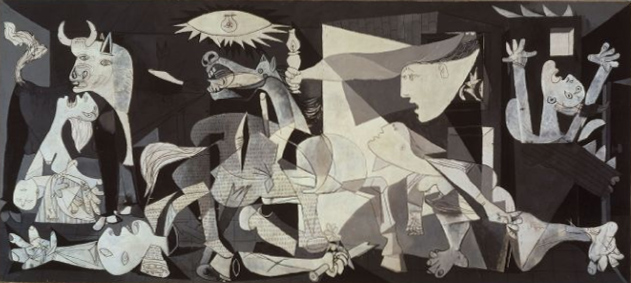
Per Picasso’s wishes, the painting itself did not return to Spain until the country enjoyed a republic.
I was quite excited to see this painting, and it definitely lived up to the hype. As the building used to be a hospital, the overall footprint was not laid out well, but this exhibit was so well curated and included so many incredible pieces from Picasso’s career that it was well worth the visit.
After 3-4 hours of taking this in, we headed out to get something to eat before hitting up another museum.
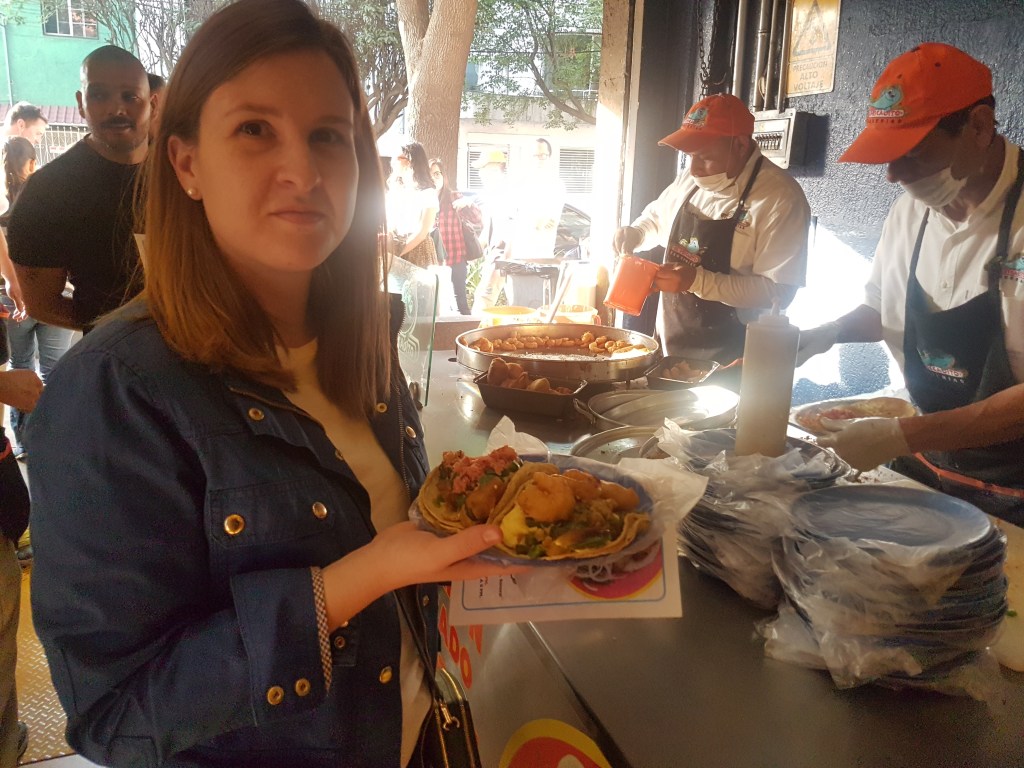
Before we came to Madrid, Zoya sent us a list of restaurants to check out. After ‘starring’ them on our map, we were always able to find a great spot to eat. And once we got there, we referenced her notes on what to order, where to sit, etc. For lunch on this day, we sat at the bar in Mercado de la Reina and ordered amazing tapas dishes that included shrimp and friend artichoke. It was a quick lunch, and one of my favourite spots of the week.
From there we headed over to the Naval Museum of Madrid:
The Museo Naval de Madrid —in English, Naval Museum of Madrid— is a national museum in Madrid, Spain. It shows the history of the Spanish Navy since the Catholic Monarchs, in the 15th century, up to the present. The displays set naval history in a wide context with information about Spanish rulers and the country’s former colonies. The collections include navigation instruments, weapons, maps and paintings.
For a 3 euro entrance fee, this museum is a pretty good deal, but I won’t be rushing back. If you’re really interested in naval history, and models of boats and military seafaring are your thing, then this is the museum for you.
However, as general students of history and politics, we found the museum a bit lacking.
To give some context, here’s what Wikipedia has to say about the Spanish Navy:
The Spanish Navy (Spanish: Armada Española), is the maritime branch of the Spanish Armed Forces and one of the oldest active naval forces in the world. The Spanish navy was responsible for a number of major historic achievements in navigation, the most famous being the discovery of America and the first global circumnavigation by Magellan and Elcano. For several centuries, it played a crucial logistical role in the Spanish Empire and defended a vast trade network across the Atlantic Ocean between the Americas and Europe and across the Pacific Ocean between Asia and the Americas.
The Spanish Navy was one of the most powerful maritime forces in the world in the 16th and 17th centuries and possibly the world`s largest navy at the end of the 16th century and in the early 17th century. Reform under the Bourbon dynasty improved its logistical and military capacity in the 18th century, for most of which Spain possessed the world’s third largest navy. In the 19th century, the Spanish Navy built and operated the first military submarine, made important contributions in the development of destroyer warships, and achieved the first global circumnavigation by an ironclad vessel.
The 1820s saw the loss of most of the Spanish Empire in the Americas. With the empire greatly reduced in size and Spain divided and unstable after its own war of independence, the navy lost its importance and shrank greatly.
During the Spanish–American War in 1898, a badly supported and equipped Spanish fleet of four armored cruisers and two destroyers was overwhelmed by numerically and technically superior forces (three new battleships, one new second class battleship, and one large armored cruiser) as it tried to break out of an American blockade in the Battle of Santiago de Cuba. Admiral Cervera‘s squadron was overrun in an attempt to break a powerful American blockade off Cuba.
In the Philippines, a squadron, made up of ageing ships, including some obsolete cruisers, had already been sacrificed in a token gesture in Manila Bay. The Battle of Manila Bay took place on 1 May 1898, during the Spanish–American War. The American Asiatic Squadron under Commodore George Dewey engaged and destroyed the Spanish Pacific Squadron under Admiral Patricio Montojo y Pasarón. The engagement took place in Manila Bay in the Philippines, and was the first major engagement of the Spanish–American War. This war marked the end for the Spanish Navy as a global maritime force.
Currently, the Spanish ‘Armada’ is the third largest navy in Europe, after the British Royal Navy and the French Navy, and the sixth in the world ranking.
For centuries, Spain was a major naval power, and the museum does a great job of showcasing their strengths. However, the museum does a perplexingly bad job of discussing the decline of the Spanish navy in the 1800s. Case in point? They effectively skip over the destruction of the Spanish Armada, and while they do discuss their colonial expansion, there’s no mention of struggles around decolonization, or of the decisive Spanish American war. If you didn’t know better, the museum would give you the impression that Spain is still a hard-hitting naval power.
That said, there are approximately a gazillion boat models in this museum, and it’s 10x larger than it seems at the outset, with over 30 rooms of boats, maps, and artifacts. If you’re even remotely interested in maritime history, this is worth checking out.
That night, we had plans to eat dinner in northern neighbourhood in Madrid. On our way there, we stopped in at one last museum, the Sorolla Museum. Madrid has a series of museums about Spanish artists, primarily based in the historic home of said artist. In this case, we visited a museum in the home of Joaquin Sorolla:
The building was originally the artist’s house and was converted into a museum after the death of his widow. Designed by Enrique María Repullés, it was declared Bien de Interés Cultural in 1962.[citation needed] The principal rooms continue to be furnished as they were during the artist’s life, including Sorolla’s large, well-lit studio, where the walls are filled with his canvasses. Other rooms are used as galleries to display Sorolla’s paintings, while the upstairs rooms are a gallery for special exhibitions.
Our walk to the Sorolla Museum followed a variety of busy streets, which made the walled garden of the home feel like a true oasis. I always really enjoy exploring homes, and this museum didn’t disappoint. Sorolla painted in the impressionist style, and painted beautiful landscapes and portraits. The artwork in the museum showcased his love of painting his family, and of his skill painting light and water. For a small entry fee, the Sorolla Museum was well worth it.
Dinner itself was a whole other experience, which I’ll save for the next post…

Grabbing breakfast in a cafe down the street!

Walking through Retiro Park on our way to the museum

The Palacio de Cristal. Originally built in the late 1800s to showcase flora and fauna from the Philippines, occupied by Spain at the time. Currently used for art exhibits.

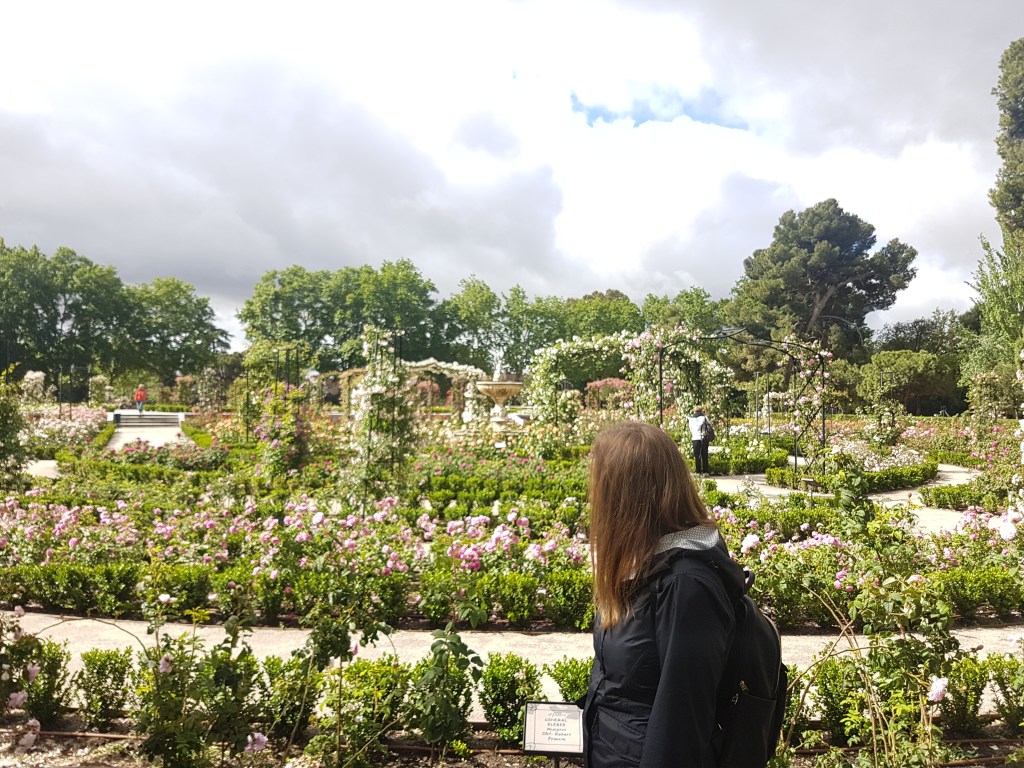
A rose garden in Retiro Park.

The train station in Madrid, across the street from the Reina Sofia

A quick trip through the Reina Sofia’s Bruce Conner exhibit.

I think that’s some kind of Dali stuff in the background

In the hallway of the museum

Beside a statue outside of the Reina Sofia.

Enjoying a snack before we order lunch

Fried artichokes. SO good.

Lunch!

Arriving at the Naval Museum

We made it!

One of the first gems at the Naval Museum

The ceiling in part of the Naval Museum

Behind me is a famous Spanish building, often featured on lists of “ugliest buildings”

The library of Madrid!

Arriving at the Sorolla Museum






 the stories that I'm telling.